|
|
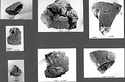
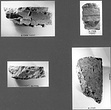
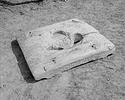
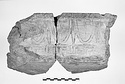
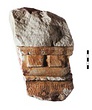
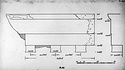
| Wall blocks with face and one pin (A 1727, A 1728); wall block with pin hole (A 1729), wall blocks with clamp cutting (A 1730, A 1731), wall blocks with plaster (A 1732, A 1733) found in the Long Late ... Horizontal (normal) ... Image | Series | Leica A |
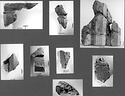
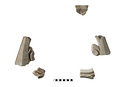
| Triglyph fragments found in the Long Late Roman Wall, east side of the Agora ... Horizontal (normal) ... Hesperia 39 (1970), pl. 61 (A 1698, A 1699, A 1700, A 1702). |
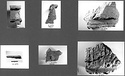
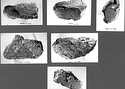
| Geison fragments (A 1693, A 1694) and mutule fragments (A 1695-1697) found in the Long Late Roman Wall, east side of the Agora ... Horizontal (normal) ... Image | Series | Leica A |
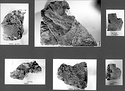
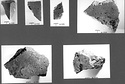
| Pattern of epikratinis on wall blocks (A 1711, A 1712), wall blocks with face with pin holes and cuttings (A 1719, A 1720, A 1721) found in the Long Late Roman Wall, east side of the Agora ... Horizontal (normal) ... Pattern of epikratinis on wall blocks (A 1711, A 1712), wall blocks with face with pin holes and cuttings (A 1719, A 1720, A 1721) found in the Long Late Roman Wall, east side of the Agora. |
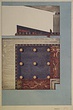
a) Bottom surface preserved. Painted lesbian leaf pattern, blue and red preserved on the cyma reversa.
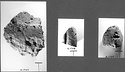
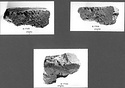
Two small fragments, b) and c), also belong of which c) is a corner fragment from mutule with one ... 12 May 1933 ... North Basement-Architecture, Block (frag. a)
Basement Corridor-Architecture Drawer No. 17 (frags. b-c) |
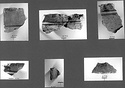
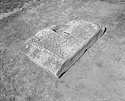
| Two views of wall block, joint and face with three pin holes (A 1722) and various wall blocks with face and pin holes (A 1723-A 1726) found in the Long Late Roman Wall, east side of the Agora ... Horizontal (normal) ... Image | Series | Leica A |
| Epikranitis fragment (A 1710), epistyle backer crowns (A 1714-1716), fragment of crowning with cyma reversa (A 1717) and geison fragment (A 1718) found in the Long Late Roman Wall, east side of the Agora ... Horizontal (normal) ... Epikranitis fragment (A 1710), epistyle backer crowns (A 1714-1716), fragment of crowning with cyma reversa (A 1717) and geison fragment (A 1718) found in the Long Late Roman Wall, east side of the Agora. |
| Wall blocks and various blocks found in the Long Late Roman Wall, east side of the Agora ... Horizontal (normal) ... 1997.01.0252 (Leica A 1734
Leica A 1737
Leica A 1742
Leica A 1743
Leica A 1738
Leica A 1744) ... Leica A 1734
Leica A 1737
Leica A 1742
Leica A 1743
Leica A 1738
Leica A 1744 ... Leica A 1734
Leica A 1737
Leica A 1742
Leica A 1743
Leica A 1738
Leica A 1744 |
| Epistyle fragments found in the Long Late Roman Wall, east side of the Agora ... Horizontal (normal) ... Hesperia 39 (1970), pl. 62 (A 1704, A 1705). |
| Doric column drum (A 1707), Ionic column base (A 1708) and Ionic column drum (A 1709) found in the Long Late Roman Wall in the east side of the Agora ... Horizontal (normal) ... Doric column drum (A 1707), Ionic column base (A 1708) and Ionic column drum (A 1709) found in the Long Late Roman Wall in the east side of the Agora. |
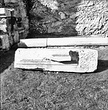
| Fragment of bottom step (A 1735) and wall block with lifting tong cutting (A 1736) found in the Long Late Roman Wall, east side of the Agora ... Horizontal (normal) ... 1997.01.0259 (Leica A 1735
Leica A 1736) ... Leica A 1735
Leica A 1736 ... Leica A 1735
Leica A 1736 |
| Broken at the top. Made to stand upright; in the bottom, an iron dowel, of which projects a part.
On one side of the wide faces is a longitudinal groove, double, with a ridge in the center. On the narrow ... 9 June 1931 ... Hesperia 39 (1970), p. 151, no. 1, pl. 47 a, p. 146, n. 4. |
| From inside corner. Length and depth fully preserved; moldings partly preserved. Fasciae worked with toothed chisel and drafted smooth at top and bottom.
Anathyrosis on end splay to receive another corner ... 7 March 1932 ... A 107 ... A 107 |
| Cornice block from inside corner. Preserved in all dimensions; two sides with anathyrosis at right angles to each other; on the two sides without anathyrosis the stone is cut away, perhaps for lightening, ... 14 July 1931 ... Agora XIV, p. 98, pl. 51 a. |
| Five fragments.
The larger fragment, c), is broken at both ends, as is the scroll underneath. Part of the finished top is preserved. It is flattened and well dressed at the back. The front has a raised ... 17 June 1931, 3 July 1931 ... A 41 ... A 41 |
| End block. Broken into two pieces. Three faces of the block are finished with a cornice-like molding; the fourth has anathyrosis and two T-clamps.
The top, which is worn smooth from later use, has cuttings ... 1931 ... L. a) 0.625, b) 0.473; W. a) 1.258, b) 1.258; Th. a) ca. 0.18, b) ca. 0.18 |
| Two opposite faces preserved, one much broken, other completely preserved. Anathyrosis on both ends. Cuttings for setting object in top, perhaps a tripod.
Cf. A 66.
Pentelic marble.
Found at I/14-10/16 ... 1931 ... Cuttings for setting object in top, perhaps a tripod.
Cf. A 66.
|
| Sides and back broken; height preserved.
Painted bead and reel along edge of bottom surface.
Coarse, buff clay, carefully painted in red and black on a fine greenish cream slip.
A 418 (Α 909, from Cave) ... 4 August 1931 ... A 105 ... A 105 |
| Fragment of a small cornice block, broken all around; the corona broken off; at the back a small rough-picked area; two dentils are preserved.
Moldings:
Upper part of cyma recta (?), ca. 0.075m.
Ovolo, ... 20 April 1931 ... Fragment of a small cornice block, broken all around; the corona broken off; at the back a small rough-picked area; two dentils are preserved.
|
| Preservation: Fragment includes small ovolo, taenia, regula and three guttae. The top and right side are preserved, dressed surfaces.
Moldings: (from top to bottom)
Small ovolo, H. 0.016m.
Taenia, H. 0.044m ... 18 June 1931 ... A 42 ... A 42 |
Both ends of the block preserved, with anathyrosis band, the lower resting surface remains to a thickness of 0.14m.; the profile under the corona is preserved, and the start of the corona, with two mutules ... 2 July 1931 ... Both ends of the block preserved, with anathyrosis band, the lower resting surface remains to a thickness of 0.14m.; the profile under the corona is preserved, and the start of the corona, with two mutules and two viae. The top surface is partially preserved, and shows the cutting for the head of a T-clamp. The back of the block is broken away.
|
|
|