|
|
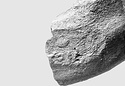
| Device; thyrsos(?).
Cf. SS 1884. Par: like SS 01884*
Rdg: made on 1.ix.54(VG)*
Msc: Bon uses? old nr 1652(VG)* Finished From destruction of wall, and the earth beneath it; 4th century A.D. [Θασίων]
thyrsos? ... 18 March 1936 ... Par: like SS 01884*
Rdg: made on 1.ix.54(VG)*
Msc: Bon uses? old nr 1652(VG)* |
Ring foot; rilled rim, sloping inwards. Two raised rings on underside. Concave moulding on undersurface. Decoration on floor: small central circle, around this, band of enclosed ovules within palmettes; ... Ca. 430 B.C ... Hesperia, XXXII, 1963, pl. 52, 33, uses a slightly smaller stamp. A much bigger palmette stamp is used on P 8438 B 13:6-L, a fragment of floor; the whole pattern can be seen on a plate which uses the same stamp, Oxford 1928.39:CVA 2(9) pl. 62(426) 8 and pl. 65(429) 18, not quite the canonical profile. P 16941 A-B 21-22:1 uses palmettes for the small central circle but ovules only for three larger circles. |
Intact with the inscription: ΦΙΛΟΜΝΗΣΤΟΣ ΙΚΑΡΙΕΥΣ.
Ends curve forward due to heavier erasure in middle.
Notches in each end apparently for fitting nails in workbench to hold plate firmly during erasure ... 16 June 1970 ... Section letters and number of uses:
For last use: kappa in incuse square stamped at left.
... Three prior uses: superimposed inscribed beta, kappa, gamma (?) ... Hence a minimum of six uses.
|
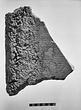
| Inscribed fragment.
Broken above, at right and below. Back recut. Left edge of a large stele.
Four different uses: first as an inscribed stele; second as a threshold, the back was cut down ca. 0.03m ... 9 June 1971 ... Four different uses: first as an inscribed stele; second as a threshold, the back was cut down ca. 0.03m. and is heavily worn; a band was left along the edge as the door stop; third period of use in a bothros, the surface of whole left edge, front and back, for as much as 0.13m, is eaten away by acids, and at the front the text is completely lost; fourth use, in modern wall, where found.
|
|
|