|
|
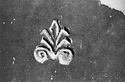
| Only the lower part remains. High base ring; slightly concave floor from which the upper wall begins to rise steeply. On the floor, within a rouletted circle are five stamped palmettes of which four remain ... 1932 ... Hesperia 3 (1934), no. C 5, p. 348. |
All three from different pots, but one example of archaic mending.
Orange buff clay. Oscar Broneer, Nb. No. 5.
Aglaurion, ca. 14m. 76 ... 7-10 July 1937 |
| An irregular disk with an impression from gem or metal finger ring.
Side A: a positive impression of a woman 's head to right in an oval field.
Side B: the letter upsilon (Y). Unglazed.
Fine buff clay ... 24 April 1937 ... Agora X, pp. 126-127, pl. 31, no. C 5. |
From a squat flat-bottomed oinochoe. Fine bands; glaze badly peeled.
Pale greenish-buff clay.
Protocorinthian. Protoattic pit and well. Leica, 7-528 ... 17 March-1 April 1936 ... Hesperia Suppl. 2 (1939), no. C 5, p. 142, fig. 100. |
|
|