|
|
From a large shallow bowl, (probably with foot?). Straight, nearly vertical rim, set off from side wall by a groove. Side wall concave-convex. On rim, outside, olive wreath in added white.
ADDENDA Pergamon ... 13 February 1935 |
Similar in shape and decoration to P 12285 (ΑΑ 230), the walls somewhat more fragmentary. Low base instead of a foot, a wide glazed band around the bottom. The glaze bands somewhat wider.
Red glaze ... 15-18 March 1938 |
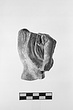
| Fragment with drapery and part of a limb.
Remains of white paint.
Hard pinkish clay, gray at core and on surface.
ADDENDA: Fragment of left side of wing of sizable bird (cock ?) to left on which sits ... 17 March 1932 |
Wall fragment with turn of shoulder. Max. dim. 0.064.
Symposion. The fragment preserves the beard, part of the left forearm and hand, two fingers of the right hand, as well as a little drapery (probably ... Ca. 440 B.C ... Normally the aulos-player is a standing girl; occasionally, the player is a youth, as on Richmond 62.1.3 by the Leningrad Painter (ARV2 1659, 3 bis; Addenda 261). For a man playing the aulos at a symposion, reclining not standing, see the one on an unattributed column-krater in Vienna from the second quarter of the 5th century (824: CVA, Vienna 2 [Österreich 2], pl. 89 [89]:1). It is uncertain whether the aulos-player on 231 stands or sits at the foot of the couch.
|
|
|