|
|
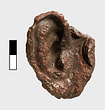
| The right ear and a little of the cheek in front of the ear are preserved.
Carefully modelled. Heavily corroded.
On the cheek is a wisp of hair or beard. Surface near middle of Stoa of Attalos. Leica ... August 1952 ... AgoraPicBk 20 (1982), fig. 17. |
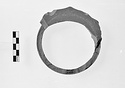
From the side of a Western Sigillata bowl exactly as P 3432 (ΟΕ 80). Plain incurved rim. Garden hole C 6, with L 2664. Leica, 7-83 ... 10 March 1936 ... Agora XXXII, no. 512, fig. 17. |
| Neck, handle and fragments from body missing. Ring foot; angular, lagynos-like body.
Incised on shoulder:
Pink clay with buff surface. Unglazed. Cistern. Leica PD 2551-1 ... 16 March 1937 ... Agora XXXIII, no. 108, fig. 17. |
| About one-third of the circumference of the rim, with the start of one handle and of the floor preserved. Several fragments do not join. High straight rim and low ring foot; floor very shallow concave ... 21 March-16 April 1935 ... Agora XII, no. 1985, fig. 17. |
| Complete foot (mended from four pieces) with part of floor above; center missing. Chamfered foot ring. Foot diameter rather larger than normal. On floor, slight rouletting between two pairs of grooves ... 22 April 1948 ... Agora XXXII, no. 518, fig. 17. |
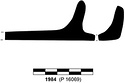
| Many small fragments give three non-joining sections of outer rim and one piece of inner rim and floor. Large flat-floored plate(?) with plain vertical slightly concave rim, a vertical flange (or inner ... 2-19 May 1939 ... Agora XII, no. 1984, fig. 17. |
Blunt point at bottom; radish-shaped body with horizontal ridges and grooves on wall; short, rather thick neck; flaring mouth; a pair of very small thick handles between neck and shoulder.
Slightly micaceous ... 13 June 1938 ... Opait (2014a), p. 48, fig. 17. |
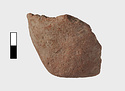
| Rather less than half preserved. Low side; broad flat floor; flat bottom.
Gritty, extremely micaceous, pinkish-brown clay. Unglazed. Well, ca. 350-320 B.C. 449 Leica PD 1140-14d ... 11-17 May 1938 ... Agora XII, no. 1986, fig. 17. |
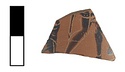
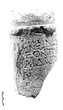
| Fine sherd with part of small figure.
Joins with AP 995. Oscar Broneer, Nb. No. 4. 98 ... 28 April 1937 ... Hesperia 7 (1938), no. 17, p. 179, fig. 17. |
| Inscribed fragment of columnar grave monument.
Back half missing. Broken below.
Chisel marks clearly visible on surface.
Blue marble. Found in modern wall. 55 Leica ... 10 June 1971 ... Hesperia 89 (2020), no. 17, p. 78, fig. 17. |
B.F sherd with figure of boar moving to right. Black glaze on reverse. Oscar Broneer Nb. No. 2, Acropolis dump, section Y 139 ... 12 Oct 1933 ... Hesperia 4 (1935), p. 250, fig. 17. |
B.F sherd with heads of two horses and two warriors. Purple paint on manes. Black glaze on reverse. Oscar Broneer Nb. No. 3 23 ... 8 Dec 1933 ... Hesperia 4 (1935), p. 248, fig. 17. |
Bit of tongue pattern at top. Back of animal (feline) below? Oscar Broneer, Nb. No 2
E. Sanctuary, back fill. 152 ... 16 Oct 1933 ... Hesperia 4 (1935), p. 249, fig. 17. |
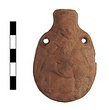
| Ointment flask with two holes for suspension.
Man on donkey side saddle on one side, and man astride a horse with a cross on the other. Oscar Broneer, Nb. No. 1. 13 ... 12 January 1931 ... Hesperia 1 (1932), p. 48, fig. 17. |
| Coarse red clay, rough red surface, household ware. Hazel D. Hansen, Nb. No. 16 ... March-April 1937 ... Hesperia 6 (1937), p. 564, fig. 17. |
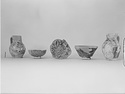
Mended from many fragments and many bits missing from lip, neck and sides. Trefoil lip; flat bottom; gently swelling sides; single vertical strap handle. In an oval double frame on the central part of ... 1 June 1933 ... Hesperia 11 (1942), p. 10, fig. 17. |
| Almost the complete circuit of the rim is missing. Low foot, flat bottom; bulging, neary spherical sides; slightly flaring mouth; single vertical strap handle. Enclosed in a double circle with cross bars, ... 31 May 1933 ... Hesperia 11 (1942), p. 10, fig. 17. |
All of the original rim has been broken away; only the spring of the gently upcurving sides is preserved. Ring base; shallow, flaring sides. Blue and brown conventional decoration on a green ground. In ... 31 May 1933 ... Hesperia 11 (1942), p. 10, fig. 17. |
Two-thirds of the rim gone. Mended from three pieces. High ring base; sides curve steeply upward.
Pinkish-buff clay with bits; bright green glaze on the exterior, except for the base which is reserved ... 1 June 1933 ... Hesperia 11 (1942), p. 10, fig. 17. |
Most of the rim and much of the sides are gone. Mended from three pieces. The sides flare out almost horizontally from the high ring base, to turn almost immediately upwards in a flaring line.
Buff clay; ... 1 June 1933 ... Hesperia 11 (1942), p. 10, fig. 17. |
|
|