|
|
| Rebecca Wood Robinson ... Damaged Protogeometric grave (E.L. Smithson: Grave XL).
Small corner only preserved, cut in part into the filling of the Submycenaean Grave J 9:2. In this corner, and spilling into the disturbed upper ... Late Protogeometric |
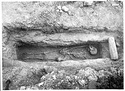
| Evelyn L. Smithson ... Submycenaean grave (E.L. Smithson: Grave XXXIV). The skeleton of a 30 year's old female ... Submycenaean |
A circular pit below Byzantine floor. It Is 1.28m deep and its bottom rests upon virgin soil, a gray clay formed by the disintegrated native rock. It is constructed for about 0.30m at the top with tiles, ... 12th c. A.D. |
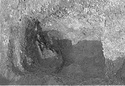
| Plundered Chamber Tomb. (Tomb XII). A few meters SE of the great white marble altar. The chamber is an irregular rectangle, oriented roughly N-S, with dromos leading in at a very gentle slope from the ... LH III A |
Irregular depression in bedrock (ca. 7x5m), ca. 2m deep; area south of E-W Late Roman wall. Dumped filling apparently intended to level off the area. Coins:
11 March 1952 #10
12 March 1952 #1-#5
13 March ... Ca. 400-325 B.C. |
Coins:
8 April 1936 #13
1 May 1936 #21 ... Byzantine-Turkish |
Fill to 6.50m., masses of stone, animal bones and coarse pottery with some unfinished poros sculpture at 6.50m. - a dump of early 3rd c. ... At 6.50m. begins use filling with numerous BHWJs and other water ... Late 1st c. to early 3rd cent. and of 4th and 5th cents |
Empty to 4.00m. From there to 9.20m. much coarse pottery, stucco fragments, animal bones, lead defixiones. ... The presence of fragments of stelae and architectural members near bottom point to dumped ... Late 2nd-early 3rd c. A.D. |
| Hole in bedrock; dumped filling used in leveling.
Probably a natural water line, tending to wash out, has been cut back for various purposes, and finally all filled in to make level bedding for 4th c., ... Ca. 350-270 B.C. |
Water deposit in Polygonal Drain (43-44/Γ-Ζ and martyra)immediately south of the south foundations of the Middle Stoa. Early branch of the original course of Great Drain. P 2248 added to this deposit by ... Ca. 420-390 B.C. |
| Late Geometric well ... Late Geometric |
A pit running E-W under Holy Apostle St., about 1.20m. square and 0.90m. deep. Built with stones about the size of a man's head. Coins:
24 April 1935 #12-#13 ... 18th c. |
Located just north of the stepped retaining wall between the Great Drain and the Poros Monument (Propylon).
Short period of use; dumped filling above, mostly cemetery debris ... Early Protogeometric |
Located in the NE corner of the early peribolos. Probably originally 1.00-1.50m. deeper, the bedrock above having been cut back in late times. Scanty pottery remains; some evidence for a period of use ... Ca. 600-570 B.C. |
One of two late wells [the other at 59/ΙΗ] cutting the line of the east wall of the peribolos and the line of the Byzantine enclosure. The shafts of the two were close together and in their upper parts ... Turkish |
Upper part collapsed (diameter 1.25m). Uniform fill with water jars. Sorted June 1956. 4 tins thrown out. Joins from all boxes, but pithos fragments and water jars mostly from boxes 6-16 ... 750-700 B.C. |
Pocket in bedrock behind stepped retaining wall ... 7th c. B.C. |
Apparently an unsuccessful well. P 37220-P 37224 (Κ 4519-Κ 4523) Catalogued on October 2012 (JPK, SS)
P 37741-P 37742 (Κ 4549-Κ 4550) Catalogued on April 2017 (BL) ... Protogeometric |
Well E (diameter 1.10-1.20m) just outside the northwest corner of the southwest Fountain House.
Dug initially as a pit (J 15:2) partially covered by an early Roman wall ... Early 7th c. B.C. |
Well on the north slope of the Areopagus. Unfinished, probably because of hardness of rock, and refilled at once, perhaps with sanctuary dump and with collapsed rock from the shaft itself.
Diameter 1.15m ... 3rd quarter of the 7th c. B.C. |
|
|