|
|
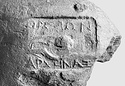
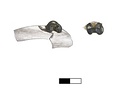
| Strigil. Finished 4th century B.C. fill under early Roman Agora floor. Θασίων
oil flask?
strigil
Ἄρχηναξ Leica ... 28 May 1951 ... 4th century B.C. fill under early Roman Agora floor. |
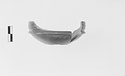
Point of pin broken off.
Bow has longitudinal ridge with cross-hatching in relief. Well in street of Roman Agora, 2nd meter.
Early Roman : 1st c. A.D. Leica, Various vii-87 ... 6 August 1946 ... Well in street of Roman Agora, 2nd meter.
Early Roman : 1st c. A.D. |
Four joining fragments give part of side and rim; groove around rim outside.
Flaky cinnamon-brown clay, orange-red glaze.
Sigillata. Samian? Well in street of Roman Agora. 2771 Leica ... 5-6 August 1946 ... Well in street of Roman Agora. |
Small fragment preserving part of rim and nozzle volute.
Red-brown glaze.
Red clay.
Type XX of Corinth collection. Cut through street of Roman Agora: layer 3a, pebble bedding for martyr. Leica ... 2 August 1946 ... Cut through street of Roman Agora: layer 3a, pebble bedding for martyr. |
| Small piece from flat floor, with rectangular stamp, illegible:
Good red glaze inside and out, chipped inside.
Sigillata. Well in street of Roman Agora. 2771 Leica, 93-43-19 PD 1172-7 ... 5-6 August 1946 ... Well in street of Roman Agora. |
Complete; mended from two pieces. Low broad foot with narrow foot ring; thick wall curving in to plain lip.
Micaceous gray clay; black glaze. Well in street of Roman Agora. Leica PD 1171-121 ... 6 August 1946 ... Well in street of Roman Agora. |
| Foot, center of floor and pieces of rim missing. Shallow bowl with keeled, grooved rim.
Light buff clay, firm dull red glaze.
Sigillata. Well in street of Roman Agora. 2771 Leica, 94-44-13 PD 1171-50 ... 5-6 August 1946 ... Well in street of Roman Agora. |
Mended from several pieces; about one-half of rim missing. Small bowl on rather high flaring ring foot; keeled rim, concave, and with flaring lip.
Thin matte red glaze inside and out. Well in street ... 5-6 August 1946 ... Well in street of Roman Agora. |
| Anathyrosis on preserved edge. On top a mason's mark: ΑΡ. A shallow rectangular cutting and a deeper circular cutting at one corner of broad surface, from reuse as threshold block.
From Temple of Ares ... February 1949 ... Brought in from Roman Agora. |
| Fragment a): from angular shoulder, with small handle twisted back on itself on shoulder.
Fragment b) scrap with similar handle.
Very thin bluish glass. Other fragments probably from same jug stored in ... 5-6 August 1946 ... Well in Street of Roman Agora. |
Mended from a number of pieces; some wall and rim fragments, and the handle, missing. Large wide funnel, with neat flaring rim. Horizontal handle attached at junction of rim and wall.
Pinkish-buff clay; ... 5-6 August 1946 ... Well in street of Roman Agora. |
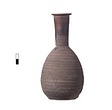
| Scattered pieces missing. Onion-shaped, large. Deep pear-shaped body; tall neck; flat rim.
Heavy gray fabric; shallow grooves on body; matte black glaze on neck.
Fragments of several unguentaria of ... 5-6 August 1946 ... Well in street of Roman Agora. |
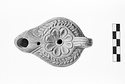
| Intact.
On disc, rosette of 8 petals framed by ring; herringbone pattern on rim. Solid grooved handle. On base, within two concentric grooves "A".
Purple-brown glaze.
Orange clay.
Late Roman.
Cf. Agora ... 28 June 1967 ... Orange clay.
Late Roman.
Cf. Agora VII, no. 1912 ... Lamp deposit beside Roman wall; removed in landscaping. |
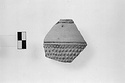
| Rim fragment from bowl or deep cup. Steep wall; plain rim thickened on inside. Rim undecorated, marked off by a groove above and below. On the wall, rows of applied dots.
Light buff fabric. Vitreous ... 5-6 August 1946 ... Well in street of Roman Agora. |
| Two joining sherds of rim and upper wall. ''Kalathos" cup, Knidian (?). Shallow conical body, projecting flange, vertical tapered rim. Shallow rippling (with faint rouletting?) covering exterior of rim ... 5-6 August 1946 ... Well in street of Roman Agora. |
Oinochoe: Italian?
Part of handle and mouth.
Slightly outturned rim. Large triple handle with appliqué head of Dionysos at base, facing into mouth of vessel. Head turns to proper left, has thick hair, ... Late Roman context |
Rim Of Large Bowl?
Small section of rim and stub of handle.
Rim steeply beveled to inside and slightly undercut; two shallow grooves below rim inside and two deep grooves outside. Handle round in section, ... Early Roman context |
Inscribed fragment of statue base.
A fragment from the top of a cylindrical base, crowned by a small moulding.
The base was later hollowed out and used as a well curb.
Four lines of the inscription preserved ... 14 June 1937 ... Found in the excavation for a modern cellar at the corner of Hadrian and Mnesikles streets, east of the Roman Agora. |
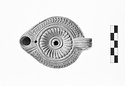
| Intact.
On disc, rays with two framing rings; two rings around filling hole. Herringbone rim. Solid grooved handle.
On base, within two concentric grooves: "X".
Orange-brown glaze.
Buff clay.
Late Roman ... 28 June 1967 ... Buff clay.
Late Roman.
Cf. Agora VII, no. 1606 ... Lamp deposit beside Roman wall; removed in landscaping. |
Plate.
About half of foot and small part of floor preserved, along with many small fragments.
Low ring foot; grooved resting surface. White fabric (10YR 8/2) with pale yellow surface (ca. 2.5Y 8/4), ... Context of before ca. 180 |
|
|