|
|
A ram or sheep with heavy horns, moving right, its head bound with fillets. The loose ends of which hang down over the neck. The thin plaque of the background extended to the right and below, exaggerating ... Early fourth century B.C ... A ram or sheep with heavy horns, moving right, its head bound with fillets. |
Ram with pointed face and large curly horns.
Short fat tail.
Legs broken.
White slip.
Buff clay. Panathenaic Way, Cut IV, just West of LRFW, Cuttings F 1 and F 3 in bedrock. 1020-1024 Leica, 82-302, 84-61 ... 27-29 May 1959 ... Ram Figurine |
Intact except for head.
A crouching lamb or other small shaggy creature, on a base.
Vent hole in end. Little modelling. A painted "saddle". Much red, white, black and green paint preserved.
Smooth red ... 8 April 1936 ... Ram Figurine |
Legs, face, tail missing.
Handmade. Probably a sheep.
Buff clay. Well. Leica, 84-61 ... 15 April 1959 ... Ram Figurine |
Fragment of left side of head of ram figurine.
Broken at neck.
Gouged technique. Remains of white paint.
Red clay. Pit. Leica ... 28 April 1932 ... Ram Figurine Fragment |
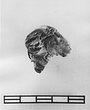
Ram 's head.
Broken away at the neck, behind, and at the top; the tip of the left horn is gone, also the lower part of the muzzle. Mended from four fragments.
The head of the ram is quite well modelled ... 16 May 1933 ... Ram 's head.
Broken away at the neck, behind, and at the top; the tip of the left horn is gone, also the lower part of the muzzle. ... The head of the ram is quite well modelled and is covered with a thick white engobe over which are traces of red.
... It may also have been part of a pot, with the rim projecting over the back part of the head of the ram.
Pinkish clay, not very fine. |
Plastic head of ram.
Most of one side preserved, and part of the other; the head is broken off below the jaw.
The animal has a large eye and curling horn; his coat is indicated by short gouged out strokes ... 3 August 1931 ... Plastic head of ram.
Most of one side preserved, and part of the other; the head is broken off below the jaw.
|
Part of left side preserved, from nose to back and top of head to breast.
Mouth missing.
Curly hair and huge coiled horn. Large vent in top of head, and pierced lug on back for suspension.
A well modelled ... 21 May 1936 ... Ram Figurine Fragment |
Fragment of head. The left ear and part of the eye are preserved, indicated by gouges.
The top of the head is bald, with heavy locks hanging below a wreath; Horn curling.
Mold made; hollow; Unglazed ... 25 June 1931 ... Ram Figurine Fragment |
Left side of head preserved.
Hole pierced through nose.
Crude technique.
Brick red clay, with traces of white slip. Clay dark gray on surface; edges blackened as if by burning.
Cf. T 50. Leica ... 11 July 1931 ... Ram Figurine Fragment |
Back of head and part of shoulder preserved.
The eye, the horn, and the fleece are gouged in.
Broken at bottom and along joint between two halves of mould. Muzzle missing.
Traces of red and white paint ... 19 May 1951 ... Ram Figurine Fragment |
Front legs folded back against chest, perhaps as result of accident when clay still soft.
Head missing.
Traces preserved of right ear (or horn).
Hard pinkish-buff clay.
Cf. T 3015. Panathenaic Way, Cut ... November 1959 ... Couchant Quadruped: Ram |
| Small well-modelled terracotta ram's head, facing right.
Retouched.
Gilding on horn.
Buff to pinkish clay. Kybele cistern. Leica, 80-81-19 ... 1935 ... Head of Ram Figurine |
| Zones of animals. Most of an animal (ram or bull), right; above, hoof of another animal (ram, boar or goat?), also right. Applied red.
Unglazed inside. Upper fill(?) Cistern. Box 76. 1812 ff. Leica ... 1933 ... Most of an animal (ram or bull), right; above, hoof of another animal (ram, boar or goat?) |
| An oval impression.
A: a nude bearded male figure, right, in process of sacrificing a ram.
Odysseus sacrificing a ram before his trip to the underworld (?)
B: smooth.
Unglazed.
Pinkish clay. Clearing ... 12 June 1937 ... A: a nude bearded male figure, right, in process of sacrificing a ram.
Odysseus sacrificing a ram before his trip to the underworld (?)
|
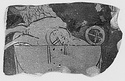
| From a bell krater, glazed inside. The top of a tripod with a ram sitting up in it; fragment of drapery in upper right corner. Medea boiling the ram? Pelias and his daughters?
ADDENDA Surface and edges ... 19-22 June 1935 ... The top of a tripod with a ram sitting up in it; fragment of drapery in upper right corner. Medea boiling the ram? Pelias and his daughters?
|
| Part of handle and body where handle was attached preserved, broken all around.
Orange-buff clay.
Head of ram.
From same die as SS 7258 but preserves the name of thee eponym not preserved on SS 7258 ... 1939 ... Head of ram.
From same die as SS 7258 but preserves the name of thee eponym not preserved on SS 7258 ... [ Ἡρά | κλειτο(ς)] Θ̣α̣σ̣[ί | Π]υ̣θόλε̣ω̣[ς]
head of ram |
| Cap(?). Head of ram.
Cf. Pridik (1917), p. 52, nos. 363-364, pl. IV 17, 18.
Early Thasian. Par: Pridik 1917, p52, 363--4, Pl IV, 17,18 (cf device)(VG)*
Msc: one found by [ ... ] among the unread, which has ... 1 April 1937 ... Head of ram.
Cf. Pridik (1917), p. 52, nos. 363-364, pl. ... [---]ς Ἡρα | κλείτο(ς) | Θασι[---]
head of ram |
| From the bottom of a large stand. Profiled lower edge preserved. Broad flat foot. Above, a zone of animals; ram to left, preceeded by another animal. Red for neck and belly of ram and for bands to either ... 18 June 1951 ... Above, a zone of animals; ram to left, preceeded by another animal. Red for neck and belly of ram and for bands to either side of rays on upper face of foot. |
Fragment of discus and rim.
Scrolls on the rim with dots and herringbone panels. A ram left on the discus.
Unglazed.
Light red clay.
Type XXVIII of Corinth collection. Modern. Leica ... 10 February 1937 ... Scrolls on the rim with dots and herringbone panels. A ram left on the discus.
|
|
|