|
|
Meritt, Benjamin D ... American School of Classical Studies at Athens ... Hesperia 16.2 2 58-62 10.2307_146947 ... 1947 ... The Persians at Delphi |
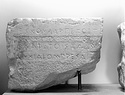
| Epigram commemorating victory over the Persians ... AMS Horizontal (normal) ... Epigram commemorating victory over the Persians. |
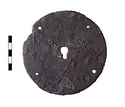
| Bronze lock plate from a house destroyed by the Persians in 480 B.C ... Craig Mauzy ... Horizontal (normal) ... 24 Sep 2004 ... Bronze lock plate from a house destroyed by the Persians in 480 B.C. |
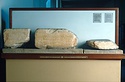
| Left corner of inscribed block. Pentelic marble. Epigram commemorating the victory over the Persians ... Horizontal (normal) ... 1 Jun 2000 ... Epigram commemorating the victory over the Persians. |
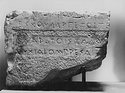
| Left corner of an epigram commemorating the victory over the Persians, I 303 a ... Horizontal (normal) ... Left corner of an epigram commemorating the victory over the Persians, I 303 a. |
| Plan showing location of archaeological deposits known to date from the clean-up after the destruction of Athens at the hands of the Persians in 480/79 B.C ... PD 2653 Horizontal (normal) ... Plan showing location of archaeological deposits known to date from the clean-up after the destruction of Athens at the hands of the Persians in 480/79 B.C. |
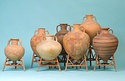
| Jars from the debris of the destruction of Athens by the Persians, 480 B.C. Far left, Corinthian A (P 12795); front row, from left, Corinthian B/Corcyraean (P 24126 and P 24887); Attic (?) (P 24882). Back ... 1 Jun 2000 ... Jars from the debris of the destruction of Athens by the Persians, 480 B.C. Far left, Corinthian A (P 12795); front row, from left, Corinthian B/Corcyraean (P 24126 and P 24887); Attic (?) |
| Left corner of inscribed block.
Epigram commemorating the victory over the Persians.
Fragment Θ 50 a), top smooth; bottom, very fine picked; side, anathyrosis. Broken at back and right.
Face dressed with ... 1933 ... Epigram commemorating the victory over the Persians.
Fragment Θ 50 a), top smooth; bottom, very fine picked; side, anathyrosis. |
| Dinsmoor, W. B ... American School of Classical Studies at Athens ... The well-preserved Temple of Hephaistos, standing on a low hill to the west of the Athenian Agora, was one of the only monuments visible when American excavations began on the site in 1931. Known throughout ... 1941 ... (on October 17, claims the author), the temple was one of a group of building projects that celebrated the defeat of the Persians and the growth of Athenian power. |
Packing under cobblestones 7 or 8 meters west of the Temple of Hephaistos. A similar filling found in a small hole in bedrock three or four meters north of the Temple. The high quality of the pottery from ... Ca. 500-440 B.C ... The high quality of the pottery from this deposit and the fact that some of it shows signs of burning has suggested that it might have come from a sanctuary destroyed by the Persians. But the presence in the filling of a number of ostraka from ostrakaphoria of the eighties indicates that some at east of the debris accumulated elsewhere and was brought in in connection with filling or leveling operations undertaken soon after the Persian defeat.
|
http://agathe.gr/guide/stoa_of_zeus_eleutherios.html Stoa of Zeus Eleutherios Lying just south of the railroad tracks, along the west side, are the remains of the Stoa of Zeus Eleutherios (Freedom) (Figs. 8, 9). This cult of Zeus was established after the ... This cult of Zeus was established after the battle of Plataia in 479 B.C., when the Greeks drove the Persians out of Greece. |
http://agathe.gr/democracy/factional_politics.html Factional Politics: The Ostracism of Themistokles A group of ostraka found together in a pit on the North Slope of the Acropolis is of special interest. There were 190 ostraka, mostly the round feet of ... These ships proved crucial in the decisive victory of the Greek fleet over the Persians at Salamis in 480 B.C., as did Themistokles' own guile in tricking the Persians into fighting in the narrow straits. |
| Odeion. Parmenides. Parrhasios. Parsley. Parthenon. Odyssey. Patrokleides. Oedipus. Pausanias. Offices, public. Oikema (prison etc.). Peace. Oineus. Oinoe, battle-painting. Pegasos of Eleutherai. Olbiades ... Agora 3 255 ... Persians |
Fillings associated with early houses on the lower north slopes of the Areopagus; various levels and dates.
Both houses were built in the 6th century B.C. and destroyed by the Persians; both also have ... 6rd c. B.C.-3rd c. A.D ... Both houses were built in the 6th century B.C. and destroyed by the Persians; both also have later histories.
|
| The Athenian Agora; Volume 014; The Agora of Athens; The History; Index; Authors. Agora, 003. Acts of Apostles, 17. Andokides, I, 40, 45, 62, 71, 76, 78, 82, 84, 85, 83, 110. Aelian, Varia History, VIII, ... Agora 14 237 ... Aischylos, Persians, 238 |
| The Athenian Agora; Volume 014; The Agora of Athens; The History; Shape and Uses of an Ancient City Centre; The Facilities for Civic Administration; The Magistrates and Boards; The Mint. Schol. Plato, ... Agora 14 78 ... Aischylos, Persians, 238 |
http://agathe.gr/democracy/democracy.html Introduction Classical Athens saw the rise of an achievement unparalleled in history. Perikles, Aischylos, Sophokles, Plato, Demosthenes, and Praxiteles represent just a few of the statesmen and philosophers, ... During this century the Athenians fought and defeated the Persians, refined their democratic system under the leadership of Perikles, and built the great temples on the Acropolis. |
http://agathe.gr/guide/history_of_the_agora.html History of the Agora The excavations of the Athenian Agora have uncovered about thirty acres on the sloping ground northwest of the Acropolis (Fig. 3). Material of all periods from the Late Neolithic to ... This threat he uttered against all Hellenes because they have agoras and buy and sell there; for the Persians themselves do not use agoras, nor do they have any." |
http://agathe.gr/overview/the_archaeological_site.html The Athenian Agora The Agora of Athens was the center of the ancient city: a large, open square where the citizens could assemble for a wide variety of purposes. On any given day the space might be used ... Following the total destruction of Athens at the hands of the Persians in 480 B.C., the city was rebuilt and public buildings were added to the Agora one by one throughout the 5th and 4th centuries, when Athens contended for the hegemony of Greece. |
http://agathe.gr/democracy/tyranny.html Tyranny As happened in many other Greek states, a tyrant arose in Athens in the 6th century B.C. His name was Peisistratos, and after several unsuccessful attempts he seized power in 546 B.C. and ruled ... : Miltiades, future hero of the battle of Marathon against the Persians, and Kleisthenes, later to be the initiator of democratic reforms. |
|
|


.png.icon.jpg)
.png.icon.jpg)
.png.icon.jpg)