|
|
Palm tree. Cistern; middle fill. Ἐπὶ Δαμο̣[κρίτο]
Κνίδιον Ἑ[λικω-υ]
Κράτης Πο[νοσυ]
palm λέτς (Ν for Η)
tree
(Σ lunate, Ω cursive) Leica ... 10 February 1937 ... Palm tree ... Ἐπὶ Δαμο̣[κρίτο]
Κνίδιον Ἑ[λικω-υ]
Κράτης Πο[νοσυ]
palm λέτς (Ν for Η)
tree
(Σ lunate, Ω cursive) |
Leaf calyx, masks and palm (?) tree.
Part of lower wall preserved.
Calyx: Covered by bands of small and large leaves. Masks between their tips. A palm tree (?) at the left side.
Clay: Pinkish, buff.
Glaze: ... 1934 ... Leaf calyx, masks and palm (?) tree.
Part of lower wall preserved.
... Masks between their tips. A palm tree (?) at the left side.
|
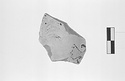
| Good firm creamy white ground; from a lekythos or an alabastron. Left, a palm tree; right, a flying bird, its head turned back (left).
Drawing in black glaze. 6th.-5th. c. fill over road. B' building fill ... 23 March 1935 ... Left, a palm tree; right, a flying bird, its head turned back (left).
|
About two-thirds of top preserved.
On rim alternating flowers and triangular leaves. On sunken discus, palm tree and animal running right.
Dull red glaze.
Brown to reddish-brown clay.
Type XXXI of Corinth ... 6 April 1954 ... On sunken discus, palm tree and animal running right.
|
Wall fragment. Much of the drawing has flaked. Max. dim. 0.046.
At the left, palm tree (fronds, part of trunk). At the right, bird (tail, neck, and head) with head turned back.
The Group of the Negro ... Ca. 480-470 B.C ... At the left, palm tree (fronds, part of trunk). ... The presence of the palm tree on 984 offers the strongest case for the fragment belonging to this group. The position of the palm fronds in relation to the bird suggests that the latter probably stood on a table or an altar. |
Bottom missing.
Low vertical rim; rising rolled handles with knobs to either side. Pinkish brown clay with dilute surfacing. Glaze, thin brown to black, on the rim and just below, inside and out; also ... Context ca. 420-400 B.C ... On the shoulder, a large palm-tree between verticals. |
Top part of lamp preserved. Tip of nozzle broken away.
Rim sunk, with raised spiral pattern.
On discus, palm tree, with filling hole on either side with raised spirals below.
Projecting nozzle set off ... 1 April 1932 ... On discus, palm tree, with filling hole on either side with raised spirals below.
|
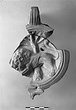
| Much of the discus and rim, with the handle, and a bit of the top of the nozzle, preserved.
On the discus a lion, rampant, left, in front of a palm tree. Double-pierced handle, five grooves above, three ... 9 May 1936 ... On the discus a lion, rampant, left, in front of a palm tree. Double-pierced handle, five grooves above, three below. |
Fragment from floor of large plate, broken all around. Careful stamped decoration: a circle surrounded by alternating small dotted circles and large motifs elaborately detailed with lines (tree or palm-branch ... 8 April 1936 ... Careful stamped decoration: a circle surrounded by alternating small dotted circles and large motifs elaborately detailed with lines (tree or palm-branch motifs).
|
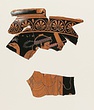
| Projecting rim, flat and reserved on top. Inside, alternating glazed and reserved bands, glazed broader and more streaked toward the middle of the pot than at the top where the surface has been polished ... 22 February -7 April 1935, 22 May 1937 ... Behind her, the trunk of a palm tree; in the field between, written vertically, the letters Κ Α
d) Gives a further fragment from the rim, mended from two pieces; in the figured zone, a broad curved band, reserved: uncertain object (palm branch?).
e) A small bit of the palmette band (joins to a)).
f) From upper wall; trace of border above; below, parts of three of the right hand branches of the palm tree.
g) Bit of rim and border.
h) Bit of border.
i) Bit of border and upper wall, with trace of one branch of palm tree.
j) (Z 1176) From lower wall, mended from two pieces. Below is preserved a bit of the border of encircled palmettes; above, at the left, part of the trunk of the palm tree, spreading somewhat towards the bottom, and to the right, written in purple, lengthwise: |
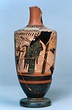
| Two fragments mended from many pieces.
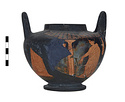
a) Draped standing woman, left, behind her a door; in front of her part of another draped figure(?), and, nearer, a column. Between her and the door, a scarf hanging ... 21 May 1937 ... Below, parts of two figures; a woman seated right, on a chair; facing her a standing woman; behind this figure a column, and, under the handles, a palm tree.
No relief contour; glaze somewhat grayed. |
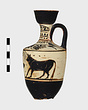
| White Ground. Base missing, otherwise unbroken.
Ornament on neck: maeander, ivy wreath, tongues. On shoulder, three palmettes and two buds; on wall, two bulls facing a louterion behing which a palm tree ... 31 May 1954 ... On shoulder, three palmettes and two buds; on wall, two bulls facing a louterion behing which a palm tree.
Firm black glaze and creamy slip.
|
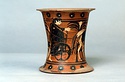
| Mended from many pieces; most of the lip, about half the base and scattered fragments of the figured scenes missing. A cylindrical stand, open at top and bottom, with a rather concave profile and simple ... 1 March 1937 ... Artemis, right, wearing a long himation, mounts a chariot drawn by four horses which stand beside a palm tree. In front of the horses and facing them stands Apollo in long chiton and himation, holding a seven-stringed lyre (strings incised) in his left hand and a flower in his raised right. Behind Apollo a young deer, left, stands under a second palm tree. The deer and Artemis are back to back.
... White is used for Artemis' flesh; for one of the horses and for decorations on the harness of another; for Apollo's wreath, the frame of his lyre, the visible lower part of his long chiton, and the dots along its lower border; for the throat, chest, belly stripe and tail of the deer; for the hearts of the two palm trees; and for the dots of the rosettes in the borders above and below. |
Mended with the missing pieces restored in plaster and painted. Handles, except for one stub, and all of foot restored. Rest. H. 0.133; rest. diam. 0.139. P. E. Corbett, Hesperia 18, 1949, pl. 80:6.
A, ... Ca. 430-420 B.C ... Behind the seated one, beneath the handle is a door; behind the standing one, next to the handle is a Doric column and beneath the handle, a palm tree. B (illustrated), two women (all of one on right; drapery of other) facing, each in a chiton and himation. |
Ten non-joining wall fragments, three (a, e, and g) of flaring rim, flat on top. Bands of glaze on inside. Glaze has a slightly greenish cast on c, f, and j. Est. diam. of rim at outer edge 0.25; P.H ... Ca. 510 B.C ... Behind her is the trunk of a palm tree and between the two:
Fragments e, f, and i each preserve palm fronds. ... Fragment j gives the lower part of the trunk of a palm tree and at the right:
This also belongs to the tree behind Artemis, for not only does the greenish cast of the glaze confirm this, but if it were the tree behind Leto, one would expect to see a bit of her drapery between the inscription and the right break. ... Talcott (Hesperia 5, 1936, pp. 59--60) thought that there was only one palm tree and conjectured (p. 61) that there was a fourth figure, perhaps Ares or Iris, to fill the space between the tree and Leto. |
| Mended from many pieces; the lip entirely missing and the handle save for its upper attachment. Strengthened with plaster at the back and on the shoulder; pieces missing throughout the body. Palmettes ... August-September 1932 ... In the center of the figured panel, a fawn, right, standing in front of a palm tree. To the left, a bearded figure, wreathed and cloaked, faces the fawn. |
On rim, double concentric circle pattern, ending in a leaf pattern at nozzle and handle.
On discus, an elephant, left; in the field between his trunk and forelegs a small tree-like object; in front of ... 20 March 1933 ... On discus, an elephant, left; in the field between his trunk and forelegs a small tree-like object; in front of his hindlegs, a chain of small circles. ... On the reverse, faint traces of a palm branch within two almond-shaped grooves. |
Two non-joining fragments, a with torus rim, b from near knee end with part of curve and reserved resting surface. P.L. a) 0.08, b) 0.14; P.W. a) 0.14.
Fragment b (illustrated) shows, on the far left, ... Ca. 430-420 B.C ... Fragment b (illustrated) shows, on the far left, the foot and a bit of drapery of a figure standing to right before a slender object that looks like the trunk of a tree. Then comes a youth (face, right arm missing) standing frontally, head turned to left. ... Finally, on the right stands a woman (head missing) to left, holding an alabastron in the palm of her outstretched right hand. |
Three non-joining wall fragments. Reserved band on inside at top of P 110. Max. dim. P 104: 0.103, P 110: 0.087, P 2223: 0.07. Prange, Niobidenmaler, p. 209, cat. no. GN 15, pl. 21 (P 110 is mispoised) ... Ca. 450 B.C ... The crescent-shaped object at the right of P 104 in the lower register may be one frond of a palm tree. See, e.g., the ones on the hydria in the Vatican, 17882, by the Painter of the Woolly Satyrs (ARV2 614, 11; Prange, p. 221, cat. no. |
Ten non-joining fragments, f with start of handle, i part of handle (not illustrated). Max. dim. a) 0.42, b) 0.232, c) 0.239, d) 0.243, e) 0.085, f) 0.10, g) 0.149, h) 0.068, i) 0.057, j) 0.077. P.H. of ... Ca. 440 B.C ... Fragment h (d) preserves most of his other foot and behind him the bottom of an object that looks like a pillar or perhaps the lower trunk of a palm tree (see below). ... For the identification of the male on fragment g (c) as King Minos and the object on fragment h (d) as a palm tree, see Shefton, pp. 336 and 337 respectively. |
|
|