|
|
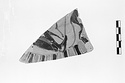
Two wall fragments from an open bowl with sharply curving side, glazed inside. Rim broken off.
a) The hindquarters of a panther, right, and the foreleg of another creature behind him.
b) At left, part ... 18 May 1939 ... Cf. for shape: CVA Munich 3, pl. 139: 1-2. |
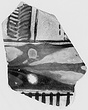
| Fragment from the floor preserving part of a groove and tiny part of the foot.
Around tondo, tongue pattern alternately red and black. Lower part of a draped figure right. Leg of someone lunging(?) to ... July 1947 ... The picture might be Herakles and Nessos; cf. CVA Munich, pl. 18, 2 and 20, 1.
|
| Three non-joining fragments.
a) Mended from three fragments, preserves part of upper body and projecting rim. On upper body, rectangular panels alternately reserved with slanting lines in dilute glaze ... 17-24 May 1940 ... Agora:Object:CVA Munich pl. 94, 6. |
Fragment broken all around. Guilloche. At bottom, clay to right; strands of a mane.
Glaze brown to black.
Cf. Munich 6077; London 1865.7-20.1(A 471). Pit. Leica, 81-534, 81-571 ... (September 1958) ... Glaze brown to black.
Cf. Munich 6077; London 1865.7-20.1(A 471). |
Wall fragment from near start of rim. Reserved band on inside. Max. dim. 0.045.
B, youth (most of head, start of shoulder) to left, wearing a himation.
The Painter of Munich 2335 (ARV2 1165, 70) ... Ca. 420 B.C ... The Painter of Munich 2335 (ARV2 1165, 70). |
Wall fragment from near rim. Reserved band on inside near top. Glaze fired brownish on outside. Max. dim. 0.059.
B, youth (head, part of right arm) to right.
The Painter of Munich 2335 (ARV2 1165, 69) ... Ca. 420 B.C ... The Painter of Munich 2335 (ARV2 1165, 69). |
NM 16059
Flat bottom; continuous profile.
Black to brown glaze.
Others include Kerameikos V, 1, pl 139, inv. no. 356; C.V.A., Munich 3[9], 117[399], 7-8; C.V.A., Copenhagen 2[2], 70[71], 6; Thorikos ... LG IIB ... Others include Kerameikos V, 1, pl 139, inv. no. 356; C.V.A., Munich 3[9], 117[399], 7-8; C.V.A., Copenhagen 2[2], 70[71], 6; Thorikos IV, p. 88, fig. 69 |
Apparently complete.
Some kind of symbol or perhaps a ligature involving the letters alpha and delta: cf. two 6th c. B.C. ligatures of these letters from the precinct of Aphaia on Aigina, A. Furtwangler, ... Furtwangler, Aegina, Das Heilihtum der Aphaia, Munich, 1906, p. 466, nos. 367, 368. |
Wall fragment, unglazed inside.
Chin, neck and a little of shoulder of Athena to left; the edge of the neck-piece of her helmet appears just below the break. White for flesh.
Charikleides group (363/2): ... Schmidt, Archaistiche Kurst, Munich, 1932, pl. 7,2) |
Part of lid with incurving rim. On underside, two concentric circles with a band between. Glaze fired greenish in places. H. 0.01; est. diam. 0.12.
On top side, from knob out: dots; egg pattern with dots; ... Ca. 430-420 B.C ... For the patterns, see the lid of Munich 2720 by the Drouot Painter (ARV2 1223, ---, 4; Addenda 349). |
Wall fragment from just below rim with start of handle at far left. Narrow reserved band on inside near top. Max. dim. 0.09.
B, youth (head and shoulders) to right, wearing a himation.
During his visit ... Probably late 5th century B.C ... During his visit to the Agora in the summer of 1953, Beazley noted on the record card: "doubtful but possibly by the Painter of Munich 2335"; not in ARV2. |
Lid and pyxis intact except for a few chips. H. with lid 0.042; without lid 0.038; diam. of pyxis at bottom 0.067.
On top side of lid: chest with lid partly open.
Inscribed on underside of lid and glazed ... Late 5th century B.C ... Inscribed on underside of lid and glazed over:
on underside of pyxis:
For a similar chest, but with the lid shut, see Munich 2726 A (CVA, München 2 [Deutschland 6], pl. 99 [295]:2). |
From the top of the wall of a bell krater. Inside, a narrow reserved band; outside, reserved band below start of rim. Head and shoulders of a youth, right; traces of another figure at the extreme left ... 29 March 1934 ... ADDENDA Doubtful, but possible by the P. of Munich 2335, (JDB summer 1953). |
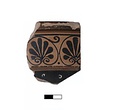
Shoulder and neck fragment. Max. dim. 0.08. Choes and Anthesteria, p. 91, cat. no. 233.
Frieze of upright encircled palmettes and lotuses. Below:
Below, at right break, part of a thick fillet tied around ... Second quarter of the 5th century B.C ... The pattern has a parallel on Munich 2493, a middle work by the Berlin Painter (ARV2 210, 187). |
| Circumscribed black figure palmettes on rim zone.
Inscribed: on wall just below rim, in white paint, the inscription broken at both sides.
Cf. The ornament used by Euthymides on the Munich amphora, Pfuhl ... June 1952 ... The ornament used by Euthymides on the Munich amphora, Pfuhl (1923), fig. 369.
|
Two non-joining fragments of neck and wall, a with start of handle. Dull black glaze, misfired red in places. Max. dim. a) 0.135, b) 0.102.
Fragment a shows the top of a head to left; fragment b (detail ... Ca. 420 B.C ... The Painter of Munich 2335 (ARV2 1162, 23). |
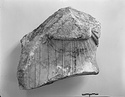
| The fragment first found comes from the middle of the back of the figure. The hair, worn in a heavy mass, square at the bottom, falls nearly to the small of the back. The folds of the garment, drawn tight, ... Early Roman Period (?) ... From replica of Munich Tyche.
White marble. |
Part of domed lid and brim with start of knob or ridge around knob. Concentric bands on underside. Est. diam. 0.13; max. dim. 0.114.
Head of woman (Aphrodite[?]) to right with sakkos, facing a palmette ... Late 5th or early 4th century B.C ... Perhaps similar to Munich 2725 from the Chalki Group (ARV2 1503, 3; Addenda 383). |
Floor fragment with start of stem. Incised line on stem. Max. dim. 0.057.
I, nude male (part of left side of torso, legs except for calves and feet) bending forward about to lift a pointed amphora (lower ... Ca. 520-510 B.C ... For a similar composition, only with a satyr, see Munich 2613 by the Poseidon Painter (ARV2 136, 3; Paralip. 334, 3; Addenda 178); also one of the komasts on Brussels A 3047 by the Epeleios Painter (ARV2 146, 7). |
Wall fragment from just below rim. Reserved band on inside near top. Glaze fired red on inside. Max. dim. 0.099. R. S. Young, Hesperia 20, 1951, pl. 79:4.
Maenad (head, left shoulder, and left arm) probably ... Ca. 420 B.C ... The Painter of Munich 2335 (ARV2 1163, 36). |
|
|