|
|
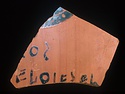
| Wall fragment broken all around. To right of fragment part of the rim of a round shield; the border outlined by incised circles.
An inscription in painted letters runs down the wall: Published as from ... 13 May 1937 ... Tholos Trench B, mid-6th. c. B.C. Layer VII. |
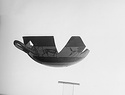
| Fragment of a seated animal.
Preserved is only the plinth, the forelegs, and a rectangular mass which may have been the back legs.
The crumbly material, resembling stone which has been badly burned, may ... 31 May-5 June 1933 ... Bottom fill.
Mid 6th c. B.C. |
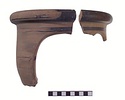
| Almost half vase preserved including one handle but no foot.
The handle band is filled with animals: A, lion and deer; B, deer and panther. Below, a reserved band. Inside, reserved medallion with a glazed ... 14 May 1937 ... Context mid-6th. c. B.C. |
Shoulder fragment.
From a closed pot of moderate size. At the base of the neck, hanging palmettes stamped one by one. Corinthian tile fabric; smooth creamy slip.
For palmettes on Corinthian relief ware ... Context ca. 600-550 B.C. |
| Two non-joining fragments preserve parts of rim and upper bowl. Slightly bulging wall; heavy rolled rim; oval cutout in wall for baby's legs. Glazed are: rim inside and out; a band below rim, a band at ... 1937 ... Glazed are: rim inside and out; a band below rim, a band at mid-wall.
Fragment a) preserves beginning of seat on inside.
... Agora VIII, no. 600 (7th c. B.C.).
Cf. Hesperia 17 (1948), pl. 65:2-3 (6th c. B.C.). |
Wall fragment, broken all around. From the lower mid-part of a panel preserving a left leg and foot of a wrestler to left, on a thin brown ground line. Around the wall below the panel are two broad purple ... 14 May 1938 ... From the lower mid-part of a panel preserving a left leg and foot of a wrestler to left, on a thin brown ground line. ... Metroon pit (η), layer III, in north part, second quarter of 6th. c. B.C. |
Bottom missing.
Probably flat bottom; narrow rim. Reserved: handle-zone with wavy band; handle-panel. Thin streaky glaze ... Mid 6th century B.C ... Mid 6th century B.C. |
Vertical handle and one horizontal handle missing.
Flaring rim, false ring foot.
The flaring rim, heavy body proportions and rudimentary foot are early features, but this piece does not correspond closely ... Context probably as late as the mid 6th c. B.C ... Context probably as late as the mid 6th c. B.C. |
Wall fragment. Glaze dull and misfired reddish here and there on inside and outside; slightly abraded. Max. dim. 0.107. H. A. Thompson, Hesperia 17, 1948, pl. 67:4; Matheson, Polygnotos, p. 354, cat. no ... Ca. 440 B.C ... At the left is an Athenian youth (most of head, left side of body to mid-thigh) standing to right, holding in his left hand a lyre (tips of arms and crosspiece missing). ... Young, "The Slaying of the Minotaur: Evidence in Art and Literature for the Development of the Myth, 700--400 B.C." (diss. Bryn Mawr College, 1972), p. 158, who points out that the lyre occurs in the victory dance on the François Vase, Florence 4209 (ABV 76, 1; Paralip. 29, 1; Addenda 21; M. Cristofani, Materiali per servire alla storia del vaso François [Bollettino d'Arte, Serie Speciale 1], Rome, 1980, fig. 65: the figure of Theseus) and in the slaying of the Minotaur on the cup in Munich by Archikles and Glaukytes, 2243 (ABV 163, 2; Paralip. 68, 2; Addenda 47), also on a late-6th-century cup in Taranto by the Edinburgh Painter (ABV 476, 3): there the lyre is hanging up. |
|
|