|
|
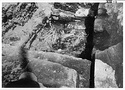
| From the neck of a large volute krater? Boxers confronting each other; on either side a judge with a staff. Groups of white dots on the judge's cloak. East footing trench of wall B. Leica ... 27 March 1936 ... Boxers confronting each other; on either side a judge with a staff. |
| Osteotheke. (Group N). Coin
7 May 1938 #7 83/ΜΔ (83-84/ΜΓ-ΜΕ: If I judge from p. 811, this grid would be the concrete retaining wall). Somebody else wrote the following grid on page 878: 83-85/ΜΓ-ΜΣΤ ... Early 7th cent ... 83/ΜΔ (83-84/ΜΓ-ΜΕ: If I judge from p. 811, this grid would be the concrete retaining wall). |
| Small lid. Plain conical flat-topped handle.
Glazed dark brown with reddish streaks. Decoration of spirals and narrow bands in opaque cream paint. Underside unpainted.
Attic clay. Cream paint largely ... 23 April 1932 ... Late Geometric or more probably early Protoattic, to judge from the spirals. |
Well in the southeast corner of the section, at 58/ΝΑ. It must have been originally made in the Roman period to judge from the character of the curbing tiles. It was however cleaned out and reused in ... 10th-Early 11th c. A.D ... It must have been originally made in the Roman period to judge from the character of the curbing tiles. |
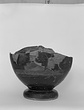
| Mended from several fragments and partially restored. Handles, neck, rim and upper body missing. Echinus base; oval body; type B. Band of maeanders and X's below figures; trace of tongue pattern at handle ... 1 June 1965 ... A) Lyre player standing right on a two-stepped pedestal, preserved to thigh level, barefoot and wearing long chiton and embroidered robe; one tassel of lyre preserved; behind him barefoot, draped Nike flying right, preserved to knees; facing him judge seated left in chair, preserved to just below shoulders, wearing himation with torso bare; left elbow leaning on chair back; rod resting on lap.
B) Man standing right, playing double flute, preserved to below shoulders, wearing long, long-sleeved embroidered robe; behind him draped barefoot Nike flying right, preserved to above knees; facing him judge standing left, preserved to below shoulders, wearing himation; long staff in right hand. |
Reused block. As of the reuse, the front, back, bottom and left end preserved. The bottom was originally a top surface, to judge from half a lifting tong cutting preserved, set in 0.135m. in front present ... April 1949 ... The bottom was originally a top surface, to judge from half a lifting tong cutting preserved, set in 0.135m. in front present front and 0.115m. from present back. |
| Broken all around.
Rear part of Centaur moving right; with branch over his shoulder; trace of another figure at left.
(The Centaurs of the Kleophrades painter are not far off. Note also that the scale ... 29 May 1954 ... If this fragment comes from a vase decorated in two zones, then to judge from the wheel marks, this will come from the lower zone, predella). |
Floor fragment. Glaze much abraded on outside. Max. dim. 0.055; est. inner diam. of tondo 0.09.
I (illustrated), two men or youths (feet, himation fold of one; a bit of the feet and drapery of the other) ... Ca. 450-440 B.C ... Between the two is a staff that to judge from its direction belongs to the figure at the left. |
Wall fragment with start of rim. Reserved line on inside. Glaze has a brownish cast. Max. dim. 0.105.
Capital of Doric column with key pattern to left, painted on the neck. On top of the abacus, bottom ... Probably third quarter of the 5th century B.C ... For Aiakos, a judge of the dead and ancestor of the Aiakidai, see LIMC I, 1981, pp. 311--312, s.v. |
| Mended from eight pieces, badly corroded.
Tip, one cutting edge, one-third of hilt, and pommel missing.
Leaf-shaped, short slender proportions to judge by the width preserved from edge to edge below hilt ... 11 May 1951 ... Leaf-shaped, short slender proportions to judge by the width preserved from edge to edge below hilt. |
| Part of one side of circular mold front and back preserved. Much of front surface gone.
Along circumference of mold series of 7 circles roughly 0.025m. in diameter preserved. Off center to the circumference ... 2 August 1973 ... A derivate mould, to judge from the vestigial rosettes. |
Four non-joining fragments: a of rim and wall with start of handle; b of lower wall and foot; c handle; d rim. P.H. of b) 0.092; diam. at rim 0.142; diam. of foot 0.14; max. dim. a) 0.224, c) 0.067, d) ... Second quarter of the 4th century B.C ... He wears a leather cap and Oriental costume. To judge from his position in the composition, he was probably mounted. |
| A low heavy foot about two-thirds preserved, with the start of the cup above. Two scraped grooves around the bottom of the stem; the rounded outer edge of the foot reserved, colored pink; elsewhere, fair ... 2 June 1933 ... Note that the name on the bottom appears to have been scratched on after the base was broken, if one may judge from the position of the letters Y M. |
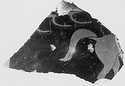
| Numerous joining and non-joining fragments. On one side stood Athena, part of whose body, shield and helmet crest remain. Of the scene on the other side there remain parts of two wrestlers and of the judge ... 11 May 1935 ... Of the scene on the other side there remain parts of two wrestlers and of the judge standing to the left side.
|
| Sides almost equal. Sharp angles.
Once side scratched: HEPAKLHS (after firing). The combination of Attic and Ionic letter forms in the one word is notable. H is used to devote both the spiritual after ... 1930 ... H is used to devote both the spiritual after and the eta, the Attic lambda also shows that `ionic influence was still somewhat tentative. To judge from the 4-barred sigma, the inscription is likely to be later than 446 BC; how much later it is hard to say. |
| Human foreparts. Hunter. Iolaos. Iris. Pantheress. Funeral Games for Patroklos. Javelin thrower. Judge. Pegasos. Judgment of Paris. Jumper. Funeral Games for Pelias. Peleus: seizing Thetis. Kerberos. Chorus ... Agora 23 361 ... Judge |
Shoulder and wall fragment from upper right corner of panel. Glaze rather dull. Max. dim. 0.087.
Warrior or Amazon (part of helmet and crest, about half of round shield) to left. To judge from the outstretched ... Second quarter of the 5th century B.C ... Warrior or Amazon (part of helmet and crest, about half of round shield) to left. To judge from the outstretched position of the tail of the crest, he (or she) is moving swiftly. |
Handle, much of shoulder and walls, and fragments from foot, missing.
Shoulder: strokes above dotted lotus bud (skipping one).
Scene: two men on an ornamental base standing to right; one of them holds ... May-June 1954 ... CVA BM, pl. 45:10; for a seated judge cf. CVA BM, pl. 61:4b. |
Lower half of body, all of torus foot, start of handle B/A. Strengthened with plaster. Thin reddish glaze on inside. Misfired reddish in places on outside. Pitted here and there. P.H. 0.035. R. R. Holloway, ... Ca. 440-430 B.C ... He is the judge, although originally the artist intended him to hold a lyre but changed his mind and turned the arm of the lyre into a staff. ... On the right sits the judge, balanced on the left by a seated woman holding a spear. ... PE 19) with the judge on Side B of 8. |
Two non-joining fragments of pyxis, a with part of wall, floor and foot. Part of underside of floor glazed. Fragment b preserves the upper part of the wall with flange for lid. P.H. of a) 0.048; P.W. 0.08; ... Ca. 420-410 B.C ... The latter may be the head of the left woman on a, who, to judge from her drapery, may have looked to right. |
|
|

.png.icon.jpg)