|
|
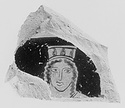
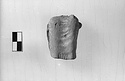
| Nose and upper lip a bit battered, back of neck cut away.
Wears straight stephane over wavy hair. Two iron pins and drill hole in neck. Fine work.
Parian marble. LRFW (Late Roman Fortification Wall) Core, ... 30 June 1959 ... Head of Goddess |
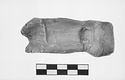
| Broken on three sides.
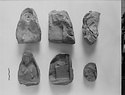
Mold for a seated female statuette - goddess.
Light orange clay. Pit. 965 Leica, 85-36-18, 87-22-32 ... 27 June-5 August 1972 ... Mold for a seated female statuette - goddess.
Light orange clay. |
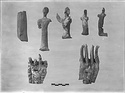
| Broken top and bottom. From stem of thymiaterion; hollow on break at top, solid on bottom break.
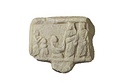
Procession of four figures, upper parts missing. Hermes, goddess, god (end of short cloak hanging down) ... 14 April 1956 ... Hermes, goddess, god (end of short cloak hanging down) and a second goddess. |
| One side only remains, and that broken away above.
Top rail of throne projects.
Goddess type. Very massive.
Flaky clay fired dark gray at the core; buff on the surface. Marble Chips Pit. 117, 1616 ff ... 13 March 1937 ... Top rail of throne projects.
Goddess type. Very massive.
|
Right hand corner of back of throne.
Surface slightly raised along inner (broken) edge where figure began.
Finely finished surface in front, slightly rougher behind.
Probably was part of a "seated goddess" ... 1937 ... Probably was part of a "seated goddess" type.
White marble - Pentelic. |
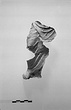
Upper torso of female figure broken along sides, neck and waist.
Broken all around.
Slight traces of drapery.
Inside rough.
Pinkish-yellow fabric with gray core.
ADDENDA RVN: Seated goddess, ca. 480-470 ... 28 June 1973 ... ADDENDA RVN: Seated goddess, ca. 480-470 B.C. |
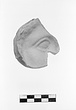
| Part of the mold for a large face, with one eye.
For a protome like T 1763 (?)
ADDENDA: Probably head from large bust-protome of goddess; cf. T 1763.
Too flat Gorgoneion (?) Cistern. 350-325 B.C. Leica, ... April 1938 ... ADDENDA: Probably head from large bust-protome of goddess; cf. T 1763.
|
The figure above the waist and the left side of the throne are missing.
Left hand pressed close to thigh; right drawn across lap.
Precise modelling. Seated goddess type.
Fine buff clay.
Cf. Hesperia 93 ... 13 March 1937 ... Seated goddess type.
Fine buff clay.
|
Wall fragment from just below rim. Reserved band 0.07 on inside below where rim started on outside. Max. dim. 0.062.
Statue of a goddess (Pandora[?]): head with polos, start of chiton or peplos, shown ... Ca. 450-440 B.C ... Statue of a goddess (Pandora[?]) ... It is uncertain whom the goddess represents. ... There, however, Pandora is bare headed, and the pins of her dress are prominent. The goddess on 308 might also be Anesidora, whose name is synonomous with that of Pandora (LIMC I, 1981, pp. 790--791, s.v. |
| Lower part of elongated columnar figure.
Traces of a girdle at the top and wavy bands of glaze.
Brownish clay.
The shape appears to be a descendant of the Mycenaean standing goddess type, but the technique ... 1 April 1932 ... The shape appears to be a descendant of the Mycenaean standing goddess type, but the technique is subgeometric. |
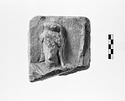
| Broken all around. Fragment from upper wall of a very large krater (bell or kalyx).
Head of goddess, full face, wearing polos. A statue?
No relief contour. Piers 15-16 west. Pocket in bedrock under south ... September 1953 ... Head of goddess, full face, wearing polos. |
| Broken on three sides. Front, back and part of one side preserved.
Drapery folds over stomach and thigh of standing frontal figure.
Back rough.
Fabric: pinkish-yellow with gray core.
ADDENDA Joins with ... 29 June 1973 ... ADDENDA Joins with T 4076. Goddess (?). |
| Broken left side, bottom and back.
There remain head and shoulders of a seated goddess, her head turned slightly left, scepter in left hand, polos on head with her garment drawn up over it.
Good Greek ... 12 May 1950 ... There remain head and shoulders of a seated goddess, her head turned slightly left, scepter in left hand, polos on head with her garment drawn up over it.
|
| Broken at right, setting tongue preserved.
Five figures enclosed by plain border. In center one figure kneels before a standing god and goddess, at the right. At the left of the kneeling figure a standing ... 19 April 1956 ... In center one figure kneels before a standing god and goddess, at the right. |
Head of goddess with wavy hair parted in middle, and a high stephane.
Mended from many fragments.
Traces of white paint.
Clay dark brown at core, light brown toward surface.
Cf. Hesperia 64 (1995), p ... 6 June 1952 ... Head of goddess with wavy hair parted in middle, and a high stephane.
|
| Broken on all sides.
Draped legs of frontal seated figure preserved.
Figure originally hollow back missing. Broken at waist and ankles.
Traces of added white paint.
Dark red fabric.
Cf. Olynthos XIV , ... 6 July 1973 ... ADDENDA RVN: Seated goddess on a Klismos. |
Broken on two sides. Parts of bottom, one side, front back preserved.
Subject: right (bent?) leg and drapery from lower part of draped frontal figure.
Back rough.
Well baked yellowish-pink fabric.
ADDENDA ... 21 August 1973 ... ADDENDA RVN: Joins with T 4076 and T 4101. Goddess (?). |
Left side missing.
A heavy veil on the back of the hair. Heavy roll of small curls around the face.
Remains of red color over white on the veil.
Archaic seared goddess type. Well. Votive deposit in the ... 28 April 1937 ... Archaic seared goddess type. |
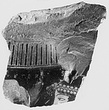
Broken off above and below; the finished sides preserved. Winged goddess (Potnia Theron), standing facing, looking right; an animal grasped in her right hand and a long-necked bird in her left. Incised ... 23-25 September 1947 ... Winged goddess (Potnia Theron), standing facing, looking right; an animal grasped in her right hand and a long-necked bird in her left. |
| a) From the shoulder of a large volute krater of heavy fabric. Tongue pattern around base of neck. The upper part of a garlanded male head, left; in front, the flame of a torch added in red. Letters in ... 14 April 1939 ... In front of her, a phiale and the staff of a flowering scepter, one or both held by Triptolemos facing the goddess.
Relief contour throughout. The hair of the loop over the goddess' temple rendered in raised dots. |
|
|