|
|
Nozzle and part of rim preserved.
Blunt, short nozzle. Double groove around narrow, convex rim. Curving sides.
Clay: fine soft reddish; red-black glaze (much worn) all over. Assembly Place, filling of ... 1932 ... (No description on the book). |
| Intact, but some corrosion.
Description before cleaning.
Inner face appears to be smooth; the outer cut by a deep incision so that it looks like two narrow rounded rings superimposed.
Missing (Winter 1976) ... 15 June 1967 ... Intact, but some corrosion.
Description before cleaning.
|
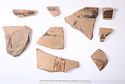
| Fragment of a krater, buff clay. Brown gray glaze decoration: rim - reserved triangle filled with concentric half circles.
Cf. Belonging with AP 2592, AP 2593, AP 2658, AP 2657.
See AP 2658 for complete ... 8 June 1938 ... See AP 2658 for complete description. |
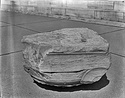
Top, bottom, front and right end preserved. Top rough-picked, as in South Stoa steps; bottom worn; front weathered. Right end has anathyrosis, picked back 0.007m. deep.
Stoa Poikile series.
Poros.
ADDENDA ... April 1949 ... ADDENDA This description does not correspond with the block numbered A 1740. |
| From a krater, brown on buff.
Cf. Belongs with AP 2592, AP 2594, AP 2593, AP 2658. See AP 2658 for complete description. C.f. slip of paper in the back of notebook Oscar Broneer, Nb. No. 5. (V). Finished ... 21 May 1937; 12, 13 June 1937; 6 April 1938 ... See AP 2658 for complete description. |
Eggs and flower
Provenience: East terrace behind retaining wall
Date:1932-4 NB pp. 677, 738
Description: max. diam. 0.035
Part of the rim occupied by a band of egg and dart and a 5-petalled rosette below ... Eggs and flower
Provenience: East terrace behind retaining wall
Date:1932-4 NB pp. 677, 738
Description: max. diam. 0.035
Part of the rim occupied by a band of egg and dart and a 5-petalled rosette below a bounding line of beading
Clay: Yellowish, buff
Glaze: Red glaze, much worn inside and out |
| For detailed description see H. A. Thompson's article in ArchEph (1953-1954), pp. 30-44.
Cf. A 41 for fragments of kithara. Catalogued 1961. Found in 1907 ca. 20.00m. south of Temple of Apollo Patroos ... 1907 ... For detailed description see H. A. |
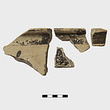
| Fragment of krater, buff clay.
Gray brown glazed decoration: rim - reserved triangle filled with series of diminishing chevrons.
ADDENDA Inventory 6 December 2017.
2 body sherds (one joining with rim, ... 13-15 April 1938 ... See AP 2658 for complete description. |
| Fragment of a krater, buff clay.
Gray brown glaze decoration: rim - reserved triangles filled with a series of diminishing chevrons.
ADDENDA 2020: Two single fragments added. A wall fragment with scar ... 21 May 1937; 12, 13 June 1937; 6 April 1938 ... See AP 2658 for complete description. |
| Full height and main mass of corner capital preserved, much damaged all around. Of the volutes only about half of one and a small bit of another preserved.
Pentelic marble.
Same series as A 1130 (ΙΙ 514) ... 15 June 1951 ... ADDENDA Detailed description and measurements by Bakalakis in ÖJh XXXVI, p. 60. |
Moulded decor: Herakles riding bull
Provenience: East stoa, NE corner, Layer II
Date:1934 NB pp. 606-607, 740
Description: max. diam. 0.109
Bowl of the lower wall preserved; Herakles riding a bull, a ... 1934 ... Moulded decor: Herakles riding bull
Provenience: East stoa, NE corner, Layer II
Date:1934 NB pp. 606-607, 740
Description: max. diam. 0.109
Bowl of the lower wall preserved; Herakles riding a bull, a lead springs from the edge below.
|
[No description on card]
ADDENDA 2018: Three non-joining sherds to a stirrup jar. No features are preserved.
The exterior decoration consists of medium bands flanking registers of isolated semicircles ... LH IIIC Middle ... [No description on card]
ADDENDA 2018: Three non-joining sherds to a stirrup jar. |
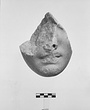
| Lower portion of female face.
Chin, mouth, nostrils, left cheek and part of left eye preserved.
The head is of a woman, life-size. The eyes are quite gone, the nose too battered for description. The ... 5 July 1937 ... The eyes are quite gone, the nose too battered for description. The lips are also worn away, and the chin, which is round and full, slightly abraded. |
Lid. Part of the glaze abraded on side. Thin brownish glaze on underside. Diam. 0.07; H. 0.012.
On top side, head, neck, and upper part of chest of panther. At the right, a thyrsos; at the left, two concentric ... Probably late 5th century B.C ... I know this piece only from the photograph and the description on the Agora record card; the dipinto is traced from the facsimile on the card. |
| Fragment of discus.
Plain rim, panelled with herringbone and impressed circles.
On discus, figure of Eros advancing to the right but looking back at an object held in the right hand; in his left hand is ... 17 July 1931 ... Corinth IV, ii, no. 1124: quoted from description, of which L 176 appears to be a cruder version; no. 1132: is a fragment like L 176, but less well preserved.
|
Upper part.
Tall-necked jug; round mouth with lightly collared rim, double-rolled handle from below rim. Neck set off from sloping shoulder by light ridge; around shoulder, at line of lower handle-attachment, ... Context ca. 520-490 B.C ... Close in profile and in general appearance, the early archaic jug from Antissa on Mytilene, B.S.A., XXXII, 1931-32, pl. 21, 12; the description of the Antissa fabric and surfaces also corresponds. |
Chip missing from top.
A: cart and horse right, seated figure (Dionysos ?) in cart, with large thyrsos (?) in front of figure.
Dots below ground line may have been letters.
Surface bad and details far ... 24 May 1951 ... The coin envelope read 1941, but no entry under that date; and description fits the 1951 date exactly. |
Wall fragment, slightly flaring. Glaze cracked a bit on outside.
Scratch at lower right. Max. dim. 0.064.
Lower part of draped forearm and hand of figure, perhaps a child, either frontal or standing ... Probably late 5th century B.C ... The description of 284 on the Agora record card suggests that the hand is that of a child and restores the inscription to read: θυμε'λη . |
Nearly a quarter of the circumference is preserved. Athena 's figure is broken away at the waist and only the head and the right shoulder of the man are preserved.
The edge of the mold curves up like ... 25 May 1933 ... (This description is of the plaster impression). |
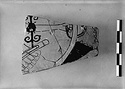
| From a sizable open vase, glazed inside, rather dull.
a) At left a warrior whose cuirass flaps hang over a shaded body; his sword sheath projects to the right. The inside of the shield of another warrior, ... 21-24 February 1936 ... ADDENDA a) Description wrong here; see publications.
|
|
|