|
|
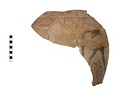
Fragment from medallion with three of long-bearded masks which are commonly found on the side wall now placed in the medallion, crowns toward the center.
The modelling is crisp and the glaze is good ... 1932 ... Hesperia 3 (1934), no. C 37. |
Collar rim. Corinthian tile fabric; mouldmade.
For an example in Corinth see, e.g. C-37-2050: Hesperia, VII, 1938, p. 604, fig. 26, 176 ... Context ca. 520-490 B.C ... For an example in Corinth see, e.g. C-37-2050: Hesperia, VII, 1938, p. 604, fig. 26, 176. |
Much missing, including the handles. Thin fabric; moulded ring foot and deep body, with rim offset inside only. Two groove rings at center of floor, surrounded by a ring of linked stamped palmettes, and ... 18 May-4 June 1937 ... Hesperia 18 (1949), no. C 37, pls. 86, 89, 90. |
| Ten joining fragments from shoulder and body. On shoulder: downward pointed rays, alternately glazed and outlines; below, a zone of strap pattern. On body: hindquarters of a large horse walking right; ... 9 June 1939 ... Hesperia 20 (1951), pl. 37:c. |
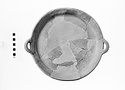
Restored in plaster. Straight lip and two horizontal handles. Body glazed to handle zone; in handle zone, three bands; on rim, four more. Inside glazed, with reserved bands inside lip.
Slightly streaky ... 17 March-1 April 1936 ... Hesperia Suppl. 2 (1939), no. C 37, p. 151, fig. 106. |
A small one.
Nearly square, with faintly concave sides. Top, irregular around outer edge which is set off by two curved depressions from an oval central area. Well.
Mixed 4th, 3rd, 2nd c. B.C. Leica, 2-243 ... 18 April 1932 |
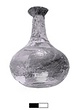
Globular body on high base, flat beneath; straight neck, flaring trefoil rim; rolled handle from rim. Corinthian tile fabric, handbuilt.
The high foot and bulbous body are traditional in Corinth in this ... Context ca. 600-575 B.C ... The high foot and bulbous body are traditional in Corinth in this fabric for hydriai, amphorae and jugs; see for example the long jug series such as
C-40-375, 373, 380: Hesperia, XVII, 1948, pl. 76, C 20, 22, 21 (late Geometric);
C-37-934, 935: Corinth, VII, i, pl. 23, 170 and pl. 24, 171 (third quarter of 7th century);
C-37-2052, 2053: Hesperia, VII, 1938, p. 601, fig. 23, 166- 167 (context of ca. 500-480 B.C.). |
Rim fragment.
Overhanging rim. Impressed slanting leaves. Corinthian tile fabric; pinkish buff surfacing.
The finish much less fine than on 1863. Close, from Corinth C-37-2079: Hesperia, VII, 1938, p ... late archaic context ... Close, from Corinth C-37-2079: Hesperia, VII, 1938, p. 602, fig. 24, 177, late archaic context. |
Flaring rim.
1926 and 1927 stand for the chytrai in common use in the decades just before and just after 500 B.C. See also, from Corinth, C-37-2058, -2060: Hesperia, VII, 1938, p. 597, fig. 21, 159, 161 ... Context ca. 520-480 B.C ... See also, from Corinth, C-37-2058, -2060: Hesperia, VII, 1938, p. 597, fig. 21, 159, 161. |
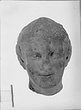
| The back part of the head is broken away, also the tip of the nose, chin and presumably pointed ears.
The head faces front. The hair is bound by a fillet, which comes to a point at the top of the head ... 10 July 1967 ... Hesperia 37 (1968), p. 52, pl. 8 c, d. |
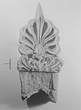
| Full height preserved; width and thickness of the antefix preserved, the cover tile broken off at the back.
The nine-petalled palmette, in low relief, rises from an acanthus bed; below this decoration ... 24 May 1933 ... Hesperia 19 (1950), p. 127, pl. 37 c. |
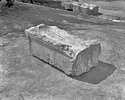
| Rim broken off, but bottom part of channel preserved on one end. Much worked down through various periods of reuse. Sides straight, flaring out at top. Anathyrosis on two edges. Pair of pry holes on one ... July 1967 ... Hesperia 37 (1968), p. 39, fig. 1, pl. 5 c. |
| Broken. Part of lip missing.
Decorated with a spiral ridge beginning at the center of the slightly concave bottom. N.E. quarter. Disturbed burial.
1st c. A.D. 61 Leica, IV-37 PD 505 ... 16 March 1936 ... Disturbed burial.
1st c. A.D ... Leica, IV-37 |
Lower part only.
Massive steep-walled basin with flat underside, the bottom pierced before firing with many round holes, 5 mm. in diameter. Corinthian tile fabric with smooth creamy slip, the inside fresh, ... Context 4th c. B.C ... For the shape in Corinth, cf. a late 6th century basin, C-37-2048: Hesperia, VII, 1938, p. 601, fig. 23, 172.
Found set in bedrock; context 4th c. B.C. |
| Uncleaned. Pit 3, above floors, under wall C. 2294 Leica, 80-37-4 ... 26 July 1978 ... Pit 3, above floors, under wall C ... Leica, 80-37-4 |
| Uncleaned. Small pit, over bedrock, west of wall C. 2262 Leica, 80-37-8 ... 28 June 1978 ... Small pit, over bedrock, west of wall C ... Leica, 80-37-8 |
| Preserved are two handles and large portions of rim and body; two major sections touch at one point giving complete diameter. Restored in plaster. Shallow, two-handled pan with concave wall and rounded ... 1964 |
Part of foot, floor and wall.
Moulded ring foot. Rim offset inside. Reserved: underside with two bands and two circles (center missing); groove above junction of wall and foot. Decoration inside: zone ... Ca. 375 B.C ... Others with rouletting are Corinth C-53-34; Corinth C-37-2495; Nostell Priory 33. |
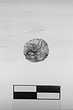
Slightly larger than B 539 (Z 1396), and not pierced.
Rather irregularly made. Tholos Trench H, north of Building C, pocket in bedrock floor of Middle Drain; with coins for the day nos. 2-37.
3rd-2nd c ... 22 February 1938 ... Tholos Trench H, north of Building C, pocket in bedrock floor of Middle Drain; with coins for the day nos. 2-37.
3rd-2nd c. |
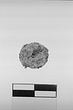
Not pierced, similar to B 540 (Z 1397), but slightly more irregular. Tholos Trench H, north of Building C, pocket in bedrock floor of Middle Drain; with coins for the day nos. 2-37.
3rd-2nd c. B.C. 2082 ... 22 February 1938 ... Tholos Trench H, north of Building C, pocket in bedrock floor of Middle Drain; with coins for the day nos. 2-37.
3rd-2nd c. |
|
|