|
|
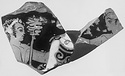
Fragment from near rim with bands of ribbed leaves on wall.
Good glaze and fabric. Cistern. Leica PD 315 ... 1932 ... Hesperia 3 (1934), no. C 34. |
| Intact save minor fractures.
Around the upper part an inscription, roughly incised.
Black glaze all over, except where worn off at edges.
Greyish earth near poros block. Leica, 8-185 PD 1133-12, DA 15223 ... 10 May 1938 ... Agora XXI, p. 15, pl. 6, no. C 34. |
| One handle and fragments from rim and wall missing. Low ring foot; concentric circles and dot underneath. Rays with narrow bands above and below, above foot. Black glaze to handle zone. In handle zone, ... 13 March 1936 ... Hesperia Suppl. 2 (1939), no. C 34, p. 150, fig. 105. |
Portion of rim from a krater.
Buff clay, red orange glaze decoration.
ADDENDA 2018: Single sherd to a krater with everted rim. No other features are preserved.
The exterior decoration consists of a ... LH IIIB-C ... Hesperia 8 (1939), p. 358, fig. 34,c. |
Collar rim with spout. Corinthian tile fabric, mouldmade.
Typical for the second half of the 5th c.; close, in Corinth, C-34-929: Hesperia, VI, 1937, p. 300, fig. 32, 194 ... Context ca. 425-400 B.C ... Typical for the second half of the 5th c.; close, in Corinth, C-34-929: Hesperia, VI, 1937, p. 300, fig. 32, 194. |
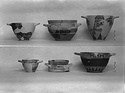
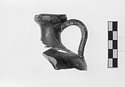
Small squat jug with melon ribs. Blister ware; red clay, gray at the surfaces.
Similar but the ribbing more careful: from Corinth, C-34-1028: Hesperia, VI, 1937, p. 288, fig. 23, 138 ... Context ca. 430-410 B.C ... Similar but the ribbing more careful: from Corinth, C-34-1028: Hesperia, VI, 1937, p. 288, fig. 23, 138. |
Shallow flat-bottomed pan; two pierced lug handles rising from rim.
Similar, from Corinth, C-34-940: Hesperia, VI, 1937, p. 305, fig. 36, 214. Fragments of another, noted in uninventoried pottery from ... Context ca. 460-440 B.C ... Similar, from Corinth, C-34-940: Hesperia, VI, 1937, p. 305, fig. 36, 214. |
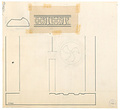
| Perhaps part of a door jamb.
The back is smooth, the front rough-picked, with a curved molding of crosses and degenerate palmettes.
Byzantine.
Pentelic marble. Lying on the floor in the passage of the ... Byzantine ... Hesperia 34 (1965), p. 169, pl. 44 c. |
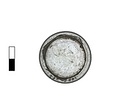
| Complete circle of base preserved, which forms a flange projecting beyond walls of cup. The bottom rises within.
Color light green. Well. Dumped filling.
1st-early 2nd c. A.D. Leica PD 2815-1 ... 21 March 1934 |
Shoulder and wall fragment.
From a sizable jug; broad melon ribs on the shoulder. Blister ware; clay red, surfaces gray to orange.
For the shape and the ribbing see especially from Corinth, C-34-1024: ... Context ca. 470-425 B.C ... For the shape and the ribbing see especially from Corinth, C-34-1024: Hesperia, VI, 1937, p. 288, fig. 23, 141. |
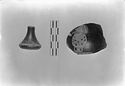
Small lid, shallow domed; neatly pointed knob.
Similar, slightly larger, P 21952 N 7:3 Hesperia, XXII, 1953, pl. 35, 114, mid 5th century; also close, Corinth C-34-945: VI, 1937, p. 305, fig. 36, 209, ... Context ca. 480-450 B.C ... Similar, slightly larger, P 21952 N 7:3 Hesperia, XXII, 1953, pl. 35, 114, mid 5th century; also close, Corinth C-34-945: VI, 1937, p. 305, fig. 36, 209, late 5th century; for the profile see 1963. |
| Fragments mended from several pieces.
a) The lower part of two female and one male figure; below is a double maeander band broken by panels with four small squares each containing a black dot. The style ... 16 June 1931 |
Foot missing.
Wide-shouldered jar, the lower part fragmentary; the spring of the substantial ring foot remains. Low vertical rim; two broad pierced handles rise above the rim. Corinthian tile fabric, ... Context ca. 450-425 B.C ... Cf., from Corinth, somewhat smaller and with a low ring foot, C-34-936: Hesperia, VI, 1937, p. 302, fig. 34, 196. |
Shoulder fragment.
From a sizable jug decorated with three rows of large projections. Blister ware; light red clay with white bits, smooth orange surfacing.
Cf., from Corinth, C-34-1023: loc. cit., fig ... Ca. 425 B.C. (?) ... Cf., from Corinth, C-34-1023: loc. cit., fig. 23, 140.
|
Shape similar to 1694, but the base low, flat beneath. Corinthian tile fabric, handbuilt.
The shape appears to change little during the 5th century; cf. C-34-935 Hesperia, VI, 1937, p. 300, fig. 32, 203; ... Context ca. 500-480 B.C ... The shape appears to change little during the 5th century; cf. C-34-935 Hesperia, VI, 1937, p. 300, fig. 32, 203; there the foot is a false ring rather than flat. |
Close to 1954; normal size. Unpierced spout, straightsided.
Others of the second half of the 5th century: P 5487 R 13:4 Hesperia, IV, 1935, p. 514, fig. 26, 80, as large as 1951 and, from Corinth, C-34-939: ... Context ca. 425-400 B.C ... Others of the second half of the 5th century: P 5487 R 13:4 Hesperia, IV, 1935, p. 514, fig. 26, 80, as large as 1951 and, from Corinth, C-34-939: Hesperia, VI, 1937, p. 305, fig. 36, 205. |
Flat-topped rim, double-grooved; ring foot. No handles; pair of suspension holes, marked but not pierced through, on rim. Glaze on rim and for bands inside.
For handleless lekanai from Corinth in the ... Context ca. 330-320 B.C ... For handleless lekanai from Corinth in the late 5th century see C-34-924, -925: Hesperia, VI, 1937, p. 300, fig. 32, 187-188. |
Fragmentary upper part.
One-piece neck and shoulder with a broad flange below the vertical rim. No trace of handles. Cooking ware.
Elaborate rims are uncommon in Attic hand-finished cooking-ware pots; ... Context ca. 425-400 B.C ... For a somewhat similar shape in Corinthian tile fabric, see C-34- 936a: Hesperia, VI, 1937, p. 302, fig. 34, 197; this piece with a lid like 1546. |
| Broken away below the shoulder. The flaring mouth is drawn to a blunt beak.
Dull but firm black glaze. Cistern. Leica, 90-12-17, 90-34-34, 4-322 ... 1932 |
Three fragments from different stoves or braziers, as for supports.
a) Black glazed-local Athenian.
b) and c) Coarse-standard Phocean(?) [JWH]. Cistern, layer II, 1st. c. A.D. Leica ... 14 April 1937 |
|
|