|
|
According to the excavator " a pre-herulian filling dumped in to fill the cistern some few years after the Herulian destruction". Coins:
10 June 1936 #2-#6
11 June 1936 #1-#19
12 June 1936 #23-#27 P 11936 ... A.D. 267 to mid 3rd c ... C 14:2 ... C 14:2 |
Late 3rd-first half 4th c ... C 14:4.3 ... C 14:4.3 |
Cistern through which well G 14:4 was dug. Filling in cistern, early Byzantine, but with various objects resembling those from the upper dumped filling in the well, below the cistern floor (5th c. A.D.) ... Early Byzantine ... C 14:6 ... C 14:6 |
Coins:
17 May 1937 #1 ... Second half 4th. c ... C 14:4.2 ... C 14:4.2 |
Patch of early fill, disturbed. 20/9/1962: Tin 145 is checked and is chiefly late archaic, but some of the coarse ware is late 5th with 4th c. B.C., and a few bits are 4th c. A.D ... Late 6th.-early 5th c. B.C ... C 14:5 ... C 14:5 |
Lower red fill with mixed Hellenistic pottery running into the 2nd. c. Coins:
4 May 1936 #1 ... 1-5 May 1936 ... C 14:1.1 ... C 14:1.1 |
Small deposit in bedrock. Coins:
20 April 1936 #2-#3 ... 4th c. B.C. to early 3rd c. B.C ... C 14:7 ... C 14:7 |
Coins:
28 May 1937 #30
29 May 1937 #1
31 May 1937 #1-#3 ... 2nd c ... C 14:4.4 ... C 14:4.4 |
Dumped fill in mouth of well. Coins:
16 May 1937 #1 ... Early 5th c ... C 14:4.1 ... C 14:4.1 |
| Artifacts, burnt bone, ash, cinders and charcoal in pit in bedrock. The pyre lay directly under mosaic floor A. the deposit is not badly disturbed, however, and it is possible that it was laid immediately ... Early second quarter of 4th c. B.C ... C 14:3 ... C 14:3 |
Chamber cistern at 95/Κ and Cistern shaft at 95/ΚΕ plus the passage between. System heavily disturbed throughout in Turkish times except for a small amount of red fill on floor of shaft. Coins:
4 May 1936 ... Hellenistic ... C 14:1 ... C 14:1 |
Turkish fill. Coins:
7 May 1936 #1-#4 ... 5-14 May 1936 ... C 14:1.2 ... C 14:1.2 |
Well in the bottom of chamber cistern at 106/ΛΓ, stratified. A soft spot in the bedrock at the west side of the well caved in and was packed with typical coarse Roman first century amphoras; the well was ... A.D. 200-150 ... C 14:4 ... C 14:4 |
| Rodney S. Young ... Grave 7 in notebook (E.L. Smithson: Grave XXI: PG). Bones discarded. Disturbed and damaged cremation (originally trench-and-hole), the east end cut away, probably contained the burial urn.
JP
It consisted ... Late Protogeometric ... C 9:14 ... C 9:14 |
Great Drain sand fill under Roman bath including small area at north end under tiles that was excavated separately.
See also A-B 19-20:1 for additional Great Drain sand fill at ca. 70-113/* Subdivisions: ... 30 July-11 August 1947 ... C 18:14 ... C 18:14 |
Byzantine pottery begins after 4.70m.; above that Roman.
Diameter 0.92m; water level -5m. Tiled well; height of tiles 0.62m ... Byzantine re-use of Roman well ... C 19:14 ... C 19:14 |
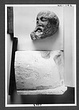
| Metope IV. Head of Eurystheus, reconstruction ... Horizontal (normal) ... ca. 1939 ... 1997.05.0180 (XXI-14 C) ... XXI-14 C ... XXI-14 C |
The neck preserved to its original height over one-half of its circumference. Gently concave in profile. Around its middle runs a garland of ivy leavs c arefully rendered in thinned clay. Just under the ... 1932 ... Hesperia 3 (1934), no. C 14. |
| Rodney S. Young ... Destroyed urn cremation. No remains. Originally assigned as part of Tomb C 9:14 (Grave 7)
JP
"Large fragments of an urn were found in the packing of a Hellenistic water channel which cut through a LPG ... Final Mycenaean/Submycenaean ... Originally assigned as part of Tomb C 9:14 (Grave 7)
JP
"Large fragments of an urn were found in the packing of a Hellenistic water channel which cut through a LPG burial area and obliterated the urn and urn-hole of LPG grave C 9:14." ... P 6723, although surely an urn, rust-stained inside from the iron jewelry and within a meter of Grave C 9:14, is much earlier than the offerings in that grave and must have come from still another burial trench in the line of the water channel; a narrow burned strip along the edge of the channel opposite the fragments may be part of that trench.
|
| An oval disk, slightly concave back.
Obverse: a kneeling warrior with helmet, shield and spear is attacked from the left by a lion. Covered with thin black glaze, spots of glaze on back.
Reverse: plain ... 21 April 1936 ... Agora X, p. 128, pl. 32, no. C 14. |
|
|