|
|
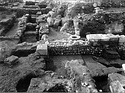
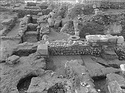
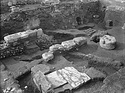
| View to show Byzantine walls. 1) Threshold block at 14/ΝΑ. Byzantine wall over the apse of the Late Roman Complex. 2) Earlier strosis at 21/ΛΑ connected with the Byzantine walls. 3) Crosswall of Roman ... southwest ... 2 Mar 1935 ... View to show Byzantine walls. 1) Threshold block at 14/ΝΑ. Byzantine wall over the apse of the Late Roman Complex. 2) Earlier strosis at 21/ΛΑ connected with the Byzantine walls. 3) Crosswall of Roman Building at 21/ΜΑ. 4) At 20/ΜΓ, block belonging to the "Burnt Building" (Odeion). |
| View to show Byzantine walls. 1) Threshold block at 14/ΝΑ. Byzantine wall over the apse of the Late Roman Complex. 2) Earlier strosis at 21/ΛΑ connected with the Byzantine walls. 3) Crosswall of Roman ... AMS southwest Horizontal (normal) ... 2 Mar 1935 ... View to show Byzantine walls. 1) Threshold block at 14/ΝΑ. Byzantine wall over the apse of the Late Roman Complex. 2) Earlier strosis at 21/ΛΑ connected with the Byzantine walls. 3) Crosswall of Roman Building at 21/ΜΑ. 4) At 20/ΜΓ, block belonging to the "Burnt Building" (Odeion). |
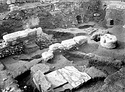
| 1) Threshold block at 14/ΝΑ. Byzantine wall over the apse of the Late Roman Complex. 2) Pithos at 3/ΜΗ connected with Byzantine level. 3) Tile floor at 9/ΜΘ. 4) At 13/ΝΓ the apse of the Roman Building ... west ... 2 Mar 1935 ... 1) Threshold block at 14/ΝΑ. Byzantine wall over the apse of the Late Roman Complex. 2) Pithos at 3/ΜΗ connected with Byzantine level. 3) Tile floor at 9/ΜΘ. 4) At 13/ΝΓ the apse of the Roman Building. 5) At 15/ΝΔ a paved floor later than the Byzantine wall (1) at 14/ΝΑ. |
| 1) Threshold block at 14/ΝΑ. Byzantine wall over the apse of the Late Roman Complex. 2) Pithos at 3/ΜΗ connected with Byzantine level. 3) Tile floor at 9/ΜΘ. 4) At 13/ΝΓ the apse of the Roman Building ... AMS west Horizontal (normal) ... 2 Mar 1935 ... 1) Threshold block at 14/ΝΑ. Byzantine wall over the apse of the Late Roman Complex. 2) Pithos at 3/ΜΗ connected with Byzantine level. 3) Tile floor at 9/ΜΘ. 4) At 13/ΝΓ the apse of the Roman Building. 5) At 15/ΝΔ a paved floor later than the Byzantine wall (1) at 14/ΝΑ. |
| Note on Nomenclature. Stoa of Zeus Eleutherios equals Royal Stoa which equals The Stoa. Temple of Apollo Patroos equals Dorpfeldt's Stoa Vasileios. Small Rectangular Building to North of Temple of Apollo; ... Η'-1 5, 6 ... Late 5th B.C ... Small Rectangular Building to North of Temple of Apollo; Probably a Small Temple within the Sanctuary of Apollo Housing a Cult Statue ... Roman Building equals the Large Rectangular Building in the North Part of the Area whose Northeast Corner Lies beneath the Railway. ... Byzantine Building equals the Large Complex of Byzantine Rooms Overlying the Roman Building and Occupying the North Part of the Section |
| Monument to SOuth of Later Altar of Zeus. General Note. Monument Bases Between South Wing of Stoa and Great Drain. Early Poros Geison. Monument Bases to East of Great Drain. Large Base at 21/ΛΣΤ, Plan ... Η'-12 2253, 2254 A 759 ... 1933 ... Byzantine Building - Complex ... East Side of Building ... Earlier Byzantine Walls |
| Preliminary Report on the 2007 Excavation Season ... John McK. Camp II ... Excavation continued this year in the sections ΒΖ, ΒΗ and Γ.
In Section ΒΖ South, two areas were investigated: the north-south road and the areas west of the road. In the road, hard-packed gravel surfaces ... 13 Jun-3 Aug 2007 ... It seems to have been a building of at least six rooms/shops set side-by-side along the street. A draw-shaft and part of the tunnel of a Hellenistic cistern complex was found outside the building to the east. The tunnel may lead to a collapsed cistern located within the building itself.
In Section Γ, the excavation of the building identified as the Strategeion continued. |
| Section Φ Season of 1937 ... Eugene Vanderpool ... In antiquity the area included in Section Φ lay outside the Agora proper and were apparently occupied only by houses and small buildings. The earliest period of which any considerable remains were found ... 25 Jan-17 Jun 1937 ... A small building with polygonal limestone walls were cleared, its purpose uncertain. ... A late Roman building covered almost the whole section and was probably part of the great complex of late Roman buildings that covered most of the center of the Agora. The most prominent feature is an apse. The building was destroyed in the 6th century A.D.
|
|
|
.jpg.icon.jpg)
.jpg.icon.jpg)