|
|
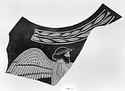
Shoulder fragment with start of neck. Glaze pitted in places. Part of the glaze fired brown. Max. dim. 0.077.
Youth or woman (wreathed head), then part of a wing of someone, both to right. Relief contour: ... Ca. 480-470 B.C ... The subject may be a pursuit, and if so, the winged figure may be Boreas or Eos. If it is Boreas, then the figure whose head is preserved would be one of Oreithyia's playmates running to left, looking back; if Eos, probably one of Kephalos' hunting companions doing the same thing. Cf. these examples. Boreas: two by Hermonax, St. ... Ohly-Dumm (LIMC III, 1986, p. 136, no. 34, pl. 113, s.v. Boreas [S. Kaempf-Dimitriadou]). |
| About one-quarter missing, mostly from lower part of body and foot; restored in plaster.
A) King looking right, right arm outstretched; scepter in left hand; woman running right, looking back left. White ... May-June 1951 ... The interior is thinly coated with brownish glaze.
Boreas Painter. |
Four non-joining fragments of rim and wall with start of underside. P 18414 a + c and P 18007 preserve the full profile of the rim. Glaze much pitted on outside. Est. diam. at rim 0.218; max. dim. P 18414 ... Ca. 460 B.C ... LIMC III, 1986, p. 136, no. 29, pl. 112 (P 18414 a + c), s.v. Boreas; W. Agard, Classical Journal 61, 1966, p. 245, fig. 7: P 18414 (a + c).
Boreas and Oreithyia; Peleus and Thetis. At the right of P 18414 a + c is Boreas (back of head, top of wings, left hand, most of legs missing) flying to right, dressed in a cloak. |
| A single fragment (with one small joining piece) preserves the upper part of the base and the stubs of the handles.
A) Boreas, wing outspread behind him, bearded wearing wreath and sleeveless chiton, ... 5 April 1932 ... A single fragment (with one small joining piece) preserves the upper part of the base and the stubs of the handles.
A) Boreas, wing outspread behind him, bearded wearing wreath and sleeveless chiton, reaches forward with both arms.
... Red for Boreas' wreath, and the wreath of the right hand figure and the leaves of the tree on B). |
| Joins P 18414. Fragment from rim of a large stand or kalathos. Straight wall; plain narrow projecting rim, flat on top. Inside glazed; top of rim reserved. Below the rim, maeander; on the wall, the top ... 25 June 1947 ... LIMC III (1986), p. 136, no. 29, pl. 112 (P 18414 a + c), s.v. Boreas. |
| Five non-joining fragments preserve rather more than half the circumference at the rim and part of the figured scene. Wall profile slightly concave; narrow rim, unglazed, flat on top. Inside, good black ... 5-6 August 1947 ... LIMC III (1986), p. 136, no. 29, pl. 112 (P 18414 a + c), s.v. Boreas. |
Wall fragment. Glaze thin in places on outside. Max. dim. 0.113.
A, male pursuing a woman. Parts of three figures remain: at the left, a bit of the himation and chiton, and left foot of a woman running ... Ca. 460 B.C ... Red: line below figures that continued around the vase.
Boreas comes to mind as the pursuer on 183, but he should probably be ruled out because he always moves much faster (often flying) than the male on 183 does. ... The Florence Painter or the Boreas Painter (ARV2 545, 1). The border of esses for the bottom of the woman's chiton is a distinctive pattern that appears in the work of both painters: the Boreas Painter: New York, M.M.A. 96.19.1 (ARV2 536, 5; Addenda 255) and Munich 2375 (ARV2 537, 9; Addenda 255); the Florence Painter: Syracuse 21189 (ARV2 541, 4) and Louvre G 360 (ARV2 541, 8). |
Wall fragment. Max. dim. 0.046.
Woman or youth (lower part of face, left shoulder with chiton), probably moving to left, looking back. The hand of a pursuer grasps folds of the chiton. Relief contour: ... Ca. 470 B.C ... If it is, the figure would be Boreas if the pursued is a woman or Eos if it is a youth (Kephalos or Tithonos). Normally, either pursuit is from left to right, but in the work of the Pan Painter, an example of each subject occurs in which the action moves from right to left. For Boreas, see London, B.M. |
Fragment of torus mouth, neck, and start of shoulder, part of body on each side. Neck glazed on inside. Glaze misfired reddish brown; abraded in places, especially on mouth and on Boreas. P.H. 0.14; diam ... Ca. 460 B.C ... Glaze misfired reddish brown; abraded in places, especially on mouth and on Boreas. P.H. 0.14; diam. of mouth 0.155. ... B 44; LIMC III, 1986, p. 136, no. 32, s.v. Boreas; LIMC IV, 1988, p. 938, no. 61, s.v. ... Red: vine of Boreas' wreath; all of Erechtheus'.
|
Wall fragment. Glaze pitted in places on outside. Max. dim. 0.076.
Man (lower part of fringed garment, start of legs) pursuing a woman (drapery, right hand about to take hold of a fold) to right. Preliminary ... Ca. 460 B.C ... The subject is probably Boreas pursuing Oreithyia (see above 36). |
Lower part of stand with flaring torus base, flat on underside. Unglazed on inside. Glaze chipped in places, especially on torus. Some abrasion on base. P.H. 0.055; est. diam. of base 0.135.
On side of ... Probably mid-5th century B.C ... I have not seen the alien stand that supports the dinos near the Boreas Painter, Bologna 330 (ARV2 540, 3). |
Rim and neck fragment. Edge of rim chipped. Max. dim. 0.09. Schleiffenbaum, Volutenkrater, p. 325, cat. no. V 207.
Symposion. On the right, the top of the filleted head of a symposiast reclining to left ... Ca. 460-450 B.C ... The small amount of the symposion that remains bears some resemblance to that on the neck of the volute-krater that is the namepiece of the Boreas Painter, which also has the key pattern to right on the side of the rim (Ferrara 2739 = T.749: ARV2 536, 1; Paralip. 384, 1; Addenda 255). |
Mended with the missing pieces restored in plaster and painted, notably much of the lower part of the body and most of the floor. Glaze abraded and misfired on mouth; abraded on neck on Side B. Rest. H ... Ca. 460-450 B.C ... Closest in shape to Kyoto, Hashimoto, an unattributed amphora (CVA, Japan 1, pl. 1 [1]:1).
The Boreas Painter (ARV2 539, 41). |
Four non-joining wall fragments, a and d with start of neck. Thin reddish glaze on inside. Glaze thin in places. Max. dim. a) 0.08, b) 0.17, c) 0.06, d) 0.065. C. Boulter, Hesperia 22, 1953, pl. 22:2; ... Ca. 450 B.C ... For a parallel (but with the figures reversed), see each side of Louvre CA 1852, an amphora Type B near the Boreas Painter (ARV2 540, 4; Addenda 256). ... on Ferrara 2739 = T.749 by the Boreas Painter (ARV2 536, 1; Paralip. 384, ---, 1; Addenda 255).
|
Fragment of cul with start of handle at far right. Glaze much pitted. Max. dim. 0.087.
Chain of double lotuses and encircled palmettes.
For this pattern on the culs of other calyx-kraters, see 270 ... Ca. 450 B.C ... PEM 7, pl. 153); also on the necks of these volute kraters, only there and on Ferrara 2892 = T.300), the lines serve to separate long fronds from short petals: Ferrara 2739 = T.749 by the Boreas Painter (ARV2 536, 1; Paralip. 384, 1; Addenda 255; CVA, Ferrara 1 [Italia 37], pl. 5 [1649]:3); two by the Niobid Painter: Bologna 268 (ARV2 598, 1; Paralip. 394, 1; Addenda 265; Prange, Niobidenmaler, p. 180, cat. no. |
Wall fragment. Max. dim. 0.096.
The fragment preserves the lower right leg, shown frontally, of someone wearing Thracian boots with fur tops, and moving to right, because in the lower right there is the ... Ca. 460-450 B.C ... E 439, compared with the Hephaisteion Painter (ARV2 298; Addenda 211); Boston, M.F.A. 00.342 by the Blenheim Painter (ARV2 598, 4; Addenda 265). Boreas: two by the Euaion Painter, Frankfurt VF β 406 (ARV2 796, 117; Paralip. 522, 117; Addenda 290) and Athens, N.M. 1586 (ARV2 798, 146; Addenda 290). |
Shoulder fragment with part of ring at junction with neck. Max. dim. 0.095.
Woman (head with hair tied up with fillets) to left before a loutrophoros-hydria (mouth, start of vertical handle, top of neck) ... Ca. 450 B.C ... Near the Boreas Painter (ARV2 540, 6). |
|
|