|
|
| ARV² 1096, 1. ARV² 1096-1102. Paralip. 452, 5. Addenda 330. ARV² 1112-1113. Paralip. 452. Paralip. 450-451. Addenda 328-329. ARV² 1103, 1. ARV² 1124, 1. ARV² 1103. Paralip. 451. Addenda 329. ARV² 1124-1125 ... Agora 30 122 ... Addenda 330 ... Addenda 332 ... Addenda 332-333 |
Wall fragment. Max. dim. 0.075.
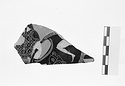
Wedding scene. At the left is the bride (mostly preserved from shoulders to knees), dressed in a himation, being led by the groom (right arm, his hand clasping her left ... Ca. 430-420 B.C ... Amsterdam inv. 3495 by the Sabouroff Painter (ARV2 841, 76); Toronto 929.22.3 = 635 by Polygnotos (ARV2 1031, 51; Addenda 317; Matheson, Polygnotos, p. 358, cat. no. P 56, pl. 56); once London Market by the Naples Painter (ARV2 1099, 46 bis), which seems closest to 100; Erlangen 301 near the Naples Painter (ARV2 1102, 3); two by the Washing Painter: Vienna 2027 (ARV2 1127, 11; Addenda 332) and Houston 37.12 (ARV2 1127, 13; Addenda 332; Reeder, Pandora, pp. 163--165, cat. no. 23). |
| Wall fragment depicts the left side of the torso and waist, the base of the neck, and the lower parts of the hair of female figure. Her left arm is seen through the interstices of the side of the Boeotian ... 22 May 1933 |
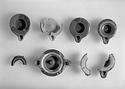
Mended from three pieces; part of the bottom, and most of the left side missing. Fragmentary.
Horizontal rim, with the wick hole projecting well into it.
Dull black glaze, on nozzle, rim, and inside. Thinned ... August-September 1932 |
Wall fragment. Max. dim. 0.10.
Nike (part of body and legs, wings) clad in a chiton, flying to left. Behind her, a woman (drapery) to left, and behind her, a bit of an object that may be a box; it looks ... Ca. 430-420 B.C ... Compare the composition of Nike and a woman on the loutrophoros-hydria in Houston, 37.12, by the Washing Painter (ARV2 1127, 13; Addenda 332; Reeder, Pandora, pp. 163--165, cat. no. 23). |
| ARV² 1128, 95. Fill. Floor. ARV² 1127, 11. Addenda 332. CVA, Tübingen 4 [Deutschland 52], pl. 5 [2522]:4-6. Böhr, CVA, pp. 22-23. ARV² 1147, 55. Addenda 335. Böhr, CVA, Tübingen 4 [Deutschland 52], p ... Agora 30 147 P 21452 P 5860 P 22207 P 27687 P 20202 P 22164 P 6672 P 22867 P 18287 P 17111 K 9-10:1 P 14:3 B 19:12 A 20-21:1 ... 420 B.C ... Addenda 332 ... Addenda 335 ... Addenda 367 |
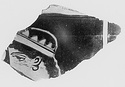
| Wall fragment broken all around; bell or calyx krater. Head of woman, left; lower part of face missing. Stephane; earring. In field, behind her, staff or spear. Relief contour.
Good glaze inside and ... 21 May 1940 |
| J.K. Anderson, Ancient Greek Horsemanship, Berkeley 1961, pp. 48-49, pls. 20-22. P. Vigneron, Le cheval dans l'antiquité gréco-romaine, Nancy 1968, p. 65, pls. 18, 20:c. ARV² 1127, 13. Addenda 332. Reeder, ... Agora 30 148 P 16575 P 5221 P 5236 P 24796 P 27346 P 24701 P 27335 P 27390 P 27351 N 10:1 S 16:1 I 13:2 ... 430-420 B.C ... Addenda 332 ... Addenda 339 ... Addenda 328 |
| Cup-Skyphoi. Stemless Cups. Lezzi-Hafter, Eretria-Maler, pp. 281-283. ARV² 76, 84. Paralip. 328, 84. Addenda 168. ARV² 77, 85. ARV² 1472, 2. ARV² 888, 151. ARV² 888, 152. ARV² 329, 133. ARV² 332, 34. Addenda ... Agora 30 66 ... Addenda 168 ... ARV² 332, 34 ... Addenda 217 |
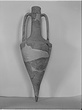
| Much mended. Handles unstamped. Long pointed base; tapering body; sharply profiled shoulder; long neck and handles; lip very lightly rolled.
Fine buff clay. Unglazed.
Cf. Hesperia 3 (1934), p. 332.
ADDENDA ... 1 June 1932 ... Hesperia 3 (1934), p. 332.
ADDENDA See also SS 370, SS 371, two amphorae with stamped handles, from same place. |
Handle and connecting part of body, in one piece. Small round handle, set vertically on the body of the jar.
Rather fine, dull red clay with small white bits; buff surface.
ADDENDA Presumably from a ... May-June 1951 |
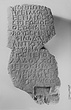
| Inscribed fragment.
Mended from two pieces; a fairly straight edge is preserved at the left side, which may be the left side of the stele; traces of rough picking in back; otherwise broken.
Fifteen lines ... 27 and 29 May 1933 |
| Put together from many fragments. Chips from the rim, larger ones from the foot, and interior gaps; both handles complete. Rim concave outside with distinct angle of offset inside. Canted handles. All ... June 1932 |
| Pyxides; Type B. ARV² 332, 35. ARV² 963, 98. ARV² 410, 63. Addenda 308. Addenda 233. ARV² 447, 275. ARV² 1094, 104. Paralip. 449, 104. Addenda 328. Buitron-Oliver, Douris, p. 85, cat. no. 240, pl. 112 ... Agora 30 52 ... ARV² 332, 35 ... Addenda 308 ... Addenda 233 |
Inscribed fragment.
Fragment from left side of stele, broken above and below.
Left side worked with toothed chisel, back roughly picked. Non-stoichedon.
Blue Hymettian marble.
ADDENDA With I 7199. Found ... 16 July 1970 |
| ARV² 208, 150. Kaempf-Dimitriadou, Liebe der Götter, p. 36, fig. 6. ARV² 560, 3. Fill. Addenda 259. ARV² 796, 117. Addenda 290. ARV² 798, 146. Kaempf-Dimitriadou, pl. 28:3. Matheson, Polygnotos, p. 373, ... Agora 30 145 P 14514 P 20034 P 16921 P 23214 P 18999 P 25348 P 25018 P 20682 A-B 21-22:1 R 10:6 ... 460-450 B.C ... Addenda 259 ... Addenda 290 ... Addenda 332 |
Inscribed fragment.
Broken all around except at front and right side.
Right side roughly smooth.
Blue Hymettian marble.
ADDENDA With I 7187. Found in late Roman context, along Panathenaic Way. Leica ... 16 July 1970 |
Most of the nozzles and much of the rim and wall missing.
Two-nozzled lamp with a rising tube in the middle. The broad flat rim has a shallow channel in it. Flat on under side. Ridged rim.
Black glaze ... 25 February 1938 |
Neck fragment with two rings between figures and ornament below. Glaze pitted and abraded in places. P.H. 0.125.
Two women (lower drapery, feet of each) facing, each wearing a chiton, the left holding ... Ca. 420 B.C ... For the combination of palmettes on one side of the neck and inverted rays on the other, see Vienna 2027 by the Washing Painter (ARV2 1127, 11; Addenda 332) and Tübingen S./10 1543 (CVA, Tübingen 4 [Deutschland 52], pl. 5 [2522]:4--6) attributed by Böhr (CVA, pp. 22--23) to the Painter of Louvre MN 558. 88 is contemporary with these but seems to be by another hand. |
| Mended from five pieces; the back part of the left side missing.
The rim hardly projecting at all on the outside, its outer edge simply set off from the body by a small groove.
Dull glaze with metallic ... August-September 1932 |
|
|
.png.icon.jpg)
.png.icon.jpg)
.png.icon.jpg)
.png.icon.jpg)
.png.icon.jpg)
.png.icon.jpg)