|
|
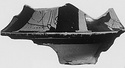
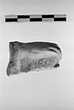
Inscribed fragment.
Relief shield separated by beveled moulding.
Pentelic marble.
Roman (?).
ADDENDA Votive shield urges identification as a dedication. Found in a wall of the modern house 631/23, east ... 18 May 1931 |
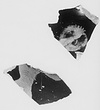
A piece each of neck, body, and handle. Fine pasty-white core. Floreate designs in green, blue, red.
ADDENDA Iznik, 1/2 XVII c. Much earlier than rest of group? JWH. Cistern. Leica, XXIV-43 ... 6 February 1936 ... Floreate designs in green, blue, red.
ADDENDA Iznik, 1/2 XVII c. |
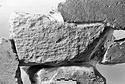
| Inscribed fragment.
Broken on all sides, excepting inscribed face.
Pentelic marble.
ADDENDA Joins with I 6233. Found in the wall of the modern house 645/2, west of the south end of the Stoa of Attalos ... 21 September 1934 |
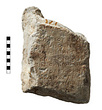
Inscribed fragment.
Inscribed face and back preserved.
Imperial letter (?).
Four lines of the inscription preserved.
Pentelic marble.
ADDENDA Joins to I 4083. Finished Found in late context, in front ... 28 January 1937 |
| Decoration in clay-colored paint; hand drawn with incision, as is also a curly tail below it. Inside of neck glazed.
Pink clay; heavy not very lustrous glaze.
ADDENDA Same vase as P 24017 (DvB 22/6/1988) ... 21 March 1932 |
Fragment of cul with start of handle at far right. Glaze much pitted. Max. dim. 0.087.
Chain of double lotuses and encircled palmettes.
For this pattern on the culs of other calyx-kraters, see 270 ... Ca. 450 B.C ... PEM 7, pl. 153); also on the necks of these volute kraters, only there and on Ferrara 2892 = T.300), the lines serve to separate long fronds from short petals: Ferrara 2739 = T.749 by the Boreas Painter (ARV2 536, 1; Paralip. 384, 1; Addenda 255; CVA, Ferrara 1 [Italia 37], pl. 5 [1649]:3); two by the Niobid Painter: Bologna 268 (ARV2 598, 1; Paralip. 394, 1; Addenda 265; Prange, Niobidenmaler, p. 180, cat. no. N 1) and Ferrara 2652 = T.740 (ARV2 599, 6; Paralip. 394, 6; Addenda 266; CVA, Ferrara 1, [Italia 37], pl. 7 [1651]:1; Prange, p. 181, cat. no. ... GN 62); and Ferrara 45685 = T.19 C VP by the Chicago Painter (ARV2 628, 1; Paralip. 399, 1; Addenda 272). |
Inscribed fragment.
Back surface smooth dressed, preserved; otherwise broken.
Imperial letter (?); mentions Herodes.
Eight lines of the inscription preserved.
Pentelic marble.
ADDENDA I 4457 joins. Finished ... 28 April 1936 |
Two joining pieces from a partly closed pot; glaze wash inside. Nude male figure moving right with extended arm. The inner marks are incised and the black glaze beneath shows in several places. No relief ... 26 May 1954 |
| Single fragment from lower part of tripod pyxis; much of one foot and about half of the flange preserved. Lower parts of two women (chiton, himation) one moving right and the other left; a column between ... 28 May 1952 ... Roberts (1978), p. 51, no. 22, pl. 25:1, fig. 5c ... Addenda, p. 303. |
Stem and about half rim and bowl and part of one handle missing. Slightly out-turned rim. Handles do not rise above rim.
Pinkish-buff clay.
ADDENDA Fragments in paper bag. Small Mycenaean tomb. 324 ... 14 May 1947 |
Four joining fragments preserve bridged spout and some adjacent rim and body of a large krater. Rim reserved, decorated with cross-strokes.
Glazed inside and out, mostly fired red.
ADDENDA Louterion ... 2 June 1953 |
Inscribed fragment.
Broken on all sides.
Three lines of the inscription preserved and traces of a fourth above; stoichedon.
Pentelic marble.
ADDENDA With EM 10235.
Transferred to the Epigraphical Museum ... 5th. century B.C. |
| Preserved up to lower part of bowl; base chipped. Low stem; hemispherical depression in underside of foot.
Buff clay. Covered with thin red wash.
ADDENDA Agora sample no. 342. Stone packing of grave ... 22 March 1954 |
Thirteen non-joining wall fragments with thin reddish wash on inside. Mended in antiquity (part of lead repair in b; hole in d). Glaze pitted and abraded here and there. P.H. a) 0.14; max. dim. a) 0.281, ... Ca. 440 B.C ... Ferrara 44894 = T.57 C VP, the youth leading the bull (ARV2 1143, 1; Paralip. 455, 1; Addenda 334; Matheson, Polygnotos, p. 406, cat. no. KL 1, pl. 125), Munich 2415, the middle youth on side B (ARV2 1143, 2; Paralip. 455, 2; Addenda 334; Matheson, p. 406, cat. no. ... Copenhagen, inv. 13817, or Florence 4006, a stamnos close to him that shows a youthful kitharode about to be crowned by two Nikai (ARV2 1062, ---, 1; Paralip. 446, 1; Addenda 323; Matheson, p. 449, cat. no. |
Fragment of flanged handle, the underside indicating the curved surface of the loop. Glaze blistered in a few places. Max. dim. 0.117. Schleiffenbaum, Volutenkrater, p. 324,cat. no. V 204.
On flange, ... Probably mid-5th century B.C ... For spirals on the flange, see Louvre G 166 (joining Louvre Cp 10799) by the Berlin Painter (ARV2 206, 129--130; Addenda 194) and three by the Niobid Painter: Bologna 268 (ARV2 598, 1; Paralip. 394, 1; Addenda 265; Prange, Niobidenmaler, p. 180, cat. no. N 1); Palermo G 1283 (ARV2 599, 2; Paralip. 394, 2; Addenda 266; Prange, p. 180, cat. no. ... For olive leaves on the back of the handle, see Naples 3240, the namepiece of the Pronomos Painter (ARV2 1336, 1; Paralip. 480, 1; Addenda 365). |
| Inscribed fragment; from a stele inscribed on two adjacent faces.
Inscribed face and possibly right side preserved.
Hymettian marble.
ADDENDA Part of the same inscription as I 431. This fragment joins ... Mid. 3rd. century B.C. |
Broken but almost complete. Ovoid body; massive base ring; trefoil mouth; handle round in section.
Thin black glaze inside and outside.
ADDENDA Laconian, JH/1967. Well, near middle of Tholos, POU. Leica ... 7 May 1938 |
| Inscribed fragment.
Small fragment of which the back and right side are preserved.
Surface only slightly marred.
Top, bottom and left side broken away.
Alliance between Boeotians and Athenians.
Ten lines ... 395 B.C. |
| Traces of white paint.
Grayish buff clay.
ADDENDA: Fragment from the waist of draped figure, holding cornucopia (?).
Much worn surface. Cistern, west chamber, lowest red deposit. Leica, XXXIV-87, 80-46-30 ... 17 March 1932 |
| Inscribed column drum.
The drum is one of a series which have been used in building the wall. Found stands upright in the tower.
Two dowel cuttings in the top. It was uncovered in the earlier excavations ... 17 January 1936 |
|
|