|
|
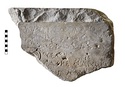
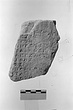
Under side smooth, upper side with figure of man marching to the right. Wall Trench I. 1334 ... 15 July 1937 ... Study Collections-Case No. 90-10 |
NM 16059
Flat bottom; continuous profile.
Black to brown glaze.
Others include Kerameikos V, 1, pl 139, inv. no. 356; C.V.A., Munich 3[9], 117[399], 7-8; C.V.A., Copenhagen 2[2], 70[71], 6; Thorikos ... LG IIB ... H 90 ... H 90 |
Head of female figure wrapped in mantle. Munsell (fabric) 2.5 YR 6/6 light red Oscar Broneer, Nb. No. 1. 103 ... 2 March 1932 ... AF 90 ... AF 90 |
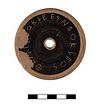
| Kylix base with black glaze. Some red lines. Inscribed on bottom. Chipped at rim but name is legible. Oscar Broneer, Nb. No. 4. 178 88-396 ... 31 May 1937 ... AO 90 ... AO 90 |
Bottom broken off. Unequal sides. Late type.
Incised on top: triangular shape (sketch on original ID card). After firing.
Glaze: black all over.
Clay: reddish, little mica. Assembly Place, filling ... 1931 ... PNW 90 ... PNW 90 |
Only the chest remains.
The upper part of a male torso, a broad strap passes diagonally
across it leading down from the right shoulder.
Clay: Gritty, ash grey inside, bug outside, faint traces of white ... Early fourth century B.C ... PNT 90 ... PNT 90 |
Slightly flaring walls. Winged creature (griffin?) left.
Battered rim fragment. No relief contour. Assembly Place, Filling of Period III ... 1931 ... PNP 90 ... PNP 90 |
Clay; fine, light buff, small bubble holes. East Sanctuary; Clearing North of Terrace Wall ... October 1932 ... PNAH 90 ... PNAH 90 |
| On rim, wavy lines.
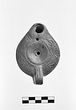
Plain discus, with central filling hole. Handle, solid, triple grooved.
On bottom, double concentric grooves.
Brown glaze.
Red clay.
Type XXVIII of Corinth collection.
ADDENDA For ... 18 June 1931 ... L 90 ... L 90 |
Slightly rising; broad, widening to neck.
Coarse yellowish-red clay, greyish toward core; traces of light slip.
Impression set obliquely, incomplete upper left and corner lower right. Ἐπὶ Ἀσκληπιο[δ]ώ ... 26 June 1931 ... SS 90 ... SS 90 |
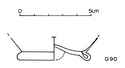
| Ring foot and start of flaring side wall preserved.
Greenish blue glass. Green sand, drain fill. Found with P 9057 and L 2748.
Early Roman to 2nd c. A.D. Leica PD 2815-1 ... 23 February 1937 ... G 90 ... G 90 |
A rosette and a disk.
Rosette of the larger size, practically complete.
Pierced for attachment.
Plain disk slightly broken.
Single piercing. Finished Mycenaean chamber tomb, general dump.
Cf. J 46. Stoa ... 19 June 1939 ... J 90 ... J 90 |
Fragment from left side of head of cock figurine.
Front (beak, etc. ) broken away.
Fluted comb indicated over large eye; start of beak set off from head by double groove; neck feathers faintly indicated ... 13 February 1932 ... T 90 ... T 90 |
Wall fragment from lower part. P.H. 0.209; P.W. 0.155.
Warriors (part of legs of each): lower part of short chiton and round shield (seen in three-quarter view) of left, part of chlamys of right, who ... Ca. 400 B.C ... Preliminary sketch.
90 is best compared with the large loutrophoros Athens (ex Schliemann)--Berlin 3209, published by G. ... It, like 90, represents the departure of a warrior for battle. |
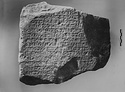
| Fragment from left side of inscribed stele.
Side, fine picked, and back rough picked, preserved; other edges broken.
Decree of club or religious organization (?).
Part of sixteen lines of the inscription ... Late 2nd. or 1st. centuries B.C ... Ι 90 |
| Upper right corner of large inscribed base; grave monument.
Top uneven but smooth. Moulding at upper edge broken away.
Letters shallow cut.
Part of six lines of the inscription preserved.
Pentelic marble ... Second half of 4th. century B.C ... Ζ 90 |
| Inscribed fragment.
A bit of the top, picked fairly fine preserved; otherwise broken all around.
The surface much weathered.
"POLEITAI" account.
Eleven lines of the inscription preserved.
Pentelic marble ... 8 May 1934 ... ΑΡ 90 |
Inscribed fragment.
Broken on all sides.
The inscribed surface convex.
Five and a half letters remain.
Hymettian marble. Found in late context, south of the New Bouleuterion. Leica ... 3 February 1934 ... Β 90 |
Inscribed large piece from top of columnar grave monument.
Mended from two pieces.
Top surface, and more than half of the circumference preserved, with the full width of the inscription.
Below convex band, ... 11 February 1932 ... Ε 90 |
Fragment from left side (?) of inscription.
Back rough picked.
Otherwise only inscribed surface preserved, which however gives the left margin of inscription. The third line is apparently a later interpolation ... 2nd. century A.D ... Δ 90 |
|
|