|
|
| Retrograde.
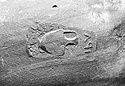
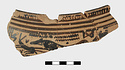
Early Thasian. Finished Bronze-casting workshop, red fill; 4th century B.C. Ἡρακ̣[ | Ἀρ]ιστ̣ο̣[---] (retr)
vaseVI Leica ... 19 April 1956 ... Bronze-casting workshop, red fill; 4th century B.C. |
| Retrograde.
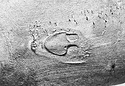
Early Thasian. Finished Bronze-casting workshop, red fill; 4th century B.C. Ἡρ[ακ | Ἀ]ρ̣ι̣σ̣[το] (retr)
vaseVI Leica ... 19 April 1956 ... Bronze-casting workshop, red fill; 4th century B.C. |
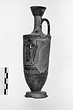
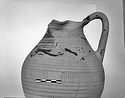
Neck and handle broken; repaired. Three palmettes, a loop of black glaze over each one, and half another beyond, on each side. On shoulder, rays.
Cf. P 10342.
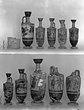
ADDENDA From a workshop imitating the Beldam ... 24 March 1936 ... ADDENDA From a workshop imitating the Beldam workshop, conceivably the same as P 10325. |
Lump of waste material containing corroded bronze, charcoal, earth pebbles. Catalogued 5 May 1973 Debris layer over floor of apsidal workshop. Lot Λ 198a. 1218 Leica ... 9 June 1936 ... Debris layer over floor of apsidal workshop. Lot Λ 198a. |
A marble brick, probably for use as a weight.
A few chips missing from edges but essentially intact. Upper layer debris in workshop; 4th. century A.D. context. 1288, 1292 Leica ... 9 June 1936 ... Upper layer debris in workshop; 4th. century A.D. context. |
Repaired; rim and part of sides missing. Surface badly gone. Quadriga.
ADDENDA Workshop of the Haimon Painter, as P 10327. Cf. also P 10342. Burned pit, pyre 8. Leica, 6-170 ... 24 March 1936 ... ADDENDA Workshop of the Haimon Painter, as P 10327. |
Mended from two pieces, preserving part of plain vertical rim and shallow sloping bowl.
Coarse red crumbly clay vitrified to dull bubbly black on interior.
Cf. B 1506 Catalogued 5 May 1973 Bronze casting ... 9 June 1936 ... Bronze casting workshop. |
Fragment of rim.
Very slightly incurved rim. Spearhead necklace with thick, dotted band, εὔνο̣[ιας⟧ above. Shiny black glaze outside; inside unglazed, with miltos.
Possibly from workshop of Dikeras and ... 290-260? ... Possibly from workshop of Dikeras and Edwards Groups.
|
| Broken all around.
Curving flat surface below straight flat surface.
Fine pinkish buff clay, black inside; traces of bronze.
Mold for part of lock or similar fixture (?) Catalogued 7 May 1973 Bronze casting ... 9 June 1936 ... Bronze casting workshop. Lot Λ 199b. |
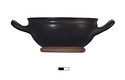
| Fragment of shallow bowl.
Mended from two pieces. Preserves part of vertical rim.
Slight inward slope, flat bottom.
Coarse red crumbly clay vitrified to dull bubbly black on interior.
Cf. B 1507. Catalogued ... 9 June 1936 ... Bronze casting workshop. |
Repaired. Part of foot and sides missing. No ornament discerned, except glazed lip, rays on shoulder, stripe just below shoulder.
ADDENDA Probably from the workshop of the Diosphos Painter. [E. Haspels] ... 24 March 1936 ... ADDENDA Probably from the workshop of the Diosphos Painter. |
About one-fourth of foot.
Foot: variety 1, with no scraped groove; continuous curve from edge of foot to underside; no wear on resting surface. Medallion: gorgoneion surrounded by small pointed ribbed ... 225-175 ... Metallic black glaze.
Workshop of Bion. |
| Two joining fragments.
For small circular object with projecting knob which was concave on top. A lid (?)
Thin gritty red clay on outside, heavy metal deposit on inside. Workshop. 4th c. A.D. Lot Λ 199b ... 9 June 1936 ... Workshop. 4th c. A.D. |
Most of foot and floor preserved. Low foot, a groove in the resting surface. Impressed decoration: eight linked palmettes surrounded by rouletting.
Pinkish-buff clay; completely glazed except reserved ... 8 April-16 May 1936 ... Corbett, Workshop A, Group II, no. 16. |
Single fragment of wall with lower handle attachment.
Subangular wall. Painted vertical ribbon or tie at left of handle attachment. Shiny black glaze outside, inside unglazed; miltos in scraped groove ... 275-260 ... Possibly from workshop of Dikeras and Edwards Groups.
|
Single rim fragment.
Rim very slightly outturned, with two scraped grooves. Part of one panel of checkerboard and one panel of concentric rectangles.
Shiny black glaze outside; inside unglazed, with ... 260-250 ... Possibly from workshop of Dikeras and Edwards Groups.
|
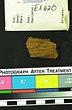
| Corner of mold for small rectangular object.
Note the raised bar in center, which ould look like a large indented Iota on the positive.
Thin yellow to red fabric.
Sherds from same fill in Box 200 C. Workshop ... 9 June 1936 ... Workshop. Burnt layers above casting pit. |
Part of foot and floor preserved. High foot, a groove in the resting surface. Impressed decoration: linked palmettes surrounded by rouletting.
Pinkish-buff clay; completely glazed except scratched line ... 8 April-16 May 1936 ... Corbett, Workshop A, Group I, no. 11. |
Surface badly worn; much of glaze gone. Three seated draped figures. The central one sits right and plays the lyre. The other two face him. Background, ivy spray.
Above picture, maeander. On shoulder, ... 23 March 1936 ... ADDENDA From the workshop of the Haimon painter, and quite likely a careless piece by his hand. For this kind, see the Stadium Street grave with the Douris aryballos (Delt. 1927-28, p. 91, fig. 1): all lekythoi from his workshop, several certainly his, and the rest too careless to attribute, but conceivably his too. |
Foot and most of floor preserved. Low foot, a groove in the resting surface. Within, eight impressed palmettes surrounded by rouletting.
Pinkish-buff clay; completely glazed except reserved groove in ... 8 April-16 May 1936 ... Corbett, Workshop A, Group II, no. 17.
|
| Upper part of shaft of an Attic gravestone, broken at bottom, front reworked with coarser pick. Top edge broken away in back diagonally from corner to dowel hole in top.
Reused as threshold block. Two ... 3rd quarter of 6th c. B.C ... West Basement-West Wall, by the workshop door |
One-third of rim and floor restored.
Beveled resting surface; convex underside. Thin-walled plate with sloping, convex floor. Scraped groove around depression and edge of floor. Dull glaze, mottled greenish ... 275-250 ... P 7703, from same deposit, is also small, probably from same workshop.
Similar to 723, except for treatment of depression. |
| Repaired; bits missing. Three maenads, ivy spray in background. Above, maeander. On shoulder, rays. White for flesh. Red for folds and fillets.
Cf. P 10326 and P 10327 (workshop of the Haimon Painter) ... 23 March 1936 ... P 10326 and P 10327 (workshop of the Haimon Painter). |
| More than half preserved, with both handles.
Spreading ring foot, concave lip. Reserved: underside of foot, except for circle and central dot, outside of foot, inner part of handles and handle panels ... 6 July 1995 ... Very similar to P 32481, same workshop? |
About one-sixth of circumference of rim, with flange and part of upper body; lip missing.
Flange projects nearly horizontally. On outer edge of flange, orange crosses. On upper body, traces of fine garland ... 275-260 ... Possibly from workshop of Dikeras and Edwards Groups. |
Repaired. Parts missing include piece of lip. Center, reclining banqueter with lyre player. From left and right, two ride up on mules. Rays on shoulder. White for lyre, flesh of player, and various ornaments ... 24 March 1936 ... ADDENDA Workshop of the Haimon Painter, as P 10327. |
Wall fragment, ridge along break on exterior; probably from a stemless cup. Interior, part of border around medallion only; wave pattern in black on reserved ground. Exterior, lower part of draped figure ... (1956) ... For the wave pattern, cf. the coarse stemless cups from the workshop of the Jena Painter. |
Part of foot, floor and wall preserved. High foot, a shallow groove in the resting surface. Within, impressed palmettes surrounded by rouletting.
Pinkish-buff clay; completely glazed except reserved ... March 1939 ... Corbett, Workshop A, group III, #4. |
One-eighth of flange, one-tenth of rim, and trace of upper wall.
Flange projects outward and upward. Orange crosses and white dots on outer edge. Traces of orange spirals on wall. Shiny black glaze.
... 275-260 ... Possibly from workshop of Dikeras and Edwards Groups.
|
Five nonjoining sections: part of rim (a, b), wall (c, d), and one moldmade shell foot (e).
Below rim, delicate grapevine running right. Shiny black glaze outside, inside unglazed with traces of miltos; ... 285-275 ... Possibly from workshop of Dikeras and Edwards Groups.
|
Floor fragment with start of stem. Glaze fired reddish brown. Max. dim. 0.092; est. inner diam. of tondo 0.08.
I, two youths (back of left, feet of both missing) facing, each wrapped in a himation, the ... Ca. 450-440 B.C ... Reserved ground line on outside.
Workshop of the Penthesilea Painter: Undetermined (ARV2 966, 21). |
Lid missing.
Flat bottom, slightly concave at center. Concave wall with concave moulding at base. Vertical flange for lid. Reserved: underside, horizontal top of wall and outer face of rim.
From the ... Ca. 430 B.C ... From the same workshop, P 3915 K 14:1. |
Fragment of a flat-bottomed clay mold for shaft and triangular head of a bronze pin (?)
Soft yellow clay.
The mold was apparently made in two parts for the top edges seem to be original. Fragment of somewhat ... 9 June 1936 ... Workshop. 4th c. A.D. |
| Two mended fragments. Part of rim pattern and upper wall preserved.
Rim pattern (top to bottom) running spiral; beading, ridge, guilloche, beading; ridge. Wall: wreath tied at top with ribbons hanging ... May 1947 ... Agora XXII, no. 104 (P 18662) workshop of Bion. |
Most of foot and floor preserved. High foot, a groove in the resting surface. Impressed decoration; seven linked palmettes surrounded by rouletting. Only three normal palmettes.
Pinkish-buff clay; completely ... 8 April-16 May 1936 ... Corbett, Workshop A, Group I, no. 12. |
Intact.
Flat bottom and slightly convex lower body. Inside all glazed except for a reserved dot at center of floor and three bands below lip.
Black to brown glaze.
Cf. Kerameikos V, 1, pl. 98, inv ... LG I ... The shape was invented in the Dipylon Workshop but died out in L.G. |
Center of floor and part of foot and wall missing; warped.
Broad, angular foot, flaring but irregular; outwardly beveled resting surface. Slight angle at top of wall; faint rippling on wall. Rim slightly ... Saucers and bowls with exterior rippling: 745, 746, 751, 757, 1098, P 28625 (P 21:4), probably all from same workshop. Similar shape: P 7214. |
Part of foot, floor, and wall preserved. Low foot, a groove in the resting surface. Impressed decoration: eight linked palmettes surrounded by rouletting.
Pinkish-buff clay; completely glazed except ... 8 April-16 May 1936 ... Corbett, Workshop A, Group III, no. 18.
|
One handle and one-fourth of body missing.
Small foot; flat resting surface; nippled underside. Low, wide, slightly flaring neck set off from body by glazed groove. Rim inclined above molding, which is ... Ca. 150 ... Δελτ 21, 1966, B1 1 [1968], p. 80, pl. 84:α, found in workshop debris on Otho Street. |
Fragment of upper wall.
Olive garland running right. Below it, Ἀφ[ροδίτης⟧ and spearhead necklace with row of dots along top of thin band, dots at tops of spears. Single tie at end. Lustrous black glaze ... 285-275 ... Possibly from workshop of Dikeras and Edwards Groups.
|
| One section, broken at end, mended from four pieces.
Rectangular terracotta brick, made of coarse powdery red clay.
Horizontal curve, heavily vitrified on interior surface.
Two preserved edges are smooth; ... 8 June 1936 ... Casting workshop. Lot Λ 201a and Lot Λ 199c. |
Handle missing.
Torus ring foot with concave moulding beneath; nipple on underside. Horizontal handle at top of lip. Reserved: resting surface and underside with two glazed circles.
Same workshop, P ... 375-350 B.C ... Same workshop, P 6378 D 15:3, foot not preserved, and P 14642 E 2:3. |
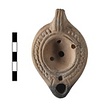
| Complete. Burnt at nozzle.
Concave disk, plain, with three asymmetrical holes around central air hole; framing band. Herringbone on rim. Sides of nozzle grooved with additional hole behind nozzle. Solid ... First half of 5th c. A.D ... Soteria workshop. First half of 5th c. |
Part of the large carefully made base for a black figured skyphos, probably from the White Heron (Theseus painter) workshop. Broadly projecting foot with convex profile (as e.g. CVA Robinson, fasc. 3, ... May-June 1954 ... Part of the large carefully made base for a black figured skyphos, probably from the White Heron (Theseus painter) workshop. Broadly projecting foot with convex profile (as e.g. |
Roof-tile fabric, light brownish buff in color and full of red and brown inclusions.
Disk: bull with filleted horns to left, and two framing rings; paneled rim: 8-S pattern. Bottom, within circle: ΕΥΤ- ... 4th c. A.D ... Perlzweig 912; for the signature, Agora VII, pp. 34-37, a prolific workshop of the late 3rd- early 4th c. |
Preserved except for mouth, most of neck, and handle. Thin, reddish brown glaze on inside. P.H. 0.065; diam. 0.057. Choes and Anthesteria, p. 87, cat. no. 211, fig. 67.
Child crawing toward a wreathed ... Ca. 420-410 B.C ... Assigned by Green to the Crawling Boy Workshop: the Class of London E 535 (BSA 66, 1971, p. 218, no. 2). |
Two joining fragments of one end of heavy mould. On the inside a smooth curved surface for a round-bottomed bowl (?)
Heavy yellow fabric. Larger fragment blackened on outside.
At the end or side, about ... 9 June 1936 ... Workshop. 4th c. A.D. |
Flat bottom; beveled rim. Light grayish buff clay with black bits.
Found set into the ground, the rim flush with the floor, an arrangement which recalls that found in bathing establishments where basins ... Context 4th c. B.C ... Ginouvès, pl. 7, 20-21; pl. 30, 98; pl. 35, 114; the same arrangement is found in workshop equipment of various periods, cf. e.g. |
Shoulder And Neck.
Lower part of neck and part of upper shoulder.
Slightly convex shoulder, smooth transition to neck. Decoration in brown glaze: band at base of neck; four swags wrapped with fillets ... Context of 1st century after Christ (no lot) ... Nearly identical and probably from the same workshop: Δελτ 20, 1965, B1 1 [1967], p. 32, pl. 33:β, upper right (Athens). |
| Mended from 12 pieces.
Preserves part of rim, neck and top of shoulder.
Sloping shoulder, neck inclined inwards horizontal ridged, with small hole 1/3 away from shoulder; handles missing.
Vertical rim ... 9 June 1936 ... Apse of bronze workshop. Lot Λ 198b. |
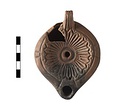
| Nearly complete. Mended from seven fragments. Missing fragment near handle and under nozzle. Burnt at nozzle.
Disk: ring, rays framed by dots; framing ring. Rim: plain with two incised panels. Nozzle defined ... 4th c. A.D ... Στρατόλαος workshop.
Reddish-orange fabric; thin, reddish-brown glaze. 4th c. |
The top of the head, with the eyes and part of the left side preserved.
Bushy brows; rolled wreath.
Traces of white and red.
Light buff clay.
ADDENDA Cf. Hesperia 20 (1951), pp. 249, 268.
Cf. Dimitrakopoulou ... 1939, 1947 ... Koukla factory fill; fill proper, and fill of terrace to west; debris from a workshop for making figurines (C 20:2), for the most part of the 3rd. and 2nd. centuries. |
Lid, about half preserved, including start of knob. Unglazed and smooth on underside, except for two circles. Incurving rim. P.H. 0.028; est. diam. 0.17. Roberts, Pyxis, p. 51, cat. no. 23, pl. 32:2.
... Ca. 460 B.C ... Assigned by Roberts (pp. 57--58) to the Penthesilea Workshop. |
Foot and mouth missing, mended from several pieces. Slight shoulder flare.
White ground. Shoulder: two circles of rays. Body: above, running maeander to right, band of three-deep check pattern, three ... 9 May 1951 ... ADDENDA Probably Beldam workshop.
Cf. P 10325. |
Foot, handle, and wall fragments missing; mended from several pieces. Narrow tapering cylinder, definite shoulder flare.
White ground. On shoulder, bars and rays. Body decoration almost entirely disappeared; ... 9 May 1951 ... ADDENDA Beldam workshop type; Haspels (1936), p. 186; for an example cf. |
Mended from 18 pieces, preserving much of neck and top of sloping shoulder.
Coarse red clay with incisions, badly cracked.
Lower part of inward-sloping to vertical neck covered with whitish accretion; ... 9 June 1936 ... Apse of bronze casting workshop. Lot Λ 198b. |
Convex top, raised ring at base of stem. Conical depres- sion in center of knob. Reserved: resting surface, zone at base of stem, in which is a zone of rays bordered at either end by a circle of glaze, ... 575-550 B.C ... A larger but very fragmentary lid from the same workshop is P 13830 U 25:2-M. |
Ring foot. Rim flanged to receive lid; strap handles. Glaze badly peeled.
From the same deposit and workshop, a twin, P 14152, von Bothmer, loc. cit.; similar, P 24173 Q 15:2. For a neck fragment of somewhat ... Late 5th c. B.C ... From the same deposit and workshop, a twin, P 14152, von Bothmer, loc. cit.; similar, P 24173 Q 15:2. |
| Fragmentary; strengthened with plaster. In black figured technique, draped female holding out flower(?) between two draped youths leaning on staves. Above, double dotted line. On shoulder, rays, and palmettes; ... 23 March 1936 ... On the grave as a whole: Diosphos painter, workshop of Haimon painter, and connected with the Emporion painter; they range from 480-470. |
Floor, most of foot, and fragment of wall preserved. High foot, a groove in the resting surface and a scraped line at the junction of the foot and bowl. Within, eight impressed palmettes surrounded by ... 8 April-16 May 1936 ... Corbett, Workshop A, Group I, no. 10. |
Foot, floor and part of wall preserved. Traces of handle attachment. Moulded foot, a groove in the resting surface. Impressed decoration: seven linked palmettes surrounded by rouletting.
Pinkish-buff ... 8 April-16 May 1936 ... Corbett, Workshop A, Group I, no. 15.
|
Foot, one handle and top of the other, three-fourths of rim, one-third of upper body, and small parts of lower body restored.
High stem. Pointed lower body, ribbed. Two pairs of antithetical dolphins, ... 275-260 ... Probably from workshop of Dikeras and Edwards Groups.
|
Wall fragment with start of shoulder. Max. dim. 0.09.
Youth at tomb. The youth (face, right shoulder, legs, and feet missing) dressed in a himation, faces to left, his right arm extended. Behind him, ... Second quarter of the 5th century B.C ... The stele belongs to Nakayama's Group B-I (Nakayama, Lekythen, p. 263).
Workshop and manner of the Tymbos Painter (ARV1 507, 19; ARV2 760, 28). |
Three-fourths of rim and center of depression missing.
Grooved resting surface. Very sloping, nearly straight floor. Deep scraped groove and ridge around depression, scraped groove around edge of floor ... Ca. 225? ... Glaze similar to that of 725 and P 11446 (E 5:2, lower fill), possibly all from one workshop. |
Floor fragment. Glaze much abraded on outside. Max. dim. 0.055; est. inner diam. of tondo 0.09.
I (illustrated), two men or youths (feet, himation fold of one; a bit of the feet and drapery of the other) ... Ca. 450-440 B.C ... Below, reserved line.
Workshop of the Penthesilea Painter: Undetermined (ARV2 966, 27). |
Flat bottom; shallow convex body; offset rim, tilted outward. Outside: bands and zigzags. Inside : procession of birds and horses to right (five horses and one bird partially preserved); in field, double ... LG IIB ... Schweitzer, Die geometrische Kunst Griechenlands, Koln, 1969, p. 324, note 67.
See Workshop of Athens 894: cf. |
Part of wall and shoulder, to base of neck, with trace of handle attachment on shoulder.
Pinecone moldmade wall, with scraped groove at top. Scraped groove at base of neck. Shoulder: ivy garland running ... Ca. 200 ... Similar garland in same position on P 17864 (Agora XXII, no. 406, p. 92, pls. 69, 89 [M 21:1]) and P 26257 (floral, probably from Workshop A [M 18:10]). |
About one-sixth of rim, small part of upper moldmade body, and one handle preserved. Made in fairly fresh mold.
Groove on inside of rim glazed. Flying Erotes carrying wreaths flank ribbed kraters, with ... 225-175 ... Almost certainly Attic, probably from Workshop A.
For Erotes cf. |
Stamped Plate.
About half of foot and floor preserved.
Deep plate or shallow bowl. Angular ring foot; beveled resting surface; slightly pointed underside. Two radiating palmette stamps (probably originally ... Context of 50 B.C. to A.D. 50 ... The occurrence of two pieces clearly from the same workshop leaves open the possibility that they are Attic, but the fabric and glaze do not appear to be local. |
Bowl fragment. Max. dim. 0.08.
I, a little of the reserved line at the outer border of the tondo. A, (illustrated) ends of two fronds of an encircled palmette, tendril, and hanging lotus from the handle ... Ca. 450 B.C ... Dilute glaze: muscles.
Workshop of the Penthesilea Painter: Undetermined (ARV2 967, 31). |
Lip and center of bowl missing.
Horizontal ribbing on bowl. Lip black; bowl intentional red.
The drawn profile of this phiale has been assisted by reference to P 23118 H 12:15-S, a similar ribbed phiale ... Ca. 500 B.C ... A pair of phialai found in Grave 30 at Olbia is from the same workshop: Leningrad OL 3993-4, Arch. |
Body fragment, unglazed on inside except for splash. P.H. 0.056; P.W. 0.073. Choes and Anthesteria, p. 84, cat. no. 190, fig. 384.
Small girl in a chiton walking to left, looking up, holding out her chiton ... Ca. 400 B.C ... Assigned by Green to the Crawling Boy Workshop: the Class of the Sydney Choes (BSA 66, 1971, p. 215, no. 8). |
Small Plate With Projecting Rim: Rome Or Etruria.
Fragments of rim missing.
Angular ring foot; beveled resting surface; flat underside. Broad, projecting rim, curving down at edge and undercut on inside ... Context of ca. 275-210 ... For plates of similar size and shape see Morel 1965, no. 127, pp. 72--73, pls. 10, 47; Morel 1969, p. 84, fig. 14 = Morel 1981, Type 1323b, p. 106, pl. 14 (dated by Morel between 305 and 265), from the workshop of the Petites Estampilles, an atelier perhaps located in Rome and dating from the late 4th to the mid-3rd century. The decoration on 1643, however, is not typical of this workshop, which favors parallel rather than radiating stamps. |
Small portion of wall, rim, and foot; center of floor missing.
Slightly flaring foot; flat resting surface. Angle near top of wall.
Slightly downturned, rilled rim with two scraped grooves. Broad scraped ... Ca. 275 ... Probably from same workshop as 822 and CVA, Brussels 3 [Belgium 3], pl. 3 [138]:13; possibly also Patsiada 1990, no. 177, p. 191, pl. 76:α and Vierneisel 1964, col. 456, fig. 50 in col. 460. |
Deep basin on disc base; squared rim; round hole neatly cut through center of the floor. Pinkish buff clay with grits; remains of light buff surfacing.
Others similar, as large or larger and with squared ... Context ca. 425-400 B.C ... From a workshop in the industrial area west of the Areopagus; late 5th or early 4th century.
|
Half of rim restored; handles missing.
Broad, flat resting surface, with scraped groove; conical underside with nipple; top of upper foot molding concave. Tapering stem. Scraped groove at junction of ... 300-275 ... Probably by same potter: 75--78, 85, 138 (workshop of Dikeras and Edwards Groups). |
Small parts of body restored.
Scraped groove in resting surface; conical underside,nippled.
Broad, pointed body. Top of rim inwardly beveled. Bolsters have two vertical grooves at center; ends pierced ... 300-280 ... Details of decoration suggest possible workshop connection to 311 and 313.
|
Part of shoulder, moldmade body, and handle attachment.
Small jug? Three ridges at top of moldmade section. Scraped groove at base of steep shoulder. Attachment for strap handle preserved on shoulder ... 200-175 ... Shiny black glaze outside, reddish brown inside.
Workshop A.
For Erotes cf. |
Cup Or Jug.
Fragment of shoulder and lower rim.
Low, rounded shoulder. Rim convex to outside, with groove at base.
Moldmade body: tops of small imbricate petals or leaves visible.
Rim pattern: jeweling ... Context of first half of 1st century ... Italian moldmade cups of the workshop of Sarius, from North Italy, dating in the first quarter of the 1st century after Christ (Dallemulle 1975, nos. 2--5, 7, pp. 279--282, figs. 6--8, pls. |
Handles, and knob of lid missing.
Flaring ring foot; deep broad bowl. Flange for lid; high lid. Four pairs of added red lines on lid outside, three pairs inside lid, three pairs inside bowl, single broad ... Ca. 575 B.C ... A similar lid from the same deposit, P 24977, is from the same workshop. The knob is missing, but the broken edge shows that the conical depression in the knob was very deep. |
| Rim fragment of shallow dinos with portion of shoulder; broken at sides, glaze chipped and slightly pitted on exterior. Mended from three fragments.
Short vertical rim with flat top, slight ridge at lip ... Late 8th or early 7th c. B.C ... In the manner of the Workshop of Athens 894 or 897.
|
| Fragments of mouth missing, otherwise intact. Flat bottom; deep ovoid body; trefoil mouth; rising double-rolled handle.
On shoulder, three running dogs, right, pursuing a hare. Zigzag and double axe as ... 8 December 1953 ... Cf. for similar dogs (and rabbit): oinochoe Athens 18444 (BSA 35 (1934-1935), pl. 25:4); ascribed by Cook to Workshop of Athens 897 (BSA 42 (1947), p. 146, n. 2). |
Foot and handles restored.
Scraped groove below handle attachments. Delicate molded rim.
Three dolphins (antithetical pair at right, one leaping right at left) over pattern of alternating hoops and ... 290-280 ... Possibly from workshop of Dikeras and Edwards Groups.
|
Lower body and less than half of foot preserved.
Foot: variety 1. Medallion: double rosette with four petals inside, eight outside, within two ridges, surrounded by palmettes.
Wall divided into four ... 225-200 ... Dull black glaze, red and mostly missing inside and underneath.
Workshop A.
From same mold as P 10877 (Agora XXII, no. 189, p. 67, pl. 35 [D 11:4, lower fill]). |
Handle missing.
Flaring foot, concave beneath. Reserved: the upper part of the body and a band at the greatest circumference. Added red: a broad band in the reserved band, a band at the edge of the foot, ... 575-550 B.C ... Two closely similar jugs have been found outside Athens and are doubtless from the same workshop: Rhodes 6595, from Ialysos: Cl. |
Disc-shaped foot; flat resting surface rising at the center to a nipple. Neck inset from shoulder. Reserved: under foot and edge of foot, neck and adjoining part of handle, inner face of shoulder with ... Ca. 500 B.C ... Besides 1115 and 1116, there were four similar catalogued from the same deposit, P 24549-50, P 24553-4, and others uncatalogued, and those from the Rectangular Rockcut Shaft are from the same workshop and of the same date, P 1291-2, P 1402, P 16782 G 6:3-U Hesperia, XV, 1946, pl. 65, 260-263; ABV 515, 4-6 and 3. |
Three-fourths of rim and half of body restored; one handle and most of the other missing.
Scraped groove in resting surface; concave underside. High, thin stem. Pointed body with groove or offset at base ... 300-285 ... For closely similar hoop and sprout pattern, see 32, 84, 71 (all probably from the same workshop), and 407. For groove at base of body see 134--136, 138; for scraped groove below handle attachment see 136. |
Over half restored; full profile preserved. Nonjoining rim fragments are not correctly positioned in restoration.
Flat resting surface; strongly nippled underside. No stem.
Deep skyphos-shaped body ... 275-260 ... Possibly from workshop of Dikeras and Edwards Groups.
|
Three-fourths of foot and over half of lower body preserved; foot partially restored.
Foot: variety 3, with worn resting surface. Made in worn mold. Medallion: rosette(?) within ridge. Calyx, below beaded ... Ca. 175 ... Dull glaze, greenish gray to ocher.
Workshop A.
For hunter and boar cf. |
About half of body restored; full profile preserved.
Shape as 161. Scraped groove below handle attachments and glazed groove below rim delineate decorative zone. A: central cornucopia, with bunch of grapes ... 275-260 ... Possibly from workshop of Dikeras and Edwards Groups.
|
Floor fragment with start of stem. Glaze misfired bluish in places.
Max. dim. 0.083; est. outer diam. of tondo 0.11.
I (illustrated), two youths (forehead, lower legs, and feet of one missing; head, ... Ca. 430-420 B.C ... But 1474 looks slightly later than the work by the painters of the Penthesilea Workshop. |
Shoulder fragment with thin, brown wash on inside near bottom. Max. dim. 0.043. Choes and Anthesteria, p. 80, cat. no. 170, fig. 287.
Youth (filleted head, much of torso, start of left arm, right hand) ... Ca. 425-400 B.C ... For well-preserved examples, see Baltimore, Johns Hopkins G 3730 by Douris (ARV2 445, 251, Addenda 241; Buitron-Oliver, Douris, p. 85, cat. no. 239, pl. 111), Brussels A 891 from the workshop of Sotades (ARV2 771, 2; Addenda 287), and Tübingen S./10 814 = E 78, formerly attributed to the Painter of London E 777 (ARV1 463, 5; not in ARV2; CVA, Tübingen 5 [Deutschland 54], pl. 41 [2658]:4, 6, 7). |
Wall and rim fragments.
Open pot, deep but narrow in proportion. Slightly pro- jecting rim flat on top; horizontal rolled handles well down on wall, projecting boss beside handle-attachment. Coarse heavy ... Context ca. 375-350 B.C ... Wherever it was made, the special shape and very heavy walls suggest it might have been intended to serve some workshop or industrial use. |
Wall fragment. Max. dim. 0.042.
Eros (head, body from the waist up, bows of wings missing) flying to right toward a woman (a bit of hair, right side of body with decorated garment) who probably stands ... Ca. 400 B.C ... If 1662 is from an acorn lekythos, as suggested above (p. 76), this might strengthen the attribution, since the largest number of attributed examples come from the Meidias Painter's workshop. |
One handle, three-fourths of wall, half of neck, and three-fourths of rim restored; masks at bases of handles missing.
Foot: variety 2. Downturned rim with one glazed and one scraped groove below. Medallion ... Ca. 175 ... Probably Workshop of Bion.
For calyx cf. |
Fragment of trefoil mouth, handle, neck, and start of body. Mended and strengthened with plaster. A small non-joining fragment with thin, streaky glaze on the inside also belongs. P.H. a) 0.12; Max. dim ... Ca. 470-460 B.C ... Relief contour.
Workshop of the Tarquinia Painter [Green]. |
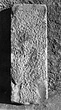
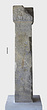
| Inscribed stele with relief.
Upper front right corner broken away and surface somewhat worn and flaked, but otherwise complete.
Tall stele with cavetto capital the face of which has a sculpted relief with ... 26 May 1972 ... Relief is a scene in a Cobbler's workshop: four men sit on chairs with curved legs, working on shoes. |
Several nonjoining sections, preserving one-fourth of rim, a few fragments of upper wall, one handle and half of the other; partially restored. Made in very fresh mold.
Scraped groove and ridge at top ... 225-200 ... Probably from Workshop A.
Theseus, probably from same stamp, occurs on fragments of two more kraters (P 19449, P 21042 [H--K 12--14]), on a moldmade amphora (455), and on moldmade bowls (e.g. |
P 23403 a, b, c
Over half of rim and one-third of lower body (a), plus two large, nonjoining rim fragments (b, c, not illustrated), with fragment b preserving trace of handle. Made in fairly worn mold ... 200-175 ... Possibly part of same pot: P 23641.
Workshop A.
For wheat cf. 372. |
Three non-joining fragments, a with part of trefoil mouth, ridged handle, neck, and shoulder; b and c of wall. Some of the glaze on a and b fired red; some abrasion. Streaky black glaze on inside. P.H ... Ca. 430-420 B.C ... Attributed by Green (BSA 66, 1971, p. 194, no. 3) to the Chevron Workshop: near the Hamilton Class, which takes its name from London, B.M. |
|
|