|
|
Three joining fragments giving medallion and part of wall. Medallion: gorgoneion encircled by groove and beaded line. Calyx: single row of leaves. On wall, griffins and animals, Herakles and Auge group, ... May-June 1947 ... Three joining fragments giving medallion and part of wall. Medallion: gorgoneion encircled by groove and beaded line. Calyx: single row of leaves. On wall, griffins and animals, Herakles and Auge group, Erotes, rosettes.
|
Three fragments from a large skyphos with up-turned handles and short concave lip. Handle band covered with brown wash. Palmettes beside handles, seated sphinxes facing palmettes. Behind sphinx, on largest ... 9 February 1935 |
| Fragmentary; base missing; restored in plaster, but without base.
On shoulder, sawtooth and zigzag line; on body, two groups of three reserved lines each; on neck, three rings and one zigzag line; on ... 18 August 1953 ... On shoulder, sawtooth and zigzag line; on body, two groups of three reserved lines each; on neck, three rings and one zigzag line; on handle, crossbars.
... Stone packing of circular pit in area of group of Protogeometric graves to N.W. of Stoa Pier 19 (ΣΑ 4, ΣΑ 5). |
| Three joining fragments of wall.
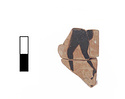
Preserves lower half of male figure to left. No incision. Trace of black glaze line below. Added red at waist.
Fine orange fabric; black glaze.
Probably from P 33200 or ... 3-8 August 1994, 6-7 July 1995 ... Three joining fragments of wall.
... Trace of black glaze line below. Added red at waist.
... Probably from P 33200 or replica. CHC group. ca. 500 B.C. |
Parts of body restored.
Rounded resting surface; pointed underside. Deep lower body.
Two pairs of antithetical leaping dolphins spaced by white dot rosettes; wave pattern of white undulating line over ... 250-240 ... Two pairs of antithetical leaping dolphins spaced by white dot rosettes; wave pattern of white undulating line over opposing diagonal strokes; three lines below, the lowest white. Shiny, gritty black glaze, dull brown and thin on one side, with stacking circle.
Shark Group.
For hand see 202. |
Three non-joining fragments:
a) Rim fragment. Two wavy lines incised before firing.
b) Shoulder fragment mended from four pieces. Raised wart and most of an incised swastika.
c) Shoulder fragment, from ... 8 June 1946 ... Three non-joining fragments:
a) Rim fragment. ... Double wavy line placed horizontally.
... For group photo see P 12272. |
| Associated with the Class of teh Oxford Siren-jug. St. Audries Painter. Salax, potter. Sandal Painter. Compare the Painter of the Palermo Gorgoneion. Sappho Painter. Segment Class. Palmette-and-swan Group ... Agora 23 357 ... Palmette-and-swan Group ... Snake-and-spots Group ... Three-line Group |
Part of foot and floor preserved. Moulded ring foot. Impressed decoration: linked palmettes surrounded by rouletting.
Pinkish-buff clay; underside reserved, with two wide and three narrow glazed circles ... 15 March 1939 ... Pinkish-buff clay; underside reserved, with two wide and three narrow glazed circles. Scratched line around bottom of wall just above foot.
Corbett, Workshp A, group IV, #9.
Cf. |
Most of cylinder restored, including all of lower part and half of flange.
Lightly scraped line on face of flange; scraped groove surrounds dome.
Deep groove with scraped groove within it surrounds ridge ... 270-250? ... Lightly scraped line on face of flange; scraped groove surrounds dome.
... Dome: torches alternate with bunches of grapes, each appearing three times. Cylinder: ivy garland running right, with dot rosettes. ... Related to Dikeras Group.
For similar motifs on a lekanis lid cf. 1308. |
One handle and half of the other as well as large parts of body and neck restored; foot and rim chipped, part of underside missing.
Slight offset at base of body; slightly beveled resting surface, glazed, ... 275-250 ... Main stem is two lines with wavy line between them; leaves on stems alternate with white dot rosettes. ... Main stem a thick, straight line; leaves on stems alternate with bunches of grapes with dotted tendrils. ... Bracket Leaf Group.
For pieces with similar decoration see 89. |
| Mended from six pieces; about half preserved, but none of the rim. On the front of the neck a panel bound above and below by a zigzag line inside a group of three narrow straight bands; on either side ... 3 May 1933 ... On the front of the neck a panel bound above and below by a zigzag line inside a group of three narrow straight bands; on either side by a pair of triple vertical bars enclosing a column of short oblique bars. |
Preserved except for mouth. Mended with small pieces of the wall restored in plaster and painted. H. to top of handle 0.203; H. to mouth 0.185; diam. 0.111.
Three youths, a nude one in the middle to right, ... Second quarter of 4th century B.C ... H. to top of handle 0.203; H. to mouth 0.185; diam. 0.111.
Three youths, a nude one in the middle to right, holding a tympanon in his left hand. ... Reserved ground line.
The Fat Boy Painter (ARV1 889, 55 ter); the F.B. Group (ARV2 1487, 94). |
Parts of lower body and part of one handle restored.
Scraped groove in resting surface; conical underside with pronounced nipple. High, concave stem. Pointed lower body, offset from stem. Sharply canted ... 275-260 ... Body of cornucopia filled in white, obscuring orange line that divides it in two. Bunches of grapes formed by a rectangle, triangle, and single line of dots, with three tendrils and single leaf at top. ... Dikeras Group.
For pieces by same hand and same potter see 75. |
Three non-joining fragments: a of convex top side and flat bottom; b of top side with stub of handle; c of side. Thin brownish black glaze on inside. Glaze has a greenish cast in places. P.H. of a) 0.026; ... Ca. 470 B.C ... Three non-joining fragments: a of convex top side and flat bottom; b of top side with stub of handle; c of side. ... Fragment c just gives a bit of the reserved ground line. Relief contour. ... Namepiece of the Group of Agora P 5562 (ARV2 777, 2). |
Handles, less than half of rim, and part of wall restored; lower body missing.
Molded rim. Knob and deep thumbprint with white paint at base of handles. Below rim: diagonal strokes in orange and white ... 100-86 ... Band is three sagging incised lines with white wavy line between the upper two, white straight line between the lower two; pendants attached by incised zigzag; white dots at tips of pendants. ... Gaudy Amphora Group.
For incision on shoulder motifs, see 443, 444, and 835. |
From a skyphos, out curving rim. Red on buff.
ADDENDA 2018: Three joining sherds to a medium deep bowl with flaring rim and a single preserved horizontal, round-section handle.
The exterior decoration ... LH IIIC Early ... ADDENDA 2018: Three joining sherds to a medium deep bowl with flaring rim and a single preserved horizontal, round-section handle.
The exterior decoration consists of stemmed bowl banding at the rim and a group of fine lines running below the handle. The handle zone is decorated with a single narrow wavy line. The handle is tri-splashed. |
Handle and parts of rim and upper body restored; lower body missing.
One to two scraped grooves below rim. Neck: ivy garland running right, with single ribbons at ends. Shoulder divided into thirds, each ... Ca. 270-260 ... Band is thick line with dots across top. ... Dikeras Group.
For garland cf. 1223. ... For division of shoulder into three sections cf. |
| Lekythos fragments. Black glaze below, a red band along its upper edge. Above, on a creamy ground a narrow band: a boy wearing a himation and carrying a spear walks right, behind a horse; fine incision ... 12 March 1935, 22 February 1938 ... Separated from large scene above by fine ground line; part of a foot, and three letters running down:
Red for the boy's fillet.
b) Found later in tin, preserves the hindquarters of another horse, and a trace of his rider; behind these, a bit of another figure, perhaps a boy with a staff, like the one on fragment a). ... Applied red for upper line of beard, wreath, and stamens of flower.
... Beazley's Pioneer Group (note found in drawer). |
Mended from numerous pieces. Somewhat more than three-fourths complete. Restored in plaster. Central medallion: Gorgon head. Lower wall: alternate winged Erotes and bunches of grapes. A band of tongue ... 23 May 1969 ... Somewhat more than three-fourths complete. ... C 42); on the right with his hand on her shoulder Poseidon with his trident; draped goddess with staff in her right hand; Apollo with lyre seated right; Amymone; group of two figures holding a third; Amymone; Apollo; draped figure with staff. ... Above spirals surmounted by anthemia. Line for miltos, now lost.
|
| A number of fragments make up into two groups:
Group a): preserves the full profile of the neck, some of the shoulder and two tall vertical handles. On the neck are two figures, very tall and thin. The ... 27 April 1938 ... A number of fragments make up into two groups:
Group a): preserves the full profile of the neck, some of the shoulder and two tall vertical handles. ... At top of shoulder, rough tongues, then the top of a head and part of some other figured decoration.
Group b): three joining fragments preserve part of body. ... Two broad glaze bands inside the lip; the front edge of the lip reserved; its outer face black outside, with an added wavy white line. |
One handle restored; part of thumb rest missing on other handle.
High, narrow, flaring foot with deep groove in outer face; grooved resting surface; deeply recessed, flat underside. Slender profile with ... 210-200 ... Decoration in incision and white: spiral wave pattern filled in with white below, based on three lines. At ends, one diagonal line with pair of parentheses, then two more diagonal lines.
First diagonal line has white dot rosette at top and two white fillets hanging down towards inside; area between parentheses white. ... Incised Wave Group.
Similar shape and decoration: 269, 270, P 28526 (Shear 1973, p. 156, note 79, pl. 33:f), P 28638--P 28640 (all from P 21:4), P 31800 (N 21:4, lower fill) (Rotroff 1991, nos. 70--77, p. 87, fig. 14, pl. 33), P 20919 and P 31742 (Agora XXVII, nos. 216, 218, p. 197, pl. 50, [Q 8--9]), P 22927 (H--K 12--14), P 25555 (H 6:4), and P 11440 (E 5:2, lower fill). |
Small parts of wall and rim restored.
Cup rests on ridge, underside concave with raised disk.
Shallow body, with broad, shallow grooves on exterior from foot to just below rim, getting shallower near ... 280-260 ... Scraped grooves below rim, around center of floor, and at half height of wall form three decorative areas. ... Thick neck, heavy brows, large, deep-set eyes. White line above roll of kausia. ... Ptolemy Group.
Cf. 376 for similar emblem but with head turned to viewer's left. |
| Callipolitis-Feytmans, Les plats attiques, p. 381, B II, no. 24, fig. 62. Plates; Other. Well. Plates; Type B II. Callipolitis-Feytmans, Les plats attiques, p. 381, B II, no. 31, pl. 76, fig. 62. Type ... Agora 23 272 P 13428 P 19741 P 22957 P 10092 P 6048 P 1599 P 14379 N 18:7 M 20:3 N 10:1 ... 470 B.C ... Three-line Group |
Two non-joining fragments, a with much of rim and body, one handle, all of ring base; b is a wall fragment with start of handle. Three concentric circles with dot on underside of floor. Glaze slightly ... Ca. 440 B.C ... Two non-joining fragments, a with much of rim and body, one handle, all of ring base; b is a wall fragment with start of handle. Three concentric circles with dot on underside of floor. ... Below, reserved line. Preliminary sketch. ... Namepiece of the Group of Agora P 1073 (ARV2 1304, 2). |
Three non-joining fragments, a with start of handle at far left and b of rim and wall; c of wall and ring base. Trace of circle on underside of floor. Max. dim.: a) 0.064, b) 0.045, c) 0.063. Est. H. 0.086 ... Probably late 5th century B.C ... Three non-joining fragments, a with start of handle at far left and b of rim and wall; c of wall and ring base. ... At the far left of fragment c there is a vertical line of glaze, indicating the start of the ornament below the other handle. ... For this class, see ARV2 984--985; Paralip. 437; Addenda 311. 1289 seems to be a slight variant on Howard and Johnson's Group VI, for it has a zone of chevrons between the two bands of laurel (AJA 58, 1954 [ pp. 191--207], p. 194). |
| (See revision below under ADDENDA.)
Mended from many fragments which make up into two principal groups. These two groups include all the figured fragments, save two, and even these can be assigned with ... 8 May 1934, 1937 ... Group a), profile from rim to stem complete. ... A non-joining fragment which perhaps belongs at the left end of this group gives the feet and lower part of the garment of a figure standing (left?) ... Incision; red and white as in group a); white also for the monster's feet.
|
Mended with the missing pieces restored in plaster and painted, notable among them, both handles, all of stem and foot, a large section of the bowl. Reserved line on inside at rim. Rest. H. 0.095; rest ... Mid-4th century B.C ... Reserved line on inside at rim. ... Around the tondo, stopped-maeander pattern with checkerboard-squares. A--B, three youths, each dressed in a himation. ... Below, reserved line.
Group YZ (ii): the Painter of Vienna 202 (ARV2 1523,---, 5). |
Mouth, most of neck, part of foot missing. Mended from many fragments with missing pieces of the body restored in plaster. Some of the white has abraded as has the black glaze below the figures. Traces ... Late 5th century B.C ... Above, three lines; below, one. ... Dilute glaze: lines above figures; ground line. Matte drawing: reddish brown for contours and youth's hair; purplish red for youth's himation and acanthus.
863 seems fairly close to an unattributed white ground lekythos in Adolphseck, 46 (CVA, Adolphseck 1 [Deutschland 11], pl. 34 [512]:3, 4 and pl. 35 [513]:2). ... The anthemion seems to belong to Nakayama's Group E-IV (Nakayama, Lekythen, p. 275). |
Three non-joining fragments of top side, a with grooves setting it off from the side. Max. dim. a) 0.066, b) 0.067, c) 0.037.
On each side, head of woman, one to left, the other to right, probably facing ... Probably first quarter of the 4th century B.C ... Three non-joining fragments of top side, a with grooves setting it off from the side. ... Below the heads, reserved line.
For human heads on the top side of an askos, see the list compiled by Hoffmann, Sexual and Asexual Pursuit, p. 13, cat. nos. ... Add: Capua P 76 (CVA, Capua 2 [Italia 23], pl. 19 [1094]:1); Warsaw 198535 (CVA, Varsovie 3 [Pologne 6], pl. 47 [278]:2, 4, 6: A, the head facing the forepart of griffin; B, the head facing the forepart of a panther); Ferrara inv. 22291 = T.408 by the Painter of Ferrara T.408 (ARV2 1504, ---, 1; Addenda 383: A, the head facing a swan; B, forepart of a panther); Ferrara inv. 23460 = T.596 from the Group of the Cambridge Askos (ARV2 1505, 6; Addenda 383; Massei, Gli askoi . . . |
| Mended from 15 fragments: more than three-quarters preserved; several large fragments missing from rim.
Plain rim. Torus foot, rising within. Thick stem with fillet at juncture of foot, offset with two ... 6 July 1995 ... Mended from 15 fragments: more than three-quarters preserved; several large fragments missing from rim.
... Decoration: tondo defined by a thin reserved line. Within, a beardless youth with short hair bathes, squatting or resting on one knee within a large basin. ... D. von Bothmer (August 1995): Epeteios group. |
Mended from many fragments with the missing pieces restored in plaster and painted, notably much of the wall under each handle and much of Side B. Ring on neck. Neck glazed on inside. Glaze abraded here ... Ca. 410 B.C ... Side B preserves parts of three youths. The first (much of body and legs missing) moves to right, looking back, supporting a large amphora of Panathenaic shape on his left shoulder and steadying it with his right hand. ... For two youths carrying a tray on a Panathenaic amphora, see the pair on the obverse of Newcastle-upon-Tyne, Univ. no no. from the Group of Polygnotos (Paralip. 445, 128 bis, Matheson, Polygnotos, p. 476, cat. no. ... For the double median line on the right youth on Side B, cf. |
| Several pieces, including chunks from sides and rim, missing. Flat bottom; straight sides; flat-topped projecting rim.
Orange-buff clay. Light slip. Surface much worn.
On side wall, just below rim, a ... 9-12 February 1937 ... Further right at edge of seal, a vertical line. This is certainly the "Dionysos by Alkamenes" type; it is not however a duplicate of either of the coins. ... The pottery with which this pot was found is a consistent group dating from the end of the 2nd and the beginning of the 1st c. ... If the seal be anything more than an idle whim of the potter or owner, one is tempted to seek a connection with the Anthesteria, the festival in which pots played such a conspicuous part, giving the names to each of the three days of the celebration, pithoigia, choes, and chytrai. |
Thirteen non-joining wall fragments with thin reddish wash on inside. Mended in antiquity (part of lead repair in b; hole in d). Glaze pitted and abraded here and there. P.H. a) 0.14; max. dim. a) 0.281, ... Ca. 440 B.C ... Fragment g shows more of the reserved line and also some of the upper part of this figure. ... Fragment c (illustrated) preserves the middle part of a woman standing in three-quarter view to left, dressed in a chiton and himation. ... PGU 20: Group of Polygnotos: Undetermined). |
Mended with small missing pieces restored in plaster and painted. Lip offset on inside; foot offset on underside. Glaze slightly abraded on handles. H. 0.074; diam. of rim 0.18; W. with handles 0.238; ... Ca. 510-500 B.C ... In the background:
Reserved line for tondo border. ... In the field:
Reserved line below figures. ... Painter, forming a group of ten vases, including the Gorgos cup. |
http://agathe.gr/publications/monographs.html Monographs Excavations in the civic and cultural center of classical Athens began in 1931 and have continued almost without interruption to the present day. The first Athenian Agora volumes presenting ... Chapter Three presents the groups in which most of them were found; their distribution is indicated on a plan of the excavation area. ... A large number of the Agora ostraka are illustrated with line drawings, a representative selection with photographs. ... At the end of the 5th century, a group of public buildings was constructed, perhaps to house some of the lawcourts. |
Broneer, O ... American School of Classical Studies at Athens ... The calyx-krater of Exekias, first published in 1937,1 was discovered at the bottom of a well in the American School excavations on the North slope of the Acropolis in Athens. The circumstances of discovery ... 1956 ... An incised line, drawn by compass, sets off the rim. ... Exekias has varied the stance of the three Greek warriors. ... The variations are an important feature of the composition; they break up the rigid symmetry of the picture and help to soften the parallelism within each group.
The second of the new fragments (Pls. 50, b and 51, a ) almost completes the figure of one of the running satyrs that fill the space between the attachments of the handles in the lower zone. |
|
|

.png.icon.jpg)
.png.icon.jpg)