|
|
Townsend, Rhys F ... American School of Classical Studies at Athens ... Hesperia 55.4 4 421-438 10.2307_148177 ... 1986 ... The Fourth-Century Skene of the Theater of Dionysos at Athens |
Merker, Irwin L ... American School of Classical Studies at Athens ... Hesperia 58.3 3 303-311 10.2307_148220 ... 1989 ... The Achaians in Naupaktos and Kalydon in the Fourth Century |
Meritt, Benjamin D ... American School of Classical Studies at Athens ... Hesperia 33.1 1 1-15 10.2307_147026 ... 1964 ... Chronology of the Late Fourth Century |
American School of Classical Studies at Athens ... Hesperia 56.1 1 72 10.2307_148350 ... 1987 ... Errata: The Fourth-Century Skene of the Theater of Dionysos at Athens |
Charitonides, S ... American School of Classical Studies at Athens ... Hesperia 30.1 1 30-57 10.2307_147320 ... 1961 ... The First Half of a Bouleutai List of the Fourth Century B.C. |
Miller, Stephen G ... American School of Classical Studies at Athens ... Hesperia Supplement 27 85-98+365-369 10.2307_1354007 ... 1994 ... Sosikles and the Fourth-Century Building Program in the Sanctuary of Zeus at Nemea |
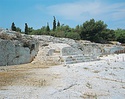
| Speaker’s platform (bema) on the Pnyx, fourth century B.C ... Cf. 2004.02.0103.
Version of LCT-77 Horizontal (normal) ... Speaker’s platform (bema) on the Pnyx, fourth century B.C. |
| The Last Quarter of the Third Century. Graindor, Cosmétes, no. 33. The Fourth Century. I.G. II (2), 3669 ... Agora 1 105 ... 275-300 A.D ... The Last Quarter of the Third Century ... The Fourth Century |
Neck fragment. Small part of the root of one handle preserved. Ring at the junction.
Part of the palmette neck ornament and of the tongue on the shoulder preserved. The palmette springs from above and ... Small part of the root of one handle preserved. Ring at the junction.
Part of the palmette neck ornament and of the tongue on the shoulder preserved. ... These volutes replaced, at the beginning of the fourth century. |
Irregular depression in bedrock (ca. 7x5m), ca. 2m deep; area south of E-W Late Roman wall. Dumped filling apparently intended to level off the area. Coins:
11 March 1952 #10
12 March 1952 #1-#5
13 March ... Ca. 400-325 B.C. |
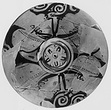
Small part of the downturned rim preserved. Part of a seated woman to left, preserved from below the knees; she wears soft leather shoes. In the field an opaque rosette.
On the down-turned rim, egg-pattern ... Small part of the downturned rim preserved. ... In the field an opaque rosette.
... Second quarter of the fourth century. |
A fragment from the lower end of the tile, preserving the full width; convex tile of the Laconian type.
Pale yellow clay; fugitive brown glaze on outside.
From the same series as A 428 (B 966), A 429 (B ... 23 March 1939 ... A fragment from the lower end of the tile, preserving the full width; convex tile of the Laconian type.
Pale yellow clay; fugitive brown glaze on outside.
From the same series as A 428 (B 966), A 429 (B 967), A 432 (B 1076), A 433 (B 1077), A 597 (B1613) and A 598 (B 1614), i.e. from the series inscribed ΔΗΜΟΣΙΟΝ, and marked by smoke holes.
They probably come from the kitchen of the Tholos, as rebuilt in the early fourth century and damaged at the end of the fourth century. |
Granular Poros stone.
Found at H/18-7/14 (Fall 2016). Found built into the substructure of the eastward extension of the small 'rectangular building' to the north of the Apollo temple. From the earth ... 1934 ... Found built into the substructure of the eastward extension of the small 'rectangular building' to the north of the Apollo temple. From the earth in which it was imbedded a few black-glazed sherds, extending down to the fourth century, but probably not later. |
Head, neck, upper left arm and right hand of a woman seated left, looking round; peplos with ornamented yoke. Behind her stands another woman whose right raised arm and part of her garment remain, the ... Behind her stands another woman whose right raised arm and part of her garment remain, the wears a peplos with a long overfold.
... Second quarter of the fourth century. |
At the left arms of a woman to right holding a box and a sash. At the right raised right arm and knee of another woman seated to left; she wears bracelets.
No relief contour. White, faded, for two balls ... At the left arms of a woman to right holding a box and a sash. ... White, faded, for two balls on the top of the box; added clay for the bracelet on the upper arm of the seated figure.
Second quarter of the fourth century. |
A woman seated right, perhaps looking left; at the left, part of a nude male fig, and of the cushion on which they both sit. At the right, small part of another figure.
White for the arms and neck, with ... 18 January 1931 ... A woman seated right, perhaps looking left; at the left, part of a nude male fig, and of the cushion on which they both sit. At the right, small part of another figure.
... "Neighborhood of the Retorted p.; second quarter of the fourth century." |
Broken all around except top and bottom.
From Square Peristyle.
Poros of Akti; fair work. Traces of fire (?). Imbedded in the foundation of the eastern of the two N.-S. walls in the west part of the Heliaia, ... 18 August 1961 ... Imbedded in the foundation of the eastern of the two N.-S. walls in the west part of the Heliaia, ca. 5.00m from its north end; a wall probably dating from the late fourth century B.C. (or perhaps more likely, second century B.C.). |
Broken away below the waist.
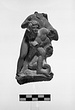
A male figure with pug nose and shaggy bears. The left hand raised to support a child which rested on the should, the child stretched its right arm around behind the head ... Fourth century. |
Torso of Satyr three quarters to left; he holds a torch in his right hand and a plate with pyramid and other cakes. Probably a statue on one of the columns on each side of Athena.
Inside glaze slant ... October 1932 ... Probably a statue on one of the columns on each side of Athena.
Inside glaze slant below the shoulder.
Fourth century. |
| Preface. List of Plates. Abbreviations and Bibliography. Introduction. Catalogue. Observations on Athenian Portrait Style in the Roman Period. The Romanization of Greek Portraits. The Late Republican Period ... Agora 1 vii ... The Third Quarter of the Third Century ... The Fourth Century ... The Fifth Century |
Lower half of draped woman seated to right; in front of her part of the skirt of another figure (?)
No relief contour. Second quarter of fourth century ... Lower half of draped woman seated to right; in front of her part of the skirt of another figure (?)
... Second quarter of fourth century. |
| Broken top and bottom.
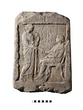
In relief, a standing woman, to right, clasps hands with seated woman.
X scratched on ground between the two figures.
Fourth century.
Marble. Built into late wall, Areopagos slope, ... 15 June 1959 ... X scratched on ground between the two figures.
Fourth century.
|
Badly corroded.
After cleaning only a part of the disc, and the knob on one side, remain.
Solid hub. Fourth Century Hole. 1635 Leica ... 13 March 1952 ... After cleaning only a part of the disc, and the knob on one side, remain.
... Fourth Century Hole. |
| Mended from many fragments; a few missing from rim and top; the knob chipped. Inside, firm black glaze, rather dull; around the down-turned edge, an egg and dot pattern, similar to the one on the top of ... 12-13 April 1934 ... Mended from many fragments; a few missing from rim and top; the knob chipped. Inside, firm black glaze, rather dull; around the down-turned edge, an egg and dot pattern, similar to the one on the top of the knob.
... Common work of the second/third half of the fourth century. |
Broken away below the nose.
Rabbit head, the flat of the ears turned towards the front. Eyes and fur indicated by deep incisions front and back.
Clay: Red, buff, rather coarse. On the left ear a little ... Fourth century A.D. |
Broken away below the chin.
Plump female face. A broad braid of hair is drawn from the forehead straight back over the top of the head. The cheeks are bordered by heavy ringlets. Eyes, mouth, and much ... Fourth century A.D. |
Only the right leg remains.
A draped childish figure reclines towards the right on a high
rectangular base, with paneled front.
Clay: Fine, buff; retaining traces of white paint on figure and base ... Fourth century B.C. |
| Part of left side and chin missing.
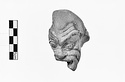
The mask ends just back of the forehead. A deeply wrinkled face with moustache and beard. The pupils of the eyes pricks. The head is bald.
Clay: Fine, buff, slightly ... Fourth century B.C. |
Part of the discus.
Draped figure riding to right on an elephant.
Unglazed.
Buff clay.
Type XXVII of Corinth collection. Well. Fourth century A.D. Leica ... 16-21 May 1937 ... Part of the discus.
Draped figure riding to right on an elephant.
... Well. Fourth century A.D. |
Broken off below the chin, hollow.
A female head, its hair drawn loosely back from the front. A mass of hair (?) rises from the back. In the ears, round rings.
Clay: Firm, buff. The flesh white, the ... Late fourth century B.C. |
Broken away below the hips.
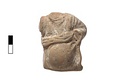
A miniature female figure, wrapped in an himation, holding the right hand over her abdomen, she wears a comic mask.
Clay: Fine, buff, retaining traces of white paint. Back ... Fourth century B.C. |
Ht Preserved: 0.059. A base has broken away.
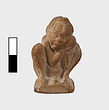
The figure of a crouching boy, bent sharply over. The mouth of the vase was attached to the lower part of the back and handle passed from it to a point on ... Early fourth century B.C. |
Arms and legs missing.
A child reclining toward the right, resting his weight on the (now missing) left arm. The base is completely broken away. Over the head a garland of leaves and fruits.
Clay: Fine, ... Early fourth century B.C. |
A female, comic mask. The face surrounded by a roll of hair.
Clay: Fine, buff, traces of white found on the crown of the head, yellow. No hangholes. The back is finished off behind of the head. Assembly ... Early fourth century B.C. |
Only the front part of the torso from the shoulders to groin remains.
The torso of an adult male in a semi-reclining posture.
Clay: Fine, buff. No traces of paint. The figure was moulded and hollow ... Early fourth century B.C. |
| Found by Mr. Kaurounoilis in 1912
Missing: the mouth of the vase and the lower part of its base; the head and left forearm or foot of one youth, the right forearm and leg of other.
Two youths wrestling ... Early fourth century B.C. |
Preserved from waist to ankles.
A female figure, erect, right knee slightly flexed, wearing chiton and himation.
Fine, buff, completely covered with white paint over which green malachite was laid in the ... Mid- fourth century B.C. |
| Complete save for the right knee and foot.
A tiny figure with negroid features sleeps hunched up; his shoulders thrust down between the knees, his clasped hands again the left cheek. The exaggerated membrum ... Early fourth century B.C. |
The head and right side of the figure remain.
A wreathed and bearded satyr, stands erect, bracing himself to support some heavy object on his left shoulder. His border was undoubtedly the drunk Dionysos ... Early fourth century B.C. |
Broken away below the chine. Hollow, lightly modeled below.
A mature female face. The hair is drawn into a pointed mass as with No. 43 and over it the himation is closely wrapped.
Clay: Fine, dull grey ... Early fourth century B.C. |
Broken off at the root of the neck.
A mature female head wearing a stephane and round earrings. The reverse is worked flat. Disk or knot over forehead.
Clay: Firm, buff. The front covered by white pain ... Early fourth century B.C. |
Missing: the left foot and all above the waist.
The figure is hollow, open below, pierced behind by a rectangular firing hole.
A woman, heavy with child standing erect, clad in chiton and
himation ... Early fourth century B.C. |
Broken away below the mouth.
Ferocious male face, hair on end. Eyes and nostrils completely pierced.
Clay: Buff, coarse, showing trace of red on nostrils, pink on mouth. The head was close in the upper ... Probably fourth century A.D. |
A ram or sheep with heavy horns, moving right, its head bound with fillets. The loose ends of which hang down over the neck. The thin plaque of the background extended to the right and below, exaggerating ... Early fourth century B.C. |
The figure is broken away below the shoulders.
A child's head with long ringlets and crowned by a low stephane is set against a background probably like that of the preceding example.
Clay: Fine, buff, ... Early fourth century B.C. |
| Missing: head, right arm below shoulders, left hand, the figure below the left dome.
The figure is hollow but without a vent. and fully modeled behind. Only the upper part of the figure was modeled.
... Early fourth century B.C. |
Solid, flattened behind.
The head of a mature female wearing a low crown and earrings. Her hair hangs down on her shoulders.
Clay: Firm, buff. The face and lower hair covered by white paint. Yellow paint ... Early fourth century B.C. |
The figure is broken away below the shoulders.
A youthful female head with curly locks falling to the shoulders, wearing a broad fillet knotted on either side above the brows and hanging loosely over ... Early fourth century B.C. |
Broken away below the nose, finished just behind the forehead with one half pierced hole.
A realistically modeled male face, probably a tragic mask.
Clay: Pale yellow, retaining traces of white paint ... Early fourth century B.C. |
Only the chest remains.
The upper part of a male torso, a broad strap passes diagonally
across it leading down from the right shoulder.
Clay: Gritty, ash grey inside, bug outside, faint traces of white ... Early fourth century B.C. |
Missing: head, feet, left arm, right forearm, back of vase.
A male figure, presumably Dionysius in a lounging attitude. He wears a chlamys fastened with a round brooch in front of the throat. The right ... Early fourth century B.C. |
Missing: head and both forearms; chips from the base.
A female figure stands erect. The lower part has been left unworked and pulled out of the bottom to form. She wears a long chiton, low girt, and an ... Early fourth century B.C. |
The dog's head and the boy above the base are missing.
A child reclines towards the right on a high base. Behind him sits a dog resting his right foreleg on he boy's thigh.
Clay: Buff, fine. Covered ... Early fourth century B.C. |
A female (?) had wearing a fillet over a wreath of fruits (?).
Clay buff, fine. Black glaze behind. Solid. From an exploratory trench at the SE corner of the Long Stoa, context of late IV century B.C ... Late fourth century B.C. |
Broken away at the shoulder.
A mature female head. The hair is in a broad roll over the brow and in ringlets falling to the shoulders. A low stephane.
Clay: Fine, buff, slightly micaceous, rounded behind, ... Early fourth century B.C. |
Broken away at the mid-neck. Hollow, rounded behind.
A mature female face. The hair is drawn in a loose roll above the brow from either side and is knotted in a peak of the forehead.
Clay: Fine, buff, ... Early fourth century B.C. |
The drapery is knotted between the thighs of a woman.
Clay buff, fairly hard. Neatly rounded behind. Wall Trench N4 top soil, disturbed ... Late fourth century B.C. |
A groove at the starting of the downturned rim, of which a tiny piece only preserved.
Head, forelegs of griffin to right part of wings of another griffin (?) to right. Scroll of a plant on the ground ... A groove at the starting of the downturned rim, of which a tiny piece only preserved.
... The glaze at the underside is somewhat metallic.
Second quarter of fourth century. |
The rear quarters and one half of the flank remains.
A standing sheep, its wool picked out in scale. The tail docked. Another similar fragment (T 123)
.
Clay: Fine, buff. White paint covered with a mauve ... Early fourth century B.C. |
Missing: mouth of the vase and part of the base.
A youth sits on a rock. His left forearm rests on the left knee, with his right hand he holds a small animal (a dog?) on the rock. His long locks are crowned ... Early fourth century B.C. |
The torso and right arm of the figure remains.
A mature female figure standing erect. She wears a long sleeved chiton and has wrapped her himation around her waist in a heavy roll.
Clay: Firm, buff ... Late fourth century B.C. |
| E.M. 8654. K.S. Pittakys, Ἐφ. Ἀρχ., 1839, No. 318 and 1842, No. 1038. U. Koehler, I.G., II, 1001. J. Kirchner, I.G., II², 2382. Δελτ., XVIII, 1963, p. 104, No. 1, line 30. Ἀρχ. Ἐφ., 1918, p. 75, column ... Agora 15 86 ... Reinmuth, The Ephebic Inscriptions of the Fourth Century B.C., Leiden, 1971, pp. 69-72 |
Broken off at shoulders.
A mature female head, the hair being in a broad roll above the forehead and falling straight back on the neck.
Clay: Buff, containing large grain of grit. Paint, if any, completely ... Early fourth century B.C. |
There remains only the body and left arm of the figure.
A female figure, probably a dancer clad in a thin clinging chiton. A thin edge of drapery flies out around her waist. The free end falls loosely ... Early fourth century B.C. |
The tip of the nose is missing.
A plump, long-haired spitz dog, with tail curled above its back. The spaces between the legs are filled in solid.
Clay: Fine, buff, covered with white paint. Hollow, ... Uncertain, probably fourth century B.C. |
Missing: head, right arms and legs below the waist.
An erect female figure clad in a thin chiton, diagonally girt with the περιαννα. Over her left forearm hands the loose mass of her mantle.
Clay: Fine, ... Early fourth century B.C. |
Broken away below the waist.
A woman has drawn her himation over her head and with her right hand raises the lower edges as if to cover the lower parts of her face.
Clay: Fine, buff, covered in front ... Early fourth century B.C. |
Missing: head, large fragments from the body, base.
An erect female (?) figure right knee slightly flexed standing clad in chiton and himation.
Clay: Fine, pale buff, covered front and back with white ... Mid- fourth century B.C. |
Traces of burning.
The relief shows Herakles at right, nude, wrestling with a lion on rocky ground. Drapery hangs behind the lion, a club behind Herakles. No card, all info taken from Hesperia. Dump ... Early fourth century B.C. |
Broken away below the nose.
Doubled pierced through back of head which is modeled down to level of the ears. Male face, with wrinkled brown. A thick fillet passe across the forehead, is knotted under ... Probably late fourth century B.C. |
Clay fine, buff, fairly soft. Solid. Head, arms, right leg and left below knee are missing. Modeled fully behind. Traces of white slip with touches of yellowish color.
Carefully modeled torso is in a ... Late fourth century B.C. |
Buff Attic clay. Reserved behind.
Mould for a girls head. Rippling hair parted in the middle and ring earrings in the ears. W.T [?] 30, Date to 2nd cent AD.- from destruction of white poros wall. 1071 ... Late fourth century B.C. |
Missing: heads of boy and bird, part of the base.
A child, resting on his doubled left leg, throws his arms around some object, probably a goose, standing by his left side. His mantle is thrown loosely ... Early fourth century B.C. |
Soft, buff clay. Traces of red on hair. Softly modeled features, a stephane or fillet ran around the hair.
Rough worn shards, [???] dates the from destruction of white poros wall, probably in medieval ... Early fourth century B.C. |
End of nozzle and handle, with much of rim, missing.
Groove around low base underneath.
Black to brownish glaze, somewhat peeled; the resting surface and the groove unglazed.
Type VI (late 5th. century ... 18 May-4 June 1937 ... Black to brownish glaze, somewhat peeled; the resting surface and the groove unglazed.
Type VI (late 5th. century variety) of Corinth collection, type 23A of Agora collection ... Latest Fifth-Fourth century B.C. |
The body completely broken away.
Moulded in two pieces, the body was hollow. The two sides identical.
Clay: Fine, buff, covered with white paint. Assembly Place, filling of Period III ... Probably early fourth century B.C. |
| Inscribed very small fragment of an inscription.
Broken all round.
Pentelic marble.
ADDENDA Joins 16b: early fourth century list of fallen. Finished Found above stelai over the Great Drain, east of the ... 15 July 1931 ... ADDENDA Joins 16b: early fourth century list of fallen ... Found above stelai over the Great Drain, east of the Metroon. |
A flat table rest and clusters of grapes, one cake, one long wreath and weak leaves?
The objects were affixed to the plaque by reddish glaze and thereafter ll was covered with site slip; no trace of ... Probably late fourth century B.C. |
Head, legs and tail missing. Solid.
A galloping horse. No trace of rider.
Clay: Fine, buff, covered with white paint, very soft clay. Modeled in the round. From the filling behind the terrace wall ... Probably early fourth century B.C. |
A nude male torso; the right arms stretched forward. The left extended sideways.
Clay: buff, fine, fairly hard. Back fully modeled. Very smooth surfaces. Hollow, no sign of vent. Only upper torso preserved ... Mid-fourth century B.C. |
The figure is broken away below the chin.
A child's head, bordered by long curly locks and set against a background with scalloped edges which probably represents a cave.
Clay: Fine, buff, covered in ... Early fourth century B.C. |
The feet were made separately and attached, they have broken away. Probably hollow, no vent.
Probably a common hen, with neck outstretched. The neck feathers indicated by channeling.
Clay: Fine, buff ... Probably early fourth century B.C. |
Part of the bottom missing.
Ribbed discus and a relief wreath around the rim; handle semi-pierced with a leaf at its base.
Unglazed.
Buff clay.
Type XXVII of Corinth collection. Well B. Fourth-Fifth century ... May-June 1937 ... Part of the bottom missing.
Ribbed discus and a relief wreath around the rim; handle semi-pierced with a leaf at its base.
... Well B. Fourth-Fifth century A.D. |
The head and legs of the figure are missing.
A siren, erect and facing front, holds below her breast in either hands castanets. Curly locks fall over her shoulders.
Clay: Fine, buff, covered behind with ... Probably early fourth century B.C. |
The left side and hand of a standing draped woman (careful work). She wears a thing chiton and a heavy himation rolled around her waist and coupled up against her left arm.
Clay buff, fine. Traces of ... Mid- fourth century B.C. |
| Inscribed fragment.
Left side preserved, elsewhere broken.
Three lines of the inscription preserved, trace of fourth; stoichedon.
Pentelic marble.
ADDENDA With I 3611. Found in disturbed modern context, ... 5th. century B.C. |
Broken away below the waist. Left side and much of face missing.
A shaggy, bearded male figure with himation drawn across the abdomen and his right hand resting on it. His chiton stripped to present ... Early fourth century B.C. |
Broken all around.
On himation only are traces of blue paint laid directly on the clay with white paint on top of it, the lower part, from wait to knees.
A standing female figure, draped in chiton and ... Mid- fourth century B.C. |
The plaque shows nude, unrelated human legs and a bear's leg (?) behind them.
Clay buff, burned dark. Irregular and chipped back.
Of Agora T578. Dump ... Probably fourth century B.C. |
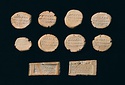
| (top) Circular terracotta tokens of Pheidon of the deme of Thriasia, Athenian cavalry commander (hipparch) at Lemnos, fourth century B.C. Upper row, left to rihgt: MC 1164, MC 1165, MC 1169, MC 1170. Middle ... Craig Mauzy ... Combination of LCT-33 and LCT-124. Horizontal (normal) ... (top) Circular terracotta tokens of Pheidon of the deme of Thriasia, Athenian cavalry commander (hipparch) at Lemnos, fourth century B.C. ... (bottom) Rectangular terracotta tokens of Xenokles of the deme of Perithoidai, commander of the border patrol (peripolarch), fourth century B.C.. |
Egg pattern around root of knob. Upper part of a woman running to right and looking back; she wears a peplos with ornamented yoke. At the right part of a large wing to right between, the top of a plant ... Upper part of a woman running to right and looking back; she wears a peplos with ornamented yoke. At the right part of a large wing to right between, the top of a plant.
... Second quarter of fourth century. |
| The Athenian Agora; Volume 26; The Greek Coins; Athenian Silver Coins; Fourth Century B.C. Head, HN², p. 373. Kraay, Athens, p. 7. Kroll 1976, pp. 338-341. IGCH 2117 (Leontinoi 1957). IGCH 2119 (Contessa ... Agora 26 8 I 7495 ... The Athenian Agora; Volume 26; The Greek Coins; Athenian Silver Coins; Fourth Century B.C ... Hopper, The Attic Silver Mines in the Fourth Century B.C., BSA 48, 1953 (pp. 200-254), p. 216 ... Hopper, The Attic Silver Mines in the Fourth Century B.C., BSA 48, 1953 (pp. 200-254), pp. 250-251 |
The horizontal band handle at the back is broken off.
Dull black glaze over all, except under side of low base.
Type IV of Corinth collection, type 21C of Agora collection. Well. Latest Fifth-Fourth century ... 18 May-4 June 1937 ... The horizontal band handle at the back is broken off.
... Latest Fifth-Fourth century B.C. |
Fragment a), large flat leaf-handle .
Fragment b), part of the flat base and side wall. Underneath, incised beneath the glaze.
Dull glaze, red to brownish and somewhat peeled.
Type XXI of Corinth collection ... 16-21 May 1937 ... Fragment b), part of the flat base and side wall. Underneath, incised beneath the glaze.
Dull glaze, red to brownish and somewhat peeled.
... Well. Fourth century A.D. |
There remains only a fragment of the rim with the hair above the forehead.
Gritty, buff clay as for architecture and terracottas. From construction debris of City Wall, compartment period, tower at west ... Late fourth century B.C. or earlier. |
Male phallos attached to a spout to the side of an open lipped vase.
Clay: Fine, buff, covered with gloss black glaze inside and out.
Priapos not glazed. Demiseus? Assembly Place, filling of Period ... Early fourth century B.C. |
Mended from three pieces; the head and the arms, outstretched from the elbow, broken off and a large chip from the breast.
No color.
Cf. Hesperia 64 (1995), pp. 415-416, n. 32, 34. Brown fourth century ... 18-21 October 1947 ... Mended from three pieces; the head and the arms, outstretched from the elbow, broken off and a large chip from the breast.
... Brown fourth century fill with marble chips beside tile drain at south. |
Broken away on left side and from waist up.
Actor as Herakles leans on his club at his right side, his feet are crossed. He wears a short chiton belted at the waist.
Pale yellow clay. Assembly Place, ... Early fourth century B.C. |
Mould for a female head crowned with a wreath of leaves, probably for a plastic vase.
Clay buff, hard; pared irregularly behind with a wheel. Some rim on top. Clearing bedrock just to the east end of ... Probably early fourth century B.C. |
Fragment missing from left side.
Double pierced through top of head, which is finished off through the crown. Male face. Bald, wrinkled brow. Wrinkled by apparently unbearded.
Clay: Fine, buff, retaining ... Early fourth century B.C. |
|
|
.png.icon.jpg)
.png.icon.jpg)
.png.icon.jpg)
.png.icon.jpg)