|
|
| The Fifth Century ... Agora 1 106 ... 400-500 A.D ... The Fifth Century |
Bradeen, D. W ... American School of Classical Studies at Athens ... Hesperia 32.2 2 187-208 10.2307_147176 ... 1963 ... The Fifth-Century Archon List |
Meritt, Benjamin D ... American School of Classical Studies at Athens ... Hesperia 14.2 2 61-133 10.2307_147005 ... 1945 ... Attic Inscriptions of the Fifth Century |
Koehler, Carolyn G ... American School of Classical Studies at Athens ... Hesperia 50.4 4 449-458 10.2307_147883 ... 1981 ... Corinthian Developments in the Study of Trade in the Fifth Century |
Corbett, Peter E ... American School of Classical Studies at Athens ... Hesperia 18.4 4 298-351 10.2307_146717 ... 1949 ... Attic Pottery of the Later Fifth Century from the Athenian Agora |
Wallace, William ... American School of Classical Studies at Athens ... Hesperia 5.2 2 273-284 10.2307_146548 ... 1936 ... An Eretrian Proxeny Decree of the Early Fifth Century |
Pease, M. Z ... American School of Classical Studies at Athens ... Hesperia 6.2 2 257-316 10.2307_146521 ... 1937 ... A Well of the Late Fifth Century at Corinth |
Clinton, Kevin ... American School of Classical Studies at Athens ... Hesperia Supplement 19 27-37 10.2307_1353967 ... 1982 ... The Nature of the Late Fifth-Century Revision of the Athenian Law Code |
Boulter, C ... American School of Classical Studies at Athens ... Hesperia 22.2 2 59-115 10.2307_146985 ... 1953 ... Pottery of the Mid-Fifth Century from a Well in the Athenian Agora |
Pit at 57/ΚΑ; small pit on the lower north slope of the Areopagus, measuring 1.05x0.80mx0.80m deep. There were traces of burning and a few bones in it, since none of them are recognizably human it is probably ... 480 - 470 B.C. |
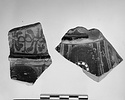
Thick ring at the join of neck. Part of the neck ornament a tiny part of the shoulder ray and upper part of the crest of Athena preserved.
Athena is turned to left. Her crest is outlined with a red band ... Thick ring at the join of neck. ... This kind of ornament is assigned(?) to the Panathenaic of the fifth century (ours is certainly one of its last appearance); a fifth century date is also supported by the use of red (Beazley, Panathenaica p. 454).
End of fifth century. |
Lalonde, G. V ... American School of Classical Studies at Athens ... Hesperia 37.2 2 123-133 10.2307_147686 ... 1968 ... A Fifth Century Hieron Southwest of the Athenian Agora |
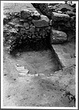
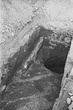
| Fifth century pit in line with the Stoa colonnade ... west Horizontal (normal) ... ca. 1935 ... Fifth century pit in line with the Stoa colonnade. |
| Fifth century pit in line with the Stoa colonnade ... AMS west Horizontal (normal) ... ca. 1935 ... Fifth century pit in line with the Stoa colonnade. |
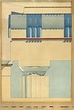
| Watercolor by Piet de Jong showing the Doric order f the late fifth-century B.C. stoa of Zeus ... Craig Mauzy ... PD 21 Horizontal (normal) ... 2006 ... Watercolor by Piet de Jong showing the Doric order f the late fifth-century B.C. stoa of Zeus. |
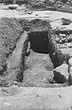
| Tholos. Trench along south side of modern cellar. Looking west. Black fill at rear end gone, but also some of the fifth century fill at the far end ... AMS Horizontal (normal) ... 8 May 1934 ... Black fill at rear end gone, but also some of the fifth century fill at the far end. |
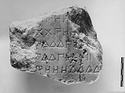
| Fragment of fifth century stele: Building accounts of the Propylaea ... Horizontal (normal) ... Fragment of fifth century stele: Building accounts of the Propylaea. |
MacDonald, Brian R ... American School of Classical Studies at Athens ... Hesperia 50.2 2 141-146 10.2307_148013 ... 1981 ... The Phanosthenes Decree Taxes and Timber in Late Fifth-Century Athens |
| Late Byzantine. Byzantine Floor. Early Byzantine or Characterless Sherds. Characterless and Roman Sherds. Brown Earth. Hellenistic. Sherds of the Fifth Century. Hard Packed Ancient Floor. Gravel. Stamped ... Η-4 754, 755 SS 1638 Lot Η 55 SS 1638 ... 18 May 1933 ... Sherds of the Fifth Century |
| Piet de Jong poster, end of fifth century BC ... Piet de Jong ... Exhibited at the Benaki Museum, 15 November 2006 to 7 January 2007 ... 1957 |
| Tholos. Trench along south side of modern cellar. Looking east. Trench cleared to bedrock. Close view to show the location of the mouth of the Early Well and step marking top of the fifth century fill ... AMS Horizontal (normal) ... 8 May 1934 ... Close view to show the location of the mouth of the Early Well and step marking top of the fifth century fill. |
| Thick ring at the joint of the neck. Very little part of the tongues on the shoulder and of the Athena's crest. Athena is turned to left. The crest is outline with a red band; round it's base, at the point ... Thick ring at the joint of the neck. ... The use of red mineral makes a dating still in the fifth century certain (Beazley, Panathenian p. 454). End of fifth century. |
http://agathe.gr/democracy/the_verdict.html The Verdict After the speeches and other evidence had been presented, the members of the jury voted by casting ballots. A series of vase paintings of the early 5th century B.C. show a mythological story, ... A series of vase paintings of the early 5th century B.C. show a mythological story, the vote for the arms of Achilles. ... Whether or not the voting scenes that appear on vases depicting this story show an actual method of voting in early 5th-century Athens, their appearance at this time may have been prompted by the enhanced importance of voting that resulted from the reforms of Kleisthenes. ... The majority are datable to the 4th century B.C., but the latest, and especially those of lead, may run into the 2nd century B.C. |
Well in the industrial area west of the Areopagus.
A flask-shaped cistern in House H with a dumped fill of the late fifth century brought from elsewhere and evidently deposited sometime in the 3rd c. B.C ... Ca. 420-400 B.C ... Well in the industrial area west of the Areopagus.
A flask-shaped cistern in House H with a dumped fill of the late fifth century brought from elsewhere and evidently deposited sometime in the 3rd c. ... Especially to be noted is the stamped Thasian amphora handle SS 9636, one of the earliest stamps recording names of officials. |
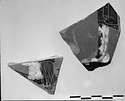
| Wall fragment, glazed inside Right leg and part of peplos of Athena, to left. White for the leg; the lower hemline as well as the drapery folds, incised.
First half of fifth century. LI-48 ... White for the leg; the lower hemline as well as the drapery folds, incised.
First half of fifth century. |
Broken away below the waist.
Pan playing on a syrinx.
Clay: Buff, coarse, covered in front with red paint. Hollow, back unmodelled. From a disturbed area to the south of the retaining wall of the ... Fifth century B.C. |
| Preface. List of Plates. Abbreviations and Bibliography. Introduction. Catalogue. Observations on Athenian Portrait Style in the Roman Period. The Romanization of Greek Portraits. The Late Republican Period ... Agora 1 vii ... The Third Quarter of the Third Century ... The Fourth Century ... The Fifth Century |
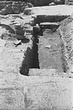
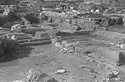
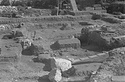
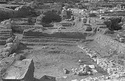
| From southeast, Late Roman disturbance gone. 1: Propylon, 2: archaic floor, 3-4: trenches of fifth century walls. From the east ... AMS Horizontal (normal) ... From southeast, Late Roman disturbance gone. 1: Propylon, 2: archaic floor, 3-4: trenches of fifth century walls. From the east. |
| From west, Late Roman disturbance gone. 1: Propylon, 2: archaic floor, 3-4: trenches of fifth century walls. From the east ... AMS Horizontal (normal) ... From west, Late Roman disturbance gone. 1: Propylon, 2: archaic floor, 3-4: trenches of fifth century walls. From the east. |
| From east, Late Roman disturbance gone. 1: Propylon, 2: archaic floor, 3-4: trenches of fifth century walls. From the east ... AMS Horizontal (normal) ... From east, Late Roman disturbance gone. 1: Propylon, 2: archaic floor, 3-4: trenches of fifth century walls. From the east. |
The lower part of the nozzle and front wall, and part of the bottom.
Signed.
Unglazed.
Buff clay.
Type XXVII of Corinth collection. Well. Upper fill. Second century A.D. construction; at transition from ... May-June 1937 ... The lower part of the nozzle and front wall, and part of the bottom.
... Second century A.D. construction; at transition from Sixth century A.D. to Fifth century B.C. |
Only the lower part of the face remains.
After moulding the nostrils and the corners of the mouth over emphasized by piercing. The size and glaze on the interior suggest that fragment comes from a ... Late fifth century B.C. |
Male phallos attached as spout to the side of a vase. On the inside is a bit of the shoulder of the aryballos?
Clay: Firm, buff. Reddish glaze on the upper part of the outer face and smeared over the ... Early fifth century B.C. |
| The Athenian Agora; Volume 15; Inscriptions; The Athenian Councillors; Introduction; The Council and the Prytaneis. Aristotle, Ἀθ. Πολ., 21, 6. Charles Hignett, A History of the Athenian Constitution, ... Agora 15 1 ... Meritt, The Athenian Calendar in the Fifth Century, 1928, passim ... Meritt, The Athenian Calendar in the Fifth Century, 1928, p. 124 ... Meritt, The Athenian Calendar in the Fifth Century, 1928, pp. 99-100 |
Upper and lower extremities missing.
Seated figure, legs covered, right elbow knee, shaggy legs, grossly exaggerated membrum virile.
Clay: Fine, buff, coated with no white glaze, pink-red painted applied ... Fifth century B.C. |
Mould for the left side of a ram's head with curling horn. For a rhyton.
Clay reddish, hard. Burned? From a disturbed area to the north of the retaining wall of the Assembly Place III ... Early fifth century B.C. ? |
http://agathe.gr/democracy/the_council_and_magistrates.html The Council and the Magistrates Like selection for military service, allotment to the Council was organized according to the division by tribes; 50 members from each tribe acted as a unit in the Council ... The Council and the Magistrates Like selection for military service, allotment to the Council was organized according to the division by tribes; 50 members from each tribe acted as a unit in the Council and held the presidency (prytany) of the Council for one of its 10 prytanies, with a third of their number constantly on duty and in residence in the Tholos, the round building next to the Council House (Bouleuterion) (14, 15). 14. Civic buildings on the west side of the Agora, from the southeast. 15. ... Allotment tokens, 450–430 B.C. The Council also supervised the election of the generals, one from each of the 10 tribes, who were the chief executive officers of the administration, replacing in this function the archons, whose power decreased in the early fifth century when they began to be chosen by lot. |
| Tholos. Trench along south side of modern cellar. Looking east. Trench cleared to bedrock. Lower right, part of poros column and base. Upper right, in deep shadow, the Early Well. The step at the upper ... AMS Horizontal (normal) ... 8 May 1934 ... Upper right, in deep shadow, the Early Well. The step at the upper left represents the slightly packed surface of the fifth century fill at the east. |
Male phallos, attached as spout to the side of a vase. On the inside is a ledge for the reception of a lid. Scratched into the clay on the upper part of the outer face: ΚΕΡΚΙΩ.
Clay: Fine, buff, burned ... Early fifth century B.C. |
Broken at top only.
The right side is set at an obtuse angle to the base line.
A draped figure sits to right on a throne with lions feet, holding kin the hand a stick? The peculiar shape suggests the ... Early fifth century B.C. |
| Other. Well. Agora 012. Agora 022. Ostraka. Agora 023. Burial. T.L. Shear Jr., The Persian Destruction of Athens: Evidence from Agora Deposits, Hesperia 62, 1993, pp. 383-482. C. Boulter, Pottery of the ... Agora 30 3 G 6:3 Q 12:3 D 7:2 R 10:3 ... Boulter, Pottery of the Mid-Fifth Century from a Well in the Athenian Agora, Hesperia 22, 1953, pp. 59-115 ... Talcott, Attic Black-Glazed Stamped Ware and Other Pottery from a Fifth Century Well, Hesperia 4, 1935, pp. 477-523 ... Corbett, Attic Pottery of the Later Fifth Century from the Athenian Agora, Hesperia 18, 1949, pp. 298-351 |
| Grave 3 in notebook. Outside Archaic cemetery, inhumation burial. Deposit list says black glaze pithos (P 8922) containing the bones of a child and four small vases. The pithos lay on its side with the ... Last quarter of 6th century B.C ... Deposit list says black glaze pithos (P 8922) containing the bones of a child and four small vases. The pithos lay on its side with the open mouth to northeast. The bottom had been cut by a late fifth century well and the upper side was caved in. |
Dumped filling in a well on the west slope of the Areopagus (apparently separate, no mends between them, but differing little in date) the bottom filling apparently thrown in towards the beginning of the ... Ca. 425-400 B.C. and earlier ... Dumped filling in a well on the west slope of the Areopagus (apparently separate, no mends between them, but differing little in date) the bottom filling apparently thrown in towards the beginning of the last quarter of the fifth century, the middle and top fillings near the end of the century, but all containing considerable material earlier than the lower limit. The deposit cannot be used for close dating except for the lower limit, ca. 415-410 B.C.. ... Three separated dumped fillings were noted, divided by layers of earth and mud; all were dumped in at about the same time, but each had somewhat distinctive characteristics. |
There remains only the front of the figure from waist to knee.
A female figure standing, with left knee slightly flexed, wearing a peplos with long overhang.
Clay: Fine, rosy buff, showing traces of ... Late fifth century B.C. |
Mould for a female head. The hair ripples off the forehead.
Fine, buff clay. Assembly Place, filling of Period III ... End of fifth century B.C. |
| Agora, 003, pp. 161-163, 220-221. Hesperia, 34, 1965, p. 73. Lexicon, Platonicum, ὀρχήστρα, (on Apology, 26 d, e). Hipparchicus 3, 2. The Athenian Theater of the Fifth Century, in Studies Presented to ... Agora 14 127 ... The Athenian Theater of the Fifth Century, in Studies Presented to D.M. |
| I 4408, fragment h. EM 6657, Stele 6, d,e.
Inscriptions: Fifth Century BC. Confiscated Property of the Profaners of the Mysteries. Stele 6, e and i ... Horizontal (normal) ... Inscriptions: Fifth Century BC. Confiscated Property of the Profaners of the Mysteries. |
| I 4408, fragment d. Stele 6, h, i. Inscriptions: fifth century BC. Confiscated Property of the Profaners of the Mysteries. Stele 6, e and i. EM 6759 ... Horizontal (normal) ... Inscriptions: fifth century BC. Confiscated Property of the Profaners of the Mysteries. |
Mould for the cheek and eye of a cow or bull, probably for a rhyton.
Clay buff, fine, thin fabric. Smoothly finished. Assembly Place, filling of Period III ... Late fifth century B.C. |
Clay fine, buff, soft. Head missing. Traces of white slip. Pin hole beneath on level bottom. Not carefully modeled.
Almost identical with Agora T IIII which is from Late 5th century context. From the ... Probably late fifth century B.C. |
| Head and feet are missing.
Sold; flat behind. Soft, tan clay.
The youth stands erect, resting his hands on his hips, he wears goat pants.
Fine buff clay; remaining traces of white paint, front and back ... Early fifth century B.C. |
Broken away at root of neck. Solid.
A mature female head. The hair is lightly bound in a kerchief and drawn into a pointed mass on the back of the head. A wisp protrudes from the top of this mass and ... Late fifth century B.C. or later. |
End of nozzle and handle, with much of rim, missing.
Groove around low base underneath.
Black to brownish glaze, somewhat peeled; the resting surface and the groove unglazed.
Type VI (late 5th. century ... 18 May-4 June 1937 ... Black to brownish glaze, somewhat peeled; the resting surface and the groove unglazed.
Type VI (late 5th. century variety) of Corinth collection, type 23A of Agora collection ... Latest Fifth-Fourth century B.C. |
Inscribed fragment.
The back rough picked; the edges broken.
Sixteen lines of the inscription preserved, with a space between the fifth and sixth.
Pentelic marble. Found in disturbed earth, outside the ... 2nd. century A.D. |
One nozzle and about half of rim and body missing.
Shape fabric and decoration as the L 4500 (OO 739).
Type IV (early fifth century group) of Corinth collection, type 22B of Agora collection. Stony fill ... 1947 ... Shape fabric and decoration as the L 4500 (OO 739).
Type IV (early fifth century group) of Corinth collection, type 22B of Agora collection. |
Part of the bottom missing.
Ribbed discus and a relief wreath around the rim; handle semi-pierced with a leaf at its base.
Unglazed.
Buff clay.
Type XXVII of Corinth collection. Well B. Fourth-Fifth century ... May-June 1937 ... Part of the bottom missing.
Ribbed discus and a relief wreath around the rim; handle semi-pierced with a leaf at its base.
... Fourth-Fifth century A.D. |
| Inscribed fragment.
Inscribed face only preserved.
Fifth century financial record; the lettering looks like that of the Erechteion accounts.
Twenty letters remain.
Pentelic marble.
ADDENDA Belongs with ... 5th. century B.C ... Inscribed face only preserved.
Fifth century financial record; the lettering looks like that of the Erechteion accounts.
... November 1954 and returned the same day ... Found in modern context, over the north end of the Middle Stoa. |
| Inscribed fragment.
Inscribed face only preserved.
Four lines of the inscription preserved, part of fifth; stoichedon.
Pentelic marble. Finished Found in Byzantine context west of the Panathenaic Way, ... 4th. century B.C. |
| Fragment from the wall of a large unglazed amphora.
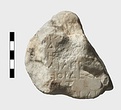
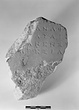
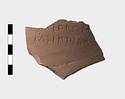
Incised outside. Όστρακο οστρακοφορίας Κλεοφώντος Κλειππίδου. Προέρχεται από το σώμα μεγάλου αμφορέως. Finished Late fifth century fill. 4374 Leica, ... 11 June 1951 ... Fragment from the wall of a large unglazed amphora.
... Late fifth century fill. |
The horizontal band handle at the back is broken off.
Dull black glaze over all, except under side of low base.
Type IV of Corinth collection, type 21C of Agora collection. Well. Latest Fifth-Fourth century ... 18 May-4 June 1937 ... The horizontal band handle at the back is broken off.
... Latest Fifth-Fourth century B.C. |
Preserved only from waist to knees
The front part of the figure was shaped in a mould and then a solid mass of clay was applied to it's back which part remained unmolded. A female figure clad in a chiton ... Mid fifth century B.C. or later. |
| C. Habicht, Athen:die Geschichte der Stadt in hellenistischer Zeit, 1995. W.S. Ferguson, Hellenistic Athens, 1911. S.V. Tracy, Athenian Democracy in Transition, 1995. Agora Guide, 1990. J.K. Davies, Athenian ... Agora 16 viii ... Walbank, Athenian Proxenies of the Fifth Century B.C., 1978, pp. 52-55 |
Small fragment of the body, and most of the strap handle at the back missing.
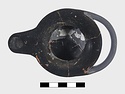
Small lamp; inside glazed; outside unglazed except for nozzle, handle, and bands at the rim. No base; the floor rises to a ... 10-12 June 1947 ... Small fragment of the body, and most of the strap handle at the back missing.
Small lamp; inside glazed; outside unglazed except for nozzle, handle, and bands at the rim. No base; the floor rises to a low point at the center.
Type IV (later fifth century group) of Corinth collection, type 21D of Agora collection. |
Part of bottom, with edge projecting below, and of the right side preserved.
On the front, the leg of a table and part of a long bench under it.
Attachment hole through the plaque, under the bench.
Broken ... 13 August 1947 ... On the front, the leg of a table and part of a long bench under it.
Attachment hole through the plaque, under the bench.
... House H, Room 14; fifth century fill in grave cutting. |
Inscribed fragment.
Right side with chisel marks preserved; elsewhere broken.
Face very rough.
Boundary for grave lot.
Four letters remain and traces of fifth.
Pentelic marble. Found in the wall of a modern ... 4th. century B.C. |
Inscribed fragment.
The right side preserved; elsewhere broken.
"POLETAI" record; sale of confiscated property.
Six lines of the inscription preserved; a space above the first, and between the fifth and ... Early 4th. century B.C. |
| The bottom is missing, and the horizontal band handle at the back broken away.
Good black glaze inside and out.
Type VI (late 5th. century variety) of Corinth collection, type 23A of Agora collection ... 18 May-4 June 1937 ... The bottom is missing, and the horizontal band handle at the back broken away.
... Type VI (late 5th. century variety) of Corinth collection, type 23A of Agora collection.
... Latest Fifth-Fourth century B.C. |
Three non-joining fragments; one with part of the floor, about two thirds of the rim, and the stamp of the nozzle; a floor fragment and a rim fragment from the back with the stump of the horizontal handle ... 24 April -13 June 1947 ... Three non-joining fragments; one with part of the floor, about two thirds of the rim, and the stamp of the nozzle; a floor fragment and a rim fragment from the back with the stump of the horizontal handle.
The rim glazed, with a reserved band on its top.
... Type IV (early fifth century variety) of Corinth collection, type 21D of Agora collection. |
One side of rim and wall missing, and chips.
Pierced collar through center of floor; single nozzle encroaching on rim; no handle.
Inside, and rim and nozzle outside, glazed; a reserved band around the ... 23 April 1948 ... Inside, and rim and nozzle outside, glazed; a reserved band around the middle of the rim.
Type IV (early fifth century variety) of Corinth collection, type 22A of Agora collection. |
Low base and continous convex wall and rim; part of three nozzles preserved.
Black glaze inside and on body most of the way to bottom.
Type IV of Corinth collection, type 21C of Agora collection. Well ... 18 May-4 June 1937 ... Black glaze inside and on body most of the way to bottom.
... Latest Fifth-Fourth century B.C. |
Inscribed fragment.
Inscribed face only preserved.
Burned and acid-eaten; behind, part of a cutting for an iron dowel.
Four lines of the inscription preserved, trace of fifth.
Pentelic marble.
ADDENDA ... 5th. century B.C. |
Fragment from left side of inscribed stele.
Broken top, bottom and at right.
Left side dressed smooth, with the back edge beveled to the rough picked back; the front edge much chipped, so that the first ... 5th. century B.C. |
| Inscribed fragment.
Inscribed face and perhaps original back preserved (now worn smooth).
A rectanguslar cutting (for reuse) along left side of inscribed face.
Four lines of the inscription preserved, ... 5th. century B.C. |
The top preserved; handle and tip of nozzle missing.
Broad down sloping rim, a ring of raised dots and ribs on the top; a large double-spiral lug on either side. On the throat of the nozzle, a large palmette ... June 1937, June 1938 ... The top preserved; handle and tip of nozzle missing.
... On the throat of the nozzle, a large palmette in relief.
... ADDENDA Four fragments of lamps of similar type remain in the tray, three of fifth to fourth century types. |
Most of the discus, part of side wall, and upper part of handle missing.
Very big lamp; concentric grooves on the bottom, pierced handle. Narrow rim with two grooves.
Lion's paw on preserved edge of discus ... 5-8 June 1937 ... Most of the discus, part of side wall, and upper part of handle missing.
Very big lamp; concentric grooves on the bottom, pierced handle. ... Roman, Fourth (Fifth) century A.D. |
http://agathe.gr/democracy/ostracism.html Ostracism In addition to the legal assassination condoned in the Law against Tyranny, a less extreme method was also available for removing powerful but dangerous men from public life. This was a formal, ... Such was ostracism, introduced as a safeguard against tyranny, later used as a weapon by rival statesmen, and finally abandoned in the late fifth century when it deteriorated into a political game. 21. Ostraka cast against Aristeides, Themistokles, Kimon, and Perikles, fifth century B.C. ... The big deposits of ostraka, found on the road from the southwest corner of the Agora, belong to the early years of the fifth century. |
Inscribed fragment.
Inscribed face, left face, and rough picked back preserved.
Treasure record from Eleusis.
Seven lines of the inscription preserved; stoichedon.
Left edge worn away so first letters ... 5th. century B.C. |
Mended with the missing pieces restored in plaster and painted, notably most of the mouth and handle. Glaze misfired reddish brown on back; abraded on inside of handle at join of neck. H. 0.181; diam ... Late 5th century B.C ... Mended with the missing pieces restored in plaster and painted, notably most of the mouth and handle. ... Mattusch, Greek Bronze Statuary: From the Beginnings through the Fifth Century B.C., Ithaca/London 1988, p. 233, fig. ... The forehead of each is bald. |
Torso of a draped standing female figure, broken below, the head missing, and the lower arms broken off. Back left plain; vent hole below.
The figure stands with both arms outstretched from the elbow ... 12 May 1951 ... Torso of a draped standing female figure, broken below, the head missing, and the lower arms broken off. Back left plain; vent hole below.
The figure stands with both arms outstretched from the elbow. ... Fill under stones (context of second half of fifth century B.C. |
| ΚΚ Excavation Report 1936 ... Dorothy Burr Thompson ... Section ΚΚ, the area inside the modern fence around the so-called Theseion, was cleared to bedrock in order to determine the entire history of that portion of Kolonos Agoraios. Excavation revealed that ... 10 Feb-13 Mar 1936 ... It was discovered that the area in earlier times was used for burials, and down to the early fifth century B.C. the hill must have been uninhabited. ... Dumps of working chips of poros and marble from the time of the of construction of the temple, and the pottery found within them, suggest that work must have begun about the middle of the 5th century. B.C., while the work on the terrace continued well down into the 5th century B.C.
|
| Preserved are upper right corner (BE 103) and joining section to lower left (BE 61). Broken diagonally above, at left side, and below.
Votive relief with simple fillet and ovolo molding above. Narrow frame ... Late 5th c. B.C. (410-400 B.C. ?) ... In her extended right hand she holds a vase by the foot. The vase compares to late fifth century thurible or incense burners.
White marble with small crystals, probably Pentelic.
Late fifth century B.C. (410-400 B.C. ?).
Similar representations on vases of the early and middle fourth century (cf. |
http://agathe.gr/democracy/standard_weights_and_measures.html Standard Weights and Measures The Controllers of Measures (Metronomoi) have also left us many samples of their work. One set of bronze weights (34), inscribed as standard weights of the Athenians, are ... Official liquid measure, fifth century B.C. 37. Official dry measure, with validating stamp and painted inscription reading DEMOSION (public property), fourth century B.C. 38. Official dry measure of bronze, late fifth century B.C. 39. ... That the same standard had been in use for centuries is witnessed by the fact that fifth century tiles have the same dimensions. 40. |
http://agathe.gr/democracy/athenian_currency.html Athenian Currency Many of the specialized administrative boards have left material traces of their activities. Most prolific of these were the moneyers, or Overseers of the Mint. Throughout her history ... Most prolific of these were the moneyers, or Overseers of the Mint. ... In the troubled years toward the end of the fifth century the same poet expressed something of what her coinage meant to Athens: Yea, for there, our sterling pieces, all of pure Athenian mold, All of perfect die and metal, all the fairest of the fair, All of workmanship unequaled, proved and valued everywhere. ... The unit of the coinage was the drachma, which represented a day’s wage for a skilled workman in the late fifth century. |
Small shallow lamp mended from three pieces; complete except for horizontal band handle at back. The floor rises to a low central cone.
Floor, rim, nozzle and handle glazed; reserved band around rim.
... 26 April 1948 ... Small shallow lamp mended from three pieces; complete except for horizontal band handle at back. The floor rises to a low central cone.
... Type IV (early fifth century variety) of Corinth collection, type 21D of Agora collection. |
About two-thirds of the rim preserved, with part of the wall; none of the bottom. The larger nozzle broken.
Deep body with convex side wall and grooved rim. One big and one small nozzle, at right angles ... 18 May-4 June 1937 ... About two-thirds of the rim preserved, with part of the wall; none of the bottom. The larger nozzle broken.
... Latest Fifth-Fourth century B.C. |
| Broken away at back, bottom and left.
From top down: ovolo, fillet, beak. One end mitered for inside corner.
Considerably weathered; color gone. Like Theseion anta cap, but larger. Fifth century finish ... 16 July 1946 ... Like Theseion anta cap, but larger. Fifth century finish.
... Assigned to the Temple of Ares.
|
Horizontal loop handle, nozzle and bottom missing.
Ring foot, deeply grooved underneath; convex body and flat slightly sloping rim with wick hole encroaching a very little on its outer edge.
Black glaze; ... 20 June 1935 ... Black glaze; reserved; a line around the central opening; the handle space, a groove at junction of foot and body; the outer edge of the foot, beneath; and the space inside the ring.
The glaze somewhat worn.
... Well F, early fifth century. |
| The Athenian Agora; Volume 26; The Greek Coins; Non Athenian Coins; Mysia; Adramyteion. BMC 7-8. H. von Fritz, Die antiken Münzen Mysiens, Berlin 1913, p. 51, no. 152. The Athenian Agora; Volume 26; The ... Agora 26 257 Κ-1184 N 30261 Τ-1023 N 68260 ΙΙ-353 N 28659 ΒΓ-68 N 5417 ... The Athenian Agora; Volume 26; The Greek Coins; Non Athenian Coins; Mysia; Adramyteion ... The Athenian Agora; Volume 26; The Greek Coins; Non Athenian Coins; Mysia; Atarneus ... S.K. Eddy, The Value of Cyzicene Stater at Athens in the Fifth Century, ANSMN 16, 1970, pp. 13-22 |
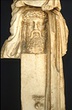
| A herm used as support for the left arm of la large statue carrying a child.
Upper half of the child is missing as well as the entire statue, whose left arm rests on the head of the herm. The base of ... 2nd c. A.D ... Upper half of the child is missing as well as the entire statue, whose left arm rests on the head of the herm. The base of the herm is somewhat chipped.
... S 2144 (ΣΑ 3253).
Cf. the description of the Herm of Alkamenes in Richter (1929) , Sculpture and Sculptors of the Greeks, p. 236, fig. 628 (p. 182, fig. 673 in the 4th edition 1970): "The style of the herm is evidently archaistic, the formal treatment of the hair and beard being conditioned by its architectonic character, for the rendering of the eyes places it in the second half of the fifth century." |
| Agora 2, no. 18. Agora 5, G 182. Well. Kroll 1973, p. 324, no. 1. Walker 1980, p. 63, no. 36. Cistern. P.E. Corbett, Attic Pottery of the Later Fifth Century from the Athenian Agora, Hesperia 18, 1949 ... Agora 26 305 P 5364 D 11:1 D 15:3 D 17:5 A-B 19-20:1 D-E 8-9:1 E 14:2 ... Time of Hadrian ... Corbett, Attic Pottery of the Later Fifth Century from the Athenian Agora, Hesperia 18, 1949 (pp. 298-351), p. 343, no. 140 ... Thompson, Three Centuries of Hellenistic Terracottas: V the Mid-Second Century B.C., VI Late Second Century B.C. to 86 B.C., Hesperia 34, 1965 (pp. 34-71), pp. 50 |
| Two joining fragments giving part of shoulder and most of the picture.
Two rows of blobs, row of dots between them, on shoulder. On wall, battle scene, onlooker at right. Two rows of dots above.
No added ... January-February 1950 ... Two joining fragments giving part of shoulder and most of the picture.
Two rows of blobs, row of dots between them, on shoulder. ... Ure (1927), Sixth and Fifth Century Pottery from Rhitsona, pl. |
Two pieces preserving the nozzle and part of rim and wall.
Wall rounded; flat rim; broad nozzle with wick-hole not encroaching on rim.
Black glaze inside and out, except for two reserved bands around top ... 26 September 1947 ... Two pieces preserving the nozzle and part of rim and wall.
... Type IV (later fifth century type) of Corinth collection, type 22B of Agora collection. |
| Thucydides, 2.14.1, 17.1-3. J.S. Boersma, Athenian Building Policy from 561/0 to 405/4 B.C., Groningen 1970, chap. VII, pp. 82-89, esp. pp. 87-92. IG I³, 237. Attische Pachturkunden, no.43, p. 99. P.A ... Agora 19 155 ... Brunt, Athenian Settlements Abroad in the Fifth Century B.C., in Ancient Society and Institutions: Studies presented to Victor Ehrenberg on his 75th Birthday, Oxford 1965 (pp. 71-92), pp. 73-75 |
| Pollux, VIII, 86. Ath.Pol. 55, 5. Pausanias, I, 28, 5. Theofrastos, IV, 36. Demosthenes, LIV, 26. Agora, 003, no. 9. Ath.Pol. 7, 1. Agora, 003, pp. 30f. A.R.W. Harrison, Law-making at Athens at the End ... Agora 14 88 ... Harrison, Law-making at Athens at the End of the Fifth Century B.C., J.H.S., LXXV, 1955, pp. 26-35 ... S. Dow, The Athenian Law Code of 411-401 B.C., Hesperia, 10, 1941, pp. 31-37 ... S. Dow, The Law Codes of Athens, Proceedings Massachusetts Historical Society, LXXI, 1953-1957, pp. 3-36 |
| Inscribed fragments.
List of names; "POLETAI" record.
Fragment Ζ 331 a), inscribed fragment.
Broken on all sides.
Nine lines of the inscription preserved, with a space between the fourth and fifth.
Fragment ... First half of 4th. century B.C. |
| A Tholos eaves tile, fragmentary but complete save for the tip, which has been restored on the evidence of A 864 (Ζ 1540). A triangular rain tile, its sides equipped with heavy flanges below, with light ... 15 February 1938 ... A Tholos eaves tile, fragmentary but complete save for the tip, which has been restored on the evidence of A 864 (Ζ 1540). A triangular rain tile, its sides equipped with heavy flanges below, with light flanges above. The under flanges are channeled toward the lower edge of the tile so as to grip a projection on the cornice. ... Like A 856 (Ζ 1532) ff., in contexts of the late fifth century, and would seem to have been discarded after the building was damaged by fire at that time. |
Nozzle and part of adjoining rim preserved.
Large, rather square ended nozzle, grooved around outer edge of upper surface. The groove ends in round holes where nozzle joins rim.
Black to brownish glaze, ... 22-23 June 1939 ... Large, rather square ended nozzle, grooved around outer edge of upper surface. The groove ends in round holes where nozzle joins rim.
... Deep cutting, sand fill, late fifth century. |
Horizontal band handle at back, and end of nozzle missing.
Ring foot; two ridges on the down-sloping top.
Black glaze inside only.
Type V (third Variety) of Corinth collection, type 24A' of Agora collection ... 10 June 1947 ... Ring foot; two ridges on the down-sloping top.
... Green late fifth century fill between drain and wall at west. |
Bookidis, Nancy ... American School of Classical Studies at Athens ... The fifth part of the Corinth volume dedicated to the Sanctuary of Demeter and Kore publishes the large-scale terracotta sculpture found in the sanctuary. Extending from the late 7th through the 4th century ... 2010 ... The fifth part of the Corinth volume dedicated to the Sanctuary of Demeter and Kore publishes the large-scale terracotta sculpture found in the sanctuary. Extending from the late 7th through the 4th century B.C., the sculpture consists of fragments from 132 to as many as 147 statues, from half- to nearly life-size. ... Several introductory chapters discuss the types represented, the findspots and possible original placement of the sculptures, and the techniques involved in their construction. |
| Potters; Painters; Groups and Classes. Early Red Figure Pot Painters. Early Red Figure Pot Painters; The Andokides Painter and The Earliest Red Figure. The Pioneer Group. The Pioneer Group; Euphronios; ... Agora 30 viii ... Late Fifth Century Pot Painters; The Meidias Painter and His Circle ... Late Fifth Century Pot Painters; Other Late Fifth Century Pot Painters ... Late Fifth Century Pot Painters; Late Fifth Century Painters of Small Pots |
|
|
.png.icon.jpg)
.jpg.icon.jpg)

.png.icon.jpg)
.png.icon.jpg)
.png.icon.jpg)
.png.icon.jpg)
.png.icon.jpg)


.png.icon.jpg)
.png.icon.jpg)

.png.icon.jpg)
.png.icon.jpg)
.png.icon.jpg)