|
|
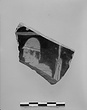
| Wall fragment.
Youth standing left, wearing pilos and chlamys; spear or stuff in his left hand.
Relief contour; a little dilute glaze for details. Good glaze inside.
ADDENDA Danae painter - cf. bell ... 25 April 1957 ... ADDENDA Danae painter - cf. bell krater in Syracuse, GRV, 666,7 [JDB, Aug. 1957]. |
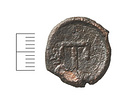
| Complete.
Obverse: head of Athena, left, in Attic helmet, struck off-center to lower left.
Reverse: lower strands of Athena's hair.
Sampi overstruck on bronze coin of Syracuse.
Cf. McClean I, p. 98, 15-17 ... 4 June 1973 ... Sampi overstruck on bronze coin of Syracuse.
Cf. McClean I, p. 98, 15-17. |
Mouth missing.
Flaring ring foot; concave handle. Narrow body. Drip-ring at junction of body and neck. Reserved: beneath foot and a band round the body, the latter decorated with an added red band, cf ... Early 6th c. B.C ... Glaze worn in many places.
Syracuse, from Megara Hyblaea, Sep. 816, has the reserved band with added red stripe in it. |
Wall fragment from bottom of figured zone. Glaze thin in places on outside. Max. dim. 0.079.
Man (legs from the knees down) to right, facing a woman (feet, a little bit of drapery at break). At the left, ... Ca. 440-430 B.C ... The two figures may have looked somewhat like those of Choinos and Oineus (only reversed) on the later bell-krater by the Dinos Painter, Syracuse 30747 (ARV2 1153, 17; Addenda 336; Matheson, Polygnotos, p. 384, cat. no. |
Wall fragment from lower part of figured zone. Grainy black glaze on inside, streaked in places. Glaze on outside fired reddish brown. Max. dim. 0.113.
Woman (lower part of chiton and himation, feet) ... Ca. 460 B.C ... Vienna 1772 (ARV2 1072, 1; Addenda 325); Syracuse 22886 (ARV2 1073, 3); Adolphseck 40 (ARV2 1073, 11; Addenda 326); Villa Giulia 3582 (ARV2 1073, 12). |
Two non-joining fragments.
Ring foot, lipped, with concave moulding beneath. Thickened rim, sloping inwards, inturned. A fillet on the lowest part of the wall. Decoration inside: enclosed ovules, linked ... 430-420 B.C ... Others with palmettes in the bowl and on rim: Oxford 1934.296 and Syracuse 24042. See also Sèvres inv. 2042: CVA (13) pl. 50(579) 2 and 12; inside, a cross formed of four small leaves, then palmettes and ivy leaves alternating, set on a circle; palmette chain on the rim. |
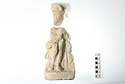
| Draped female figure preserved from waist to ankles.
She wears a chiton, which clings closely to her. Around the lower part of her body she has thrown her heavy himation of which one end is tossed over ... February 1936 ... ADDENDA "Syracuse" type (AS 2009). |
Wall fragment from near handle and a little of the return below the rim. Max. dim. 0.085. Matheson, Polygnotos, p. 368, cat. no. CHR 17.
Woman (most of head with fillet, right half of body to waist) to ... Ca. 440 B.C ... CHR 40, pl. 111] and Syracuse 35188 [ ARV2 1048, 41; Addenda 321; Matheson, p. 373, cat. no. |
Shoulder and wall fragment from upper right corner of panel. Glaze rather dull. Max. dim. 0.087.
Warrior or Amazon (part of helmet and crest, about half of round shield) to left. To judge from the outstretched ... Second quarter of the 5th century B.C ... For the horsehairs of the crest, see these two parallels: Philadelphia 48.30.3 by the Oreithyia Painter (ARV2 496, 4) and the namepiece of the Painter of Syracuse 23510 (ARV2 510, 1). 184 is closer to the latter, but there is not enough preserved to be sure of an attribution. |
Floor fragment with start of stem. Two concentric circles with central dot on underside. Max. dim. 0.053. H. A. Thompson, Hesperia 28, 1959, pl. 22:b; Schefold, Göttersage, p. 154, fig. 203; LIMC V, 1990, ... Ca. 510 B.C ... The earliest known literary reference is Pindar, Pythian 2.21--48, composed in the 470's for Hieron of Syracuse.
The Hermaios Painter (ARV2 110, 7; Addenda 173). |
Rim fragment. Narrow reserved band on inside at rim. Max. dim. 0.097.
Below rim, egg pattern with dots on fascia; then a concave molding decorated with a ribbon pattern with dots in the interstices.
... Ca. 440 B.C ... For the ribbon pattern, not common on the rims of bell-kraters, see Villa Giulia 50590 by the Hischylos Painter (ARV2 162, 5; Addenda 182); Argos, C 909 by Hermonax (ARV2 485, 23; Addenda 248); Oxford 1954.246, probably by the Painter of the Woolly Satyrs (ARV2 614, ---, 2); Boston, M.F.A. 10.215 by the Chicago Painter (ARV2 629, 20); two by the Barclay Painter: Louvre A 488 (ARV2 1067, 2) and Basel, Antikenmuseum und Sammlung Ludwig, Kä 404 (ARV2 1067, 2 bis; 1681; Paralip. 447, 2 bis; Addenda 325; CVA, Basel 3 [Schweiz 7], pl. 12 [324]:1,2); Syracuse 22886 by the Eupolis Painter (ARV2 1073, 3); four unattributed examples: from Olynthos inv. 8.56 (Robinson, Olynthos V, pl. 65:110), Louvre G 485 (CVA, 5 [France 8], pl. 32 [373]:1, 3, 4, 6), Delos, no no. |
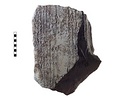
| Fragments of inscribed block.
List of names; possibly the list of those who lost their lives at Syracuse.
Fragment Η 419 a), broken away above, below, and to the left. The right side has anathyrosis ... Late 5th. century B.C ... List of names; possibly the list of those who lost their lives at Syracuse.
Fragment Η 419 a), broken away above, below, and to the left. |
Wall fragment with part of rim. Reserved line on inside at junction of rim. Max. dim. 0.13.
Warrior (feet missing), nude but for his helmet, attacks to left, his spear in his slightly raised right hand, ... Ca. 440-430 B.C ... PGU 85); Brooklyn 09.3 by the Cassel Painter (ARV2 1084, 15; Addenda 327); Syracuse 37175 by the Orpheus Painter (ARV2 1104, 2; Addenda 329). |
Wall fragment. Glaze thin in places on outside. Max. dim. 0.113.
A, male pursuing a woman. Parts of three figures remain: at the left, a bit of the himation and chiton, and left foot of a woman running ... Ca. 460 B.C ... The border of esses for the bottom of the woman's chiton is a distinctive pattern that appears in the work of both painters: the Boreas Painter: New York, M.M.A. 96.19.1 (ARV2 536, 5; Addenda 255) and Munich 2375 (ARV2 537, 9; Addenda 255); the Florence Painter: Syracuse 21189 (ARV2 541, 4) and Louvre G 360 (ARV2 541, 8). |
Three non-joining fragments: P 22490 of rim and start of wall; P 30996 of rim; P 13366 of wall and cul with stub of handle. Reserved line at top of rim on inside. Max. dim. P 13366: 0.105, P 22490: 0.083, ... Ca. 500-490 B.C ... Black palmettes do not seem occur elsewhere on the culs of red-figured calyx-kraters, but they are known from two black-figured examples, both related to the Antimenes Painter: Syracuse, where a single palmette at each handle frames the figured composition (ABV 281, 18) and Louvre F 316 (ABV 281, 19). |
Lower half of body, all of torus foot, start of handle B/A. Strengthened with plaster. Thin reddish glaze on inside. Misfired reddish in places on outside. Pitted here and there. P.H. 0.035. R. R. Holloway, ... Ca. 440-430 B.C ... For two or three continuous units with saltire-squares, see Syracuse 44291, a bell-krater in his manner (ARV2 1041, 9; Addenda 319; Matheson, p. 444, cat. no. |
|
|