|
|
Base and stem preserved.
Chip missing from side of base.
Wide base with downturned edge.
Colorless glass. Trench to stone Drain at S.E. corner of section. 3357 Leica PD 2023-8 ... 31 March 1953 ... Trench to stone Drain at S.E. corner of section. |
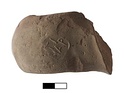
Fragment from wall of a small closed vase; thin black glaze on outside.
Scratched through the glaze: Tholos trench W, inside small stone drain, early 5th. c. B.C. 2469 Leica PD 1133-1(A 4) ... 27 April 1938 ... Tholos trench W, inside small stone drain, early 5th. c. |
Most of rim and discus preserved; end of nozzle missing.
Rays on deeply sunken discus, vine leaves and grapes on rim.
Yellowish-gray clay.
Type XXVII of Corinth collection. Stone Drain at Southeast corner ... 31 March 1953 ... Stone Drain at Southeast corner of section. |
| Large, broad; junction with neck not completely preserved.
Rather coarse red clay; remains of cream slip.
Impression shallow; large sharp letters, squarish with rounded corners. Stp: sqr, w/ rnded corners(VG)* ... 10 May 1932 ... From stone drain with sherds from bottom of drain and earlier date. |
| Intact.
A. female head, right.
B. head left, helmeted (?). At surface of stone packing between drain and house wall. 8222 Leica ... 1 April 1949 ... At surface of stone packing between drain and house wall. |
Small fragment from bottom of lamp with part of signatures in raised letters.
Black glaze.
Pinkish-buff clay.
Type XVIII of Corinth collection, Signed Bases type of Agora collection.
Cf. L 2055.
In ... 27 April 1947 ... In Stigma stone drain; Box 210. |
Handle and end of nozzle missing.
Plain rim and discus. Lugs on each side.
Matte red glaze on upper part only, and dripped on to lower part.
Red clay.
Type XXIV of Corinth collection. Stone Drain at Southeast ... 31 March 1953 ... Stone Drain at Southeast corner of section. |
Mended from numerous fragments; partly restored in plaster. Half egg shape on high ring foot. Spurred handles. Garland on wall.
Black glaze, mottled and worn. Pink clay. Silt in northward continuation ... 10 August 1961 ... Silt in northward continuation of stone drain bordering west side of S.W. |
| A small segment remains, including a little of the rim.
A shallow basin with slightly offset and sharply profiled rim, with two grooves around the outside.
The floor was slightly stippled, its mid-part ... 28 April 1938 ... Tholos Trench W, inside small stone drain. |
Only the upper part remains. Restored in plaster. Neckless; rim sharply everted; strap handle attached to rim. Rounded bottom.
Gritty buff clay with very sketchy brown wash.
Another such in storage ... 10 August 1961 ... Silt in northward continuation of stone drain bordering west side of S.W. |
Nozzle missing and much of wall.
Slightly defined base; central tube.
Thin black glaze on floor and in two broad bands on rim.
Pale buff clay.
Corinthian (?).
Type IV (early 5th. century group) of Corinth ... 27 April 1938 ... Tholos Trench W, inside small stone drain. |
Three joining pieces preserve slightly less than half of plate. Very low ring foot; wide rim with upturned lip. Rouletting on outside of lip.
Cinnamon-brown clay with mica in it. Red glaze badly peeled ... 31 March 1953 ... Trench to Stone Drain at S.E. corner of section, north of Roman wall. |
Inscribed fragment of round stone.
Originally spherical in shape with round hole through center.
Six letters remain.
Pentelic marble. Found in late Roman context in terracotta drain, at the north foot ... 10 May 1939 ... Inscribed fragment of round stone.
Originally spherical in shape with round hole through center.
... Found in late Roman context in terracotta drain, at the north foot of the Areopagus. |
| Broken on all sides.
Parts of four lines of the inscription preserved.
Hymettian marble. Found in mixed Hellenistic and Roman context, outside the Market Square, to the southwest, in the disturbed area ... 4th. century B.C. |
Inscribed fragment.
Inscribed face and original top preserved.
Parts of three lines of the inscription preserved.
Whitish limestone. Found in Byzantine context east of the Great Drain, in the industrial ... 16 April 1947 |
| Inscribed fragment.
Inscribed face only preserved.
Five lines of the inscription preserved.
Hymettian marble. Found in Byzantine context in the industrial area, east of the Great Drain. 4888 Leica, 89-28-20, ... 3 June 1947 |
| Inscribed fragment.
Inscribed face only preserved.
Four letters remain.
Hymettian marble. Found in Turkish context under Holy Apostles Street, west of the Great Drain, between the Middle Stoa and the Heliaia ... 24 April 1935 |
Fragment of inscription.
Top, back and right side preserved; broken at left and below.
Three lines of the inscription preserved.
Hymettian marble. Found in mixed Hellenistic to late Roman context, south ... 2nd. century B.C. |
Inscribed fragment.
Rough edges all around, but right side and back may represent original surface of stone as used.
Letters roughly cut on poor surface.
Blue limestone. Found in Byzantine context east ... 4 April 1947 ... Rough edges all around, but right side and back may represent original surface of stone as used.
Letters roughly cut on poor surface.
... Found in Byzantine context east of the Great Drain, in the industrial area. |
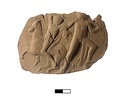
| Plaque with battle scene; youth attacking rider.
Mended from four fragments; edge along top broken. Top of head of standing youth missing, and tip of shield which he holds on his left arm.
Perhaps a trial ... 10 May 1932 ... Back of stone drain.
Early Hellenistic (?) |
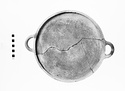
| Mended from three fragments. Complete. Shallow; slightly incurved rim; two horizontal handles attached to rim.
Bean parcher.
Brown clay containing very fine grit. Blackened by fire on floor and underside ... 10 August 1961 ... Silt in northward continuation of stone drain bordering west side of S.W. |
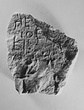
Inscribed fragment.
Inscribed face only preserved, a thin sliver.
Five lines of the inscription preserved.
The marble heavily veined with quartzy grayish-green.
Pentelic marble. Found in Hellenistic context ... 8 June 1939 |
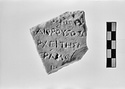
Inscribed fragment.
Chip missing from upper left corner, center right, possibly lower left.
Stone used twice, first inscription partially erased, then turned upside down and used again. Second clearer ... 22 April 1953 ... Chip missing from upper left corner, center right, possibly lower left.
Stone used twice, first inscription partially erased, then turned upside down and used again. Second clearer inscription.
Gray stone, Hymettian marble ... Found in drain, southeast of the church of the Holy Apostles. |
Inscribed fragments.
Two joining fragments.
Broken at bottom, piece missing from lower left side, and chips from upper left and right corners.
Six lines of the inscription preserved.
Hymettian marble ... 2 April 1952 |
Inscribed family grave stone.
The top broken off.
Tapering stele with a projection (now worn away) across the bottom.
The letters at the right side preserved where they were covered; worn farther to ... 6 May 1949 ... Inscribed family grave stone.
The top broken off.
... Found as step or paving slab in street just to west of bridge over Great Drain, southwest of the Market Square. |
| About half of rim and wall missing; also one handle. Mended from four fragments. Plain lip, straight wall, low base ring; spurred strap handles. Ivy garland high on wall.
Red clay, mottled black glaze ... 10 August 1961 ... Silt in northward continuation of stone drain bordering west side of S.W. |
Fragment from floor and rim with handle stub. Shallow bowl; sharply inturned rim. Trace of vertical handle rising from rim.
Clay black at core, brown on surface, containing much fine grit.
Very similar ... 10 August 1961 ... Silt in northward continuation of stone drain bordering west side of S.W. |
Inscribed fragment.
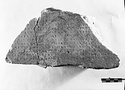
Letters inscribed on a partially smoothed down broken surface; back worn smooth; worn breaks at sides and top, in crude pediment form, may be contemporary with inscription; broken at ... 1st. century B.C. |
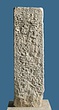
| Inscribed boundary stone of Agora.
The corners of its upper are much rubbed. All surfaces were roughly picked.
On the broad face that looks norheast, a band was smoothed with a toothed chisel across the ... 27 February 1938 ... Inscribed boundary stone of Agora.
The corners of its upper are much rubbed. ... One line of the inscription preserved, around top and right side of stone.
Coarse-grained white marble, with bluish streaks ... Found in situ at the fork in the ancient road ca. 4.00m. south of the fork in the Great Drain, to the East of the Tholos. |
Fragment of top part; back and left side preserved.
On rim, impressed ovules, interrupted at the nozzle; at the break, a bit of the volute on the left side preserved.
Discus plain, almond-shaped, with ... 17 May 1932 ... In stone drain. |
Inscribed fragment.
Rough broken edges all around.
The sides, except for chip at upper left corner, and diagonal break at lower left, are probably the original edges of stone as inscribed; the slightly ... Ca. 400 B.C ... The sides, except for chip at upper left corner, and diagonal break at lower left, are probably the original edges of stone as inscribed; the slightly rougher surface across the top probably represents a later break.
... Found in Hellenistic context east of the Great Drain, in the industrial area. |
| Fragment from side of a shallow bowl.
Broken all around.
Decoration from top to bottom: 1) Bottom of a row of hooks; four grooves as border. 2) Zone with tree and curved garland. Border of cross hatching ... 31 March 1953 ... Trench to stone Drain at S.E. corner of section. |
From side of bowl. Female figure with flowing drapery (high girt chiton with over-fold and swallow-tailed scarf) moving right, her left arm outstretched, her right hand on her hip.
Good black glaze, ... 16 May 1949 ... Stone packing about TC rectangular drain. |
| Inscribed.
The bottom, and both sides, slightly hollowed out. On the top, the dolphin extends from corner to corner diagonally, in a sunken panel. Below the dolphin, a raised letter, M; above, N A, retrograde ... 30 March 1934 ... Stone fill in drain over stereo.
|
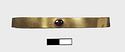
| Bracelet set with red stone.
Intact though slightly bent.
A plain band of solid gold with a single small oval red stone set in it. Χρυσό ψέλιο με κορνηλίνη. Rectangular feeder drain which enters the Great ... 3 December 1948 ... Bracelet set with red stone.
Intact though slightly bent.
A plain band of solid gold with a single small oval red stone set in it ... Rectangular feeder drain which enters the Great Drain from the north west at about the middle of the Poros Building south of the Tholos (a small part had been exposed by rain). |
| Broken on left end, finished with anathyrosis on right end; rough picked on back; very rough worked on bottom. The thickness at the front is less than that at the back.
At the right end on the under side ... 30 March 1933 |
Full height of side preserved, less than one-quarter of circumference. Thickened lip; vertical side with two grooves at bottom; part of almost flat bottom, but none of resting surface preserved.
Parts ... 7 April 1953 ... Stone Drain at S.E., 3rd. c. |
Inscribed fragment.
Broken at bottom and back. Front and sides smooth-finished.
Top smooth-finished only along front; picked behind.
Four lines of the inscription preserved; complete.
Hymettian marble ... 2 April 1948 ... Found in tumbled stone north of wall across Great Drain, southwest of the Market Square. |
Fragment from rim of a heavy plate with flattened turned-back rim.
Gray sand- or stone-biscuit; firm dark blue vitreous green glaze. Brick shaft and drain, fill B, late late Roman. 1593 Leica PD 1091-55 ... 1-2 June 1938 ... Gray sand- or stone-biscuit; firm dark blue vitreous green glaze ... Brick shaft and drain, fill B, late late Roman. |
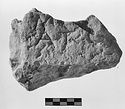
Triangular, flat; roughly flaked.
Flint. Well, Grave in Metroon, Drain cut, from the filling of the shaft. Cf. P 6072, P 6073. Leica ... 22 April 1935 |
Inscribed fragment.
A hunk of stone with letters on a very rough surface. Edges and back very rough, but may be contemporary with inscription.
Conglomerate; mortgage Horos.
Five lines of the inscription ... 13 June 1947 ... A hunk of stone with letters on a very rough surface. ... Found in the wall of a Byzantine house southwest of the Market Square, east of the Great Drain. |
Hoop made of spirally twisted wire enlarged at one end to hold socket for (missing) stone.
Socket bordered by loops of wire. Note that the wire of the hoop is smooth toward the small end, beaded toward ... 18 June 1965 ... Hoop made of spirally twisted wire enlarged at one end to hold socket for (missing) stone.
Socket bordered by loops of wire. ... Bottom of old coarse of Great Drain beneath Middle Stoa, south of pier 15; along with coins nos. 1-6. |
| Fragment of inscribed stele.
The back and the right side are preserved, the back rough picked and the right side smooth.
Preamble of decree restored to the Archonoship of Nikokles.
Parts of nine lines ... 302/1 B.C ... Parts of nine lines of the inscription preserved; stoichedon.
The stone is much water worn.
... Found in late Roman context in the big drain, west of the Panathenaic Way, at the northwest corner of the Library of Pantainos. |
| Fragments of an inscribed stele.
Two joining fragments show letters; thickness of stone preserved; back rough picked.
Left side shows toothed chisel, with drafted edge; right side possibly cut subsequent ... Early 3rd. century B.C ... Two joining fragments show letters; thickness of stone preserved; back rough picked.
... ADDENDA Two other fragments similar, but with no traces of letters, preserved, one from a corner (H. 0.175m.; W. 0.175m.; Th. ca. 0.08m.) back rough picked; the other showing top or bottom, of stone (H. 0.235m.; W. 0.287m.; Th. 0.095m.), back (?) ... Found attached to slabs over the Great Drain, east of the Metroon. |
| Inscribed fragment.
Upper right part of a pedimental stele, its lettered face crowned by an ovolo and a cavetto moulding.
The broken top of another pedimental stele lay nearby.
These pieces are of interest ... Middle of 3rd. century B.C ... Six lines of the inscription preserved.
The stone much worn by traffic on all sides.
... Found in a context of the 1st. century B.C. in Middle Drain, southeast of the Tholos. |
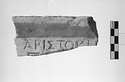
| Inscribed fragment of statue base.
Moulding on bottom indicates that it was top of pedestal statue base.
Inscribed face shows that this is the left portion.
Reverse and top are rough picked. Upper lines ... 18 July 1966 ... Letter spacing: 0.009m.
Stone is smooth on inscribed and left sides.
... Plugging tile water drain in late addition to Roman Wall. |
| Inscribed fragment.
Inscribed face and a bit of back preserved.
Mended from two pieces. Found face up.
Decree in praise of the sitophylakes of the archonship of Athenodoros.
Thirteen lines of the inscription ... 240/239 B.C ... Ephoreia (31/7/1987)-storage of stone objects Plato Academy (Drakontos 7 st); joins with M 2136 ... Found in the wall of a built drain of late Roman date, over the north end of the East Stoa. |
| Inscribed fragments; traces of a moulding at the top.
Fragment Ζ 476 a), broken on all sides. The spring of a projecting moulding extends 0.03m. from the inscribed face of the stone.
Clear traces of ... a) (Ζ 476) 29 April 1933
b) (Ζ 1145) 13 May 1937 ... The spring of a projecting moulding extends 0.03m. from the inscribed face of the stone.
Clear traces of red in the letters. ... a) (Ζ 476), found in late Roman context in a pit, among loose stones, east of the Tholos.
b) (Ζ 1145), found in late Roman destruction debris of large monument at fork of Great Drain. |
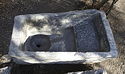
| Complete.
The tub is apparently made from a re-used block. It is broken away at the back. Running lengthwise through the under surface is a channel, possibly an indication of an abortive attempt to split ... 1939 ... The sides of the tub are 0.06m. thick; the back wall 0.08m. thick, the front wall 0.105m. thick. A drain-hole is cut through the left side of the tub, drawing water from the level of flow at its rear left corner. ... The rear end and the right side will have abutted against the walls of the room at the corner; the smooth-worked upper half of the front of the tub will have been visible; and the left side, which is provided with the drain-hole and crude anathyrosis along the top will have had a thin facing of stone or plaster. The rear end of the tub must have been raised higher than the front end, so as to allow the drain-hole to be at or a bit above floor level.
|
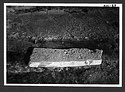
| Broken in two large and several small pieces. The inside edge and both ends are missing. The outer face is lightly stippled with at smoothed band along top and bottom. The under surface was rough-picked ... 1938 ... In the top are two rectangular sinkings centered 0.255m. from the outer face of the stone and 1.17m. from one another. ... Removed from the covering of Tholos Drain 2. |
|
|