|
|
Unpierced handle; chevrons on rim; jewelled cross in square discus; palm leaf on reverse.
Unglazed.
Brownish clay.
Type XXVIII of Corinth collection. Paved Building; soft fill on top of east wall at southeast ... 4 June 1938 ... Paved Building; soft fill on top of east wall at southeast corner. |
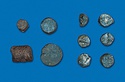
| The pieces are cut from a slightly polygonal rod.
Cf. B 1046 for similar flans from the same area. Originally entered as coins. Late fill on line of east wall of building II, i.e. the poros building southeast ... 3 June 1952 ... Late fill on line of east wall of building II, i.e. the poros building southeast of church of Holy Apostles. |
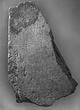
| Inscribed fragment.
Inscribed face, left side and back preserved; also the bottom which is cut as a tenon leaded to a depth of 0.075m.
Decree concerning the Skias, replacement of bedding etc.; Archon: ... 190 B.C ... Found in late Roman level in the Tholos Trench L, immediately southeast of the building. |
| Typical slim handle, rather descending.
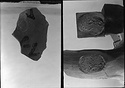
Large circular impression, from carelessly made clay die(good example for photograph); slightly incomplete both sides. Rdg: doubts about the rdg; =Qra"swn= usually ... 4 March 1933 ... Middle Stoa Building Field; southeast trench. |
| Complete corner block. Rough on back. Channels have curved top, slightly undercut. On top, mason's mark: Α. Painstaking work.
Possibly reused in Southeast Temple.
Pentelic marble. Found at R/6-15/12 (Fall ... August 1959 |
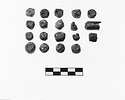
| Eleven pieces cut from a rod.
One of these is the remnant of the rod, become to short for further cutting. Eight pieces are "normal", two are scraps.
The cutting was done with a chisel anywhere from one ... 16 June 1953 ... Is poros building the mint - ΑΡΓΥΡΟΚΟΠΕΙΟΝ ?) ... Foundation blocks, northeast corner of the poros building, southeast of church of Holy Apostles. Found in removing a little firm ancient earth from above the edges of the foundation blocks at the corner of the poros building. Remains of small furnaces of the late Helenistic and early Roman periods. |
Building block reused for late Roman inscription.
Right side, back and bottom preserved, these being the bottom, side and end respectively of the building block upon which the inscription was cut, when ... 24 March 1937 ... Building block reused for late Roman inscription.
Right side, back and bottom preserved, these being the bottom, side and end respectively of the building block upon which the inscription was cut, when it was reused, on its end.
... Found in late Byzantine road fill, over the southeast corner of the temple of Ares. |
| Top chipped. Rough on both sides and behind. Tops of channels curved and slightly undercut. On top, mason's mark: Β. Rather course work.
Possibly reused in Southeast Temple.
Pentelic marble. Found at R/7-15/11 ... August 1959 |
| Complete. Channels terminate above in straight line, deeply undercut. On top are tong holes, one pry hole, and mason's mark in from of Ο.
Possibly reused in Southeast Temple.
Marble.
Same series as A 2975 ... August 1959 |
| Complete. Finished smooth behind; good anathyrosis on sides. Top of channels almost straight; deeply undercut. On top, one cutting for double T-clamp to tie triglyph to adjacent backer. Cuttings for lifting ... August 1959 |
| Good anathyrosis on left side; right side very rough; back scooped out to reduce weight (?). On top, large cutting for double T-clamp on left side, connecting not with metope but a backer. Two pry holes; ... August 1959 |
| Top drum, without flutes. On both the top and bottom the smooth dressed original outer joint surface stands out from the roughly reworked inner area. On the top a carefully cut mason's mark. Empolion cutting ... 3 June 1964 |
| Broken at ankles. Front left and back right corners of plinth missing.
Feet of Roman standing statue about life-size, with simple sandals with one strap across foot, one running down instep. Standing with ... 18 June 1974 |
| Broad handle, curving down close.
Fairly fine red clay with distinct lighter surface layer (with an inner break line) and gray core; light slip as on the Knidian handles.
Impression from an enghraved ... 6 March 1933 ... Middle Stoa Building Field; southeast trench. |
| A flake from the lower outer part of a base drum preserving parts of two flutes. Lower part of flute (0.07m.) finished delicately with the drove, upper part more carelessly. Very slight relieving surface ... 13 July 1960 ... Material and scale as well as provenance point to the Square Building - South Stoa II series. In the Square Building the fluting had probably only been started top and bottom, to be finished when the columns were used in South Stoa II. ... Cf. the history of the Thorikos columns reused in the Southeast Temple. |
| Fragment Θ 26 a), from right side of inscribed block; fine picked on one side, rough picked on the back.
Fragment Κ 115 b), back and left side preserved. Fifteen lines of the inscription preserved.
Fragment ... 127/6 B.C ... ADDENDA Most of the fragments of this inscription were found near the southeast corner of the Agora. ... The stele appears to have stood originally in front of the terrace of the Stoa of Attalos, about opposite Pier 5 from the south, and to have been broken up after the Herulian invasion for use as building material in the late Roman Fortification. A quantity of small fragments and chips from it, opposite Pier 5, presumably left behind when the stele was broken up for building use.
ADDENDA 2023:I 286 was found with IL 2281 (Lead Dowel)
Cf. |
|
|