|
|
A ram or sheep with heavy horns, moving right, its head bound with fillets. The loose ends of which hang down over the neck. The thin plaque of the background extended to the right and below, exaggerating ... Early fourth century B.C ... A ram or sheep with heavy horns, moving right, its head bound with fillets. |
Ram with pointed face and large curly horns.
Short fat tail.
Legs broken.
White slip.
Buff clay. Panathenaic Way, Cut IV, just West of LRFW, Cuttings F 1 and F 3 in bedrock. 1020-1024 Leica, 82-302, 84-61 ... 27-29 May 1959 ... Ram Figurine |
Intact except for head.
A crouching lamb or other small shaggy creature, on a base.
Vent hole in end. Little modelling. A painted "saddle". Much red, white, black and green paint preserved.
Smooth red ... 8 April 1936 ... Ram Figurine |
Legs, face, tail missing.
Handmade. Probably a sheep.
Buff clay. Well. Leica, 84-61 ... 15 April 1959 ... Ram Figurine |
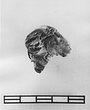
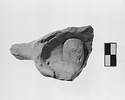
Fragment of left side of head of ram figurine.
Broken at neck.
Gouged technique. Remains of white paint.
Red clay. Pit. Leica ... 28 April 1932 ... Fragment of left side of head of ram figurine.
Broken at neck.
|
Ram 's head.
Broken away at the neck, behind, and at the top; the tip of the left horn is gone, also the lower part of the muzzle. Mended from four fragments.
The head of the ram is quite well modelled ... 16 May 1933 ... Ram 's head.
Broken away at the neck, behind, and at the top; the tip of the left horn is gone, also the lower part of the muzzle. ... The head of the ram is quite well modelled and is covered with a thick white engobe over which are traces of red.
... It may also have been part of a pot, with the rim projecting over the back part of the head of the ram.
Pinkish clay, not very fine. |
Plastic head of ram.
Most of one side preserved, and part of the other; the head is broken off below the jaw.
The animal has a large eye and curling horn; his coat is indicated by short gouged out strokes ... 3 August 1931 ... Plastic head of ram.
Most of one side preserved, and part of the other; the head is broken off below the jaw.
|
Part of left side preserved, from nose to back and top of head to breast.
Mouth missing.
Curly hair and huge coiled horn. Large vent in top of head, and pierced lug on back for suspension.
A well modelled ... 21 May 1936 ... Ram Figurine Fragment |
Fragment of head. The left ear and part of the eye are preserved, indicated by gouges.
The top of the head is bald, with heavy locks hanging below a wreath; Horn curling.
Mold made; hollow; Unglazed ... 25 June 1931 ... Ram Figurine Fragment |
Left side of head preserved.
Hole pierced through nose.
Crude technique.
Brick red clay, with traces of white slip. Clay dark gray on surface; edges blackened as if by burning.
Cf. T 50. Leica ... 11 July 1931 ... Ram Figurine Fragment |
Back of head and part of shoulder preserved.
The eye, the horn, and the fleece are gouged in.
Broken at bottom and along joint between two halves of mould. Muzzle missing.
Traces of red and white paint ... 19 May 1951 ... Ram Figurine Fragment |
Front legs folded back against chest, perhaps as result of accident when clay still soft.
Head missing.
Traces preserved of right ear (or horn).
Hard pinkish-buff clay.
Cf. T 3015. Panathenaic Way, Cut ... November 1959 ... Couchant Quadruped: Ram |
| Small well-modelled terracotta ram's head, facing right.
Retouched.
Gilding on horn.
Buff to pinkish clay. Kybele cistern. Leica, 80-81-19 ... 1935 ... Head of Ram Figurine |
| Zones of animals. Most of an animal (ram or bull), right; above, hoof of another animal (ram, boar or goat?), also right. Applied red.
Unglazed inside. Upper fill(?) Cistern. Box 76. 1812 ff. Leica ... 1933 ... Most of an animal (ram or bull), right; above, hoof of another animal (ram, boar or goat?) |
| An oval impression.
A: a nude bearded male figure, right, in process of sacrificing a ram.
Odysseus sacrificing a ram before his trip to the underworld (?)
B: smooth.
Unglazed.
Pinkish clay. Clearing ... 12 June 1937 ... A: a nude bearded male figure, right, in process of sacrificing a ram.
Odysseus sacrificing a ram before his trip to the underworld (?)
|
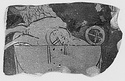
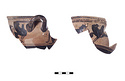
| From a bell krater, glazed inside. The top of a tripod with a ram sitting up in it; fragment of drapery in upper right corner. Medea boiling the ram? Pelias and his daughters?
ADDENDA Surface and edges ... 19-22 June 1935 ... The top of a tripod with a ram sitting up in it; fragment of drapery in upper right corner. Medea boiling the ram? Pelias and his daughters?
|
| Part of handle and body where handle was attached preserved, broken all around.
Orange-buff clay.
Head of ram.
From same die as SS 7258 but preserves the name of thee eponym not preserved on SS 7258 ... 1939 ... Head of ram.
From same die as SS 7258 but preserves the name of thee eponym not preserved on SS 7258 ... [ Ἡρά | κλειτο(ς)] Θ̣α̣σ̣[ί | Π]υ̣θόλε̣ω̣[ς]
head of ram |
| Cap(?). Head of ram.
Cf. Pridik (1917), p. 52, nos. 363-364, pl. IV 17, 18.
Early Thasian. Par: Pridik 1917, p52, 363--4, Pl IV, 17,18 (cf device)(VG)*
Msc: one found by [ ... ] among the unread, which has ... 1 April 1937 ... Head of ram.
Cf. Pridik (1917), p. 52, nos. 363-364, pl. ... [---]ς Ἡρα | κλείτο(ς) | Θασι[---]
head of ram |
| From the bottom of a large stand. Profiled lower edge preserved. Broad flat foot. Above, a zone of animals; ram to left, preceeded by another animal. Red for neck and belly of ram and for bands to either ... 18 June 1951 ... Above, a zone of animals; ram to left, preceeded by another animal. Red for neck and belly of ram and for bands to either side of rays on upper face of foot. |
Fragment of discus and rim.
Scrolls on the rim with dots and herringbone panels. A ram left on the discus.
Unglazed.
Light red clay.
Type XXVIII of Corinth collection. Modern. Leica ... 10 February 1937 ... Scrolls on the rim with dots and herringbone panels. A ram left on the discus.
|
| Single fragment preserves most of discus, with a ram, left.
Unglazed.
Reddish clay.
Type XXVIII of Corinth collection.
Cf. L 3005, Φ 289, from this same container. Well; container 62. Leica, LXIII-24 ... 6 April 1937 ... Single fragment preserves most of discus, with a ram, left.
Unglazed.
|
| Prow of terracotta boat. Blunt ram at front. Seat within. Very crude.
Reddish clay. Munsell (fabric) 5 YR 6/6 reddish yellow Oscar Broneer, Nb. No. 3. 33 86-5-7, 86-5-8 ... 13 December 1933 ... Prow of terracotta boat. Blunt ram at front. Seat within. |
| Wall fragment broken all around. Bearded man (portion of head and shoulders) to right and sheep. Incision. Red for beard.
ADDENDA Ram horn is white. MBM. Catalogued 28 July 1978. Stoa Gutter Well. 5504 ... 24 May-9 June 1954 ... ADDENDA Ram horn is white. |
On the discus, a ram, left; on the panelled discus, double spirals.
Solid grooved handle.
On the bottom, a single circular groove; traces of a signature inside (?).
Reddish clay.
Type XXVIII of Corinth ... 19 April 1934 ... On the discus, a ram, left; on the panelled discus, double spirals.
|
Single fragment preserves over half of low heavy ring foot and most of medallion inside (ram, left). Around medallion, grooves.
Red glaze on interior. Exterior unglazed. Dump (tiles, etc.) over Roman ... 28 April 1937 ... Single fragment preserves over half of low heavy ring foot and most of medallion inside (ram, left). Around medallion, grooves.
|
Part of one side and end of nozzle missing.
Rim, panelled, with spirals; discus, ram, standing left; handle, grooved, semi-pierced. Reverse, single circular groove.
Very thin red glaze.
Red clay.
Type ... 22 July 1947 ... Rim, panelled, with spirals; discus, ram, standing left; handle, grooved, semi-pierced. |
| Inside, part of a medallion surrounded by a purple band. Outside, from center, rays, three rows of dots, alternating; part of ram walking left. Purple red retouches. Disturbed Β' building fill; tiles ... 11 April 1935 ... Outside, from center, rays, three rows of dots, alternating; part of ram walking left. |
| Rough blocking, rather inept, of figure carrying an animal, perhaps a ram, on his shoulders, Kriophoros (?).
Head of man and part of animal broken away.
Unfinished.
Poros. Under projecting block of LRFW ... Roman period ... Rough blocking, rather inept, of figure carrying an animal, perhaps a ram, on his shoulders, Kriophoros (?).
|
From wall of a cup; inside glazed gray to black. Most of a ram, feeding left. Purple for neck; white for horn, belly and scrotum. Hasty incision for some details.
Pinkish-buff clay; good glaze fired ... 19-27 May 1937 ... Most of a ram, feeding left. |
Moldmade with gouged details. One fully curled ram's horn, an eyebrow and most of a human eye preserved.
Brown clay with thin black wash over, worn.
ADDENDA Knidian or Coan - jug in form of a ram [JWH] ... 27 April 1956 ... ADDENDA Knidian or Coan - jug in form of a ram [JWH]. |
Part of handle and back preserved. Vase probably in the form of a ram, with handle as the back. Mould-made. Fleece indicated by light incisions. Slashes along sides of handle.
Brown clay, gray on inside; ... 1964 ... Vase probably in the form of a ram, with handle as the back. |
Two non-joining wall fragments from below maximum diameter. Brownish black glaze on inside, streaked in places. Max. dim. a) 0.084, b) 0.057. W. B. Dinsmoor, Hesperia Suppl. V, p. 136, fig. 63:16.
Man ... Probably second quarter of the 5th century B.C ... Man or youth on ram to right. Fragment a preserves the lower border of his short chiton, the paw of a feline(?) skin hanging down alongside, most of his right leg and both feet, much of the body, shoulders, start of forelegs of ram. Fragment b shows the fetlock and hoof of the ram's left foreleg (will not match right foreleg on a). |
A small fragment of the discus and rim preserved.
The design of the rim has not been sufficiently preserved to be visible.
On the discus, the forepart of a ram in relief. The discus is edged by three grooves ... 16 May 1933 ... On the discus, the forepart of a ram in relief. The discus is edged by three grooves.
|
| Lip slightly out-turned; uptilted handle. Two rim fragments and one with handle preserved and wall fragments. Palmette to each side of handle; in band animals: lion, left, and ram, left, and part of another ... 28 May 1936 ... Palmette to each side of handle; in band animals: lion, left, and ram, left, and part of another lion, right. |
Intact except for chips.
Spirals on panelled rim. Ram, left, on discus; grooves and ridges at edge.
Semi-pierced handle, double grooved front and back.
Incised beneath, within a single groove.
Unglazed ... 10 June 1938 ... Spirals on panelled rim. Ram, left, on discus; grooves and ridges at edge.
|
| Two non-joining fragments; from an oinochoe or amphora. Thin brown glaze inside.
a) A ram bearing a boy in short jacket to right.
b) A foot of the beast and part of the maeander band.
Relief contours ... 13 March 1937 ... Thin brown glaze inside.
a) A ram bearing a boy in short jacket to right.
b) A foot of the beast and part of the maeander band.
|
| Fragments of top third of pot with mouth and handles, filled out in plaster; one non-joining fragment from lower wall preserved. Bauch-amphora with collar rim. On either side, in a reserved panel, bordered ... 7 April 1938 ... On either side, in a reserved panel, bordered top and sides by a single glaze line, a ram, walking right.
|
Mended from many fragments; a bit of the rim, at the nozzle, and of the rim and body at the back, right, missing.
Double spirals, panelled, on rim.
On discus, ram left.
Handle semi-pierced, triple grooved ... 3 March 1933 ... On discus, ram left.
Handle semi-pierced, triple grooved above, double below.
|
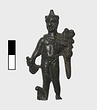
| Hermes stands facing, on a small concave sided base.
He is nude save for a twist of drapery around his shoulders.
In his right hand he carries a small bag, in his left a daduceus. On his head is a small ... 27 May 1935 ... Animal at feet (Ram ?).
Base missing (3/19/58, 9/2000). |
Mended from five pieces; none of the stem, and none of the rim preserved. Inside, small reserved medallion. Outside, below, a reserved band; above, a broad band with animals: on one side, a ram left, white ... 26 January 1937 ... Outside, below, a reserved band; above, a broad band with animals: on one side, a ram left, white for horn, top of head and spots on body, red on shoulder and rump; facing him a panther(?) |
| Intact.
On rim, panelled guilloche enclosing leaves.
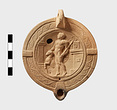
On discus, Hermes left, a cloak over his left shoulder, the caduceus in his left hand, leading a ram by the horns. Stele at left crowned by cap. Altar ... 17 March 1937 ... On discus, Hermes left, a cloak over his left shoulder, the caduceus in his left hand, leading a ram by the horns. |
| About one-half preserved, including one handle, mended into two large non-joining fragments (a, b), with two small non-joining fragments (c, d).
Out-turned rim with degenerate dot-ivy. Same scene both ... 6 July 1995 ... Same scene both sides: ram to right between sphinxes to left and right. |
Wall fragment. Burned (clay is gray). Glazed misfired reddish brown on outside. Max. dim. 0.06.
Pelias and daughters. The fragment shows the cauldron with the foreparts of the ram (head missing). On the ... Probably mid-5th century B.C ... The fragment shows the cauldron with the foreparts of the ram (head missing). ... The small part of the vessel indicates that this Peliad is Medea, for the vessel would hold the magic potion with which she will rejuvenate the ram. For two fuller examples, see London, B.M. |
| Mended from many pieces; fragments missing from walls, foot and rim; restored in plaster. At the top of the figured zone, below the lip, a vine-dot border.
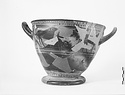
Sides A and B the same: in the center, Dionysos(?) ... August-September 1932 ... On each side of him a ram, right; to the extreme left, a satyr dancing right.
|
|
|