|
|
| For a pyxis of type D.
On top a wheel.
On underside, incised before glazing (Π):
No relief contour. North end of Stoa Terrace, from bottom of pit below the floor of a house between the foundation for ... 18 August 1953 ... Red Figured And White Ground | Pyxides | Type D |
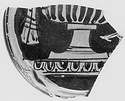
| About one-quarter of lid preserved; from a pyxis of type D.
Lower half of an elaborate pot: ribbed kantharos or standed krater standing on a band of egg and dot. The ends of a taenia hang beside the pot ... 18 May 1953 ... Red Figured And White Ground | Pyxides | Type D |
| Small chip missing at edge of rim. Rim neatly grooved and moulded.
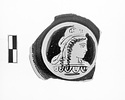
Male head left; a fillet around his forehead. Relief contour for profile and nape.
Lid glazed all over, except for inner moulding on ... 27 April 1954 ... Red Figured And White Ground | Pyxides | Type D |
Fragment with part of rim, its vertical edge grooved. Glazed on underside. Part of rim broken. Max. dim. 0.06; est. diam. 0.06.
On top side: kantharos or calyx-krater (ribbed cul, stem, and foot) standing ... Probably late 5th century B.C ... Red Figured And White Ground | Pyxides | Type D |
Intact except for chip in rim. H. 0.009; diam. 0.07. M. Lang, Graffiti in the Athenian Agora (Agora Picture Book 14), Princeton 1988, p. 16. fig. 44 (detail).
Filleted male head to left. Relief contour ... Third quarter of the 5th century B.C ... Red Figured And White Ground | Pyxides | Type D |
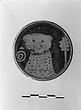
Lid. Part of the glaze abraded on side. Thin brownish glaze on underside. Diam. 0.07; H. 0.012.
On top side, head, neck, and upper part of chest of panther. At the right, a thyrsos; at the left, two concentric ... Probably late 5th century B.C ... Red Figured And White Ground | Pyxides | Type D |
Lid and pyxis intact except for a few chips. H. with lid 0.042; without lid 0.038; diam. of pyxis at bottom 0.067.
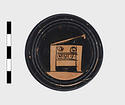
On top side of lid: chest with lid partly open.
Inscribed on underside of lid and glazed ... Late 5th century B.C ... Red Figured And White Ground | Pyxides | Type D |
Intact except for a chip or two and slight abrasion of the glaze. Glazed on underside. Diam. 0.07; H. 0.01. Agora XXVII, p. 168, cat. no. 12, pl. 31.
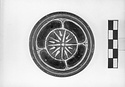
On top side: wheel with starburst pattern in center ... Probably late 5th century B.C ... Red Figured And White Ground | Pyxides | Type D |
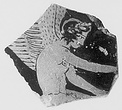
Fragment of lid. Glazed on underside. Max. dim. 0.036.
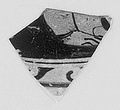
Eros (wreathed head, body, start of thighs, most of wings, outstretched arms, except for hands) to right. Preliminary sketch. Relief contour. Dilute ... Late 5th century B.C ... Red Figured And White Ground | Pyxides | Type D |
Fragment of lid with downturned rim, glazed on underside. Max. dim. 0.19.
Child (forearms, hand) crawling to right. On upper half of rim, hanging spirals ... Late 5th century B.C ... Red Figured And White Ground | Pyxides | Type D |
Most of the top of lid, a little of the side preserved. Rim around medallion molded; groove around inside of rim. Glazed on underside. Est. diam. 0.055; max. dim. 0.059.
On top side of lid, head of Phrygian ... Early 4th century B.C ... Red Figured And White Ground | Pyxides | Type D |
| From a small lid with edge turned down. Outer face of edge decorated with black hooks. On top, a pair of hands close together, one with a bracelet; compare the crawling children on the Choekännchen.
Attic ... 26 February 1934 ... Red Figured And White Ground | Pyxides | Type D |
| Small bulging flange, the lower edge reserved, the upper edge scraped, forming a slightly raised border around the lid.
Head and long neck of lion facing. In field right, thyrsos; left, concentric circles ... 20 May 1932 ... Red Figured And White Ground | Pyxides | Type D |
| Flat-topped lid for a small box; downturned flange. A small segment of rim and flange remain. Rim and border of central medallion are moulded. In medallion, head and shoulders of female figure facing right, ... 24-26 August 1937 ... Red Figured And White Ground | Pyxides | Type D |
| Intact when found; lid broken by a visitor, but mended complete except for chips.
Small pyxis with molded foot and inset lip. Resting surface and top of lip preserved.
Single letter scratched on bottom ... 27 April 1954 ... Red Figured And White Ground | Pyxides | Type D |
| Broken all around.
Eros, right, wreathed; arms outstretched. Ends of wings, hands and most of legs missing. Pose somewhat as if riding.
Relief contours; white berries in wreath. Thin fabric; underside ... (1953) ... Red Figured And White Ground | Pyxides | Type D |
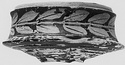
| Mended from four fragments; edges chipped, knob broken off at base. Flat-topped lid with inset flange, its outer profile concave. Black and reserved bands; band of tongues at base of knob and just inside ... 1 June 1965 |
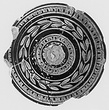
| [Originally identified as a pyxis.] Stem base and chips missing. Shallow type, with inset lip to receive cover. Projecting flange at bottom; black blobs on flange. Laurel wreath on sides. No relief contour ... 19 May 1938 |
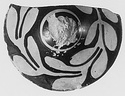
| Type A. About two-thirds preserved; knob broken off. Top rises toward knob in shallow concave curve. Edge bevelled and inset, to fit over inset rim of pyxis. Laurel wreath on the top. On the underside, ... 9 June 1949 |
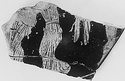
Wall fragment of pyxis with flange for lid. Groove just below flange. Surface incrusted with iron oxide accretions. Max. dim. 0.063.
Woman (lower legs, feet missing) dressed in a himation, standing to ... Ca. 450 B.C. |
Mended from three fragments. Knob broken off; rim chipped. Round with high-stemmed knob; sloping up toward center. Concave flange. Band of tongues around rim and around base of knob; band of double palmettes ... 31 May 1965 |
Fragment with start of brim. Glazed on underside, slightly abraded. Max. dim. 0.061.
Two women (torso and legs) to left, each in a chiton. Behind them, Eros (ends of wings, part of right leg) flying to ... Ca. 410-400 B.C. |
Wall fragment of pyxis with flange for lid. Max. dim. 0.042.
Woman (face, right shoulder, and right hand) to left, holding a lighted torch. She wears a peplos and necklace. White: necklace; flame of torch ... Late 5th century B.C. |
Lid, preserved except for knob and chips in brim. Band and four concentric circles with central dot on underside. Finger smudge in glaze on underside. Diam. 0.17; P.H. 0.15. R. R. Holloway, Hesperia 35, ... Late 5th century B.C. |
| Small fragment preserves part of a draped female figure leaning towards another figure at left. At right, the lower part of the wings and the leg of an Eros. At the edge below, start of the rim.
Glaze ... May-June 1949 |
Lid fragment, about two-thirds preserved with start of knob and incurving rim. Band and three concentric circles with central dot on underside. Glaze misfired brownish in places. Diam. 0.087.
On top side, ... Probably late 5th century B.C. |
About two-thirds of body and flanged rim of pyxis preserved. One foot missing; chip in another. Red wash on underside. H. 0.095; max. diam. 0.107. L. Talcott, Hesperia 4, 1935, pp. 476, fig. 1:2 and 480, ... Ca. 430 B.C. |
Wall fragment of pyxis with part of flange for lid. Max. dim. 0.059. D. B. Thompson, An Ancient Shopping Center (Agora Picture Book 12), Princeton 1971, fig. 57.
Wedding scene(?). A woman (preserved to ... Ca. 430-420 B.C. |
| Two pieces from an almost straight side wall. Slight out-turn at lip; vertical flange, inset from lip, reserved.
a) Part of ovule band preserved at top. Head and right shoulder of draped woman; head, in ... 28 May 1938 |
Brim fragment with groove at outer edge. A bit of the glaze lines flaked on left Niobid's himation. H. 0.014; est. diam. 0.14; max. dim. 0.09. C. Clairmont, AK 6, 1963, pl. 8:1, 2; Roberts, Pyxis, p. 133, ... Ca. 430 B.C. |
P 17517 a, b, c
Four nonjoining sections preserving slightly less than half of circumference of flange (a, b), part of edge of dome (c), and section of cylinder (a, b, d). (Only fragments b and c are ... 350-300? ... P 17517 a, b, c
Four nonjoining sections preserving slightly less than half of circumference of flange (a, b), part of edge of dome (c), and section of cylinder (a, b, d). (Only fragments b and c are illustrated.) ... Painted ovolo in this position is common on red-figured pyxides of Type C: Talcott and Philippaki 1956, nos. 138--140, 143--145, pp. 35--37, pl. 11. |
|
|