|
|
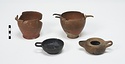
| A compact group of four complete vases and a lamp, found on a house floor; possibly the remains of a sacrificial pyre but without evidence of burning or the characteristic votive vases.
Layer II, "nest ... 425-400 B.C ... A compact group of four complete vases and a lamp, found on a house floor; possibly the remains of a sacrificial pyre but without evidence of burning or the characteristic votive vases.
... The pottery types suggest an identification as a pyre; the close similarity of the two skyphoi in size and firing (unevenly fired red) suggests that they were part of the same kiln batch and were purchased together. ... Neither burning nor bone is recorded (Young has not identified as pyre probably because of the early date, which would have made its burial after the abandonment of the house impossible). |
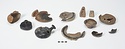
| Disturbed pyre dispersed in fill of Room 5, House D.
Pyre pots in very fragmentary condition were noticed by Barbara Tsakirgis in later analysis of pottery that had been excavated in 1938; no mention of ... 14 June 1938 ... Disturbed pyre dispersed in fill of Room 5, House D.
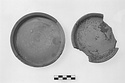
... Another group of pyre pots excavated in 1969 immediately to the east is probably part of the same disturbed group(s). It is likely that more than one pyre is involved: the two rilled-rim plates do not match and there are three lekanis lids (rarely does a pyre contain more than two lekanides). |
Both handles and fragments of body and rim missing. Ring foot; straight, not incurved, rim.
Pinkish-buff clay; red glaze. Finished Layer II, group of pots in S.E. corner. 642 Leica ... 31 July 1946 |
Small fragments of rim and handles missing. Thin fabric; ring foot; body curved in to plain rim.
Clay buff to gray; glaze red to tan and black; evidence of stacking when fired. Finished Layer II, group ... 31 July 1946 |
| Small lekanis: intact. Low ring foot; rim flanged at inner edge to receive lid. Brown glaze inside and out save for reserved bottom.
Lid: two joining fragments, one segment of rim missing. Flat-topped ... 2 May 1955 ... The lamp L 5203 (Τ 3201), found close by, is perhaps to be associated with the group ... Disturbed pyre burial. |
Small fragments of body missing. Ring foot; handle at level of plain rim; three grooves around wall.
Black glaze over all. Finished Layer II, group of pots in S.E. corner. 642 Leica ... 31 July 1946 |
| About half the rim missing; one small fragment joins; ohterwise intact. No base; the bottom flat and rough. Low rim, slightly rounded at the top.
The glaze thin and dull. Well, dump. Leica, 92-3-19 (group ... 12 April 1934 |
| Complete.
Ring foot; straight side wall; flat rim, grooved; rolled handle.
Black glaze inside.
Buff to gray clay, finely finished and unglazed on outside.
Type V of Corinth collection, type 24A' of Agora ... 31 July 1946 |
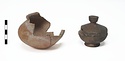
Mended from many pieces; small fragments of body and of rim missing. Squat round-bottomed body; round mouth; vertical band handle.
Cooking ware fabric; unglazed; wheel made. Not found in Dec. 2011 to ... 31 July 1946 ... Not found in Dec. 2011 to be put with the rest of the pyre ... Layer II, group of pots in S.E. corner. |
Repaired. Half foot missing and part of sides near shoulder. Herakles and three Amazons. Three dotted lines above. Rays on shoulder. White for flesh of Amazons and various ornaments; where it has been ... 24 March 1936 ... Cf. the Herakles and Amazons lekythos, Athens 400, which belongs to the Pholos group, closely related and probably a sub-division of haimon. ... Burned pit, pyre 2. Not on Agora grid. |
Wall fragment. Max. dim. 0.10.
Chariot (left hind leg of horse, hock of right; part of wheel) to left above pyre (top with flames). At the lower right, Nike (head with wreath, part of wing), also to left ... First quarter of the 4th century B.C ... Chariot (left hind leg of horse, hock of right; part of wheel) to left above pyre (top with flames). ... Herakles) and Ferrara 15637 = T.376 B VP from the Group of Ferrara T.376 B (ARV2 1424, 1; Addenda 376; LIMC V, p. 129, no. 2923, pl. 121). ... This may be the subject of 442, although normally a nymph, not Nike, appears next to the pyre dousing the flames, and the pyre is likely to be a jumble of logs. |
| Graffiti. Metal working, influence on pottery. Brann S 17-18. Brann R 22. Young pp. 225f. Miniature painting. Grinders, list of. Mourning women. Handmade pots. Mule. Heads, plastic. Mycenaean revival ... Agora 8 133 ... Kerameikos Mug Group ... Pyre Group |
|
|
.png.icon.jpg)