|
|
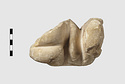
Part of one end preserved, but neither edge. On underside, lug for holding tile in position.
Island marble. Marble pile. Leica ... 20 June 1959 ... On underside, lug for holding tile in position.
Island marble. |
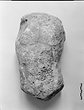
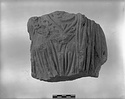
| Split off from background roughly on the plane of contact. Head, both arms and both legs broken off. Front of torso and breaks except those of back much weathered.
Nude male torso in more or less frontal ... March 1954 ... Nude male torso in more or less frontal position with both arms raised, legs apart, back arched so that small of back is cut free of background.
Shape and size of breaks on back and position of drill-channels indicate that this is the torso of Theseus from the Sinis metope, S II.
... From marble pile in position of Odeion stage. |
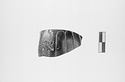
Handle missing.
Small one-handler; break at side gives position of handle. Flat bottom, plain rim. Purplish brown clay, buff surfacing, worn; streaky brownish glaze wash, applied by dipping, inside and ... Context ca. 425-400 B.C ... Small one-handler; break at side gives position of handle. Flat bottom, plain rim. |
| From lower wall.
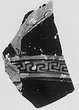
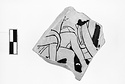
Male right lower leg in striding position.
Below, band of key pattern. Good glaze; dilute glaze for muscles. No relief contours. "Latrine" cut 3, green fill below floor F. 2115 Leica ... 16 May 1949 ... Male right lower leg in striding position.
Below, band of key pattern. |
Lower body and legs of a boy in a seated position, supported by a woman's hand which is life-size. The boy's body is nude, but a cloak covers his legs.
Pentelic marble. House 650 A/19. Leica ... 9 January 1959 ... Lower body and legs of a boy in a seated position, supported by a woman's hand which is life-size. |
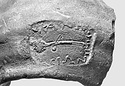
| Broad, ribbed handle of typical curve and position of seal.
Clay russet to ash-gray.
Impression carelessly made (clay die?) and shallow set. Stp: clay die?* Finished Middle Stoa Building Field with 4th ... 25 February 1933 ... Broad, ribbed handle of typical curve and position of seal.
Clay russet to ash-gray.
|
Fragment from upper part of lamp.
Grotesque head with pierced handle on forehead and filling hole behind it. Trace of wick hole in position of mouth.
Traces of matte brown to red glaze.
Thick yellow-buff ... 7 May 1952 ... Trace of wick hole in position of mouth.
Traces of matte brown to red glaze.
|
| Intact. Found in situ in the southwest corner of the small shrine with naiskos and round altar west of the ancient road and partly under the modern street. Removed from its position by some unauthorized ... 27 October 1965 ... Removed from its position by some unauthorized person in October 1965. |
| Upper half of body preserved.
Athena wears chiton with aegis over it, himation over left shoulder. Right arm, missing, doweled on separately, held in raised position.
Island marble. Byzantine wall over ... June 1959 ... Right arm, missing, doweled on separately, held in raised position.
Island marble. |
Dipinti; graffiti on flanges. Archaic.
Same series as A 2600 (Τ 3586).
For discussion of dipinti and graffiti see notebook p. 6157.
Finished Found in position in the archaic pipe line that fed the Southeast ... March 1956 ... Found in position in the archaic pipe line that fed the Southeast Fountain House; cf. |
Knob missing.
Lid. Flat top with two grooves. Raised disc beneath with two small tabs projecting from it. The position of one of the tabs is indicated on the top by a scratch made in the soft clay before ... 5th c. B.C ... Raised disc beneath with two small tabs projecting from it. The position of one of the tabs is indicated on the top by a scratch made in the soft clay before glazing. |
| Depicts leg in horizontal position so that figure was prostrate or swimming or running rapidly. Brownish glaze on a slip of the pinkish brown clay; incision for ankle and toes. Inside covered with silvered ... 29 February 1932 ... Depicts leg in horizontal position so that figure was prostrate or swimming or running rapidly. |
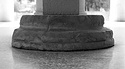
| Cuttings in under side for two channel dowels placed on radii alternating with dowels in top of base; dowels centered 0.20m. in from periphery.
From Stoa of Attalos.
Removed from poros bedding below base ... 5 August 1955 ... In Lower Colonnade beside its original position ... Found in situ in first position from south in inner colonnade; removed by engineers after repeated discussion in the course of which it was decided that the ancient base, cracked and faulty, should be replaced with a new base to carry the weight of the new column. |
| Single fragment preserving one-quarter of the circumference of neck wall: transition from neck to shoulder.
Offset ridge rides fairly high on neck, though position of handles and rim unclear.
Smooth ... 9 August 1994 ... Offset ridge rides fairly high on neck, though position of handles and rim unclear.
|
| Head, arms, lower legs and feet missing.
Female figure in twisted position. She lies on her stomach with body from waist up held upright in frontal position, with arms placed horizontally across the body, ... 1938 ... Female figure in twisted position. She lies on her stomach with body from waist up held upright in frontal position, with arms placed horizontally across the body, with hands meeting in center. |
Fragment from wall of a cup. Preserved is the greater part of a nude man and woman in erotic position; at right and below, part of another figure or object. Purple for man's hair, white for woman's flesh ... 23 May-3 June 1938 ... Preserved is the greater part of a nude man and woman in erotic position; at right and below, part of another figure or object. |
Part of dome, flange, and cylinder preserved.
High dome. Flange thickened at edge, with stamped ovolo on reserved face. Dome: volute garland running right, with white dots within tendrils (now missing) ... 290-275 ... For stamped ovolo in this position cf. Kopcke 1964, no. 4, pp. 26--27, pl. 10:3. |
Half of upper body and part of one spout preserved.
High upper body. Two scraped grooves at junction of upper and lower body. Spiral wave pattern running right on upper body, with dolphins above; olive(?) ... 225-200 ... For dolphins in this position see Alt-Ägina II, i, no. 493, p. 70, pl. 38. |
| Wall fragment, broken all around. Upper wall of mug, probably of Phideas shape. Ribbed wall. In gap between ribs, stamped palmettes. Probably same palmette stamp as P 31451; probably from the same vase ... 27 June-5 August 1972 ... Agora XII, nos. 207, 408, for stamped decoration in this position. |
Clay fine, buff, fairly soft. Solid. Head, arms, right leg and left below knee are missing. Modeled fully behind. Traces of white slip with touches of yellowish color.
Carefully modeled torso is in a ... Late fourth century B.C ... Carefully modeled torso is in a position straining upward and towards the right. |
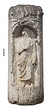
| In a niche in the column, there is a standing man in relief. The face is broken off. He wears a long robe. His left arm hangs at his side, his right across his chest. Inscribed on column below. Parts of ... 14 November 1934 ... Parts of two lines; better reading perhaps when in better position.
Pentelic marble.
|
About one-third of floor and foot preserved. From a bowl with rounded wall and low ring foot. A ridge on the floor just outside the position of the foot. At center of floor a stamp, partly preserved: cross ... 1931 ... A ridge on the floor just outside the position of the foot. |
Part of flattish irregular clay ring with signs of attachment of originally six small standing figures. Restored with one such figure in position.
Applique headdress, arms stretched forward, cleft face ... November 1959 ... Restored with one such figure in position.
Applique headdress, arms stretched forward, cleft face.
|
Plastic Attachment From Large Open Vessel: Pan.
Wall fragment.
Scraped groove on wall at level of bottom of attachment. Trace of something, possibly a bolster, resting above head of attachment.
Beardless ... 240-200 ... For scraped groove in this position on bolster bowl cf. 581, 586. |
Lip and bowl fragment with ring base. H. 0.042; est. diam. at rim 0.145; diam. of base 0.077; est. diam. of tondo 0.11.
I, jumper (head, most of arms missing) about to take off to left from a standing ... Ca. 420 B.C ... I, jumper (head, most of arms missing) about to take off to left from a standing position. In front of him is an object that looks like a goal post. |
Fragment depicts hand holding five-stringed lyre. Wheel marks and curve of fragment indicate the lyre is held in a horizontal position. The strings rendered by incision; white on the horns of the lyre ... August-September 1932 ... Wheel marks and curve of fragment indicate the lyre is held in a horizontal position. The strings rendered by incision; white on the horns of the lyre. |
Broken at one corner. A sheet of lead almost square pierced with 21 holes grouped together not quite in the center of the plaque.
The broad edge of the plaque was bent back to help hold the strainer in ... 5 June 1954 ... The broad edge of the plaque was bent back to help hold the strainer in position over the mouth of the pipe.
|
| Part of the stem and floor; incised line around the stem. On the floor, part of a figure, nude save for a cloak over his arms, running right in a crouching position. Trace of some object at the extreme ... June 1937 ... On the floor, part of a figure, nude save for a cloak over his arms, running right in a crouching position. Trace of some object at the extreme right. |
Top broken off. Equal sides.
Stamp on side (near bottom): Sphinx (?) The impression is quite indistinct and may not be a sphinx at all, but it is hard to see what else it could be. It faces right, its ... 1932 ... It faces right, its head cocked upward in an awkward position, wing projecting stiffly behind, almost rectangular.
|
Dipinti; graffiti on flanges. Archaic.
Same series as A 2600 (Τ 3586).
Cf. picture, notebook p. 5454 (M.C. notes however that she never could see a trace of the upper half of the pipe itself.)
For discussion ... March 1956 ... Found in position in the archaic pipe line that fed the Southeast Fountain House; cf. |
| Top surface shows practically no wear but bottom is badly worn by reuse as a paving block.
Both ends show clamp position scratched on, and further back the clamps as executed.
Same workmanship and series ... 1933 ... Both ends show clamp position scratched on, and further back the clamps as executed.
|
Fragment of floor and lower wall, broken all around. From bowl(?) with plain convex walls and very low ring foot. Center of floor, within position of foot, recessed in two degrees.
Orange-cinnamon micaceous ... 22 July 1931 ... Center of floor, within position of foot, recessed in two degrees.
|
| Two joining fragments forming complete Samian A plate. Deep plate on low ring foot; vertical rim with rouletting at top and bottom. On floor, over position of ring foot, two concentric grooves. At center ... 10 May 1952 ... On floor, over position of ring foot, two concentric grooves. |
Unglazed outside. On black glaze inside, part of a nude figure lying face down with arm extended out behind, in a diving position(?). The figure painted in added red with interior detail incised. To left, ... 1935 ... On black glaze inside, part of a nude figure lying face down with arm extended out behind, in a diving position(?). The figure painted in added red with interior detail incised. |
Broken at bottom.
Female frontal head crowned with polos decorated with palmettes. Hair worn in chignon. Earrings added flat discs of clay.
Broken just below neck.
Back not articulated, solid.
Buff fabric ... 1 August 1973 ... best stored in a horizaontal position, with the perspex dowels not removed (but not mounted on the base.)
... Best stored in a horizontal position, with the perspex dowels not removed (but not mounted on the base). |
| Broken on three sides. One edge, front and back preserved.
Subject not clear: looks like a fold of drapery falling to bottom edge of a plaque. Could possibly be a mould.
Back surface gone.
Yellowish-pink ... 2 August 1973 ... best stored in a horizaontal position, with the perspex dowels not removed (but not mounted on the base.)
... Best stored in a horizontal position, with the perspex dowels not removed (but not mounted on the base). |
Badly weathered; broken away on all sides.
But tool marks on top and rough appearance and position of letters suggest that the top may be original and the stone never carefully finished to receive the ... 27 December 1933 ... But tool marks on top and rough appearance and position of letters suggest that the top may be original and the stone never carefully finished to receive the inscription.
|
| Apparently the left hind leg.
The position, not vertical, but forming an angle of ca. 0.45 to the supposed ground line, suggests that the horse was rearing. Hollow cast; carefully modelled; the hairs of ... 23 June 1933 ... Apparently the left hind leg.
The position, not vertical, but forming an angle of ca. 0.45 to the supposed ground line, suggests that the horse was rearing. |
Broken on three sides. Bottom edge preserved.
Back of fragment preserved.
Smooth and not articulated.
Inside rough.
Buff fabric.
ADDENDA RVN: Joins with T 4122. See also T 4136. Well in Room 6, box 62, ... 2 August 1973 ... Best stored in a horizaontal position, with the perspex dowels not removed (but not mounted on the base.)
|
| a) Lower part with fillet at bottom. Covered with doodles.
b) Upper part with torus at top and flat band below it.
From East Building.
Blue marble. Found at S/9-17/7 (Fall 2016). a) Erected from original ... 1959 ... a) Erected from original recumbent position inside East Building.
b) In situ to the south of fragment a), lying recumbent north-south below epistyle A 2850. |
Parts of upper body and one strap handle preserved; partly restored. Fragments have not all been restored in correct position relative to one another.
Slender body flaring out to rim. One strap handle ... Late 4th-early 3rd century ... Fragments have not all been restored in correct position relative to one another.
|
Wall fragment with part of return and handle root. Max. dim. 0.075.
Woman (back of hair, much of body) dressed in a long chiton, leaning to right. Behind her is part of the handle ornament.
The position ... Probably early 4th century B.C ... Behind her is part of the handle ornament.
The position of the woman suggests that she may be a charioteer. |
Two joining fragments of floor and foot of Pergamene plate, broken all around. From large flat-floored plate with heavy ring foot and recessed base. Floor thickened on underside toward foot. Inside, over ... 8 June 1931 ... Inside, over position of foot, two groups of rouletted bands set close together. |
Knob broken from top, otherwise intact save minor chips. A small round lid with deep, solid central portion below to fit inside mouth; from this project two small tabs to prevent lid from falling off when ... 4 June 1949 ... A small round lid with deep, solid central portion below to fit inside mouth; from this project two small tabs to prevent lid from falling off when pot was tipped. The position of one of these is indicated on the top by a scratch made in the soft clay before glazing.
|
Half of base and a bit of wall preserved. From a bowl on heavy low ring foot. On floor, a groove just inside position of ring foot; outside the groove, a circular band of round impressions apparently made ... (1931) ... On floor, a groove just inside position of ring foot; outside the groove, a circular band of round impressions apparently made with the end of a hollow [tube]; within the groove, a circular band of similar impressions and seven lines of similar impressions radiating from the center.
|
About half missing. Two joining fragments. Hemispherical; glazed inside and out. Scraped groove at rim. Flat base, reserved. Inscribed on the outside before firing. Scene of a man and a dog in an erotic ... 13 July 1967 ... Scene of a man and a dog in an erotic position also incised. |
Four joining fragments of foot and floor, including trace of upward turn of rim. Flat-floored plate on low ring foot; inner face of foot bevelled. Grooves on floor in two groups of two each. The outer ... 1937 ... The outer group over the position of the ring foot. |
Single fragment preserves part of floor and wall. From an extremely small Samian A plate of the shape of P 9866. Low plain ring foot; flaring wall with vertical rim set off by a "keel". Rouletting on vertical ... 1937 ... Two grooves on floor inside position of ring foot. |
Wall fragment from slightly below maximum diameter. Max. dim. 0.075. Agora XXVII, p. 167, cat. no. 2, pl. 31.
Youth or man (torso, start of thighs, beginning of right arm) leaning far forward to right ... Ca. 500-480 B.C ... Dilute glaze: muscles.
The position of this figure suggests that he is a wrestler, except that one leg should be more forward for balance: cf. ... Conceivably, he might be a jumper in a position similar to that of the one on a skyphos in Salerno by the Triptolemos Painter, 1131 (ARV2 367, 103). |
Broken on three sides.
Draped right arm of reclining figure holding partially preserved lyre-shaped object.
Smooth back not articulated. Hollow.
Buff to pink fabric.
ADDENDA RVN: Joins with T 4136, T ... 2 August 1973 ... best stored in a horizaontal position, with the perspex dowels not removed (but not mounted on the base.)
|
| Stone broken at bottom, right, back and top. Smooth finished left edge with beginning of curved molding near top. Incised lined divide a half circle into twelve units. Lightly scratched letters near center ... 25 June 1951 ... Scratches in fourth position in no way resemble a Δ.
|
Large lid. Two fragments preserve the profile from the edge to near the center where it rises sharply; on the underside, two concentric rows of large teeth. A fragment of a heavy strap handle may belong ... Context ca. 525-500 B.C ... A fragment of a heavy strap handle may belong but its position is uncertain. |
| Broken on top, re-cut on sides, surface chipped and worn.
Lower edge of dedicatory relief, with inscription below relief. In relief lower parts of four horses' legs and hoofs, with horse in prancing position ... 22 Jul 1981 ... In relief lower parts of four horses' legs and hoofs, with horse in prancing position. On left side of relief, part of another figure preserved.
|
Single fragment of foot and floor. From a bowl with ring foot and circular depression at center of floor (cf. P 9826 and P 9926); also P 11461, which is from this cistern but is a deeper bowl). On the ... 1937 ... On the floor, just outside the position of the ring foot, coarse rouletting.
|
Lower part of body with ring base. Thin, streaky blackish brown glaze on inside. P.H. 0.130; diam. of base 0.115. Choes and Anthesteria, p. 80, cat. no. 168, fig. 177.
Male (most of legs) running or dancing ... Ca. 420 B.C ... Male (most of legs) running or dancing to left toward another figure (foot), a cloak probably over his shoulders. The position of the foot in front of him suggests a seated figure. |
Floor fragment. Concentric bands and circles on underside of floor. Max. dim. 0.03; est. outer diam. of tondo 0.09. Burn, Meidias Painter, p. 118, cat. no. MM 148.
Woman (lower part of chiton, sandaled ... Ca. 410-400 B.C ... From the position of her feet, her left leg was crossed over the right. |
| Side and possibly top preserved; other two sides broken much of front surface gone.
Subject: only part clearly preserved is fold of drapery. If top of mold is actually preserved, then the position of drapery ... 21 August 1973 ... If top of mold is actually preserved, then the position of drapery fold, hanging from the top, indicates that this piece was one of a series for casting of a large object.
|
Wall fragment with return and start of neck, which is glazed on the inside. Glaze has a brownish cast.
Uncertain subject. What remains in the lower right looks like the bald forehead and snub nose of ... Probably mid-5th century B.C ... Not from the same vase as 67 because P 18411 a has no glaze on the inside and comes from a comparable position in the vase. |
| About half preserved. The shoulder is flattened above a low curved body; very low base. Traces of the line of the neck and of the attachment of the handle remain. On the shoulder is a seated dog with very ... 22 June 1931 ... On the shoulder is a seated dog with very pointed nose and long wavy tail, one paw raised; facing him is another animal in a similar position with a beak-like nose (griffin?).
|
Single fragment of floor and foot; center of floor missing. Flat floor on very low ring foot, the inner surface of ring foot bevelled and offset from the base by a ridge. Trace of a vertical rim. Two grooves ... 1937 ... Two grooves on floor, one near rim, the other over the position of the ring foot. |
| Head, two arms, one breast and upper portion of back preserved. Very worn.
Both arms bent and holding hair.
Traces of paint on face and back.
Aphrodite (?).
Part of circular vent in back. Koroplast's ... 25/28 July 1995 ... The figurine should be stored on her back, this is the most stable position.
The piece should be handled with care due to the presence of the pigment. |
Broken on two adjacent sides.
In preserved corner there is a scroll ornament. Beneath it are two sides of a triangle. Possibly the crowing decoration of a figurine group.
Back smooth and not articulated ... 1 August 1973 ... best stored in a horizontal position, with the perspex dowels not removed (but not mounted on the base.)
|
| Mended from several fragments; nothing remains of the foot and but little of the rim. Partly restored in plaster.
Inside and lower part of outside black glazed; reserved line around inside of lip. Upper ... 11-13 June 1932 ... Nothing remains of handles, but two pairs of pendent lines indicate the position of one of them.
|
| Numerous joining and non-joining fragments of rim and floor. Shape as P 16410 (ΓΓ 857). On the floor, inside the position of the badly preserved low ridge foot, a circle of rouletting between two pairs ... 28 April-2 May 1939 ... On the floor, inside the position of the badly preserved low ridge foot, a circle of rouletting between two pairs of grooves.
|
| Many fragments mending to two large fragments, non-joining, but position certain; profile can be restored complete. Oinochoe, shape III; mouth missing, but trefoil shape certain from form of handle, lip ... 24 June 1949 ... Many fragments mending to two large fragments, non-joining, but position certain; profile can be restored complete. |
| Three joining fragments. Rim not preserved. Central knob missing, apparently broken in antiquity, for two holes pierced through clay inside its position probably for attachment of ring handle.
Egg pattern, ... 12 April 1955 ... Central knob missing, apparently broken in antiquity, for two holes pierced through clay inside its position probably for attachment of ring handle.
|
| Mended and restored. Parts of body, rim, one spit-rest and handles missing. Concave, hollow foot with two roughly cut square openings opposite each other. Steeply sloping sides of bowl rise to broad flat ... 21 August 1973 ... Base of heavy loop handle preserved in position between spit-rest and above square opening of base.
|
Part of seated figure.
Broken off at the waist.
Decorated from waist down with horizontal zigzags; above waist, the feet of a standing figure (?). The toes indicated by incision.
Probably a plagon from ... 2 May 1935 ... T 807, from outside grave 20, in the same position and decorated in the same way, but slightly larger; not impossibly from same pot (and that perhaps P 5499). |
Floor fragment with stem and fillet. Incised line at top and bottom of fillet. Max. dim. 0.035.
I, satyr: long beard, start of outstretched right arm, part of chest and abdomen, left hand holding the ... Late 6th century B.C ... Dilute glaze: muscles.
The position of the satyr's left hand, loosely gripping the shaft of the thyrsos, resembles these, all trumpeters: one by the Bowdoin Eye-Painter, Berlin inv. 3217 (ARV2 168, 15); Louvre G 70 by the Scheurleer Painter (ARV2 169, 6; Paralip. 338, 6; Addenda 183); and Louvre G 73, near both painters, the tondo (ARV2 170, ---). |
Part of wall and shoulder, to base of neck, with trace of handle attachment on shoulder.
Pinecone moldmade wall, with scraped groove at top. Scraped groove at base of neck. Shoulder: ivy garland running ... Ca. 200 ... Similar garland in same position on P 17864 (Agora XXII, no. 406, p. 92, pls. 69, 89 [M 21:1]) and P 26257 (floral, probably from Workshop A [M 18:10]). |
Shoulder fragment with start of return. Max. dim. 0.041.
Youth (head with leopard or panther skin as cap, right shoulder with chiton and more of the pelt) to right, bent forward slightly. Instead of the ... Second quarter of the 5th century B.C ... Dilute glaze: face of pelt; down on cheek.
The position of the figure suggests that he is driving a chariot. |
| Mended from many fragments; largely complete; restored in plaster.
Pyxis: low ring base, unpainted. Flange unpainted save for stripe around inner edge. Around body, triple zigzag band with single zigzags ... 16 April 1932 ... Row of short strokes near edge, matched by similar row in corresponding position on handle.
|
| Preserved complete in three joining fragments.
Blade straight sided tapering gently to a point. Clear midrib. Hilt cast in one piece with blade. Flanged front and back for reception of wooden (?) hilt ... 29 June 1949 ... hilt plates which were attached with iron rivets, three of which are still in position.
840gr |
Two joining fragments from outer edge of flat plate with low upturned rim. Within the rim is a narrow channel, lower than the interior surface of the plate and separated from it by a wall that rises to ... May-June 1951 ... Around the underside of the floor is a shallow groove corresponding to a position of the inner wall above.
|
Missing about one-third, including both handles; the position of one handle root is indicated. Restored in plaster. Rounded ring foot, higher on one side than on the other; flat resting surface; inner ... May-June 1951 ... Missing about one-third, including both handles; the position of one handle root is indicated. |
Broken on three sides. Parts of front, back, bottom preserved.
Subject uncertain. Fairly flat, unarticulated back. Figure was hollow. Bottom edge now forms more or less one end of an oval.
Front curves ... 2 August 1973 ... Best stored in a horizaontal position, with the perspex dowels not removed (but not mounted on the base.)
|
| Front of head, tip of tail and parts of feet missing. Neck is held in a vertical position and the head faces front.
Wings are not articulated except for a bulge on either side of the body. The tail is ... 10 August 1981 ... Neck is held in a vertical position and the head faces front.
|
| Missing are head, legs and arms. Chips mended.
Figure presumably female (?) because of pale skin color dressed in deep red garment falling in folds. Garment clasped over right shoulder, decorated all ... 17-20 August 1971, 3 April-5 May 1972 ... Beginning of thighs turned outward suggesting striding position.
Slip of skin fine beige.
|
The top is somewhat chipped. Only the crowning member of the pedestal is preserved.
In its top are two sinkings for the feet of a bronze statue. Beneath the plinth proper is a cyma recta above an ovolo ... 6 March 1934 ... The block has been used as a threshold in its present position, as shown by a socket for a door pivot, cut in its top.
|
| Much worn by traffic in its present position. From same series as A 2987, with which it corresponds in material, measurements and workmanship.
Marble cloudy gray in color with pronounced lamination. Excellent ... 1959 ... Much worn by traffic in its present position. From same series as A 2987, with which it corresponds in material, measurements and workmanship.
|
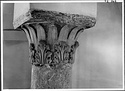
| Complete.
So-called Tower of the Winds type, with lotus leaves springing from behind a single row of acanthus.
Originally covered in plaster and painted. "In the final period of the church all the capitals ... Used as SW capital of the church of the Holy Apostles and re-used at the same position in the restoration of the church in 1954. |
Oinochoe: Italian?
Part of handle and mouth.
Slightly outturned rim. Large triple handle with appliqué head of Dionysos at base, facing into mouth of vessel. Head turns to proper left, has thick hair, ... Late Roman context ... The shape may have been something like CVA, Stuttgart 1 [Germany 26], pls. 51, 52 [1263, 1264] and CVA, Philadelphia 1 [USA 22], pl. 22 [1078], Apulian red-figure oinochoai with appliqués in this position. |
Wall fragment. Narrow reserved band on inside near top. Max. dim. 0.08.
Poseidon (most of head, torso, left arm and thigh) leaning forward a bit, probably seated or standing with his left leg bent, the ... Ca. 430-420 B.C ... The figure of Poseidon may have been in a position comparable to that of Herakles on the painter's bell-krater in Omaha, Joslyn Art Museum, 1963.485 (ARV2 1163, 40; Paralip. 458, 40; Addenda 338). |
| Fragment of tondo of red figured cup. Part of a tendril. Above tendril, leaf in added color.
In field behind, a painted E.
Good black glaze inside, peeling somewhat outside.
Attic.
Cf. P 32422 from ... 24 May-9 June 1954 ... P 32422 has an inscription: ΕΛΟΧΟΣΕΝ and the initial Ε is in the same position as the Ε on P 31009. |
| Complete but for chips from wall; mended from sixteen pieces. Same type as P 27448, but two vertical strap handles from rim to belly, faint ring foot nicely profiled, body well articulated. Paint all over ... 10-11 August 1965 ... Probably Furumark, MP type 66 or 67, but a variant in size and position of handles - LH II-III A-B. |
| Mid-forearm to palm of left arm and hand of over life-size statue has long sleeve with thick cuff at wrist, snug fitting. All fingers broken off. Strut on wrist just above palm; heavy rasp work on palm ... 16 August 1977 ... Thumb held inwards as seen in folds of flesh and position. Sleeve has several broad thick folds carefully finished; cuff soft, thick rolled edge.
|
| Right side broken off. Like A 3732. Upper surface preserves dowel hole without pour channel and cutting for Π-clamp. Right corner of back is cut in roughly 0.15m. from rear surface on left. Anathyrosis ... 24 July 1969 ... It was recovered from the marble pile left by the excavations of the 1860's and set in its present position in the early 1950's. |
Lower part of rim, one handle attachment, and about one-sixth of body preserved.
Scraped groove above molded area. Lower body has no relief but seems to be moldmade. Most of body covered with pine-cone ... 225-200 ... Same painted rim pattern in same position on 602; for pine-cone scales cf. |
Three non-joining fragments, d from handle reserve with start of handle. Max. dim. a) 0.066, c) 0.045, d) 0.057. Prange, Niobidenmaler, p. 167, cat. no. A 53.
Fragment a (illustrated) preserves the face ... Ca. 470-460 B.C ... White or red: liquid.
The position of the man in relation to that of the phiale and the upward tilt of his head suggest that he is seated.
|
Wall fragment from just below rim. Reserved band on inside near top.
Max. dim. 0.086. Matheson, Polygnotos, p. 371, cat. no. CHR 32.
A, youth (or man) pursuing someone in the presence of a woman. At ... Ca. 440 B.C ... Before her is a man or youth (part of left shoulder with himation, his petasos hanging down), probably running to left (the high position of the petasos suggests this interpretation). |
Wall fragment with return. Thin glaze on inside. Max. dim. 0.055.
Youth (head) to left, with head thrown back. Relief contour: chin.
Dilute glaze: muscles.
The position of the youth's head and his open ... Ca. 480-470 B.C ... Dilute glaze: muscles.
The position of the youth's head and his open mouth suggest that he is singing, perhaps accompanying himself on the barbiton. |
Four non-joining fragments: a of rim and wall with start of handle; b of lower wall and foot; c handle; d rim. P.H. of b) 0.092; diam. at rim 0.142; diam. of foot 0.14; max. dim. a) 0.224, c) 0.067, d) ... Second quarter of the 4th century B.C ... To judge from his position in the composition, he was probably mounted. |
| A low heavy foot about two-thirds preserved, with the start of the cup above. Two scraped grooves around the bottom of the stem; the rounded outer edge of the foot reserved, colored pink; elsewhere, fair ... 2 June 1933 ... Note that the name on the bottom appears to have been scratched on after the base was broken, if one may judge from the position of the letters Y M. |
Torso alone preserved.
The position in which the figure stood is not to be determined from the remaining fragment. The right arm appears to have been drawn backward. On the right shoulder is tied, in ... 23 June 1936 ... Torso alone preserved.
The position in which the figure stood is not to be determined from the remaining fragment. |
| Intact. Slight flaking of painted surface.
Proto-phi type figurine, with left arm distinctly modelled, curving up and resting on chest between breasts. Right arm down, across abdomen; bulge at position ... 24-30 July 1998 ... Right arm down, across abdomen; bulge at position of hand. Eyes and hair modelled. |
| Part of the mouth and nose have been broken off as has the left ear.
The neck is sufficiently preserved to show that the head is turning left. The roughly chiseled back may be original and the head perhaps ... 500-450 B.C. (?) ... The roughly chiseled back may be original and the head perhaps part of a whole body in relief.
Position of right ear shown by a shallow hole. |
Fragment, glazed on underside. Max. dim. 0.105.
Youth (head, left shoulder and arm, most of feet missing) seated in three-quarter view to left on a cloak, his right hand resting on his thigh. The position ... Late 5th century B.C ... Youth (head, left shoulder and arm, most of feet missing) seated in three-quarter view to left on a cloak, his right hand resting on his thigh. The position of his shoulders and lock of hair suggests that he looked to right. |
| Four fragments, some possibly joining, preserving portion of fibula, including part of spring, pin, and perhaps catchplate. Very poorly preserved; heavily corroded and blistered, with most of the fragments ... 6 February 1936 ... Mounted in position in ethafoam.
|
Single fragment preserves about one-third of foot and floor, and part of wall. Plain low ring foot, flaring wall. On floor, two grooves over position of foot. Interior decoration in pale reddish-purple ... 17-23 June 1939 ... On floor, two grooves over position of foot. Interior decoration in pale reddish-purple paint, on the unglazed clay surface, in a design of thick stripes (originally four in number?) |
| Jar missing tip, one handle, much of neck and part of wall; rim on flat topped collar set off by a depression; no groove. Strengthened with plaster.
Capacity: (revised from wheat VG 1939 of 25.800) 26.300 ... 9 February 1937 ... Dim: D 0.338*
Par: like 1084 H main drain [ ... ] apptly same place,
ca 5c AC(VG)*
Rdg: see stp at base of missing hdl, nothing read; suggesting in new
analysis of M 20 : 1, that the stp on the missing hdl was of
=IEROKLHS=+lets since at the base of the hdl of another jar of
=IEROKLHS= is secondary stp, unusual position matched on this
jar(VG 6.iv.62)* |
|
|