|
|
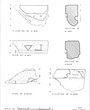
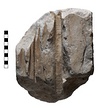
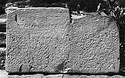
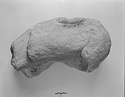
Corner of abacus and one volute of an Ionic capital. The bottom of the volute cut down and smoothed, with some pick marks visible. Chisel marks visible throughout.
Pentelic marble. Well. 2541 Leica ... 7 August 1970 ... The bottom of the volute cut down and smoothed, with some pick marks visible. |
Complete; slightly damaged on upper surfaces by pick.
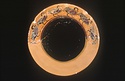
Square one, plain on lower surface; on upper surface, within a low raised border, an amphora.
No letters visible. Clearing over north-south wall. Leica ... 16 June 1939 ... Complete; slightly damaged on upper surfaces by pick.
Square one, plain on lower surface; on upper surface, within a low raised border, an amphora.
|
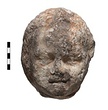
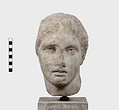
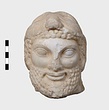
| Broken off at neck, very battered and worn; left side, behind cheek, reworked with a pick. Head of a child, perhaps originally from a relief.
Pentelic marble. Byzantine wall. 1813 82-4-34, 82-4-35 ... 14 July 1981 ... Broken off at neck, very battered and worn; left side, behind cheek, reworked with a pick. Head of a child, perhaps originally from a relief.
|
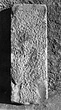
| Inscribed fragment.
Inscribed face and pick dressed bottom preserved.
Parts of four lines of the inscription preserved.
Pentelic marble. Found in original fill of the late Roman Fortification, in the area ... 29 August 1946 ... Inscribed face and pick dressed bottom preserved.
|
Inscribed fragment.
Broken all around.
Back rough. Surface in poor condition.
"Attic Stelai".
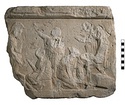
Marble sugary in texture especially at left and right; damaged by pick at center.
Pentelic marble. Found in ... 5 May 1959 ... Marble sugary in texture especially at left and right; damaged by pick at center.
Pentelic marble. |
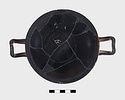
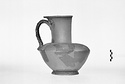
The vase was complete as it stood in the ground; its upper part was broken by the pick, small fragments now missing. Flat bottom; round mouth; high swung handle.
Glaze mottled, brownish-red and peeled ... 27 July 1957 ... The vase was complete as it stood in the ground; its upper part was broken by the pick, small fragments now missing. |
| A pick-mark on back may indicate that full thickness is preserved, otherwise broken all around. Fascia projecting 0.014m. On top, relieving surface 0.019m. from front edge.
From the Temple of Ares.
Pentelic ... 23 July 1956 ... A pick-mark on back may indicate that full thickness is preserved, otherwise broken all around. |
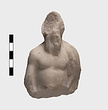
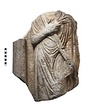
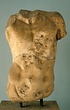
| Torso and part of head of nude bearded man, possibly Socrates; cloak over left shoulder.
Broken at bottom. Back rough, with occasional pick marks.
Pentelic marble. ’νω μέρος μαρμάρινου αγαλματιδίου Σωκράτους ... 20 May 1949 ... Back rough, with occasional pick marks.
Pentelic marble. |
Inscribed fragment.
Inscribed face and rough picked top preserved.
The back shows traces of pick, but perhaps re-cut.
Dedication to Zeus Boulaios.
Two lines of the inscription preserved.
Pentelic marble ... 53/2 B.C ... The back shows traces of pick, but perhaps re-cut.
|
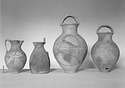
| Part of handle and some of body missing. Restored in plaster. Moderately high neck; ridged basket handle.
Buff clay. Light buff slip.
ADDENDA Broken in earthquake, 7 Sept. 1999. Finished Well, containers ... 7-8 April 1937 ... With care - don't try and pick it up by the handle! |
The object seems not to have been cast but to have been cut from a plate of lead.
Edges roughly trimmed. In one face are two ancient incisions (2 minae).
(One corner bears three marks made by our workman ... 26 May 1954 ... (One corner bears three marks made by our workman 's pick). |
Inscribed fragment.
Inscribed face, back and probably left side preserved.
Heavy pick marks at bottom of face where it is cut back from some late reuse.
Eight lines of the inscription preserved; stoichedon ... Ca. 430 B.C ... Inscribed face, back and probably left side preserved.
Heavy pick marks at bottom of face where it is cut back from some late reuse.
|
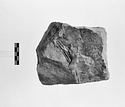
| Fragment broken at top, bottom and side opposite slab edge, but in latter area rough pick-work begins on back surface at an oblique angle to back of slab.
Folds of drapery parallel to a slab, which could ... 23 September 1969 ... Fragment broken at top, bottom and side opposite slab edge, but in latter area rough pick-work begins on back surface at an oblique angle to back of slab.
|
| Left side of relief, the back shows widely spaced pick strokes, over which the surface has been worn smooth. Side rough-picked.
Head and legs below knees missing. The figure wears chiton and himation, ... 1933 ... Left side of relief, the back shows widely spaced pick strokes, over which the surface has been worn smooth. |
Fragment from top of inscribed monument.
Broken at both ends and at bottom. The back, with small pick-marks, curves, at the top toward the front.
In front at the top, some sort of ornamental device has ... 1933 ... The back, with small pick-marks, curves, at the top toward the front.
|
| Broken at sides and top; pick-marks on back may represent original back surface, but perhaps later cutting contemporary with the cut surface now at bottom.
Parts of two figures facing right, the one at ... 19 February 1952 ... Broken at sides and top; pick-marks on back may represent original back surface, but perhaps later cutting contemporary with the cut surface now at bottom.
|
| Outward flaring keeled lip. On upper face of lip, procession of geese, right. On outer face of lip, between purple bands, "running dog". On front neck panel, gorgon running right, pick-like object in right ... 23 February 1935 ... On front neck panel, gorgon running right, pick-like object in right hand; on back panel, lotus and palmette. ... Agora XXIII: Aristaios (head mostly missing), winged, running to right, looking around, with a pick in his right hand. |
| Inscribed altar.
Both sides and bottom preserved and part of top. It has the rolled edge preserved on the left side. On the right the top of the stone has been cut off. The face and sides show pick marks ... Second half of 4th. century B.C ... The face and sides show pick marks and anathyrosis, the face being no smoother, altough the part where the letters are, is less rough.
|
| a) Fragment with part of a columnar surface (side or top) with projecting rough-picked fascia (as if of semi-attached column) at side, and smooth finished front surface with two sharp cut grooves, forming ... 26 August 1946 ... Clear traces of red in incised grooves; irregularly spaced cuttings, perhaps late pick-marks on front surface.
|
| Nearly life-size. The surface of the head above the right ear shows a flat pick-marked area about 0.09m. x 0.012m. The right side of the face is eroded, and the bridge of the nose worn down from the right ... 18 April 1932 ... The surface of the head above the right ear shows a flat pick-marked area about 0.09m. x 0.012m. |
| Parts of rim missing. Restored in plaster. Similar in shape and fabric to P 5116 (Α 1038), with a similar graffito scratched through the dry glaze in the middle of the floor, as well as on the underside ... 12-15 March 1935 ... Do not pick up object from the rim. |
| A fragment of a chariot group (?), left.
Body, beginning of neck and part of right foreleg of front horse, with hand and arm of charioteer stretched over his back almost touching neck, and much battered ... Latter part of 6th c. B.C. (?) ... Rough-picked back surface, apparently original; note however pick marks behind arm, that would make background very thin above the group.
|
Inscribed fragment used as a moulding.
Broken at both sides and at back. The bottom is preserved and has a smooth band at the edge (anathyrosis?). The top has a narrow fascia, next the inscribed surface; ... 13 April 1933 ... The surface of the inscription is roughly finished and shows distinct pick marks.
Three letters and part of a fourth remain.
|
| a) The torso from just above the waist to the shoulder is preserved. The right arm and shoulder are missing; the left shoulder and part of the upper arm is intact. The head is missing, but the beginning ... a) (Ξ 28) 27 October 1934
b) (Ο 1077) July 1956 ... Except for a break on the left side of the chest, the original surface of the fragment is intact.
b) Lower abdomen and hips, battered. Pick-marks on front. |
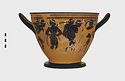
Mended with the missing pieces restored in plaster and painted, notable among them, both handles, all of stem and foot, a large section of the bowl. Reserved line on inside at rim. Rest. H. 0.095; rest ... Mid-4th century B.C ... On one side (illustrated), most of one youth except for his back, to right, holding a discus or tympanon decorated with a cross and four dots, preceded by another facing a third (head, shoulders, part of drapery missing) who holds what looks like a pick in his right hand (a bit of the handle, one end of pick). |
| Broken off across the neck; end of nose and chin chipped. Pick-marks on forehead.
Head, half life-size, turned slightly to the figure's left. Hair and beard rendered in small tight bead-like curls. The ... 30 July 1947 ... Broken off across the neck; end of nose and chin chipped. Pick-marks on forehead.
|
| Upper part of shaft of an Attic gravestone, broken at bottom, front reworked with coarser pick. Top edge broken away in back diagonally from corner to dowel hole in top.
Reused as threshold block. Two ... 3rd quarter of 6th c. B.C ... Upper part of shaft of an Attic gravestone, broken at bottom, front reworked with coarser pick. Top edge broken away in back diagonally from corner to dowel hole in top.
|
| Foot, one-third of body, one handle as far up as arch, and part of upper neck and rim, preserved. Partly restored, with additional 6 non-joining fragments. Flaring foot with groove in outer edge; angular ... 1937 ... Keep weight inside vase at all times.
pick up by the base |
| Broken at left and bottom. Back worn down. Surface badly chipped, especially heads of figures.
At left sits Athena, somewhat elevated, resting her chin on her left hand. Left elbow supported by left knee, ... 21 June 1972 ... She gesticulates with her right arm, her left arm falls down her side and she holds an implement, a mallet or a pick. 2) Behind her a standing figure with right arm raised, left arm across body; she looks up at her raised hand. 3) and 4) Two figures trying to lift a large block; the first tries it with a lever, the second steadies the block. 5) Behind them a figure with right knee up. |
| Inscribed fragments of base. From a circular monument.
Fragment ΟΑ 260 a), inscribed face only preserved.
Above the smooth dressed inscribed band, the stone is pick-dressed. Below, the face makes an oblique ... a) (ΟΑ 260) 20 April 1938
b) (ΖΖ 42) 5 April 1939 ... Above the smooth dressed inscribed band, the stone is pick-dressed. Below, the face makes an oblique angle with the inscribed band.
|
| Mended from many fragments. The foot and the lower part of the vase, part of the handle, and many small other fragments missing. On either side, possibly the game of ΕΦΕΔΡΙΣΜΟΣ or ΕΝΚΟΤΥΛΗ. Two similar ... August-September 1932 ... Two similar groups of boys pick-a-backed on young men alternate with single figures. |
Shoulder fragment. Dull black glaze on inside. Glaze pitted and abraded in places. Max. dim. 0.152. Schleiffenbaum, Volutenkrater, p. 322, cat. no. V 198.
Youth (head with olive wreath, left shoulder ... Ca. 400 B.C ... For lines across the forehead of a figure in frontal or three-quarter view, a sign of stress, see Naples 2045 = 2883, connected with the Pronomos Painter and the Talos Painter: two giants, one stooping to pick up a big stone, the other hurling one (ARV2 1338, ---; Paralip. 481, ---; Addenda 366) and Tübingen S./10 1568 = E 160, near the Talos Painter (ARV2 1339, 1; Addenda 367), now attributed to the painter himself (Paralip. 481); several of the figures on Würzburg H 5708, near the Talos Painter (ARV2 1339, 5). |
Inscribed fragment; twice used as Ionic capital.
Originally the crowning block of a small monument or stele, on the front face the projecting moulding is preserved, and below a curved line marking the ... 2nd.-3rd. centuries A.D ... At a later time another inscription was written on the top face of the stone; the lower and right edges show rough pick marks where the mouldings were hacked away.
|
| Seven fragments. Plain maeander, left, below figured zone. Inside unglazed.
a) Preserves the wall of the vase from the top of the lower cylindrical portion to near the top of the figured zone. Parts of ... 19-23 March 1936 ... In the field behind him, a pick.
c) Part of the border (chipped), and bits of two figures: a foot right, and a right hand, its fingers resting on the toes of the foot.
|
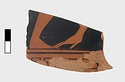
Five non-joining wall fragments, a with start of keel. Glaze much pitted on underside of bowl. P.H. a) 0.18; max. dim. a) 0.25, b) 0.174, c) 0.087, d) 0.107, f) 0.062; est. circumference at ground line ... Ca. 500 B.C ... He overlaps the handle of a pick, its head (mostly missing) stuck firmly in the ground (this would explain the vertical position of the head). |
|
|