|
|
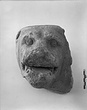
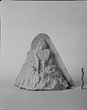
| Part of the mouth and nose have been broken off as has the left ear.
The neck is sufficiently preserved to show that the head is turning left. The roughly chiseled back may be original and the head perhaps ... 500-450 B.C. (?) ... Head Fragment of Lioness or Lion |
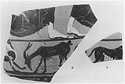
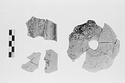
| Three non-contiguous fragments of a large closed pot, but probably a stand.
a) Feet of two draped women walking to right. Below, in an animal frieze, a sphinx and a goat.
b) Drapery.
c) Part of a lioness(?) ... 18 February 1937 ... Below, in an animal frieze, a sphinx and a goat.
b) Drapery.
c) Part of a lioness(?) going to right, from the lower frieze.
White for the women's feet, the sphinx's head and breast, and the teats of the lioness. |
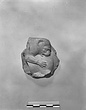
| Relief plaque of lioness attacking a bull.
Original surface preserved at top and at lower part of right side.
Back broken. Head and foreshoulder of lioness preserved. Bull 's head missing.
She is bitting ... Card: 4th c. B.C ... Relief plaque of lioness attacking a bull.
... Head and foreshoulder of lioness preserved. Bull 's head missing.
|
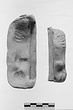
| First interpretation: mold for lion or lioness (?).
Complete.
The mold for one half (lengthwise) of a crouching animal with large fluffy tail. Cistern. Coroplast 's dump. Leica, 8-105, XXXIV-50, L-9, 80-56-34 ... 16 April 1938 ... First interpretation: mold for lion or lioness (?).
Complete.
|
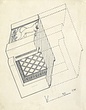
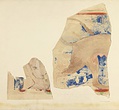
| Bottom preserved, otherwise broken. Fragment from lower edge of an epistyle (?) or similar beam. Bead and reel below, part of a palmette above, in blue and black.
Pentelic marble.
Belongs with lioness ... 17 February 1938 ... Belongs with lioness lintel A 818 (II 251). |
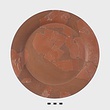
| Parts of rim and base preserved, non-joining. Low bowl on slightly raised base ring; flaring sides ending in broad overhanging rim, on which is relief of a lioness, running right.
Red clay, good red ... 10 June 1936 ... Low bowl on slightly raised base ring; flaring sides ending in broad overhanging rim, on which is relief of a lioness, running right.
|
Two joining fragments: that with more complete lioness from cistern at 21/ΙΗ. From a column krater with very flat shoulder. On shoulder the heads and necks of two lionesses and the tail of another.
Fine ... 29 May-6 June 1933 ... Two joining fragments: that with more complete lioness from cistern at 21/ΙΗ. |
| Seated lion; in the background, above, small running animal (ferret, dog?); beside it head of a lioness, below snake.
Parts of two adjacent edges preserved; broken at the left; knob on the back.
Probably ... 8 July 1947 ... ; beside it head of a lioness, below snake.
|
| Hunting scene.
Part of medallion, lower wall and three non-joining fragments preserved.
Medallion: Mutilated by a large hole and surrounded by raised lines from which spring small round-ended leaves.
Calyx ... 1934 ... On one of the fragments a man riding an animal hurling a spear. Lioness, and animal feet on the others.
|
| Several non-joining fragments give part of the broad flaring rim, and a little of the flat floor of a large Late Roman A plate with very low ring foot. Restored in plaster. Rim decorated with a frieze ... 12 May 1939 ... Rim decorated with a frieze of running animals with trees between in applied relief; preserved: three trees, a donkey, right, part of a goat, right, a stag, right, and part of a lioness or tiger, left.
|
| Seven fragments, making up to four:
a) Two joining fragments preserve full height of block and left end of block, part of bracket and of coffer.
b) Two joining fragments preserve part of fascia below face ... 10 March 1938 ... Seven fragments, making up to four:
a) Two joining fragments preserve full height of block and left end of block, part of bracket and of coffer.
b) Two joining fragments preserve part of fascia below face A, to full height.
c) Two joining fragments preserve part of face B, with full height of fascia, part of soffit and coffer.
d) Preserves full height of fascia below face B, with soffit and part of coffer.
e) A sizable fragment, found 7 April 1959 in file of marbles from 1938-1939 excavations, which joins fragment a) at right and gives part of lioness' belly and part of front leg.
... The block was elaborately decorated in color: Face A: preserved are the hindquarters of a lioness walking right, her left leg advanced, her tail arched over her back. |
|
|