|
|
Wall and shoulder fragment.
Impressed and incised decoration: garland of ivy leaves with a zone of curved lines above and below; at shoulder curve, a row of large circles. Blister ware; clay gray, red ... Context 4th c. B.C. and earlier ... Similar patterns on other blister ware jugs, e.g. from Corinth, the Potters' Quarter, inv. KP 858; from Isthmia, on several large jugs (p. 208). |
Bottom wholly restored.
Incised wavy lines at level of both handle attachments and down outer face of handle.
Unglazed and handmade.
For ware, Hesperia 30 (1961), pp. 316-317.
For incised decoration ... 7th c. B.C ... No cooking ware jugs of comparably small size are reported from the Agora or Kerameikos, but see jugs like ours from Anavyssos: Πρακτικά, 1911, p., 124, especially nos. 25, 27. |
P 20858 a, b, c, d, e, f, g, h, i, j, k, l
Intact except for small chips.
Thirteen small jugs inventoried under one number. Raised base with flaring profile, slightly concave underside, and plump, pear-shaped ... 300-250 ... Thirteen small jugs inventoried under one number. |
Flat bottom and convex side wall.
The letters -AI- (Greek?) incised on the resting surface after firing with a sharp point. Left to right?
Coarse, pinkish buff clay, unglazed.
Jugs with flat bottoms ... Early 7th c. A.D ... Coarse, pinkish buff clay, unglazed.
Jugs with flat bottoms are veryy late in the Roman period: cf. |
Elongated one-piece shape; exaggerated trefoil rim with moderate spur at handle-attachment inside. Gritty micaceous pinkish clay; buff surfaces; mastic wash inside.
With 1623-1627, poor relations of the ... Context ca. 350-320 B.C ... The spur at the rim, characteristic for this shape, does not occur on other trefoil jugs. |
Globular body on flat bottom; tall neck, rolled rim, strap handles from middle of neck. Gray ware; the clay light in color and very slightly gritty; black glaze wash, thinly applied in broad stripes and ... Context ca. 460-440 B.C ... Fabric similar to 1475, also to the jugs, 1704-1706, Pl. 76 and the askos 1729, Pl. 80; the surface finishes vary. |
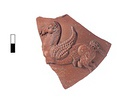
| Winged Pegasus flying left, in rather high relief. Edge of barbotine decoration above and to right.
The clay a pinkish-buff (not resembling Pergamene); the glaze orange-red, somewhat resembling Samian, ... 24 March 1936 ... ADDENDA Group of early Roman red glaze jugs with barbotine decoration etc. |
Similar to 1615 but rim flat on top and sharp-edged; light finger-grooves down outside of handle. Wet-surfaced; black glaze wash on rim, for a pair of bands at shoulder and one on foot.
A considerable ... Context ca. 415-400 B.C ... A considerable variety of jugs came from this deposit; for the same shape as 1616, in rather poor black, see 188, Pl. 10; also similar, but with trefoil mouth, 189, Pl. 10; and cf. p. 204, note 3. |
Top, neck and upper part of body preserved. A jug with wide moulded projecting rim short neck, and sharply angular shoulder. Flat vertical handle, rim to below shoulder.
Light red clay and glaze, burned ... 21 May 1936 ... ADDENDA Similar tall narrow jugs, with vertical burnishing on outside are common in the cemeteries of Saloniki. |
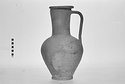
| Intact except for part of neck and rim, and chips. Ring foot; deep ovoid body; light handle ridge near top of tall neck; projecting lip; broad handle lightly ridged.
Coarse gritty buff clay, fired bright ... 18 April 1951 ... Not less than 11 jugs of this type from same fill, 2 in household pot storage, 3 in tray; rest discarded. |
Globular body on flat bottom; narrow neck with spreading rim, the deep vertical face undercut. Handle concave on outer face. Clay light gray, yellowish at the surfaces which are lumpy and pitted; heavy ... Context ca. 460-440 B.C ... As noted in the original publication, this is not a shape typical for the fabric; other large blister-ware jugs, as 1675- 1677, Pl. 77, are moreover thin-walled. 1662 is most likely from a different source. |
Tall-necked ovoid jug on low flat base; round mouth with plain rim, strap handle rising slightly from the rim. A large Ε scratched on the neck. Pinkish buff fabric somewhat micaceous; pale buff surfacing ... Context ca. 520-480 B.C ... For the profile see the oval jugs in plain white and coarse wares from Cyprus; e.g., S.C.E., IV, 2, fig. |
Tall-necked trefoil jug, rim ridged. Coarse buff clay; dull red glaze wash reaching to near foot. Imitation Cypriot (?).
The shape is like the Attic 4th century jugs such as 1621, Pl. 73, but the fabric ... Context ca. 375-350 B.C ... The shape is like the Attic 4th century jugs such as 1621, Pl. 73, but the fabric and finish are foreign. |
| Slightly curving neck with flaring lip; attachments for vertical band-handle on longer side of neck.
Coarse clay, light red to gray.
From a retort(?).
ADDENDA Additional fragments added from sherds ... 2 May 1939 ... Bent-necked jugs with bottoms: JNES 21 (1962) pp. 161-174, esp. fig. 4 (not exactly same). |
Meager ovoid body on ring foot; tall straight neck; heavy rolled rim with sharp ridge below it; strap handle from neck. Crudely made of soft, reddish somewhat micaceous clay; remains of light buff surfacing ... Context ca. 375-340 B.C ... The relation of large neck and small body are somewhat as in 1620, but the make is much inferior and the ridge below the rim has not been noted on Attic jugs. For related shapes from Black Sea sites see, e.g., Histria, II, pl. 75 (Grave XXI, 6) and bibliography p. 181. |
Squat round-mouthed jug; the lip missing except at the handle and the body fragmentary but the profile complete. Ring foot; strap handle from rim. Light gray clay, heavy fabric; dull black glaze not reaching ... Context ca. 375-325 B.C ... For the shape compare the mushroom jugs, Pl. 9. A gray- ware example from Porto Cheli (Inv. |
One-fourth of upper body and small part of rim preserved.
Kantharos or jug? Rounded, wheelmade shoulder with scraped groove at top. Low, flaring neck. Molded, overhanging rim with groove on inside. Lower ... 100-50 ... With the addition of a handle, this would resemble the smaller moldmade jugs with wide mouths (e.g. 515). |
Globular body on high base, flat beneath; straight neck, flaring trefoil rim; rolled handle from rim. Corinthian tile fabric, handbuilt.
The high foot and bulbous body are traditional in Corinth in this ... Context ca. 600-575 B.C ... The high foot and bulbous body are traditional in Corinth in this fabric for hydriai, amphorae and jugs; see for example the long jug series such as
C-40-375, 373, 380: Hesperia, XVII, 1948, pl. 76, C 20, 22, 21 (late Geometric);
C-37-934, 935: Corinth, VII, i, pl. 23, 170 and pl. 24, 171 (third quarter of 7th century);
C-37-2052, 2053: Hesperia, VII, 1938, p. 601, fig. 23, 166- 167 (context of ca. 500-480 B.C.). |
A single fragment preserves the neck, the band handle and the mouth. Long narrow cylindrical neck, purposely dented at the front to give it a slight bend. Band handle from below rim to near bottom of neck ... 17 July 1947 ... ADDENDA For bent-necked jugs with bottoms, see R. |
Flaring ring foot; high strap handle concave on outer face. Glazed: the neck, a line around the body just below the handle-attachment, the outer face of the foot and the wall just above.
Other jugs from ... 550-525 B.C ... Glazed: the neck, a line around the body just below the handle-attachment, the outer face of the foot and the wall just above.
Other jugs from this period: P 1258 G 6:3-L Hesperia, VII, 1938, p. 387, fig. 23, 18; ABV 442, B 2 (Class of Agora P 14045, third quarter of 6th century) and P 14045 Q 18:1- POU Hesperia, VIII, 1939, p. 257, fig. 13, 3; ABV 442, B 1, which should perhaps be dated before the middle of the century, as it has a broad band and a glazed strap handle and is a link between the early and the later series. |
Much of body and rim restored in plaster. Similar to P 17348 (ΩΔ 332) in shape and decoration. Three glaze bands below handle; wavy line on shoulder, almost a zigzag.
Two similar jugs with wavy lines ... July 1946 ... Two similar jugs with wavy lines and bands stored in tins.
|
Handle missing.
Flaring foot, concave beneath. Reserved: the upper part of the body and a band at the greatest circumference. Added red: a broad band in the reserved band, a band at the edge of the foot, ... 575-550 B.C ... Two closely similar jugs have been found outside Athens and are doubtless from the same workshop: Rhodes 6595, from Ialysos: Cl. |
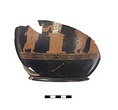
| Ring foot, heavy rounded body; inside, thin streaky glaze. The base preserved complete, and about half the figured panel on the front of the body.
The panel bordered by reserved line at the left and by ... 4 April 1935 ... Possibly the presentation of the garlanded jugs in the sanctuary of Dionysos in the marshes on the 12th Anthesterion. |
|
|