|
|
Broken all around, only front and back surfaces preserved. On back, mason's mark: Α. Face much weathered.
From the Temple of Poseidon at Sounion.
Island (?) marble.
Seems to belong to same series as A ... 31 August 1951 ... Found by Homer A. Thompson in architecture store room. |
| Two joining fragments.
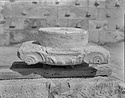
Abacus, fillets, and top of volutes recut to make base for interior support of fourth period of church. Lower part of volutes cut off.
Developed fifth century type egg and dart ... 18 February 1936 ... ADDENDA Dreruf points out that this capital is identical with another now lying beside the Guard's House below the Nike Temple (Homer A. Thompson, 7 July 1937). |
| Broken at bottom, and along right side of head towards back. Top of cap, tip of nose and chip below left eye missing.
Male head, about half life-size, turned left about three quarters. Shaggy mustache ... 13 March 1952 ... ADDENDA Scale ca. 20% smaller than figures of the so-called " Small Attalid Dedication" (see conjecture by Homer Thompson in Hesperia 22 (1953), p. 55). |
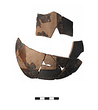
Wall fragment. Glaze greenish on inside, rather flaked and abraded on outside on figures. Max. dim. 0.093. R. S. Young, Hesperia 20, 1951, pl. 80:4; Ages of Homer, p. 459, fig. 28.16.
Uncertain subject ... Ca. 400 B.C ... Young, Hesperia 20, 1951, pl. 80:4; Ages of Homer, p. 459, fig. 28.16.
|
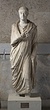
| Nose chipped; otherwise intact except for minor chips. Portrait of middle-aged man with close-trimmed beard and mustache. Hair simply treated and cap-like except for locks falling over forehead. Eyes have ... Late 3rd c. or early 4th c. A.D ... ADDENDA Homer A. Thompson's account attached to the card:
Found in a Byzantine house foundation some 5.00m. to the west of the mid part of the Odeion, together with fragments of two inscribed bases of the Roman period (I 6502, I 6503), the leg of a male figure of life-size, roughly worked (S 1605), and pottery of the 3rd c. |
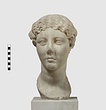
| Intact save for end of nose and ancient chip from right ear and recent chips from hair and left ear.
Socket for fitting into body rough-picked; carried up high in back of neck.
Hair in marked waves above ... Julio-Claudian period ... ADDENDA Homer A. Thompson's account attached to the card:
Found in the S.E. corner of the east stoa of the Commercial Agora, immediately north of the Church of the Holy Apostles, in a level of the second half of the 3rd c. |
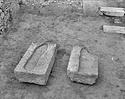
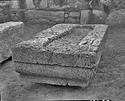
| Complete. Corner block from the plinth of a large monument. Finished on two adjacent sides with a cyma reversa. In top a shallow bedding, apparently for a colossal left foot.
Hard gray poros.
(Consider ... 2 September 1964 ... ADDENDA
Comment by Homer A. Thompson, 1966.
|
| One corner hacked away by the house builder.
From another corner of the same monument as plinth A 3475. In this case, however, the bedding for the foot extended into a second (missing) block. Socket for ... 2 September 1964 ... ADDENDA
Comment by Homer A. Thompson, 1966.
|
Mended from many fragments with the missing pieces restored in plaster and painted, notably much of the wall under each handle and much of Side B. Ring on neck. Neck glazed on inside. Glaze abraded here ... Ca. 410 B.C ... Binder recognized that the third figure on Side A is a flute-player; she restored
as Χρυσο'γονος and identified him as the flute-player of Alkibiades (information conveyed by John Traill to Homer Thompson in a letter of February 13, 1986). |
| Eleven pieces comprising two non-joining fragments. To Young's publication of six pieces are now added five more, two of which help to complete to inscription.
Part of the side wall with reserved panel ... 600 B.C ... Hemberg shows that Apollo receives the title Anax in Homer and Classical literature far more often than any other deity, and since, like Zeus, Apollo was worshipped on Mount Hymettos (Pausanias, I, 32,2), it is possible that the inscription is a dedication to both deities.
|
Fifteen non-joining fragments of wall, P 18278 b--c and P 19582 a--d of torus rim with zone of ornament below. Glaze mottled here and there; has a greenish cast in places; abraded in part on rim. Max ... Ca. 480 B.C ... What comes to mind immediately, of course, is the Achaeans' mission to Achilleus described by Homer in Book IX of the Iliad and illustrated by the Kleophrades Painter on his hydria in Munich, inv. 8770 (Paralip. 341, 73 bis; Addenda 189). ... Hellström, "Achilles in Retirement," Medelhavsmuseet [The Museum of Mediterranean and Near Eastern Antiquities, Stockholm] 25, 1990, pp. 19--31), is that a woman should not be present, at least not as we know it from Homer and from the representations (see LIMC I, pp. 106--114). ... In red-figured representations of the second arming, Thetis and her sisters, the Nereids, present the new set of armor to Achilleus, a contradiction with Homer, who has Thetis act alone, but which may have been inspired by a different version. |
|
|