|
|
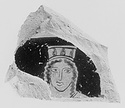
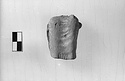
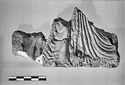
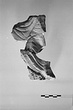
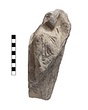
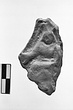
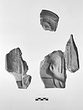
| Nose and upper lip a bit battered, back of neck cut away.
Wears straight stephane over wavy hair. Two iron pins and drill hole in neck. Fine work.
Parian marble. LRFW (Late Roman Fortification Wall) Core, ... 30 June 1959 ... Head of Goddess |
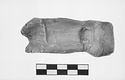
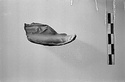
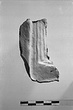
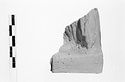
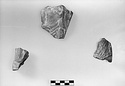
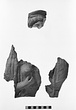
| Broken on three sides.
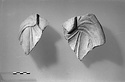
Mold for a seated female statuette - goddess.
Light orange clay. Pit. 965 Leica, 85-36-18, 87-22-32 ... 27 June-5 August 1972 ... Mold for a seated female statuette - goddess.
Light orange clay. |
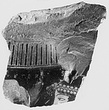
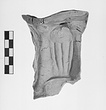
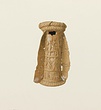
| Broken top and bottom. From stem of thymiaterion; hollow on break at top, solid on bottom break.
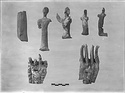
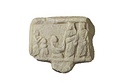
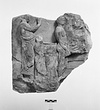
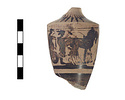
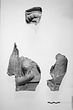
Procession of four figures, upper parts missing. Hermes, goddess, god (end of short cloak hanging down) ... 14 April 1956 ... Hermes, goddess, god (end of short cloak hanging down) and a second goddess. |
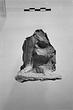
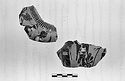
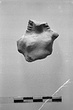
| One side only remains, and that broken away above.
Top rail of throne projects.
Goddess type. Very massive.
Flaky clay fired dark gray at the core; buff on the surface. Marble Chips Pit. 117, 1616 ff ... 13 March 1937 ... Top rail of throne projects.
Goddess type. Very massive.
|
Right hand corner of back of throne.
Surface slightly raised along inner (broken) edge where figure began.
Finely finished surface in front, slightly rougher behind.
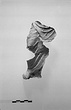
Probably was part of a "seated goddess" ... 1937 ... Probably was part of a "seated goddess" type.
White marble - Pentelic. |
Upper torso of female figure broken along sides, neck and waist.
Broken all around.
Slight traces of drapery.
Inside rough.
Pinkish-yellow fabric with gray core.
ADDENDA RVN: Seated goddess, ca. 480-470 ... 28 June 1973 ... ADDENDA RVN: Seated goddess, ca. 480-470 B.C. |
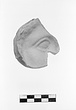
| Part of the mold for a large face, with one eye.
For a protome like T 1763 (?)
ADDENDA: Probably head from large bust-protome of goddess; cf. T 1763.
Too flat Gorgoneion (?) Cistern. 350-325 B.C. Leica, ... April 1938 ... ADDENDA: Probably head from large bust-protome of goddess; cf. T 1763.
|
The figure above the waist and the left side of the throne are missing.
Left hand pressed close to thigh; right drawn across lap.
Precise modelling. Seated goddess type.
Fine buff clay.
Cf. Hesperia 93 ... 13 March 1937 ... Seated goddess type.
Fine buff clay.
|
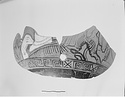
Wall fragment from just below rim. Reserved band 0.07 on inside below where rim started on outside. Max. dim. 0.062.
Statue of a goddess (Pandora[?]): head with polos, start of chiton or peplos, shown ... Ca. 450-440 B.C ... Statue of a goddess (Pandora[?]) ... It is uncertain whom the goddess represents. ... There, however, Pandora is bare headed, and the pins of her dress are prominent. The goddess on 308 might also be Anesidora, whose name is synonomous with that of Pandora (LIMC I, 1981, pp. 790--791, s.v. |
| Lower part of elongated columnar figure.
Traces of a girdle at the top and wavy bands of glaze.
Brownish clay.
The shape appears to be a descendant of the Mycenaean standing goddess type, but the technique ... 1 April 1932 ... The shape appears to be a descendant of the Mycenaean standing goddess type, but the technique is subgeometric. |
| Broken all around. Fragment from upper wall of a very large krater (bell or kalyx).
Head of goddess, full face, wearing polos. A statue?
No relief contour. Piers 15-16 west. Pocket in bedrock under south ... September 1953 ... Head of goddess, full face, wearing polos. |
| Broken on three sides. Front, back and part of one side preserved.
Drapery folds over stomach and thigh of standing frontal figure.
Back rough.
Fabric: pinkish-yellow with gray core.
ADDENDA Joins with ... 29 June 1973 ... ADDENDA Joins with T 4076. Goddess (?). |
| Broken left side, bottom and back.
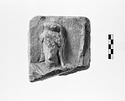
There remain head and shoulders of a seated goddess, her head turned slightly left, scepter in left hand, polos on head with her garment drawn up over it.
Good Greek ... 12 May 1950 ... There remain head and shoulders of a seated goddess, her head turned slightly left, scepter in left hand, polos on head with her garment drawn up over it.
|
| Broken at right, setting tongue preserved.
Five figures enclosed by plain border. In center one figure kneels before a standing god and goddess, at the right. At the left of the kneeling figure a standing ... 19 April 1956 ... In center one figure kneels before a standing god and goddess, at the right. |
Head of goddess with wavy hair parted in middle, and a high stephane.
Mended from many fragments.
Traces of white paint.
Clay dark brown at core, light brown toward surface.
Cf. Hesperia 64 (1995), p ... 6 June 1952 ... Head of goddess with wavy hair parted in middle, and a high stephane.
|
| Broken on all sides.
Draped legs of frontal seated figure preserved.
Figure originally hollow back missing. Broken at waist and ankles.
Traces of added white paint.
Dark red fabric.
Cf. Olynthos XIV , ... 6 July 1973 ... ADDENDA RVN: Seated goddess on a Klismos. |
Broken on two sides. Parts of bottom, one side, front back preserved.
Subject: right (bent?) leg and drapery from lower part of draped frontal figure.
Back rough.
Well baked yellowish-pink fabric.
ADDENDA ... 21 August 1973 ... ADDENDA RVN: Joins with T 4076 and T 4101. Goddess (?). |
Left side missing.
A heavy veil on the back of the hair. Heavy roll of small curls around the face.
Remains of red color over white on the veil.
Archaic seared goddess type. Well. Votive deposit in the ... 28 April 1937 ... Archaic seared goddess type. |
Broken off above and below; the finished sides preserved. Winged goddess (Potnia Theron), standing facing, looking right; an animal grasped in her right hand and a long-necked bird in her left. Incised ... 23-25 September 1947 ... Winged goddess (Potnia Theron), standing facing, looking right; an animal grasped in her right hand and a long-necked bird in her left. |
| a) From the shoulder of a large volute krater of heavy fabric. Tongue pattern around base of neck. The upper part of a garlanded male head, left; in front, the flame of a torch added in red. Letters in ... 14 April 1939 ... In front of her, a phiale and the staff of a flowering scepter, one or both held by Triptolemos facing the goddess.
Relief contour throughout. The hair of the loop over the goddess' temple rendered in raised dots. |
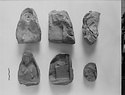
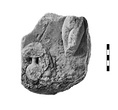
Parts of two adjacent sides preserved, front and back. Part of front surface missing.
Subject not clear, possibly represents back ground of relief.
Back slightly smoothed.
Fabric pinkish-yellow with gray ... 6 August 1973 ... Mold for bust of a veiled goddess. |
| Mold for lower part of draped, standing frontal figure, which appears to have stood on rectangular stand.
One side, front and back preserved. Part of surface from front missing.
Smooth exterior.
Fabric: ... 2 August 1973 ... ADDENDA Possibly a standing goddess (?). |
| Broken on three sides. One side, front, back preserved.
Lower part of one human leg covered with drapery and fold of drapery falling free along one side of it.
Back smooth.
Yellowish-pink fabric with gray ... 1 August 1973 ... ADDENDA RVN: Woman or goddess. Late 5th. century. |
Lower corner of mold preserved; broken on two sides. Most of front surface missing.
Subject seems to be the left foot and lower part of leg from frontal draped figure, standing on raised base.
Back smoothed ... 21 August 1973 ... ADDENDA RVN: Standing woman or goddess, probably as T 4106. |
| Broken on three sides. Parts of bottom, front, back preserved.
Subject: single human leg covered with simple drapery standing on rectangular base set within projecting frame.
Back fairly smooth.
Pinkish-yellow ... 21 August 1973 ... ADDENDA RVN: Seated goddess; mid. 5th century. |
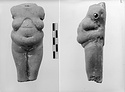
| Preserved from irregular break at neck to lower legs, with perforation for attachment of arms at shoulder.
The representation of pendulous breasts and belly protruding in folds is that common to comic ... 1 March 1932 ... The representation of pendulous breasts and belly protruding in folds is that common to comic figures and images of the fertility goddess.
Mold made, hollow. |
| Broken on all sides, back preserved.
Nude goddess, perhaps Aphrodite at her bath, preserved from the waist to the knees, stands at right; at left is an amphora with a cloak thrown over it.
Good modeling ... 17 August 1977 ... Broken on all sides, back preserved.
Nude goddess, perhaps Aphrodite at her bath, preserved from the waist to the knees, stands at right; at left is an amphora with a cloak thrown over it.
|
Two non-joining fragments of slightly outturned rim and wall. Max. dim. a) 0.081, b) 0.047.
Triptolemos. Fragment a (illustrated) shows on the left either Demeter or Persephone (legs missing from the ... Probably mid-4th century B.C ... Added clay (with traces of gilding): wreath, jewelry, dot on left shoulder of goddess; bands around shafts of torches; contour and decoration on phiale and footed dish; contour of leaflike object; wreath at lip. White (partly gone): flesh of goddess and Triptolemos; garments (there is only a trace of pink on the goddess' chiton). |
| Aphrodite Pandemos seated on goat.
Preserved: rear part of goat and part of goddess from below waist to below knees. Part of original edge of plaque at left. Background of plaque curves slightly with high ... 1933 ... Preserved: rear part of goat and part of goddess from below waist to below knees. |
| Mended from two pieces. Broken on all sides. Most of front surface gone.
Subject uncertain. All one can see with certainty is an enclosed zig-zag line.
Back rough.
Fabric: pinkish-yellow with gray core ... 21 June, 5 July 1973 ... Seated woman or goddess from plastic vase (?). |
Broken on three sides. Part of one side, front, back preserved.
Subject uncertain. Mold has slightly uneven hollowed out area, possibly representing drapery folds oner knee or arm.
Back roughly smoothed ... 5 July 1973 ... ADDENDA RVN: Mold for large protome of veiled goddess. Joins with T 4081 and T 4086. |
Two non-joining fragments with start of handle on each; a of wall from lower part of figured zone; b upper part of wall with start of rim. Reserved band on inside at top of b. Glaze flaked in part. Draw ... Mid-4th century B.C ... Farnsworth, AJA 64, 1960, p. 75, H and I, and pl. 16.
Goddess rising (Aphrodite[?]). Fragment a (illustrated) preserves part of the neck, shoulders, and right hand of the goddess rising from the ground. ... White: flesh of goddess; boukranion. |
| Part of front surface gone.
Subject not clear. Possibly legs of figure on one side with heavily draped figure in center.
Broken on all sides. Front and back preserved.
Back smoothed with fingers.
Fabric ... 2 August 1973 ... Probably standing women or goddess. |
| Broken on three sides. Front and back and one side partially preserved.
Subject not clear. Possibly center section of seated draped female torso.
Back roughly smoothed.
Fabric pinkish-yellow with gray ... 2 August 1973 ... ADDENDA RVN: Mold for large protome of veiled goddess. Joins with T 4086 and T 4103. |
| Rough-picked back and a little of bottom preserved. Otherwise broken all around. Probably had a rough tenon at the bottom.
Above a smooth band, part of the figure of a goddess in chiton and himation seated ... February 1954 ... Above a smooth band, part of the figure of a goddess in chiton and himation seated sideways on a she-goat.
|
| Broken on three sides. One side, front, back preserved.
Fragment of half upper torso and head of draped frontal female figure.
Long hair falling over preserved shoulder.
Smooth back.
Pinkish-yellow fabric ... 1 August 1973 ... A dancer or a goddess (?). |
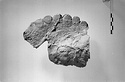
Only the left side of the figure remains; head and legs completely gone.
Seated goddess type, arms pressed close to thighs.
Note that the clay was first pressed thin in the mould; then the concavity was ... 13 March 1937 ... Seated goddess type, arms pressed close to thighs.
|
| Broken above and at right.
Back rough-picked.
From left to right, a bearded man in himation, his right arm raised; a child in himation; a large lebes standing on a tripod; a nude youth carrying a jug ... 18 April 1949 ... in his right hand; the body of a large seated figure to right, probably a goddess.
Pentelic marble. |
| Broken on all sides. Front and back preserved.
Part of mold preserved is for bent, draped knee.
Smooth back.
Goddess (?).
Fabric pinkish-yellow with gray core.
Cf. T 4121.
ADDENDA Joins with T 4101, ... 2 August 1973 ... Smooth back.
Goddess (?).
Fabric pinkish-yellow with gray core.
|
| Broken on two sides. Lower corner, front, back preserved.
Subject: right (?) foot and lower part of leg from heavily draped three quarter view figure standing on rectangular stand.
Smoothed back.
Well ... 21 August 1973 ... Fragment of standing woman or goddess. |
| Broken all around. A bit of lower surface preserved.
Mold for lower legs and feet of heavily draped figure with feet protruding from drapery.
Orange clay.
Cf. T 4041, T 4042, T 4047, T 4048, T 4049.
Cf ... 27 June-5 August 1972 ... ADDENDA Seated goddess; for mold for weak derivative of same series from the same context, see MC 1226. |
| A small pilaster in relief (section number Ω 490).
The original left side preserved, broken elsewhere.
Background painted blue, pilaster red.
ADDENDA: C. Grandjouan: Fragment a) (section number Ω 1462) ... 18 April 1938, 23 July 1969 ... Seated goddess facing right with arms out-stretched. Goddess wears Ionic peplos, himation and a polos, the hair falling free behind.
|
| The fragments make up into two principal groups, which preserve the full width of one side of a smallish neck amphora.
a) Four joining fragments: head and shoulders of Dionysos, a goddess, and Apollo, ... 1 March 1937 ... The fragments make up into two principal groups, which preserve the full width of one side of a smallish neck amphora.
a) Four joining fragments: head and shoulders of Dionysos, a goddess, and Apollo, to right, and face of a goddess to left; above, black tongues, and the spring of the neck. ... b) Two joining fragments: the lower part (except feet) of a draped standing figure, to left, probably the goddess whose face is preserved in group a); the head and neck of a young deer, right, looking up at her; the lower part (except feet) of Hermes, right; part of the floral ornament about the handle.
|
| Slice of the left side of a votive relief. Smooth surface preserved of left side and back; broken at diagonal at top of left corner and bottom right corner.
Standing female, perhaps a goddess, preserved ... 19 August 1977 ... Standing female, perhaps a goddess, preserved to waist, top of head broken off. |
Very slightly chipped and worn.
The goddess is seated on a simple backed throne, dressed in a chiton and wearing a polos. Her hair hangs to her shoulders. In her right hand she holds a patera, in her left ... Very slightly chipped and worn.
The goddess is seated on a simple backed throne, dressed in a chiton and wearing a polos. |
| Single fragment preserving body of lekythos; missing neck, handle and foot.
Sloping shoulder. Cylindrical body tapering to foot. Tongues and rays on shoulder. Thin uneven double line at top of body does ... 3-8 August 1994 ... Thin uneven double line at top of body does not go round. Goddess mounting chariot. |
| The "Mother of the Gods'" in relief on a thin plaque.
Broken all around. The left hand of the goddess broken away.
She is seated, a kalathos on her head, a phiale in her extended right hand.
Traces of ... 2 May 1935 ... The left hand of the goddess broken away.
|
| One side, front and back preserved.
Part of mold preserved is for folds of drapery falling vertically possibly hanging free along right side of a figure no longer preserved.
Fabric pinkish-yellow with ... 6 August 1973 ... Probaly the bust of a goddess. |
| Broken on three sides. One side, front, back preserved. Small part of front surface missing.
Subject appear to be upper left arm, shoulder and small part of torso from draped female figure, with drapery ... 7 August 1973 ... ADDENDA RVN: Mold for large protome of veiled goddess. See also T 4081, T 4086, T 4103: apparently the same series, but one generation later. |
| Broken on all sides, back not preserved.
Fragment of draped female torso broken at neck and just below waist. Left arm bent with hand placed near left breast. Upper right arm held against torso; broken ... 27 July 1973 ... From group of standing Goddess figures.
Inside fairly smooth.
|
| A high polos, crowned with a heavy bound wreath, and framed by a falling veil which flies out at the sides; the bottom apparently finished.
The polos is decorated with zones of figures in low relief; a ... 9 June 1937 ... The polos is decorated with zones of figures in low relief; a seated goddess holding a tympanon; votaries dancing, and comic figures at the bottom.
|
Winged(?) Goddess.
Bottom of cup with part of lower body.
Cup rests on ridge (worn) surrounded by groove; convex underside.
Hemispherical profile, plain body. Bust of female figure with head turned ... 200-175 ... Winged(?) Goddess.
Bottom of cup with part of lower body.
|
| a) Several joining fragments preserve a little more than half of the circumference, giving the lower part of the figured scene.
b) Single fragment from upper wall, with handle space and a little of Faces ... 28 June 1939 ... White for the goddess' flesh; yellow overpainting for details. ... Large lifting hole cut through figured scene at bottom, at goddess' left shoulder.
|
| Broken on three sides. Part of one side, front and back preserved. Some of front surface and most of back surface gone. Mended.
Mold represents folds of drapery presumably hanging vertically.
Back smoothed; ... 29 June 1973 ... ADDENDA RVN: Mold for large protome of veiled goddess. Probably part of same mold as T 4066, T 4068 and T 4069. |
| Mold for upper part of frontal head wearing crown. Part of mold for right eye, small section of nose, parts of hair and crown preserved.
Upper edge, front, back preserved.
Mold rough on outside.
Fabric ... 6 August 1973 ... ADDENDA RVN: Mold for protome of veiled goddess. Probably part of the same mold as T 4066, T 4068 and T 4096. |
| First interpretation: standing nude male figurine.
Chest and lower part of head, with stumps of arms preserved.
The left arm was stretched straight out at the side, the right also partly extended. A single ... 25 April 1940 ... ADDENDA: Seated goddess, with arm over back of klismos.
|
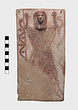
| Surface gone from lower left part of plaque.
A goddess with upraised hands standing between two snakes. The head in relief. In upper corners, holes for suspension.
Painting in deep red over white slip, ... 31 March 1932 ... Surface gone from lower left part of plaque.
A goddess with upraised hands standing between two snakes. |
| Preserved to base of neck, end of nose missing, a chip from the chin and minor fractures.
A life-sized head of a woman or goddess (Nemesis?), turned slightly left. Hair parted in the middle and softly ... 18 May 1938 ... A life-sized head of a woman or goddess (Nemesis?), turned slightly left. |
| Part of one side of circular mold front and back preserved. Much of front surface gone.
Along circumference of mold series of 7 circles roughly 0.025m. in diameter preserved. Off center to the circumference ... 2 August 1973 ... ADDENDA RVN: Mold for a large seated woman or goddess draped in chiton and himation. |
Mended from three pieces. Upper part and most of one side missing.
Roughly rectangular mold for front part of figured group; parts preserved represent heavily draped female figure, standing with legs crossed, ... 1 August 1973 ... Woman or goddess (resting dancer?). |
| First interpretation: head with high figured crown.
Front part of head carrying a kanoun.
Preserved to chin. Piece of kanoun broken off right side.
Worn features. Curly hair which seems to hang down over ... 2 March 1932 ... Hands raised to support a kanoun with the statue of a goddess in a shrine with arched top; on either side uncertain ornament (partly plume ?) |
| Inscribed fragment.
Head missing, and part of right leg; minor fractures.
The eagle is standing, his left foot advanced. Feathers carved in shallow but naturalistic style. In bottom surface of plinth, ... (ΙΙ 430) 9 May 1938
(ΘΘ 296) 21 May 1938 ... Dedication to Demeter and Kore; "The two Goddess".
The inscription runs around the face of the roughly oval plinth.
|
Apparently complete in a single letter: A; np letters to either side. Upside down to vessel.
Single alphas are often found on objects dedicated to Athena, undoubtedly as abbreviations of the goddess' ... Single alphas are often found on objects dedicated to Athena, undoubtedly as abbreviations of the goddess' name (cf., for example, those from the sanctuary of Athena on the acropolis of Sparta: B.S.A. 30, 1928-1930, p. 251, fig. 6, nos. 1-11, 14, 22). |
| Broken on three sides. Bottom, front and back preserved.
Looks as if the break on one side occurs very near the original edge. Mold for upper torso of draped female figure with right arm bent at elbow ... 6 August 1973 ... ADENDA RVN: Mold for large protome of veiled goddess, with hands between breasts. |
Mended from numerous pieces. Somewhat more than three-fourths complete. Restored in plaster. Central medallion: Gorgon head. Lower wall: alternate winged Erotes and bunches of grapes. A band of tongue ... 23 May 1969 ... C 42); on the right with his hand on her shoulder Poseidon with his trident; draped goddess with staff in her right hand; Apollo with lyre seated right; Amymone; group of two figures holding a third; Amymone; Apollo; draped figure with staff. |
| Broken on three sides. One edge, front and back preserved.
Subject not clear: looks like a fold of drapery falling to bottom edge of a plaque. Could possibly be a mould.
Back surface gone.
Yellowish-pink ... 2 August 1973 ... ADDENDA RVN: Mold for protome of veiled goddess. Part of the same mold as T 4066 and T 4068. |
| Broken on three sides. Part of bottom preserved.
High slightly curved base above which there are a few not very well preserved drapery folds, apparently representing bottom of some garment.
Fairly smooth ... 21 June 1973 ... ADDENDA RVN: Libation-pouring goddess beside a stele. |
Mended from fragments with missing pieces restored in plaster and painted, notably part of the neck and about two-thirds of the body. H. 0.267; rest. diam. 0.117. T. L. Shear, Hesperia 9, 1940, p. 299, ... Ca. 410 B.C ... At the left, the goddess (right leg, part of chiton and himation) mounts the vehicle (most of wheel, box, part of rail, pole, and breastwork). |
Part of neck, all of handle except for a small piece, shoulder, start of body. Mastoi on shoulder. P.H. 0.145; P.W. 0.135. J. R. Green, Hesperia 31, 1962, p. 87, fig. 2; pls. 31, 32:12.
Athena with chariot, ... Ca. 410 B.C ... All that remains of the goddess is her Corinthian helmet pushed back on her head and a little drapery. |
Wall fragment. Glaze misfired slightly reddish brown on outside. Deep scratch on outside. Max. dim. 0.056.
Athena and chariot, the team to left. What remains of the horses is a bit of their withers and ... Ca. 460-450 B.C ... Of the harness parts, the end of the yoke, part of the yoke pad, and reins are visible. The goddess stands on the right-hand side of the team, facing the vehicle. |
Mended from many fragments with the missing pieces restored in plaster, notably about half of the mouth, lower half of body in back, and all of foot. Glaze abraded on handle. Rest. H. 0.187; rest. diam ... Ca. 490-480 B.C ... Nike at altar. The goddess, dressed in a long chiton with a himation over it, a stephane on her head, bends over to left, sprinkling incense on a flaming altar from a box held in her left hand. |
Mended with missing pieces restored in plaster and painted, notably sections of the lower part of the body. Glaze abraded around handle B/A. H. 0.563; rest. diam. 0.415. T. L. Shear, Hesperia 7, 1938, ... Ca. 440-430 B.C ... Holloway, Archaeology 19, 1966, p. 115, fig. 4; Beck, Album, pl. 47:256 (A); Goddess and Polis, p. 50, fig. 31 (A); Matheson, Polygnotos, p. 440, cat. no. ... B, king and Nike. The goddess, dressed in a long chiton with a himation over it, stands to right, holding a phiale in her outstretched right hand. |
Preserved except for part of mouth and neck, which is restored in plaster and painted. Thin, reddish brown glaze on inside. Glaze slightly abraded on handle. Two holes in handle for ancient mend. H. 0.218; ... Ca. 410-400 B.C ... Two Nikai standing before a tripod decorated with a fillet and mounted on a two-stepped base. Each goddess wears a peplos and is decked out with a necklace and a bracelet on each arm. |
Mended with the missing pieces restored in plaster and painted, notably much of the figured part. Glaze has abraded in many places. The panel is not placed exactly opposite the handle but slightly to the ... Mid-5th century B.C ... All that remains of the goddess rising out of the ground is a bit of drapery. |
Mended with many fragments restored in plaster andpainted, notably all of the mouth and handle, part of the body. Rest. H. 0.316; rest. diam. 0.132. J. R. Green, Hesperia 31, 1962, p. 84, fig. 1, pl. 28:2 ... Ca. 410 B.C ... All that remains of the goddess is part of her himation, her right foot on the ground, and her right arm, with bracelet, extended to hold the reins, which are simply fine lines drawn in the glaze before it was completely dry. |
| Fragments from rim, wall and foot missing; filled out in plaster. Laurel wreath on rim; maeander broken by checkerboard below scene; egg and dot around handles; double palmette ornament under handles; ... 1 June 1937 ... The third figure, Herakles, left, leans on his club, his lion skin over his left arm; much of his upper part is missing; a bit of a phiale, which he appears to be extending in his right hand, to be filled from the goddess' jug, remains. |
Twelve non-joining fragments of lip and bowl. Fragment f preserves the start of the stem on the underside. Start of handle on fragment i. Reserved line on inside at rim. Max. dim. a) 0.133, b) 0.071, c/g) ... Ca. 450-440 B.C ... The presence of hunters and a winged goddess confirms the subject, but it is a very unusual arrangement of the main protagonists, because Eos is not close to her quarry. ... The only remaining space for him would seem to be in the missing area diametrically opposite the goddess.
The Painter of Bologna 417: I, A--B (ARV2 one 597, 8; ARV2 908, 14); the Painter of London E 777: zone around tondo (ARV2 one 618, 8; ARV2 940, 8). |
Two non-joining body fragments, a strengthened with plaster and painted. Start of handle at far left of fragment a. Good glaze, slightly brownish on b. P.H. a) 0.18, b) 0.112; max. dim. a) 0.223, b) 0.162 ... Ca. 470 B.C ... Besides the comparison with the Pig Painter just cited, one may add two others: in general, the figures of Prokroustes on side A and to a lesser extent the winged goddess on side B of Cambridge GR 22.1937 = 37.22 (ARV2 565, 36; Addenda 260). |
Five non-joining fragments of shoulder and wall. Glaze dull on outside. Surface of figures rather abraded. Max. dim. a) 0.089, b) 0.077, c) 0.147, d) 0.102, e) 0.092.
Athena and the Giant. Fragment a ... Ca. 490-480 B.C ... Fragment a (illustrated) shows the back of the goddess' helmet, a tiny bit of her aegis, and the upper contour of her right arm held out at shoulder level. |
Four non-joining fragments of rim and wall with start of underside. P 18414 a + c and P 18007 preserve the full profile of the rim. Glaze much pitted on outside. Est. diam. at rim 0.218; max. dim. P 18414 ... Ca. 460 B.C ... The rest of the figures belong to the Peleus and Thetis scene, the hero and goddess not preserved. |
Two non-joining wall fragments, a with start of return, unglazed on inside. Max. dim. a) 0.104, b) 0.024. LIMC IV, 1988, p. 929, no. 5, s.v. Erechtheus.
Athena and Hephaistos. Fragment a preserves Athena ... Ca. 470-460 B.C ... Fragment b preserves the top of the forehead of a goddess to right, wearing a stephane. |
Four non-joining fragments, a -- c of shoulder, d of neck. Glaze misfired slightly on tongue pattern on fragment a. From a very large krater. Max. dim. a) 0.127, b) 0.15, c) 0.089, d) 0.093. G. Schwarz, ... Ca. 460 B.C ... She did not observe the inscription naming Zeus and thus calls him Triptolemos; nor did she notice the flames of Demeter's torch painted below her name; the goddess on fragment b is not identified and the scepter, branch, and phiale are not linked with Triptolemos but merely mentioned. |
Lower half of body, all of torus foot, start of handle B/A. Strengthened with plaster. Thin reddish glaze on inside. Misfired reddish in places on outside. Pitted here and there. P.H. 0.035. R. R. Holloway, ... Ca. 440-430 B.C ... Holloway, Archaeology 19, 1966, p. 113, figs. 1--3, p. 114, fig. 6; Beck, Album, pl. 44:237, 238; Goddess and Polis, fig. 38; Matheson, Polygnotos, p. 445, cat. no. |
Four non-joining wall fragments, a, c, and d with part of outturned rim. Max. dim. a) 0.055, b) 0.071, c) 0.04, d) 0.169; est. diam. at rim 0.26. H. Riemann, AA, 1937, p. 94, fig. 3 (fragment d); ILN, ... Ca. 470-460 B.C ... Clairmont (Parisurteil, p. 50, cat. no. 144) opts for calling the second goddess not Aphrodite but Peitho, on the analogy of a contemporary skyphos fragment in New York attributed to a follower of Douris on which the name is inscribed (New York, M.M.A. 07.286.51: ARV2 806, 1). |
Ten non-joining wall fragments, three (a, e, and g) of flaring rim, flat on top. Bands of glaze on inside. Glaze has a slightly greenish cast on c, f, and j. Est. diam. of rim at outer edge 0.25; P.H ... Ca. 510 B.C ... These belong to two different palm trees, one behind each goddess. Fragments f and i belong to the one behind Artemis because the glaze has a slightly greenish cast as it does on fragment c. |
|
|