|
|
| Earlier Work. Plans ... ΟΟ-25 4806, 4807 ... Earlier Work |
Small compact deposit. Cutting. High proportion of good black glaze; 21 loom weights (19 pyramidal, 2 lentoid); a very large red-figured skyphos somewhat recalls the style of earlier work of the Dinos ... Ca. 430-420 B.C ... High proportion of good black glaze; 21 loom weights (19 pyramidal, 2 lentoid); a very large red-figured skyphos somewhat recalls the style of earlier work of the Dinos Painter. |
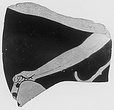
| From a column krater; inside, the glaze thins toward the shoulder. Nude right arm of a man right, pouring from a jug. Below arm, part of staff. Brown for inner drawing on the arm. Careful work without ... 10 May 1935 ... Careful work without relief contours; best glaze ... Red fill, Hellenistic and earlier mixed. |
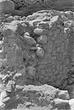
| North-South Byzantine Wall and remains of rough East-West Wall showing that the North-South Wall and its west facing were partially dismantled when the rough East-West Wall was built. From northwest. Taken ... AMS southeast 1126 Horizontal (normal) ... June 1990 ... Taken at an earlier stage of the work than the photo on p 1124. |
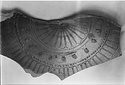
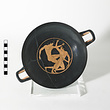
| High, moulded ring foot, glazed all over and inside below, save for a reserved circular space, with ring and dot decoration in the center. Stamped decoration on interior; as far as preserved: large central ... 10-12 April 1934 ... Delicate work.
Attic clay, good black glaze ... Green fill, 5th. c. and earlier under north building. |
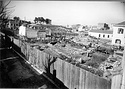
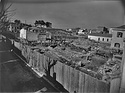
| Central area of the Agora, work in Section Θ. Along the fence, the Street Agion Apostolon at bottom left corner joining above the Street Patousa also fenced. The Church of Vlassarou in right background ... northwest ... April 1933 ... Central area of the Agora, work in Section Θ. ... Cf. 1997.09.0038 for a view of the same section three months earlier. |
| Central area of the Agora, work in Section Θ. Along the fence, the Street Agion Apostolon at bottom left corner joining above the Street Patousa also fenced. The Church of Vlassarou in right background ... AMS northwest Horizontal (normal) ... April 1933 ... Central area of the Agora, work in Section Θ. ... Cf. 1997.09.0038 for a view of the same section three months earlier. |
| Central area of the Agora, work in Section Θ. Along the fence the Street Agion Apostolon joining at bottom left corner the Street Patousa also fenced. The Church of Vlassarou in right background. Cf. 1997.09.0038 ... northwest ... 11 Feb 1933 ... Central area of the Agora, work in Section Θ. ... Cf. 1997.09.0038 for the same view a month earlier and 1997.09.0037 for the same view a month later. |
| Central area of the Agora, work in Section Θ. Along the fence the Street Agion Apostolon joining at bottom left corner the Street Patousa also fenced. The Church of Vlassarou in right background. Cf. 1997.09.0038 ... AMS northwest Horizontal (normal) ... 11 Feb 1933 ... Central area of the Agora, work in Section Θ. ... Cf. 1997.09.0038 for the same view a month earlier and 1997.09.0037 for the same view a month later. |
| Rotroff, S ... American School of Classical Studies at Athens ... The second of two volumes on the Hellenistic fine ware unearthed in excavations in the Athenian Agora, this book presents the Hellenistic wheelmade table ware and votive vessels found between 1931 and ... 1997 ... Especially important is the development of a chronological framework that builds upon and refines the author’s earlier work in this area. |
| Investigations in the Area of the Tholos 1937 ... Homer A. Thompson ... An overview of the work carried out in the area of the Tholos in 1937. The 6th century B.C. accumulation was stripped away revealing a complex of foundation walls, of limestone polygonal construction, ... 5 Apr 1937-21 Jul 1947 ... An overview of the work carried out in the area of the Tholos in 1937. ... Black-figured pottery found in the debris overlying the floors of the earlier houses provide a terminus post quem for the earliest Tholos. |
Upper wall covered by a rich floral band bordered above by egg and dart, below by guilloche. On lower wall there remains the tip of a long serrated leaf with flowers to right and left. Thin wall. Very ... 29 July 1965 ... Very delicate work; thin brownish glaze.
... Stoa cross cut, piers 19 and 20, terrace, layers II-V; from a mass of fill thrown by the builders of the Middle Stoa into the foundation trench of an earlier monument. |
Deeply outcurved rim, slender uptilted handles, disc foot with spreading outer profile. Inscribed on inside, underside and exterior. The graffiti on this and other lekanai from the same deposit, here 1794, ... Context ca. 470-460 B.C ... The graffiti on this and other lekanai from the same deposit, here 1794, 1795, 1796, shown in the earlier publications, will be republished by Miss Lang, with facsimile drawings.
A faithful representation of just such a lekane appears in the sacrifice scene on the cup in Oxford 1911. 617: ARV 559, 152, late work of the Pan painter. |
| Mended from four pieces. Lightly stepped foot.
Reserved band around medallion. Within, two boxers, boxing with bare hands; the victor is about to strike his opponent who is falling to the ground and holds ... Ca. 500 B.C ... Inscription in field:
Relief contour; the outline of the upper part of the head of the victor twice done.
Late work of Epiktetos. ... Ca. 500 B.C. or somewhat earlier.
For the foot, cf. |
| Sections Ε, Ν, Η 1952 ... Homer A. Thompson ... Mycenaean graves were excavated in section Ε.
Section Ν was disturbed by late pits, bothroi and walls. Excavation was carried out through Roman levels. The area seemed to have been leveled out and raised ... 4 Mar-31 May 1952 ... Remains of various topographical structures were revealed. Earlier fills were found only in wells and pits cut down into bedrock. A Mycenaen tomb was excavated.
Work in section Η was confined to cleaning in and around the large late Roman building covering most of the section. |
| Preliminary Report on the 2001 Excavation Season ... John McK. Camp II ... Excavations were carried out at the northwest of the Agora in sections ΒΖ and ΒΕ, and in the area of the Eleusinion in section ΕΛ.
In Section ΒΖ, the investigation of the settlement of the 11th century ... 11 Jun-3 Aug 2001 ... In section ΒΕ, the work in the Classical shop building continued. ... Further work was done in both of the two Mycenaean chamber tombs, dated to the 14th century B.C. ... This material lay directly on bedrock leaving no sign of earlier activity in the area. |
| ΚΚ Excavation Report 1936 ... Dorothy Burr Thompson ... Section ΚΚ, the area inside the modern fence around the so-called Theseion, was cleared to bedrock in order to determine the entire history of that portion of Kolonos Agoraios. Excavation revealed that ... 10 Feb-13 Mar 1936 ... It was discovered that the area in earlier times was used for burials, and down to the early fifth century B.C. the hill must have been uninhabited. ... Dumps of working chips of poros and marble from the time of the of construction of the temple, and the pottery found within them, suggest that work must have begun about the middle of the 5th century. B.C., while the work on the terrace continued well down into the 5th century B.C.
|
| Preliminary Report on the 2006 Excavation Season ... John McK. Camp II ... This summer the 75th anniversary of the beginning of the excavations and the 50th anniversary of the reconstruction of the Stoa of Attalos were celebrated.
Excavation were concentrated on two areas: northwest ... 13 Jun-4 Aug 2006 ... In section Γ work continued in the building identified as the Strategeion. ... East of the road, earlier walls came to light, indicating that the Classical commercial building continued. |
http://agathe.gr/overview/contact.html Staff and Contact Information The Agora Excavations offices are located within the ancient Agora archaeological site, on the upper floor of the Stoa of Attalos. The offices in the Stoa of Attalos are open ... Stored in the Agora excavation photographic archives are several hundred thousand negatives and images that document work since 1931. Traditionally archaeological photography has been shot with black and white film, but color photography and more recently digital imaging are increasingly being used. ... The superimposition of many generations of buildings, ancient to modern in as much as eight meters of archaeological context inevitably requires the dismantling of later structures to reveal earlier ones, consequently the drawn architectural record assumes a unique importance as a record of the evolving human built environment of Athens. ... The development of the collection and its recording was conducted under the inspiration of Virginia Grace, a member of the original Agora staff of 1931 who continued to work at the site until her death in 1994. |
http://agathe.gr/democracy/sokrates.html Sokrates The philosopher Sokrates was one of many Athenians critical of the people and their control over affairs of state. His probing public debates with fellow citizens led to his trial for impiety ... The cup can be dated by details of its shape to about 460 B.C., a time rather earlier than would be consistent with the Simon known to Sokrates and mentioned in the literary sources. ... After executing him, the Athenians felt such remorse that eventually they commissioned a bronze statue of Sokrates, the work of the renowned sculptor Lysippos, which they set up in the Pompeion in Athens (Diogenes Laertios 2.43). |
Eight non-joining wall fragments, a and b with rim and strengthened with plaster. Band on inside at rim, a narrower one 0.068 below rim. Glaze fired red on inside, slightly misfired below figures on outside ... Ca. 460-450 B.C ... Vatican 16535, an oinochoe somewhat connected with the Heimarmene Painter and with Polion but earlier than their work: Eros flies toward Menelaos, holding a garland (ARV2 1173, ---; Paralip. 460, top; Addenda 339). |
http://agathe.gr/publications/monographs.html Monographs Excavations in the civic and cultural center of classical Athens began in 1931 and have continued almost without interruption to the present day. The first Athenian Agora volumes presenting ... Special emphasis is placed on stylistic criteria for dating each work, and the more interesting examples are discussed in some detail. ... This comprehensive reference work is indispensable for students and scholars of Greek coinage and history. ... Especially important is the development of a chronological framework that builds upon and refines the author’s earlier work in this area. |
|
|
.jpg.icon.jpg)