|
|
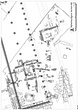
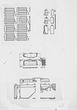
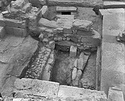
| Doric building at Thorikos.
Pelasgic remains in Greece and Italy, pl. 20 ... AMS Horizontal (normal) ... Doric building at Thorikos.
|
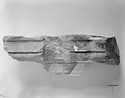
| Top preserved; broken at bottom, sides and back.
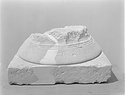
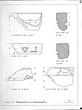
A Doric crowning molding, consisting of a vertical face above a hawk's beak, below which are a groove and then a flat band 0.007m. above the surface below ... 9 March 1937 |
| Much worn by traffic in its present position. From same series as A 2987, with which it corresponds in material, measurements and workmanship.
Marble cloudy gray in color with pronounced lamination. Excellent ... 1959 ... Architecture | Building Blocks | Masons Marks ... Architecture | Capitals | Doric |
| Fragment from front top. Cutting for a patch at right end. Fine work.
Material and workmanship as of A 2915, i.e. Square Building - South Stoa II series.
Hard creamy poros. From demolition of tower of ... 21 July 1959 |
| Top is flat with a vertical step between a lower front and a higher back part. Cyma reversa bed mold, hawk's beak crown. Cutting for two Π-clamps at each end. In each end a cutting for an end dowel, which ... 28 May 1964 ... Architecture | Building Blocks | Masons Marks ... Architecture | Geisons | Doric |
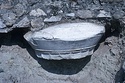
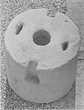
| The flutes roughly cut away and the drum reused as a millstone (or olive press weight, see Expedition 21).
On the top mason's mark, the letters: Β Θ.
From the Temple of Ares.
Pentelic marble. Found at ... 1953 ... Architecture | Building Blocks | Masons Marks ... Architecture | Columns | Doric |
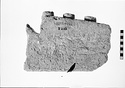
| Fragment with regula with guttae.
One side preserved with anathyrosis; top rough-picked to within 0.035m. from edge. Fragmentary evidence of a mason's mark (probably letters) on top surface. Evidence ... 5 April 1933 ... Architecture | Architraves | Doric ... Architecture | Building Blocks | Masons Marks |
| One end preserved, with anathyrosis. Surface of corona roughened apparently to receive color, for slight trace of red is visible.
Full height preserved; the mason's mark Ε (other letters broken away) incised ... 5 April 1933 ... Architecture | Building Blocks | Masons Marks ... Architecture | Geisons | Doric |
| From a lateral horizontal cornice, a cyma reversa soffit molding with a vertical fascia high above it. The nosing molding is much battered; possibly an ovolo. In the top two rafter cuttings, and at each ... 10 May 1937 ... Architecture | Building Blocks | Masons Marks ... Architecture | Geisons | Doric |
| Hawk's beak for bed and crown moldings; plain soffit. Cutting for double T-clamp at one end of top; and for two dowels in back (repair?). Overhang 0.42m.
Island marble.
Same as A 2991.
Cf. A 2751: with ... 1959 |
| About one quarter of capital preserved with original top and bottom, and part of the rectangular cutting of the centering. Surface finished with at fine toothed chisel, as if intended for stucco but no ... 2 May 1953 |
| A flake from the lower outer part of a base drum preserving parts of two flutes. Lower part of flute (0.07m.) finished delicately with the drove, upper part more carelessly. Very slight relieving surface ... 13 July 1960 |
| Block apparently complete. Only the right end has been exposed; in its upper half the end was left rough and its front edge chamfered to take the overlapping next frieze block (?); the lower half is cut ... 18 July 1963 |
| Anta capital assembled from 36 fragments. Stoa Poikile series.
On the top of the capital note the following indications for the placing of the architrave: a relieving surface, 0.10m. wide and 0.003m. deep, ... April 1949, 17 March 1952 |
Broken around except on top and face. Much of painted pattern preserved on hawk's beak and fascia. Doric cymation on hawk's beak, maeander on fascia.
Top picked smooth with 0.045m. relieving band.
From ... 1953 |
| Top, left side, mutule and via, and front surface preserved, but front surface broken at corner, and at top and bottom.
From a horizontal cornice. A large letter, Κ, on slightly rough top surface. Traces ... 14 February 1952 ... Architecture | Building Blocks | Masons Marks ... Architecture | Geisons | Doric |
| Broken left and back, bottom worn down. Crowning molding broken away. Fascia bears red paint. Part of one mutule and one via. Gutta cut off, traces indicate their diameter. Anathyrosis on side. Mason's ... Architecture | Building Blocks | Masons Marks ... Architecture | Geisons | Doric |
Granular Poros stone.
Found at H/18-7/14 (Fall 2016). Found built into the substructure of the eastward extension of the small 'rectangular building' to the north of the Apollo temple. From the earth ... 1934 |
Back and bottom surface broken away; top preserved, with evidence of a clamp cutting. The crowning molding projects 0.018m. Anathyrosis on preserved end. Weathering along front edge on top.
Assigned to ... 27 January 1934 |
| Complete. Finished smooth behind; good anathyrosis on sides. Top of channels almost straight; deeply undercut. On top, one cutting for double T-clamp to tie triglyph to adjacent backer. Cuttings for lifting ... August 1959 ... Architecture | Building Blocks | Masons Marks ... Architecture | Friezes | Doric | Triglyphs |
| Complete. Channels terminate above in straight line, deeply undercut. On top are tong holes, one pry hole, and mason's mark in from of Ο.
Possibly reused in Southeast Temple.
Marble.
Same series as A 2975 ... August 1959 ... Architecture | Building Blocks | Masons Marks ... Architecture | Friezes | Doric | Triglyphs |
| Good anathyrosis on left side; right side very rough; back scooped out to reduce weight (?). On top, large cutting for double T-clamp on left side, connecting not with metope but a backer. Two pry holes; ... August 1959 ... Architecture | Building Blocks | Masons Marks ... Architecture | Friezes | Doric | Triglyphs |
| Top chipped. Rough on both sides and behind. Tops of channels curved and slightly undercut. On top, mason's mark: Β. Rather course work.
Possibly reused in Southeast Temple.
Pentelic marble. Found at R/7-15/11 ... August 1959 ... Architecture | Building Blocks | Masons Marks ... Architecture | Friezes | Doric | Triglyphs |
| Complete corner block. Rough on back. Channels have curved top, slightly undercut. On top, mason's mark: Α. Painstaking work.
Possibly reused in Southeast Temple.
Pentelic marble. Found at R/6-15/12 (Fall ... August 1959 ... Architecture | Building Blocks | Masons Marks ... Architecture | Friezes | Doric | Triglyphs |
Broken at left, right and below. Rough-picked back preserved. A smooth relieving band runs along the front edge of the top surface. Rest of surface slightly higher and dressed with a toothed chisel. Mason's ... 3 May 1951 ... Architecture | Building Blocks | Masons Marks ... Architecture | Friezes | Doric | Metopes |
| Broken on both sides and bottom.
On top mason's marks, the letters Γ Δ, facing inside.
From the Temple of Ares.
Pentelic marble. Byzantine walls along road between Gymnasium and Byzantine Houses to west ... 9 May 1951 ... Architecture | Building Blocks | Masons Marks ... Architecture | Friezes | Doric | Metopes |
| Reused as millstone (or as olive press weight, see Expedition 21), but in excellent preservation.
On top, mason's mark, the letters: Σ Δ. On either side at bottom a dowel cutting and pry cutting.
From ... February 1953 ... Architecture | Building Blocks | Masons Marks ... Architecture | Friezes | Doric | Triglyphs |
Part of front, top, and right surface preserved. Top front edge broken away.
On right side a rough-picked cutting. Fascia above triglyph.
On top surface, mason's mark: Θ.
Series A 238. Assigned to the ... 14 May 1937 ... Architecture | Building Blocks | Masons Marks ... Architecture | Friezes | Doric | Triglyphs |
| Corner block with triglyphs on both faces preserved in full dimensions though broken. Inner surfaces rough-picked; top, toothed chisel.
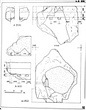
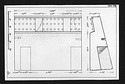
Dowel hole and mason's marks very carefully cut (se drawing) on top ... 27 July 1931 ... Architecture | Building Blocks | Masons Marks ... Architecture | Friezes | Doric | Triglyphs |
| Some of the upper part of a triglyph and a bit of the adjacent metope.
Hard buff travertine.
From same building, Square Peristyle, South Stoa, as cornice A 1926 etc., A 1824 etc., A 2924, A 2931 and ... 28 April 1952 |
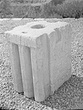
| Doric cornice block (pentelic marble). From the series known as "Building X": a small building associated with the Stoa of Attalos. Compare the triglyph block A 2094 ... The cards A 1545 and 1546 mention Stoa Terrace Fountain? Horizontal (normal) ... ca. 1952 ... Doric cornice block (pentelic marble). From the series known as "Building X": a small building associated with the Stoa of Attalos. |
| Doric cornice block (pentelic marble). From the series known as "Building X": a small building associated with the Stoa of Attalos. Compare the triglyph block A 2094 ... The cards A 1545 and 1546 mention Stoa Terrace Fountain? Horizontal (normal) ... ca. 1952 ... Doric cornice block (pentelic marble). From the series known as "Building X": a small building associated with the Stoa of Attalos. |
| Doric cornice block (pentelic marble). From the series known as "Building X": a small building associated with the Stoa of Attalos. Compare the triglyph block A 2094 ... The cards A 1545 and 1546 mention Stoa Terrace Fountain? Horizontal (normal) ... ca. 1952 ... Doric cornice block (pentelic marble). From the series known as "Building X": a small building associated with the Stoa of Attalos. |
| Both ends and top cut away. Face of metope shows toothed chisel, face of triglyph finished with drove; back shows long vertical striations of a single point. Undercutting at middle of back for a shift ... 6 July 1966 |
| Top and one end cut away, one end broken. Back rough finished with long vertical chisel strokes of a single point. Undercutting in middle of back for a shift bar. Metope faces finished with toothed chisel; ... 6 July 1966 |
| Both ends and top cut away. Block comprised three triglyphs and two metopes with a triglyph in the middle. Both ends and top cut away. The block rested on a raised bearing surface in its middle above the ... 6 July 1966 |
| Fragment of a triglyph. Pendelic marble. From the series known as "Building X": a small building associated with the Stoa of Attalos. Compare the Doric cornice blocks, A 1545 and A 1546 ... The cards A 1545 and 1546 mention Stoa Terrace Fountain? Horizontal (normal) ... ca. 1952 ... From the series known as "Building X": a small building associated with the Stoa of Attalos. Compare the Doric cornice blocks, A 1545 and A 1546. |
http://agathe.gr/guide/south_stoa_ii.html South Stoa II South Stoa II ran westward from the south end of the East Building, parallel to the Middle Stoa (Figs. 38, 41). Dating to the second half of the 2nd century B.C., it consisted of a single ... South Stoa II South Stoa II ran westward from the south end of the East Building, parallel to the Middle Stoa (Figs. 38, 41). Dating to the second half of the 2nd century B.C., it consisted of a single Doric colonnade of limestone, the superstructure reused from a building of the 4th century B.C. ... South Stoa I was put out of use by South Stoa II, and much of the earlier building was quarried away at the west to accommodate the lower floor levels of the South Square. |
From shoulder and upper wall of a closed pot; lebes gamikos(?).
Above, tongue pattern. On the wall, a little of the face of a woman, left and part of her outstretched hand. In front of her, a Doric column ... 23 June 1967 ... In front of her, a Doric column. No relief contour ... Cut along east wall of East Building ca. 13.50m. to 17.50m. from the south end, over cobbled surface. |
http://agathe.gr/guide/stoa_of_zeus_eleutherios.html Stoa of Zeus Eleutherios Lying just south of the railroad tracks, along the west side, are the remains of the Stoa of Zeus Eleutherios (Freedom) (Figs. 8, 9). This cult of Zeus was established after the ... Reconstruction of the Doric Stoa of Zeus Eleutherios, ca. 430–420 B.C. Though dedicated to a god, the building takes the form commonly used for a civic building: a stoa (colonnade or portico), with two projecting wings. Built of marble and limestone in the years around 425 B.C., the stoa had Doric columns on the exterior and Ionic columns within. |
| From a bell krater. Part of two women, draped, moving right. The one at left wears a Doric chiton and holds an oinochoe in her right hand. The one at right wears a thin chiton and himation. Wine pours ... 27 February 1935 ... The one at left wears a Doric chiton and holds an oinochoe in her right hand. ... Red mixed fill. B' building fill, disturbed (c). |
| Placing ancient triglyph blocks near the south end of the building ... Cf. 80-53 northeast ... 16 Feb 1959 |
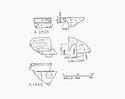
| Doric capital from footing trench along the south face of the original north foundation of the Stoa of Attalos. Compare the fragment of another capital, from below the floor of the Square Building (A 1490) ... August 1952 ... Doric capital from footing trench along the south face of the original north foundation of the Stoa of Attalos. Compare the fragment of another capital, from below the floor of the Square Building (A 1490). Also with the two poros wall crowns (A 1645, A 1975). |
| Agora, Archaic Cemetery. Bracelet. Corinthian. Agora, North Slope. Branch. Agora, Rectangular Rock-cut Shaft. Other. Cornucopia. Well. Corslet. Couch. Aigina. Cradle kithara. Altar. Crosshatching. Amphora ... Agora 23 363 G 6:3 Q 12:3 ... Doric: building ... Building |
| Stoa. Section II; Byzantine House D. Section II. Hadrianic/Antonine Aqueduct. Circular Building. Plemochoai. Skyphos by Makron; London E 140. Doric Frieze above Side Door of Little Metropolitan Church ... Agora 31 x ... Circular Building ... Doric Frieze above Side Door of Little Metropolitan Church |
| Hellenistic Fill between Stoa Back Wall and Retaining Wall. Late Roman Lamps above Southeast Corner of Stoa. Remains of Yellow Poros Building beneath North Part of Stoa. Bedding Block in Situ. Fragment ... Α-9 1923, 1924 A 485 MC 1256 Α 1327 MC 1255 MC 1257 L 5886 H 6:9.2 MC 1256 MC 1257 L 5886 ... 10 February 1932 ... Remains of Yellow Poros Building beneath North Part of Stoa ... Doric Capital |
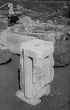
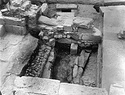
| Northern part of the built drain. Soft Yellow Poros Wall to right; west wall of the 'Marble Paved Building' to left; Green Lime Mortar Wall top center; earlier paved road (cut through by drain) in center ... south 184 ... 25 May 1970 ... Soft Yellow Poros Wall to right; west wall of the 'Marble Paved Building' to left; Green Lime Mortar Wall top center; earlier paved road (cut through by drain) in center. Note two wheel-rutted blocks: the top one is an Archaic anta capital, the bottom one is an Archaic Doric column capital. |
| Northern part of the built drain. Soft Yellow Poros Wall to right; west wall of the 'Marble Paved Building' to left; Green Lime Mortar Wall top center; earlier paved road (cut through by drain) in center ... AMS south 184 Horizontal (normal) ... 25 May 1970 ... Soft Yellow Poros Wall to right; west wall of the 'Marble Paved Building' to left; Green Lime Mortar Wall top center; earlier paved road (cut through by drain) in center. Note two wheel-rutted blocks: the top one is an Archaic anta capital, the bottom one is an Archaic Doric column capital. |
Fragment from an upper wall.
Hermes, wreathed and filleted, wearing a chlamys clasped round his shoulders, and holding the caduceus in his upraised right hand, moves left, looking back right, his left ... 1931 ... In the field behind Hermes are four Doric columns crowned by an entablature, the columns cut off short above the figures. ... White for the building, with the members of the order indicated in yellow overpainting. |
http://agathe.gr/guide/royal_stoa.html Royal Stoa On the west side, lying just south of the Panathenaic Way, are the remains of the Royal Stoa (Stoa Basileios), one of the earliest and most important of the public buildings of Athens (Figs ... The identification of the building is secure, thanks to Pausanias and two inscribed herm bases dedicated by king archons and found in situ on the steps of the building. ... (Plato, Theaetetos 210d) The building is small for a stoa, only 18 meters long, with eight Doric columns across the front and four down the middle (Fig. 64). |
| Stoa of Zeus. Geison Fragments to East of Apollo Patros. Geison Fragment A 148. Stoa Nike S 312 at 24/ΝΣΤ. Stoa Nike Photos. Doric Drum A 150. Various Fragments to East of Zeus and Athena Temple. Destruction ... Η'-12 2247, 2248 A 148 S 312 A 150 S 373 A 225 A 608 S 795 A 674 A 675 A 881 S 1923 ... 1936 ... Doric Drum A 150 ... Doric Drum in Same Place ... Fragment of Doric Capital A 881 from Byzantine Building Room VI |
http://agathe.gr/guide/stoa_poikile.html Stoa Poikile Across modern Hadrian Street are the most recent excavations (2003), along the north side of the square. Here have been revealed the remains of another large stoa, identified on the basis ... The stoa was of the Doric order outside, with Ionic columns inside, built mostly of limestone, with marble for the interior column capitals (Figs. 65, 66). ... Cross section of the Stoa Poikile, with Doric columns outside, Ionic within; ca. 470–460 B.C. ... Actual armor and weapons taken from defeated enemies were also displayed on the building to remind Athenians of former glory. |
| Stoa of Zeus. General Account (September 1931). South Foundations. First Noted. First Cleared. Complete Clearance. East Foundations. Clearing. Explorative Pit North of Railway. Early Pit beneath. Floor ... Α-9 1911, 1912 A 46 A 47 A 49 A 420 A 676 ... Floor and Building Fill ... Doric Column Fragments ... Doric Column |
http://agathe.gr/guide/late_roman_fortification_wall.html Late Roman Fortification Wall East of the East Building and Mint we arrive once again at the Panathenaic Way, which in this area is lined along its eastern side by a massive wall built in the 3rd century ... Late Roman Fortification Wall East of the East Building and Mint we arrive once again at the Panathenaic Way, which in this area is lined along its eastern side by a massive wall built in the 3rd century A.D. ... The wall is made up almost entirely of reused architectural pieces taken from buildings and monuments destroyed by the Herulians: marble architrave blocks, Ionic and Doric columns, inscriptions, and statue bases were all used to make two solid faces, while the interior was filled with rubble. |
| Agora Volunteer Report 2017 ... John McK. Camp II ... Excavations took place in three sections, ΒΘ, ΒΖ and ΟΟ, covering a time span from the 14th century B.C. to the 12th century A.D.
In Section ΒΘ work continued in later layers over and in front of the Stoa ... 12 Jun-4 Aug 2017 ... A collapse of the fill over the Eridanos river opened up part of its south channel and it was possible to see large Doric column drums used as part of the channel construction. ... In Section ΒΖ South, excavation of Room 4 of the Classical Commercial Building was completed, and more levels of the North-South Road were explored.
|
http://agathe.gr/democracy/state_religion.html State Religion: The Archon Basileus There was no attempt in Classical Athens to separate church and state. Altars and shrines were intermingled with the public areas and buildings of the city. A single ... The king archon held office in the Royal Stoa, a small colonnaded building along the west side of the Agora square. ... There were four inner columns evenly spaced within the length of the building; these, too, were Doric. Continuous benches ran along the back and across the ends of the building. The 2nd-century A.D. traveler Pausanias identified the stoa clearly: "The first (building) on the right is the stoa called Basileos, where sits the 'King' (Basileus) when he holds the annual magistery called 'Kingship'" (Description of Greece 1.3.1). |
http://agathe.gr/guide/hephaisteion.html Hephaisteion Overlooking the Agora from the hill to the west (Kolonos Agoraios), is the Hephaisteion, the best preserved example of a Doric temple in mainland Greece (Fig. 12). It was dedicated jointly ... Hephaisteion Overlooking the Agora from the hill to the west (Kolonos Agoraios), is the Hephaisteion, the best preserved example of a Doric temple in mainland Greece (Fig. 12). ... George, 7th century A.C. The building owes its remarkable state of preservation to two factors: Athens is not in a major earthquake zone, and the temple was converted into a Christian church in the 7th century A.D. (Fig. 13), saving it from later quarrying for building material, though deep depressions in the steps show where the lead used to seal metal clamps was gouged out. |
http://agathe.gr/guide/library_of_pantainos.html Library of Pantainos Lying partially under and behind the Late Roman wall are the remains of a building identified by its inscribed marble lintel block as the Library of Pantainos, dedicated to Athena ... Library of Pantainos Lying partially under and behind the Late Roman wall are the remains of a building identified by its inscribed marble lintel block as the Library of Pantainos, dedicated to Athena Archegetis, the emperor Trajan, and the Athenian people in the years around A.D. 100 (Figs. 43, 44). ... As a cultural and educational building, the library reflects the role of Athens as the principal university town of the Roman empire. ... The northern stoa runs eastward, along the south side of a marble street that led in Roman times from the Agora to the Doric gateway of the market of Caesar and Augustus, also known as the Roman Agora. |
http://agathe.gr/guide/temple_of_ares.html Temple of Ares Just north of the Odeion lie the ruins of a building identified by Pausanias as a temple of Ares (Figs. 56, 57). The foundations are of Early Roman construction and date, but the marble ... Temple of Ares Just north of the Odeion lie the ruins of a building identified by Pausanias as a temple of Ares (Figs. 56, 57). ... They can be restored as a Doric peripteral temple, close in plan, date, and size to the Hephaisteion [5]. |
|
|




.png.icon.jpg)
.png.icon.jpg)
.jpg.icon.jpg)
.jpg.icon.jpg)
.jpg.icon.jpg)