|
|
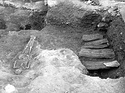
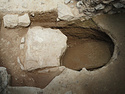
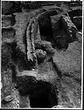
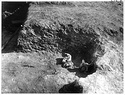
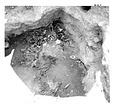
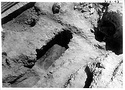
Crescent-shaped cutting in bedrock at 47/ΙΓ; on the north slope of the Areopagus, slightly to the west of the dromos of the Mycenaean Chamber Tomb.
Dimensions of cutting : max. diameter ca. 2.50m.; depth ... Ca. 500-450 B.C.
400-350 B.C ... Cutting |
Rectangular cutting at 58-60/ΚΘ-Λ, probably a plundered wall trench ... 350-290 B.C ... Rectangular Cutting |
Early cutting beside Great Drain: 103-111/Λ-ΛΓ (= "Deep cutting" Pit at 107/ΛΑ).
Abandonment filling in channel for early drain; the fragment of a red figured bell krater, P 17000, probably to be dated ... Ca. 425-395 B.C ... Drain cutting |
Well at 35/ΛH. In the northern part of the market square, north of the altar of Ares. Stony fill with late Geometric sherds. Not dug ... Late 8th century B.C ... Well Cutting |
Cutting in bedrock (Panathenaic Way Cut II, Cutting C1); loose gravelly filling over bedrock including a number of terracotta figurines. Lot ΠΑ 61? P 26458 is probably a slip. One fragment noted as from ... 4th c. B.C ... Cutting in Bedrock |
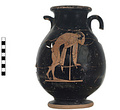
The almost complete red figure hydria set into this cutting suggests the possibility of a 5th c. burial put into a much earlier grave cutting; however, the remainder of the filling appears thoroughly disturbed ... 450-425 B.C- Late Roman disturbance ... Cutting in Bedrock |
A circular cutting in bedrock ... Late 6th-early 5th c. B.C ... A circular cutting in bedrock. |
Perhaps originally a grave cutting ... Ca. 390-380 B.C ... Perhaps originally a grave cutting. |
Small deposit in earlier grave cutting. No bones or any other indication that the cutting had been reused as a grave ... Mid-5th c. B.C ... Small deposit in earlier grave cutting. No bones or any other indication that the cutting had been reused as a grave. |
Scanty dumped filling in an abandoned well cutting ... Ca. 425-420 B.C ... Scanty dumped filling in an abandoned well cutting. |
| Circular pit and irregular cutting north of it. Diam. of pit ca. 0.80m; Dimension of irregular cutting ca. 1.00x1.20m. The pit was dug into bedrock and filled with red earth which was packed with undisturbed ... Second half of 7th c. B.C ... Circular Pit and Irregular Cutting |
Disturbed burial set into a cutting in hardpan. No lot ... 2nd half of 5th c. B.C ... Disturbed burial set into a cutting in hardpan. |
Hole at 65/ΚΔ; small cutting in bedrock with scanty pottery ... 450-400 B.C ... Hole at 65/ΚΔ; small cutting in bedrock with scanty pottery. |
Pit at 48/ΚΕ; circular cutting in bedrock (diameter ca. 1m) ... Ca. 500-470 B.C. (?) ... Pit at 48/ΚΕ; circular cutting in bedrock (diameter ca. 1m). |
Cutting in stereo. Early 4th c. fill with some Hellenistic-Early Roman disturbance ... Ca. 400-375 B.C ... Cutting in Stereo at 86/ΣΤ-Ζ |
| Homer A. Thompson ... Grave XIII in notebook. Cutting in bedrock. One skeleton. Bones discarded. No offerings.
JP ... LH III/EPG (date uncertain) ... Grave XIII in notebook. Cutting in bedrock. |
Narrow trench in bedrock. Cf. Section Σ, p. 4358 (nb. XXII) same trench, same filling.
EV notes that the cutting probably.. to the "narrow cutting in bedrock". The filling seemed to be ca. 425-420 B.C ... Third Quarter to Last Quarter of 5th c. B.C ... EV notes that the cutting probably.. to the "narrow cutting in bedrock". |
Deposit in a cutting in bedrock on Kolonos Agoraios. Sherds in container Lot ΠΘ 4a ... Probably 4th c. B.C ... Deposit in a cutting in bedrock on Kolonos Agoraios. |
Grave 2.
Shallow cutting, 1.00x0.47m, in bedrock; possibly a child's burial, but no skeletal remains preserved ... Late 5th c. B.C ... Shallow cutting, 1.00x0.47m, in bedrock; possibly a child's burial, but no skeletal remains preserved. |
| This cutting was filled in at the time Road 6 was laid. Homogeneous dumped fill.
This deposit represents fill which was brought in at the time Road 6 at the west end of the Middle Stoa was laid to fill ... Ca. 480 B.C ... This cutting was filled in at the time Road 6 was laid. |
Two narrow trenches at right angles to each other.
Small deposit in bedrock cutting Good black glaze ware ... 430-420 B.C ... Small deposit in bedrock cutting |
| Dorothy Burr Thompson ... Grave 12 in notebook. Cut in bedrock. (E.L. Smithson: Grave VII: PG) Few bones (discarded). Rectangular cutting in bedrock.
JP ... Early Protogeometric ... Rectangular cutting in bedrock.
|
Layer 7 in South Peristyle of court of Roman House Ε. Irregular cutting in bedrock with sand, gravel, fallen bedrock. Some burning ... 275-250 B.C ... Irregular cutting in bedrock with sand, gravel, fallen bedrock. |
Well at 69/ΚΗ (diameter 1m).
The well forms the south apse of the apsidal cutting south of the late Roman entrance porch ... Late 8th c. B.C ... The well forms the south apse of the apsidal cutting south of the late Roman entrance porch. |
Kernos Deposit (?): below floor of Building A, over and in cutting at 33/ΚΗ P 30162-P 30172 added on 4 May 1973 ... 4th c. B.C ... : below floor of Building A, over and in cutting at 33/ΚΗ |
| Eugene Vanderpool ... Grave (E.L. Smithson: Grave XXXVIII: PG)
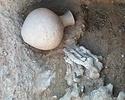
Shallow oval cutting in natural bedrock lintel of Mycenaean chamber tomb O 7:5, containing a large two-handled cooking pot. Within, the unburned bones of a foetal ... Developed-Later Protogeometric ... Smithson: Grave XXXVIII: PG)
Shallow oval cutting in natural bedrock lintel of Mycenaean chamber tomb O 7:5, containing a large two-handled cooking pot. ... The upper part of the cutting and one side of the jar sheared away in Classical times |
Pocket in bedrock, 50/Λ (= Trench, 50-54/Λ), measuring 4.00x0.60m, 0.60-0.90m deep; possibly cutting for wall foundation Coins:
22 April 1932 #1 ... 330-300 B.C ... Pocket in bedrock, 50/Λ (= Trench, 50-54/Λ), measuring 4.00x0.60m, 0.60-0.90m deep; possibly cutting for wall foundation |
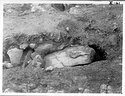
| Dorothy Burr Thompson ... Circular cutting. Grave 24 in notebook. In some records as Grave IV bis. Baby's bones: discarded. No offerings. Negs. KK 99, KK 100, X-61 ... LH III/EPG (date uncertain) ... Circular cutting. Grave 24 in notebook. |
Fillings in an irregular cutting, the context at one end is of the early 5th. c. and at the other end of the second half of the 5th. c ... Early 5th c. B.C ... Fillings in an irregular cutting, the context at one end is of the early 5th. c. and at the other end of the second half of the 5th. c. |
Rectangular cutting, not entirely preserved, west of underground drain. Contained good black glazed pottery, some stamped, and a little coarse ware, along with bits of bone and part of a skull ... Third quarter 5th c. B.C ... Rectangular cutting, not entirely preserved, west of underground drain. |
| Grave I in notebook = RSY Grave 2.
Inhumation burial in Cemetery on West Slope of Areopagus. Outline of grave disturbed by later cutting. Outstretched skeleton, probably of adult female. PD 731-a ... Late 8th century B.C ... Outline of grave disturbed by later cutting. Outstretched skeleton, probably of adult female. |
| Dorothy Burr Thompson ... Grave 26. In some records as Grave I ter. Bones discarded.
Notebook says: child bones (no skull), no offerings.
Circular cutting in bedrock, about 3m south of D 6:3. Neg. KK 234 ... LH III/EPG (date uncertain) ... Circular cutting in bedrock, about 3m south of D 6:3. |
Filling in a sizeable pit. The objects, along with the dimensions of the cutting from which they came, might suggest offerings in a disturbed grave but there was no evidence of skeletal remains ... Ca. 430-415 B.C ... The objects, along with the dimensions of the cutting from which they came, might suggest offerings in a disturbed grave but there was no evidence of skeletal remains. |
| Marcie Handler ... Fill within the drain from the basin on the west side of Roman Room B through Wall A.
After we removed the fill within the basin on the west side of Roman Room B (BZ XXVII p. 5325), we began excavating ... Late Roman ... After we removed the fill within the basin on the west side of Roman Room B (BZ XXVII p. 5325), we began excavating in the cutting on the east face of a conglomerate block that is part of Wall A. The cutting was semicircular, and the fill was silty and very hard-packed. The cutting is probably a drain that carried water from the basin through Wall A and onto the North-South Road. |
| Dorothy Burr Thompson ... Grave 14 in notebook. Cutting in bedrock. Cremation: bones in pit (E.L. Smithson: Grave XXIV: PG). Bones discarded.
[JP] Nb. says at 16-17/ΞΖ and 16/ΞΖ on cards and on deposit list.(SD) ... Early Geometric I ... Grave 14 in notebook. Cutting in bedrock. |
| Rodney S. Young ... Grave 19 (In some records as Grave VIII). No remains, no burned matter or traces of burning.
JP
A small cutting with a single offering. The pit may have been for a simple child/infant inhumation, with ... Early Protogeometric ... JP
A small cutting with a single offering. ... Another similar cutting, at right angles, probably from another burial. A further cutting, just to the south, roughly rectangular, oriented east-southeast to west-northwest, measured 0.95m in length, 0.53m wide, and 0.47m deep. |
| Shallow cutting into bedrock (L. 1.70m, W. 0.55m.) oriented north and south, head at south. Skeleton stretched out , with head on left side. Southern top edge of grave projects to form protective niche ... 750-725 B.C ... Shallow cutting into bedrock (L. 1.70m, W. 0.55m.) oriented north and south, head at south. |
Small compact deposit. Cutting. High proportion of good black glaze; 21 loom weights (19 pyramidal, 2 lentoid); a very large red-figured skyphos somewhat recalls the style of earlier work of the Dinos ... Ca. 430-420 B.C ... Small compact deposit. Cutting. |
| Grave 7 in notebook. Area disturbed in Roman times; outlines of the shaft had been obliterated.
The northwest end, however, was preserved in a cutting in the rock of the sloping hillside. This cutting, ... 750-700 B.C ... The northwest end, however, was preserved in a cutting in the rock of the sloping hillside. This cutting, 0.59m wide, extended to a total depth of 0.62m below the rock surface. ... The earlier burial, Grave XX, occupied the bottom of the cutting; the later, Grave XIX, rested on a filling of ash 0.38m above it. |
Red Figure Pocket in front of Retaining Wall at 74-77/ΛΖ-ΛΘ.
Pit , a large cutting in bedrock, irregular in outline, reaching a depth of ca. 1m; dumped filling of alternating layers-broken pottery fragments ... Ca. 430-410 B.C ... Pit , a large cutting in bedrock, irregular in outline, reaching a depth of ca. 1m; dumped filling of alternating layers-broken pottery fragments on quantity, figured, plain, glazed and coarse. |
Well, unfinished?
The shallow depth, small diameter, lack of water and any use fill make it possible that this was not a well, although the character of the cutting is difficult to explain otherwise. The ... Ca. 440-420 B.C ... The shallow depth, small diameter, lack of water and any use fill make it possible that this was not a well, although the character of the cutting is difficult to explain otherwise. |
| Marcie Handler ... This deposit is a Mycenaean cist grave with two cover slabs, a type of burial described by Immerwahr in Agora XIII (pp. 103-104). Cist graves appear side by side with chamber tombs in the Mycenaean cemeteries ... LHIIB-LHIIIA:1 ... Cist graves appear side by side with chamber tombs in the Mycenaean cemeteries of the Agora.
The cutting for the grave measured 1.80m long (E to W) and 1.06m wide (N to S). ... Six small stones were found wedged between the edges of the boulder and the edges of the cutting, and four more small stones were found just south of the collapsed poros slab, indicating that they were also used to line the cutting or fill the gap between the cutting and the slab.
... The upper fill covering the boulder on the west end of the cutting (Lots ΒΖ 2128 and 2130) dated to ca. 500 B.C., and the fill lying directly on top of the boulder (Lot ΒΖ 2131) dated to the late 8th c. |
| Margaret Crosby ... Grave, disturbed.
Rectangular cutting in bedrock 1.70m long and 0.60m deep. The north half was cut away by a modern cellar wall and only 0.20-0.10m of fill was left. A the bottom there was a thick layer ... 510 - 490 B.C ... Rectangular cutting in bedrock 1.70m long and 0.60m deep. |
| Mycenaean Chamber Tomb SE of Stoa Pier 12 (Burial 8).
Roughly rectangular, measuring 1.70m by 1.40m, and was cut down to within 0.65m. by the construction of the Square Building. A rectangular cutting ... Early Myc. IIIA ... A rectangular cutting at the northwest corner may have been the entrance, although this cutting may be later; the southwest corner of the chamber appeared to have been unfinished.
|
A well lined with a very well built stone wall, carefully made and fitted to the curve of the well cutting, with footholds running down its N and S faces. This wall, of small stones, runs to 7.30m. from ... 23-29 March 1937 ... A well lined with a very well built stone wall, carefully made and fitted to the curve of the well cutting, with footholds running down its N and S faces. ... At the east side at the surface, a beam cutting was made to hold a beam to support a brick vault over the mouth of the well. |
| Mycenaean grave to west of House N, room 5, with the burial of two young children. Rough rectangular cutting in soft stereo (0.95x0.64x0.28), lying under the western wall of a Geometric house, contained ... Myc. III C:1 ... Rough rectangular cutting in soft stereo (0.95x0.64x0.28), lying under the western wall of a Geometric house, contained the doubled-up skeletons of two small children. ... The cup had been placed in an upright position at the bottom of the cutting, before the upper body was put in, but because of the cramped space and double up postures, it seems likely that both burials took place simultaneously.
|
Square Peristyle (Square Building) Constructions fill + other (square peristyle area); fragmentary and with some earlier material but in the main, where undisturbed, a homogenous deposit. Coins:
26 May ... Βefore 300 B.C ... Piers 17-18E. Cutting floor of Square Building |
| Mycenaean Burial.
The cutting was roughly rectangular (1.60 by 0.50m) and was once covered with rough stone slabs, two of which were found over the body. The skeleton, presumably that of a man, lay in ... Myc. III A-B ... Mycenaean Burial.
The cutting was roughly rectangular (1.60 by 0.50m) and was once covered with rough stone slabs, two of which were found over the body. |
Drain Trench at 62/ΜΗ.
The presence of a number of fairly well preserved vases of good quality suggested to the excavator the possibility that the cutting might once have contained a burial. No skeletal ... 325-300 B.C ... The presence of a number of fairly well preserved vases of good quality suggested to the excavator the possibility that the cutting might once have contained a burial. |
| Brian Martens ... Mycenaean Chamber Tomb J 1:11, located in the area north of Wall K, was partially excavated during the 2014 season. At this point the full western extent of the chamber has not been located because of ... LHIIIA ... A small cutting at the northeastern boundary of the chamber was explored. We removed a segment of the preserved ceiling that measured about 1m by 0.50-0.60m, in order to reach this cutting safely. A wide and steeply sloping dromos was revealed, approaching the chamber from the west (with later well J 1:12 cutting through its eastern extent). The southern edge of the dromos, cutting into the marl bedrock, was excavated up to Wall 7. |
One of two late wells [the other at 59/ΙΗ] cutting the line of the east wall of the peribolos and the line of the Byzantine enclosure. The shafts of the two were close together and in their upper parts ... Turkish ... One of two late wells [the other at 59/ΙΗ] cutting the line of the east wall of the peribolos and the line of the Byzantine enclosure. |
| Rodney S. Young ... Disturbed burial (no remains), probably an infant pot inhumation.
Inhumation grave 17 in notebook. (E.L. Smithson: Grave XIX: PG).
Shallow oval cutting containing a banded amphora on its side, mouth ... LPG ... Shallow oval cutting containing a banded amphora on its side, mouth to west, sheathed in a large two-handled cooking jar, split irregularly lengthwise, south to east. ... BC sherds in cutting. Both pots Protogeometric, the amphora probably intrusive in the 4th. c. |
Beneath layer 11. "Despite its extreme irregularity this pit may be an early well, for it would seem definitely to be an artificial cutting and sherds were found in its lowest part," (Nbp. 2095).
Contemporary ... SubMycenaean ... "Despite its extreme irregularity this pit may be an early well, for it would seem definitely to be an artificial cutting and sherds were found in its lowest part," (Nbp. 2095).
|
A 3rd. c. B.C. cistern and an unfinished rectangular cutting of the 2nd c. B.C. which destroyed some of its upper part. These two features are combined in this deposit; the following objects are identified ... 3rd-2nd c. B.C ... B.C. cistern and an unfinished rectangular cutting of the 2nd c. ... These two features are combined in this deposit; the following objects are identified as from the rectangular cutting: P 16675, P 16676, P 30434, P 30435,
L 4038.
|
Channel J (in ΗΗ)
Cutting that probably originally held a drain. Packed with amphoras and other coarse pottery. It tapped the poros aqueduct wall just East of our explanatory trench at the East end of ... 1st c. B.C. - early 1st. A.D ... Channel J (in ΗΗ)
Cutting that probably originally held a drain. |
| Laura Gawlinski ... Burial of a woman (young adult female ca. 18-20); precise dating difficult due to disturbance by later features, but the amount of Neolithic and Geometric pottery extracted from the trench is significant ... Prehistoric ... Burial of a woman (young adult female ca. 18-20); precise dating difficult due to disturbance by later features, but the amount of Neolithic and Geometric pottery extracted from the trench is significant. No cutting found for grave, but area seems to have been demarcated by rows of stones to the north and south, bedrock to west. |
Dromos of a Mycenaean Tomb at N end of Stoa Terrace (Burial 3). No remains. Perhaps to be associated with dromos of a Mycenaean chamber tomb (?) observed in this area (XIV, p. 2707).
Tomb found when workmen ... Myc. III A ... A soft spot in the earth revealed a cutting about 0.95m wide running from west to east and sloping downward toward the east, apparently the dromos of a chamber tomb, with its chamber under the stylobate foundations of the Stoa. The cutting was filled with greenish earth and contained only two sherds. |
Well under Poros Building Drain at 62/ΛΣΤ, west of the Areopagus. Digging abandoned at 6.10m due to a collapse of the soft bedrock at the west. Small amount of supplementary filling was added in the upper ... Ca. 520-480 B.C ... Small amount of supplementary filling was added in the upper part of the well, probably when the cutting was bridged over to allow for the building of the Poros Drain.
|
| Eugene Vanderpool ... Infant grave near Phaidon street cistern. No offerings.
Roughly rectangular, almost elliptical cutting in bedrock, measuring 0.70m long, 0.35m wide, and 0.40m deep, oriented south-southwest to north-northeast ... Late Helladic III C/Early Protogeometric (date uncertain) ... Roughly rectangular, almost elliptical cutting in bedrock, measuring 0.70m long, 0.35m wide, and 0.40m deep, oriented south-southwest to north-northeast. |
| Mycenaean grave. It consisted of a shallow rectangular cutting in bedrock about 1.40m by 0.70m, but it was probably somewhat bigger, since the east side and a large part of the north side had been cut ... Myc. IIIA:1-2 ... It consisted of a shallow rectangular cutting in bedrock about 1.40m by 0.70m, but it was probably somewhat bigger, since the east side and a large part of the north side had been cut away by later builders. |
Eugene Vanderpool ... Disturbed burial: Pocket in bedrock (Grave 11: PG). In some records as Grave XI. No remains. No cutting or traces of burning nearby
The coin listed here was found "cleaning bedrock", presumably at the ... Developed to Late Protogeometric ... No remains. No cutting or traces of burning nearby
The coin listed here was found "cleaning bedrock", presumably at the time the disturbed burial was found [5 March 1934 #5).
|
| Anne McCabe ... Adjacent to the SW face of Byzantine Wall 14. The circular cutting, 0.90m in diameter, appeared at 53.504m under a layer of loose rubble (Lot 481). Wall of the well roughly built, consisting at the top ... 11-19 July 2006
24 June-21 July 2009 ... The circular cutting, 0.90m in diameter, appeared at 53.504m under a layer of loose rubble (Lot 481). |
| David Scahill ... At northeast corner of Classical Building II; on south side of dromos of Tomb K 2:5, and separated from it by ca. 0.6m of bedrock. Chamber cut through bedrock. The northeast corner of chamber defined ... LHIII A:1 ... Upper fill of stones and earth inside cutting with Geometric sherds. |
| (Grave XXIX: EG).
Rectangular cutting with remains of charred human bones and both burned and unburned pottery fragments. Bones discarded.
Rectangular trench cut through earth into bedrock, oriented east-west ... Middle Geometric I ... Rectangular cutting with remains of charred human bones and both burned and unburned pottery fragments. |
| Rodney S. Young ... Grave 10 in notebook. No remains. Probably grave of a woman.
Only a small portion of the inhumation pit was preserved at the northeast edge of pit A, a large oval cutting of modern date dug for the construction ... Middle Geometric II ... Only a small portion of the inhumation pit was preserved at the northeast edge of pit A, a large oval cutting of modern date dug for the construction of a circular wall at its center, later used as a cess- pit. |
| Brian Martens ... It was partially excavated during the 2012 and 2013 seasons. The tomb, located at the center of Room III in the NE area of section ΒΖ, was found under fill surrounding perpendicular mid-to late 6th c ... LHIIIA ... Disarticulated human remains (ten individuals including adults, children, an infant, and fetuses) were found in the cutting east of Wall 17 and at least one fetal rib was found in the cutting opposite at the west.
... A strip of fill at the north side of the cutting, just below the scarp of Wall L remained unexcavated at the end of the season (J/17,18-1/10,11; 51.290-51.376 masl.)
2018:
We removed a final strip of fill in the chamber below the scarp under Wall K (J/17,19-1/10,11). |
| Sacrificial Pyre = Pit in floor (identified as pyre by SIR); with the characteristic small plates and saucers. "Saucer Grave" at 12/ΚΑ.
Dimensions: 2m (length)x 0.70 (width).
North of north wall of building ... First half 4th c. B.C ... Both the large size of the cutting and the presence of a kernos are unusual, but the rilled-rim plate and the saucers suggest that this is a pyre. |
| David Scahill ... Behind northeast corner of Classical Building; east wall C. Below Hellenistic levels and early Classical pit. Chamber cut through bedrock, depth ca. 0.90m., diameter ca. 2m., roughly square in shape, angling ... LH III A:1 ... Possible dromos cutting in northwest corner, running under wall C.
|
| Pit (6x10) in the valley between the Areopagus and the Hill of the Nymphs. Large cutting in bedrock with 540 ostraka, mainly of the late eighties of the 5th. c. B. C. Much pottery, principally of the early ... Ca. 500-450 B.C ... Large cutting in bedrock with 540 ostraka, mainly of the late eighties of the 5th. c. |
Evidence of stratification into five layers, although joins between the layers. Layer VI added when the construction of the Roman building above required it. No subdivisions assigned.
Flask-shaped cistern ... Early 3rd-late 2nd c. B.C ... May reflect the cutting of wall trenches and leveling operations preparatory to laying the foundations for Hellenistic Building. |
Disturbed "Votive Deposit" at 27-28/ΙΖ-ΙΗ
Reddish fill in five circular cutting in bedrock, considered by the excavators to have been one deposit. Fill was disturbed in later periods, probably by construction ... 7th c. B.C, with intrusions ... Disturbed "Votive Deposit" at 27-28/ΙΖ-ΙΗ
Reddish fill in five circular cutting in bedrock, considered by the excavators to have been one deposit. |
| Brian Martens ... Located in the southern section of Room I, now bound by the scarp of Wall U at the north,, the scarp of Wall L at the east,, and a modern pit at the south. At its now low elevations, excavated in the 2015 ... Third quarter of 5th c. B.C ... The roughly circular cutting is better articulated along its upper elevations; however, as it continues deeper we lose definition and the fill expands outward in all directions. |
| Mycenaean Grave to W of Pier 12 (Burial 11).
The northern part of the tomb had been cut away by the foundation trench for the south stylobate of the Square Building that preceded the Stoa, and the dromos, ... Myc. IIB-IIIA:1 ... Although it might be argued from the single internment and the absence of any preserved dromos that this was a pit grave, the location of the body along the edge of the cutting would seem rather to indicate a small chamber tomb that has been cut away at the north. |
Hellenistic fill South of Middle Stoa near NW corner of Heliaea. This fill contained material later in date than that which made up the middle Stoa Building Fill.
Only the coins (and a few amphora handles ... To ca. 140 B.C ... Descriptions on coin envelopes:
Hell fills of middle stoa and s of drain c (lowest);
Hell fill over intermediate strosis + cutting intermed. strosis 22/ΛΒ;
20/ΛΔ Hell fill.
|
| Marcie Handler ... Pyre under floor no. 9 in the center of Room 4. It was adjacent to the southern face of Wall 4, but at lower elevation than the lowest course of the wall foundation (which was found at 52.250 masl.), suggesting ... 375-350 B.C ... The top surface of Floor no 10 was found at 51.977-52.072 masl, and the edges of the cutting for the pyre pit were found at virtually the same elevation (51.933-52.003 masl). |
| Eugene Vanderpool Homer A. Thompson ... Mycenaean Grave to W. of "Court Room" below Stoa Terrace with "Ballot Box" (Grave XXIX).
Unusual type, conforming neither to our pit nor to our cist graves, and consisted of two parts. The outer part was ... Mycenaean III A-B ... The inner part of the grave was revealed when the stone packing along the north side had been removed. The cutting in bedrock was seen to extend well beyond the stones, forming a rectangular cist (1.50 by 2 by 0.90m deep). |
| David Scahill ... Below packed clay floors in Room 2 of Classical Building II; bordered on east and south sides by polygonal cross wall and back wall extension for Classical Building. Late Roman wall and drain installation ... LHIII A:1 ... Loose fill of stones and earth with large number of Geometric sherds ranging from Protogeometric to late Geometric in date, from top of cutting extending down into layer of tomb contents. |
| Homer A. Thompson ... (Grave XXX: EG)
Rectangular cutting with burned bones of a female 40-45 years old, and both burned and unburned pottery fragments.
Rectangular trench, measuring approximately 0.80m long, 0.40m wide, with ... Middle Geometric I ... (Grave XXX: EG)
Rectangular cutting with burned bones of a female 40-45 years old, and both burned and unburned pottery fragments.
|
| RSY Grave 51.
The grave lay on the slope of the Areopagus in Roman house O, just east of the line where the hillside is scarped for the foundation of the west wall of the house.
Cutting:the pit cut in ... Archaic period/6th or 7th c ... No finds listed from "fill in grave cutting" around the pithos, e.g. |
| Mycenaean Small Chamber tomb.
The cist measures 1,90m E to W, 0.75-0.90m N to S, max. depth -1.30m. Nothing was found in it; cleaned in modern times and used as a cesspool. Some of the SW part of it had ... Myc. IIIA, early 14th c ... All that remains of the chamber is a small segment with a maximum preserved dimension of 1.20m, which is bordered on the north by a modern wall and on the east by a cesspool. The cutting is not straight either in vertical or horizontal section, which shows that the chamber was circular in plan and probably roughly semi-circular in section. |
| Well cut into bedrock under late Roman building in ΕΛ. 1.2m in diameter with small cutting of unclear function at south edge about 0.2m wide. Walls cut straight down, tapering near bottom to 0.8m. Footholds ... Late Archaic ... Well cut into bedrock under late Roman building in ΕΛ. 1.2m in diameter with small cutting of unclear function at south edge about 0.2m wide. |
Mycenaean Well (S/1,2-13/20,14/1). Underneath the NE Room of the Library of Pantainos, along its S side, as a cutting in bedrock containing reddish fill with bits of green bedrock. The feature is rectangular ... 30 June-23 July 1975 ... Underneath the NE Room of the Library of Pantainos, along its S side, as a cutting in bedrock containing reddish fill with bits of green bedrock. |
| Initially uncovered with a diameter of c. 1.05m. Its south side extends under the south wall of the Classical structure and so clearly predates it. The highest preserved portion of the well shaft (at the ... 22 July-9 August 1994
26 June 1995
3-7 July 1995 ... It is not clear at exactly what elevation the lining wall originally began, but it seems unlikely that the entire shaft was lined, for the cutting in bedrock for the upper part of the shaft, where it is well preserved on the east side, lies directly above the inner face of the lining wall below. |
| Marcie Handler ... Located in the south section of Room E in the Byzantine Building east of the North-South Road. The uppermost 1.5 meters of well lining was built of well-coursed stones (some reused marble blocks) and tiles ... 12th c. A.D ... We removed two courses of terracotta lining from the top of the well, and excavated the packing fill behind it to reveal the original cutting for the well. |
| Marcie Handler ... Cist grave for two infants. The grave was cut into a sterile rocky layer on its southern and western sides, and a sterile fill layer on its northern and eastern sides. No obvious grave marker was present, ... Early Iron Age ... (bottom), and the width of the grave was 0.420m (top) and 0.387m (bottom). The cutting for the grave pit measured 0.91m in length and o.64 m. in width. |
| Mycenaean Chamber Tomb occupies a considerable part of the western half of section ΕΕ; lies about half way up the north slope of the Areopagus towards its eastern end, just below the highest point of the ... Myc. III A:1 ... There is only one grave cutting in the floor of the chamber, neatly placed in the SW corner (1.80m length; 0.60m width; 1.20m depth). |
|
|