|
|
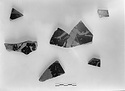
Wall fragment with start of cul. Max. dim. 0.043.
Satyr (left leg, end of tail) to left, holding a full wineskin (part). On cul, tongue pattern. Preliminary sketch. Relief contour. Dilute glaze: muscles ... Ca. 470 B.C ... Wall fragment with start of cul. Max. dim. 0.043.
Satyr (left leg, end of tail) to left, holding a full wineskin (part). On cul, tongue pattern. ... For other examples of the tongue pattern on the cul of a kantharos, see Boston, M.F.A. 95.36 by the Brygos Painter (ARV2 381, 182; Paralip. 366, 182; Addenda 227) and Boston, M.F.A. 98.932 by the Amphitrite Painter (ARV2 832, 36; Paralip. 422, 36). |
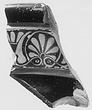
Rim and wall fragment with a bit of cul. Max. dim. 0.08.
Decoration from rim to cul: rim: tongue pattern with dots; wall: lozenge pattern with lozenge and dot in each unit, ivy pattern, feather pattern; ... Probably second quarter of the 5th century B.C ... Rim and wall fragment with a bit of cul. Max. dim. 0.08.
Decoration from rim to cul: rim: tongue pattern with dots; wall: lozenge pattern with lozenge and dot in each unit, ivy pattern, feather pattern; cul: tongue pattern. |
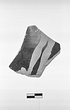
Fragment of lower part of wall and cul. Max. dim. 0.078.
Right leg from knee down, left heel of male to right. Plant on ground; some kind of object behind him. On cul, diagonally addorsed palmettes. Relief ... Probably mid-4th century B.C ... Fragment of lower part of wall and cul. Max. dim. 0.078.
... Plant on ground; some kind of object behind him. On cul, diagonally addorsed palmettes. |
Four joining fragments preserve one handle and parts of wall and cul.
A) Female figure (a bit of skirt remains) and, next to the handle, the legs of a standing youth.
B) The lower part of a cloaked figure ... 12 April 1957 ... Four joining fragments preserve one handle and parts of wall and cul.
A) Female figure (a bit of skirt remains) and, next to the handle, the legs of a standing youth.
B) The lower part of a cloaked figure and the trace of a second.
On the cul, maeander broken by checkerboard squares.
|
Part of rim, wall, cul, all of one handle. Glaze abraded on handle. P.H. 0.075.
On body, four bands: 1 and 3: tongue pattern, 1 above a row of dots; 2 and 4: laurel wreath to right with fruit. On cul: ... Last quarter of the 5th century B.C ... Part of rim, wall, cul, all of one handle. ... On body, four bands: 1 and 3: tongue pattern, 1 above a row of dots; 2 and 4: laurel wreath to right with fruit. On cul: tongue pattern above a row of dots. |
Fragment of lower wall with start of cul. Clay a bit gray (burned[?]). Max. dim. 0.063.
On wall, laurel wreath to right with fruit. On cul, tongue pattern.
At the very top there is a little bit of reserve ... Probably last quarter of the 5th century B.C ... Fragment of lower wall with start of cul. Clay a bit gray (burned[?]). ... On wall, laurel wreath to right with fruit. On cul, tongue pattern.
|
Wall fragment with start of cul at very bottom. Max. dim. 0.07.
Satyr (legs, the right frontal, the left in profile, end of tail), leaning to right (the glaze lines on the inside and the bit of ground ... Probably third quarter of the 5th century B.C ... Wall fragment with start of cul at very bottom. |
Three non-joining wall fragments, a with wall and cul, b with rim and part of one handle, c with a bit of the cul. Max. dim. a) 0.095, b) 0.09, c) 0.05.
On rim, tongue pattern above a row of dots. On ... Probably late 5th century B.C ... Three non-joining wall fragments, a with wall and cul, b with rim and part of one handle, c with a bit of the cul. ... Below the panels, laurel wreath with fruit to right. On cul, tongue pattern above a row of dots. |
Mended from many fragments with missing pieces restored in plaster and painted. More than half of rim, much of wall on Side A, both handles, except for stubs of B/A, all of foot lost. Narrow reserved band ... Ca. 430 B.C ... Glaze abraded on cul; fired greenish in places. ... Below the figures, at the top of the cul, stopped-maeander pattern with saltire-squares.
|
Wall fragment with start of cul and all of one handle. Glaze slightly greenish on inside; abraded slightly on handle. P.H. 0.09.
A, woman (a little bit of lower drapery) to right, facing a man or youth ... Probably 430-420 B.C ... Wall fragment with start of cul and all of one handle. |
| Fragment preserving a little of rim and upper wall. On rim, linked palmette and lotus band. On wall, a little of the front top of a wreathed head, left. Relief contour for the ornament; red for the wreath ... February 1956 ... CWJE compares the pattern on the cul of the calyx krater, CVA Louvre, G 33, nos. 3 and 6.
|
Most of flaring wall on one side, part of cul, all of one handle, and start of the other. Glaze misfired brownish on outside; considerable abrasion. P.H. 0.075; diam. at rim 0.109. C. Boulter, Hesperia ... Ca. 450 B.C ... Most of flaring wall on one side, part of cul, all of one handle, and start of the other. |
| From the wall of a krater, possibly a calyx krater; a trace of the spring of the cul appears to be preserved below. Firm black glaz e inside. Pair of nude male legs, right foot frontal, left foot turned ... 18 April 1939 ... From the wall of a krater, possibly a calyx krater; a trace of the spring of the cul appears to be preserved below. |
Fragment with part of rim, its vertical edge grooved. Glazed on underside. Part of rim broken. Max. dim. 0.06; est. diam. 0.06.
On top side: kantharos or calyx-krater (ribbed cul, stem, and foot) standing ... Probably late 5th century B.C ... On top side: kantharos or calyx-krater (ribbed cul, stem, and foot) standing on a pattern of egg and dot. ... (this has a ribbed cul, which may favor identifying the vessel on 1057 as a calyx-krater). |
Mended with missing pieces restored in plaster and painted, notably most of the rim, all of the foot, much of the wall, part of each handle and the cul. Narrow reserved band on inside 0.035 below rim ... Ca. 470 B.C ... Mended with missing pieces restored in plaster and painted, notably most of the rim, all of the foot, much of the wall, part of each handle and the cul. Narrow reserved band on inside 0.035 below rim. ... On the lower part of the rim below the torus, egg pattern with dots. On cul, stopped-maeander pattern with saltire-squares. |
Three non-joining fragments: P 22490 of rim and start of wall; P 30996 of rim; P 13366 of wall and cul with stub of handle. Reserved line at top of rim on inside. Max. dim. P 13366: 0.105, P 22490: 0.083, ... Ca. 500-490 B.C ... Three non-joining fragments: P 22490 of rim and start of wall; P 30996 of rim; P 13366 of wall and cul with stub of handle. ... At the top of the cul, dot band; at handle, a few fronds of an encircled black palmette, probably part of a frieze. ... Encircled palmettes in black glaze on both the rim below the torus and on the cul of 252 do not seem to have a parallel on either black-figured or red-figured calyx-kraters. |
Mended with the missing pieces restored in plaster and painted, notably parts of the wall, all of one handle, and part of
the other. Cul, stem, and foot gone. Rest. H. 0.07; est. diam. at rim 0.10. H ... Mid-5th century B.C ... Mended with the missing pieces restored in plaster and painted, notably parts of the wall, all of one handle, and part of
the other. Cul, stem, and foot gone. |
Six non-joining fragments, a of rim, body, and cul; b and c of wall and cul; d -- f of wall. P.H. of a) 0.13; est. diam. at rim 0.25; max. dim. b) 0.11, c) 0.108, d) 0.042, e) 0.034, f) 0.029.
Revel ... Second quarter of the 4th century B.C ... Six non-joining fragments, a of rim, body, and cul; b and c of wall and cul; d -- f of wall. ... The estimated diameter at the cul is ca. 0.18, the circumference, 0.711, and these dimensions would accommodate the figures in the sequence suggested here. |
| Alabastra. Amphora Type A. Amphora Type B. Cup-skyphos. Amphorae. Cup, standed. Amphorae, one-piece. Dicing. Guilloche. Dinoi. Amphorae, three types distinguished. Handle. Amphorae, type uncertain. Dinoid ... Agora 23 368 ... Cul |
Fragment of cul and body. Max. dim. 0.09.
On cul, chain of double lotuses and encircled palmettes.
The only painter to favor the chain of double lotuses and palmettes on the culs of his calyx-kraters ... Ca. 450 B.C ... Fragment of cul and body. Max. dim. 0.09.
On cul, chain of double lotuses and encircled palmettes.
|
Body, all of handle B/A, start of the other, foot. Mouth and rim missing. Much of the glaze misfired reddish. Chip in surface between second and third youth on Side B. Narrow reserved band on inside near ... Ca. 440 B.C ... Below the figures, at the top of the cul, maeander pattern with saltire-squares. |
Fragment of cul with start of handle at far right. Glaze much pitted. Max. dim. 0.087.
Chain of double lotuses and encircled palmettes.
For this pattern on the culs of other calyx-kraters, see 270 ... Ca. 450 B.C ... Fragment of cul with start of handle at far right. |
Thirty-two non-joining fragments of rim, wall, and cul. Narrow reserved band on inside of rim, another 0.082 below rim. Glaze pitted on some fragments; has a greenish cast here and there. Max. dim. P 7282 ... Ca. 440 B.C ... Thirty-two non-joining fragments of rim, wall, and cul. Narrow reserved band on inside of rim, another 0.082 below rim. ... At the top of the cul: maeander pattern with saltire-squares (P 7282 h + P 8445 g [illustrated]; P 7282 q). Fragments P 7282 v--w preserve some of the handle reserve on the cul, v with handle root. |
| Nine fragments, not all certainly from the same pot.
a) Satyr running right; in front of him, a burning torch held in the hand of another figure. White for flame of torch.
b) Woman in Doric chiton moving ... 28 March 1936 ... Part of a nude right arm.
q) Fragment of the cul. A saltire square.
r) Wall fragment. |
Fifteen non-joining fragments of wall, P 18278 b--c and P 19582 a--d of torus rim with zone of ornament below. Glaze mottled here and there; has a greenish cast in places; abraded in part on rim. Max ... Ca. 480 B.C ... Near the bottom of the fragment there is the head of a spear pointed downward, not touching ground; at the very bottom is the ground line and start of the cul. The only other fragments that seem for certain to belong to this side are P 19582 g and i. |
|
|
.png.icon.jpg)