|
|
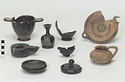
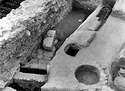
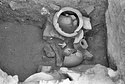
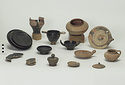
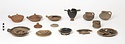
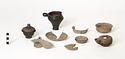
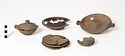
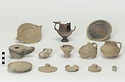
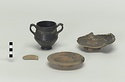
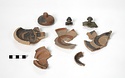
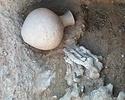
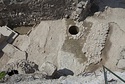
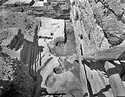
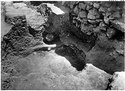
| Classical Pyre between floors in Room 2 of Classical Building II.
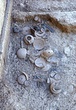
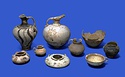
Below floor at 51.66 7masl. Broken pyre pots in fill of ash and carbon, from 51.541-51.513, resting on next floor at 51.513 masl, next ... Ca. 400-390 B.C ... Classical Pyre between floors in Room 2 of Classical Building II.
|
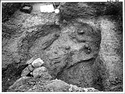
| Classical dump at N/1,6-6/6,8.
Layer 14 in Early Trench E. A tremendously thick layer of dumped fill with ceramic contents ranging down through the second half of the 5th century and into very early years ... Late 5th c. (Early 4th c.) ... Classical Dump |
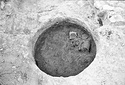
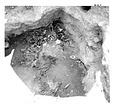
East of Classical Building II backwall, above Mycenaean chamber tomb K 2:5. Rough circular pit of reddish brown fill cut into geometric fill that extends down inside tomb. Some evidence of burning on pottery ... Ca. 460 B.C ... East of Classical Building II backwall, above Mycenaean chamber tomb K 2:5. |
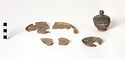
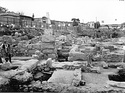
| Classical Building II, Layer 7B ... 1st c. A.D ... Classical Building II, Layer 7B. |
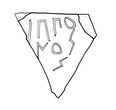
| Layer of crushed bedrock with ostraka, behind Classical Building ... 17 June-17 July 1996
28 July 1997 ... Archaic-Classical |
| A well at the northeast corner of Classical Building, behind back wall. Dumped fill appears to have occurred as a single event as there are joining sherds throughout.
POU date ca. first half 5th c. B.C.; ... 5th c. B.C ... A well at the northeast corner of Classical Building, behind back wall. |
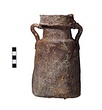
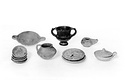
| Sacrificial Pyre I, Classical Building II.
The pyre was set through the original floor level of the northern room of the Classical Building and apparently is the remainder of a ritual conducted when the ... Ca. 375-350 B.C ... Archaic-Classical |
Classical commercial building, room 3, against south wall. Small fragments of pottery dispersed in fill overlying two floor levels (at 51.897 and 51.941 masl). Five objects of pyre type: ribbon-handled ... 4th c. B.C ... Archaic-Classical |
| Marcie Handler ... It was situated in the NW corner of Room 3 in the Classical Commercial Building, just S of Wall 11, the cross-wall that divides Room 3 from Room 4 to the north. The pyre pots were found surrounded by ... Late 4th c. B.C ... Archaic-Classical |
| Handler ... Found in an area of disturbed fill north of a floor surface in Room 4 of the Classical Commercial Building. The floor surface (n. 3 on the west side of Room 4) was preserved at 52.503-52.544 masl., and ... 2nd half 4th c. B.C ... Archaic-Classical |
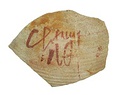
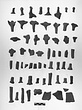
A total of 79 ostraka was recovered from Room 5 of the Classical Building.
More of this deposit was excavated in the 2021 season on the opposite side of the scarp of Wall R, up against the face of Wall ... 500-475 B.C ... A total of 79 ostraka was recovered from Room 5 of the Classical Building.
More of this deposit was excavated in the 2021 season on the opposite side of the scarp of Wall R, up against the face of Wall 4. |
| Marcie Handler ... The Pyre was revealed in a layer of 4th c. fill in the north end of Room 6, just south of Wall 8. Room 6 is defined by the street wall (Wall A) on the west, Wall 7 on the east, Wall 9 on the south (preserved ... 4th c. B.C ... This pyre is the northernmost pyre found in Section ΒΖ North, and its location suggests that the Classical Commercial Building continues this far north. |
Well West of N-S Street. Coin
2 August 1982 #704 ... Ca. 115-75 ... Archaic-Classical |
| Excavation of this pit began in 1995, tentatively identified as a pyre. This proved to be so with continued excavation in 1996. The deposits J 2:8 and J 2:9 were combined to become J 2:9. Miniature vessels ... Ca. 300 B.C ... Archaic-Classical |
| Hellenistic Pyre below packed clay floors of Room 2; west of Late Roman wall extension, below tile platform terracotta drain installation, bordered on the north by bedding foundation stones of crosswall ... Ca. 300 B.C ... Archaic-Classical |
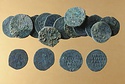
| Coin hoard. Room 2: soft soil north of floor surface. Coins:
23 July 1999 #924-#944. Anonymous folles with the head of Christ on the obverse dating between 770-1059 ... 23 July 1999 ... Archaic-Classical |
Filling under North-South Road surface, apparently to raise the level of the road as thickness of fill varies depending on height of road. Fill sits on earliest, cobbled road layer. The road surface set ... Mid-6th c. B.C ... Archaic-Classical |
| Matt McCallum ... The pyre was uncovered in a small, triangular area between the BZ Building foundations (but at a lower level) and the northern scarp of the current excavation area. It rested in a patch of orange-brown ... 1-7 August 2006 ... Archaic-Classical |
| Mike Laughy ... This pyre was found within an otherwise mostly sterile fill directly under a white floor surface in the southern section of Area IV. It was located ca. 0.50m. east of a similar deposit, Pyre J 2:25. The ... 4th c. B.C ... Archaic-Classical |
| Destruction Fill in channel of Apsidal Building.
Cf. nb.p. 989 for continued digging in this channel. Coins:
24 July 1990 #202, #204, #208
27 July 1990 #219-#222
30 July 1990 #226
31 July 1009 #236
1 August ... 14 June-3 August 1990 ... Archaic-Classical |
| A well in the courtyard (Room 8) of a Byzantine House of Period II. The well was covered by a large squared poros wellhead and a marble puteal (apparently neither inventoried). Within the well shaft, the ... 14 July-9 August 1989
2-13 July 1990 ... Archaic-Classical |
Kevin Daly ... This deposit has only one object, are you sure this is a deposit? ... 525 B.C ... Archaic-Classical |
Anne McCabe ... Pithos D, adjacent to Pithos A at the NE, is built of stone and broken tile, beehive-shaped, unlined, with no floor. The wall of Pithos D appears to have been cut by the construction of the mortar wall ... 4-6 July 2007
31 July 2007 ... Archaic-Classical |
| Dimensions: 1.10m in diameter and 1,36m deep.
It could have been started as a well but then abandoned at a shallow depth (perhaps due to Persian invasion of Athens). BG vessels (including one inscribed ... 500-470 B.C ... Archaic-Classical |
| Tile-lined well. Excavation of the well terminated at 47.548m. due to cave-in danger. Cf. MC 1499 and L 5995 found in vicinity of well; also ST 897, ST 943 and MC 1384 plus coin N 12048 (ΒΕ-1403) found ... 15 June 1993
28 June 1993
23-30 July 1993 ... Archaic-Classical |
Ione Shear ... Tile burial of an adult male found in 1991 on top of cover slab of south channel of river ... 27 June-3 July 1991 ... Archaic-Classical |
| David Scahill ... Beneath toichobate floor level in Room 1 of Classical Building II, against the south ashlar wall, ca. 1.50m. east of the southwest corner of the building. Deposit of broken pyre pots in small pit, 1.00m ... Ca. 325 B.C ... Pyre in Room 1 of Classical Building II |
Classical Pit under Rubble Wall of Predecessor of Square Building and above Geometric Well (Q 8:9) ... Classical Pit under Rubble Wall of Predecessor of Square Building and above Geometric Well (Q 8:9) |
Filling in Classical Floor of Agora, to the north of the Temple of Ares; possibly a disturbed pyre ... Early 4th c. B.C ... Filling in Classical Floor of Agora, to the north of the Temple of Ares; possibly a disturbed pyre. |
| David Scahill ... Below packed clay floors in Room 2 of Classical Building II; bordered on east and south sides by polygonal cross wall and back wall extension for Classical Building. Late Roman wall and drain installation ... LHIII A:1 ... Chamber Tomb Below Floor of Room 2 of Classical Building II |
NW corner of Civic Offices, lowest layer above Roman road metal[classical floor, see nbp. 1907]. Coins:
12 May 1950 #1-#10 ... Mid 3rd. c. A.D ... NW corner of Civic Offices, lowest layer above Roman road metal[classical floor, see nbp. 1907]. |
Geometric Well under Rubble Wall of Predecessor.
Classical pit above a Geometric well with a small amount of pottery from the late 6th to the middle of the 4th c. B.C. Estimated Grid ... Late 8th century B.C ... Geometric Well under Rubble Wall of Predecessor.
Classical pit above a Geometric well with a small amount of pottery from the late 6th to the middle of the 4th c. |
| David Scahill ... Protogeometric/Early Geometric well under floors in Room 1, Classical Building II, on north side of south ashlar wall. See J 3:9 for the burial within this well.
Cf. Hesperia Suppl. 50 (2018), p. 106, ... 27 June 2001
17 July 2002 ... Protogeometric/Early Geometric well under floors in Room 1, Classical Building II, on north side of south ashlar wall. |
The following objects may be from this level or from the 'Mixed Classical Level at 10/Δ: SS 449, SS 450, SS 451 (nbp. 186, 2819). Coins:
4 March 1933 #1-#6 (cf. #7-#13)
7 March 1933 #39 ... 150-86 B.C ... The following objects may be from this level or from the 'Mixed Classical Level at 10/Δ: SS 449, SS 450, SS 451 (nbp. 186, 2819). |
| David Scahill ... Burial in Geometric well (J 3:8), in Classical Building II, Room I, next to south ashlar wall. "No grave goods!"
ADDENDA: J. Papadopoulos later associated P 34449 and P 34450 to that grave. (Cf. Agora ... Geometric ... Burial in Geometric well (J 3:8), in Classical Building II, Room I, next to south ashlar wall. |
Pit at 9/Ε Coins:
7 March 1933 #15-#23 ... Classical to Turkish ... Classical to Turkish |
| Anne McCabe ... Adjacent to the SW face of Byzantine Wall 14. The circular cutting, 0.90m in diameter, appeared at 53.504m under a layer of loose rubble (Lot 481). Wall of the well roughly built, consisting at the top ... 11-19 July 2006
24 June-21 July 2009 ... Archaic-Classical |
Clearing bedrock on line of early (Archaic) peribolos wall, east of entrance on the south side, west end. Uncatalogued material: 50 sherds, 83 fragments. of plemochoai.
Classical Ware : lekythos; plemochoai ... Early 2nd c. B.C ... Uncatalogued material: 50 sherds, 83 fragments. of plemochoai.
Classical Ware : lekythos; plemochoai.
|
Cistern C (pit) in West Room of late Roman House.
Mixed dump of material, with a little Classical, much Roman dating at least as late as 3rd century A.D., and large amount of late Hellenistic. Coins:
1 ... Late Hellenistic and Roman ... Mixed dump of material, with a little Classical, much Roman dating at least as late as 3rd century A.D., and large amount of late Hellenistic. |
| Eugene Vanderpool ... Grave (E.L. Smithson: Grave XXXVIII: PG)
Shallow oval cutting in natural bedrock lintel of Mycenaean chamber tomb O 7:5, containing a large two-handled cooking pot. Within, the unburned bones of a foetal ... Developed-Later Protogeometric ... The upper part of the cutting and one side of the jar sheared away in Classical times |
Pocket on the line of the early (Archaic) peribolos wall at entrance on the south side. Uncatalogued material: 215 sherds, 186 + frags. plemochoai and 4 objects.
Classical Ware : black glaze; mug; rilled-rim ... 3rd quarter 4th c. B.C ... Uncatalogued material: 215 sherds, 186 + frags. plemochoai and 4 objects.
Classical Ware : black glaze; mug; rilled-rim plate; lekythos; miniatures. |
Mycenaean burial, disturbed (Piers 12-13 east). Plan unclear.
Bones discarded.
It was found in the trench for the east stylobate of the Square Building. It was so badly disturbed by the Classical builders ... Myc. IIIA:2 ... It was so badly disturbed by the Classical builders that it is impossible to tell anything about the plan, whether it was a small chamber tomb or a pit grave. |
| Pyre against north face of polygonal wall, Room 2, Classical Building II. No floor preserved above, but the pyre is below floor level 51.820masl, preserved just to the east and above patchy floor with ... Ca. 275-260 B.C ... Pyre against north face of polygonal wall, Room 2, Classical Building II. |
| Sacrificial Pyre II, Classical Building II.
Found right beneath the stuccoed channel built for sluicing in the 1st c. A.D., and must have been partly disturbed when the channel was constructed. It may ... Ca. 250 B.C ... Sacrificial Pyre II, Classical Building II.
|
| David Scahill ... Behind northeast corner of Classical Building; east wall C. Below Hellenistic levels and early Classical pit. Chamber cut through bedrock, depth ca. 0.90m., diameter ca. 2m., roughly square in shape, angling ... LH III A:1 ... Behind northeast corner of Classical Building; east wall C. Below Hellenistic levels and early Classical pit. Chamber cut through bedrock, depth ca. 0.90m., diameter ca. 2m., roughly square in shape, angling inward toward top. |
| Disturbed Mycenaean chamber tomb.
It was the first Mycenaean burial found in the Agora. It is situated about 20m due south of Tomb VII, only a few meters beyond the south edge of the Augustan foundation ... Myc. IIIA (1st half of 14th c.) ... Shear in his Annual Report wrote "the scant remains of three skeletons lying close together just beneath the floor level of the classical period." |
Back fill in an unfinished well, originally dug only to a depth of 3.80m. Apparently dug in the 3rd. c. B.C. and refilled at once; the filling contained a scattering of 5th. and 4th. c. fragments as well ... To early 3rd century ... B.C. and refilled at once; the filling contained a scattering of 5th. and 4th. c. fragments as well as early Hellenistic; context irrelevant for the classical period. A supplementary filling in the upper 0.50m. is dated to the late 2nd. c. |
Fill in abandoned cistern, lower terrace adjacent yo the Eleusinion on the north.
Uncatalogued material: 189 sherds, 4 objects. Many kernoi fragments.
Objects : loom weights; lamp.
Early ware : Gray Minyan; ... Mid. 4th c. B.C ... Archaic-Classical : black figure; black glaze; amphora; cup; krater; oinochoe; skyphos; cup-kantharos; bolsal; stemmed dishes; echinos bowls; fish plates; plates; lekanis; pyxis; thurible; miniature kothon; unglazed; plemochoai.
|
| Shallow pit in bedrock on the upper terrace, ca. 3m. southeast of the Rocky Outcrop. Uncatalogued material: 46 sherds, 61 terracotta figurines and 4 objects.
Early ware : Neolithic; Gray Minyan; Mycenaean; ... Archaic with intrusions ... Intrusions : Classical ware; black glaze bowl; jug.
|
| Marcie Handler ... The remnants of a disturbed pyre in a layer of dumped Hellenistic fill. The fill was found in the area on top of and east of the eastern wall of the Classical Commercial Building at its north end. Fragmentary ... Ca. 225 B.C ... The fill was found in the area on top of and east of the eastern wall of the Classical Commercial Building at its north end. |
Michael Laughy ... West and adjacent to Modern Wall 5, we excavated 12th-13th c. A.D. fill, in some places a half meter deep or more. The fill was remarkably uniform in content throughout. Typical pottery included: fine ... 12th-13th c. A.D ... sherds: 1824
"classical black glaze": 38
Lot T 143:
fine sgraffito; slip painted; inscribed ware; plain glaze; brown and green glaze; polychrome glaze; Byzantine lamp fragments; coarse handles, rims, bases, body sherds; cooking ware; earlier finewares; ridged ware; combed ware; amphorae fragments; bone.
sherds: 2037
"classical black glaze": 44 |
| Laura Gawlinski ... Bronze foundry north of bridge on Piraeus street, east of Great Drain.
Keyhole-shaped bronze casting pit, cut into bedrock.
2016: Continuation of the excavation of a rectangular pit with foundry debris, ... Late 6th-early 5th c. B.C.
(Late Archaic/ Early Classical) ... (Late Archaic/ Early Classical) |
| Initially uncovered with a diameter of c. 1.05m. Its south side extends under the south wall of the Classical structure and so clearly predates it. The highest preserved portion of the well shaft (at the ... 22 July-9 August 1994
26 June 1995
3-7 July 1995 ... Archaic-Classical |
| David Scahill ... At northeast corner of Classical Building II; on south side of dromos of Tomb K 2:5, and separated from it by ca. 0.6m of bedrock. Chamber cut through bedrock. The northeast corner of chamber defined ... LHIII A:1 ... At northeast corner of Classical Building II; on south side of dromos of Tomb K 2:5, and separated from it by ca. 0.6m of bedrock. |
Dug bedrock filling in a well of unusually large diameter (1.35m.), possibly the original source of water for a factory for making terracotta figurines (water for the workshop with waterproofed floor and ... 4th. c. B.C ... ; topographical considerations however indicate that the well was probably not filled in before Roman times; the context is thus irrelevant for the Classical period. |
| Mycenaean Chamber Tomb opposite ΣΑ pier 15. It was discovered about 20m to the west of Pier 15 of the Stoa of Attalos and almost in a line and a few meters south of Tomb XX. although the entire upper part ... Myc. II-IIIA/B ... It was discovered about 20m to the west of Pier 15 of the Stoa of Attalos and almost in a line and a few meters south of Tomb XX. although the entire upper part had been cut away in Classical times, leaving only the lowest o.50 to 0.80m., and a Classical pit had cut away the northwest corner of the chamber, the burials were remarkably undisturbed and the chamber could be planned and measures. the dromos opening to the northeast, was short and steep and irregularly cut. it was 0.70m wide and was preserved to a length of 1.50m; a few stones of the blocking wall of the doorway remained.
|
| Located at the bifurcation of the Panathenaic Way and West Road.Byzantine fill (9th-10th century) in upper 5.70m. with a series of Classical to Hellenistic accumulations below. Coins:
10 July 1971 #861 ... 14 June-27 July 1971 ... Located at the bifurcation of the Panathenaic Way and West Road.Byzantine fill (9th-10th century) in upper 5.70m. with a series of Classical to Hellenistic accumulations below. |
| Mycenaean Chamber Tomb SE of Stoa Pier 12 (Burial 8).
Roughly rectangular, measuring 1.70m by 1.40m, and was cut down to within 0.65m. by the construction of the Square Building. A rectangular cutting ... Early Myc. IIIA ... No offerings and no trace of bones were found in the rest of the chamber, which had been somewhat disturbed in Classical times. |
Michael Laughy ... Debris pit, located in Room 2 of ΒΘ East. Pit measures ca. 2.30 by 1.70m., and nearly a meter deep. The pottery from the pit dates ca. 10th-12th c. A.D. The fill of the pit consisted of soft, black charcoal ... 10th-12th c. A.D ... A.D., but one suspicious piece Early Modern sherd, and one Turkish pipe)
sherds: 486
"classical black glaze": 17
Lot T 200:
coarse rims, handles; lamp fragments; Turkish pipe fragments; combed ware; ridged ware; cooking ware; Turkish imitation marbled ware; porcelain; monochrome glaze; inscribed sgraffito; slip painted.
sherds: 394
"classical black glaze": 8 |
| The cistern was lined with stones at the top with an opening 0.80 m in diameter. For the most part, it seemed to cut into bedrock except along its northern edge where some 5th c. B.C fill remains and main ... 2-19 July 2010 ... Archaic-Classical |
| Homer A. Thompson ... PG grave to NW of Pier 19 (Grave 4).
It consisted of a rectangular pit, oriented north-south, cut into bedrock. Only the lowest part of the tomb pit was preserved; the upper part was cut away in the Classical ... Earlier-Developed Protogeometric ... Only the lowest part of the tomb pit was preserved; the upper part was cut away in the Classical period. The very northern end of the original pit tomb may have been cut by the foundations for the Stoa of Attalos. |
Well at U/10-14/4, in Byzantine Room I.
Well is ca. 1.20m in diameter, dug into bedrock. Excavated to depth of roughly -8.00m; sides started collapsing and thus did not dig to full depth. Some stone-lining, ... June 15-16, 17-31 July 1972 ... A much used marble well-head was found collapsed into well midway down period of use fill and a fragment of a ceiling coffer from the Temple of Ares.
Classical dump fill of the 5th-4th c. |
| Rodney S. Young ... Grave 3 in notebook (E.L. Smithson: Grave XIII: PG). Urn cremation (trench-and-hole), adult female.
JP
Rectangular trench, measuring approximately 1.10x0.45m, but which may have been larger, cut through ... Late Protogeometric ... Much of the trench and the upper part of the urn-hole were destroyed by Classical and Hellenistic builders. |
Mycenaean Tomb to E of Stoa Shop 19 (ΣΑ 2).
Found while digging just east of Stoa Shop XIX, when came upon some bones, Mycenaean sherds and a pot. As the excavation was enlarged the legs of two skeletons ... Myc. III A:2 (2nd half of 14th c.) ... The floor of the tomb was level with the seventh foundation course of the Stoa, and there was no great depth of bedrock fill above the bones, barely 0.20 to 0.30m before the Classical level. No sure limit to the tomb cold be fixed in any direction, although tunneling to the east the following year was done to a maximum penetration of 1.80m east of the Stoa Foundations. |
| Homer A. Thompson ... Cremation burial (trench-and-hole) under S. edge of E-W Street, northern burial. In some records as Grave XLVII.
The western part of the offering trench of the tomb was lost to a Turkish cess pit, and ... Middle Geometric I ... The tomb was found directly below a Classical wall. What survived was the south and east section of the original grave, including a strip of the pyre trench, reddened from burning to a depth of 0.05m, and below it a shallow urn-hole, roughly square, ca. 0.60m to the side, cut through earth almost to the level of bedrock, to a depth of about 0.30m.
|
Mycenaean Well (S/1,2-13/20,14/1). Underneath the NE Room of the Library of Pantainos, along its S side, as a cutting in bedrock containing reddish fill with bits of green bedrock. The feature is rectangular ... 30 June-23 July 1975 ... The location of the well immediately beside a wall of the library main room, as well as the coincidence of the top edge of the well with the bottom level of the library Main Room wall, would suggest that the shaft was cut into during preparations for the construction of the library, which also removed any structural remains that may have been associated with the use phases of the Classical wells.
[per Jan, some of the info for this lists new grid as ,T1/1 instead of the correct , 14/1. |
| An extensive cistern system on the lower north slope of the Areopagus, south chamber with blind tunnel extending further south (south tunnel); north chamber; drawshaft further north, extends to north tunnel ... Ca. 320-240 B.C ... The network of underground reservoirs intended to supply the private houses of classical times which must have stood there to the south of the public market-square. |
| James Artz Pirisino Daniele Kylindreas Miltiades ... Excavation in Room 3 of ΒΘ West revealed 5 ceramic vessels in a row against the eastern face of Wall 12. 3 complete vessels (ΒΘ 122, 124, and 125) were catalogued, along with the base of a plain glazed ... 9th-11th c. A.D ... Plain glaze ware; Constantinople white ware; monochrome glaze; green and brown painted ware; combed ware; ridged ware; gouged ware; amphora toe; incised coarse ware; Roman lamp fragment and red wares; classical red and black glaze (including geometric, archaic, and classical); coarse base with strange shape, handle and neck close to base; coarse handles, bases, rims, and body sherds; micaceous body; cooking ware, including joining lid fragments; painted and unpainted plaster; roof and floor tile fragments; pithos lid, rim and body fragments; worked stone; stone revetment; bone; metal; glass |
Accumulated debris on the west side of the market square.
Related layers added 1999/2000 (JWH), e.g. "Gravelly layer above burning", "Clearing Classical floor", "Lowest level above bedrock", "Below burning", ... First half of 5th c. A.D ... "Gravelly layer above burning", "Clearing Classical floor", "Lowest level above bedrock", "Below burning", etc.
|
|
|