|
|
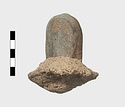
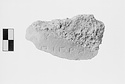
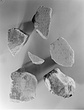
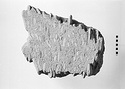
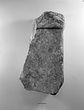
| Oblong pebble with rounded ends and flattened sides set vertically a coarse, gritty mortar fragment.
Votive?
Cf. AM 32. Oscar Broneer, Nb. No. 2.
Found in earth above Pit in 18:G 101 91-32-15 ... 17 October 1932 ... Pebble set in Cement |
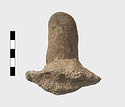
| Oblong, roughly cylindrical pebble with rounded ends set vertically in a coarse, gritty mortar fragment.
Votive?
Cf. AM 31. Oscar Broneer, Nb. No. 2. 101 91-32-16, 91-32-17. 91-32-18 ... 17 October 1932 ... Pebble set in Cement |
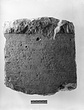
Inscribed fragment.
Top partly preserved.
Covered with cement.
Hymettian marble. Found in modern house wall. Leica ... 1958 ... Covered with cement.
Hymettian marble. |
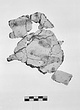
| The plaster was laid on crude brick in two layers, the first containing coarse sand and brown in color, the second of white lime and marble dust, smooth polished.
In a few fragments the finishing coat ... 29 April 1953 ... Architecture | Plaster, Stucco, Faience and Cement |
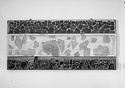
| Scores of fragments were found. Some of the pieces have been made up into two panels. The rest are stored in a tray.
The plaster is of three colors, red, black and a stippled white. Enough is preserved ... 11 December 1953 ... Architecture | Plaster, Stucco, Faience and Cement |
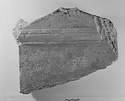
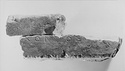
| Fragment from a rectangular plaque; part of one edge preserved.
Both faces finished; on one the edge is raised, and set off by two grooves; on the other the plain edge rises by a shallow molding to a ... 16 April 1937 ... Architecture | Plaster, Stucco, Faience and Cement |
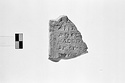
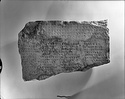
| Inscribed fragment.
Inscribed face only preserved, with cement adhering on all broken surfaces.
Two lines of the inscription preserved.
Hymettian marble. Removed from cement underpinning of pavement of ... 10 December 1963 ... Inscribed face only preserved, with cement adhering on all broken surfaces.
... Removed from cement underpinning of pavement of marble slabs in the Tholos, from a point a little south of the modern cellar cutting in the floor. |
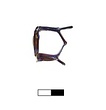
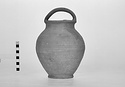
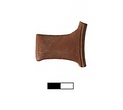
| Handle.
Mended from two pieces.
Small vertical handle with thumb and finger rests.
Much oxidized. Red fill over cement floor.
Late Hellenistic. Leica PD 2815-7 ... 3 April 1934 ... Red fill over cement floor.
Late Hellenistic. |
| Part of circular tile for a column.
Coarse buff clay, traces of cement.
Finger prints.
Cf. A 652.
ADDENDA Hypocaust pillar tile. Cistern, Layer II. Leica, LIX-85 ... 16 April 1937 ... Coarse buff clay, traces of cement.
Finger prints.
|
Cylindrical lid with loop handle.
Somewhat corroded on one side; slightly bent; otherwise unbroken.
The sides are double, the inner wall extending lower than the outer. Round about the spots where the ... 4 April 1933 ... Round about the spots where the metal is corroded, a considerable amount of cement adheres; Bedded in the cement are bits of cloth, white, closely woven, with rather coarse thread.
|
Broken all around. Roof tile fragment with cement adhering.
Pentelic marble.
From the Temple of Hephaistos. Probably pulled out of Byzantine barrel-vault. Collected from roof of temple. Leica ... September 1974 ... Roof tile fragment with cement adhering.
Pentelic marble.
|
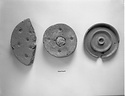
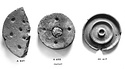
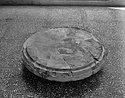
| Thick circular tile with a hole through the center and four, shallow, round indentations on the upper face.
Cement in the central hole.
Cf. A 807. Well. Leica, LIX-85 ... 27 April 1936 ... Thick circular tile with a hole through the center and four, shallow, round indentations on the upper face.
Cement in the central hole.
|
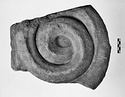
| Fragment broken all around.
Large relief of serpent, spiral of coils remains.
Traces of cement indicate reuse in wall.
Pentelic marble. Marble dump S.W. of Odeion. Leica, 95-8-27 ... 2 June 1951 ... Traces of cement indicate reuse in wall.
|
| Roof tile fragment with water curb and anathyrosis. Cement adhering.
Pentelic marble.
From the Temple of Hephaistos. Probably pulled out of Byzantine barrel-vault. Collected from roof of temple. Leica ... September 1974 ... Roof tile fragment with water curb and anathyrosis. Cement adhering.
Pentelic marble.
|
Inscribed fragment.
Inscribed face only preserved.
Hymettian marble. Found in mixed fill at south end of terrace of the Stoa of Attalos; once built into late Roman Fortification, as cement shows. Leica ... 4 May 1950 ... Found in mixed fill at south end of terrace of the Stoa of Attalos; once built into late Roman Fortification, as cement shows. |
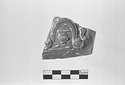
| Moulded decoration of krater beneath crescent and between rosettes.
Fine dark pink clay; hard red glaze inside and out.
Western Sigillata Bowl. Just above brick and cement floor. Leica, 2-289, 93-40-14 ... 14 March 1932 ... Just above brick and cement floor. |
| The sheet is folded into a thin rectangular packet.
Traces of cement. Note that on the published photograph, the number written on the object, reads IL 68. This is incorrect. Well. Leica, 3-237 ... 22 May 1933 ... Traces of cement. |
| Inscribed fragment.
Inscribed face and left side preserved.
Cement on face.
Six lines of the inscription preserved.
Hymettian marble. Found in late Roman disturbance, in classical floor to southeast of ... 22 May 1937 ... Inscribed face and left side preserved.
Cement on face.
Six lines of the inscription preserved.
|
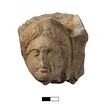
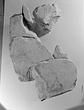
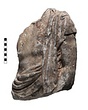
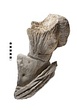
| Small head, broken all around; the left cheek chipped. Behind the head a mass as of drapery(?).
Red cement on the surface, as if from nearby heavy Roman wall.
Pentelic marble. In late fill. Leica ... 13 April 1934 ... Behind the head a mass as of drapery(?).
Red cement on the surface, as if from nearby heavy Roman wall.
|
Inscribed fragment.
Broken at right, above, below and behind.
Some of right edge seems to be preserved. From large block, text within and above wreath. Parts covered in cement.
Pentelic marble. Found in ... 24 March 1972 ... Parts covered in cement.
Pentelic marble. |
| Roof tile fragment from back of tile showing upper tile overlap of 0.049-0.05m. by strong weathering line. Cement adhering.
Pentelic marble. Probably pulled out of Byzantine barrel-vault. Collected from ... September 1974 ... Roof tile fragment from back of tile showing upper tile overlap of 0.049-0.05m. by strong weathering line. Cement adhering.
Pentelic marble. |
| Parts of body and rim missing. Ring foot; outward flaring wall with vertical rim, flaring slightly at the top.
Yellow clay, red glaze badly flaked.
Pergamene Ware. Finished Burned fill below cement ... 3 April 1934 ... Burned fill below cement floor. |
| Inscribed Herm base.
Inscribed front; front partly covered with cement of late Roman usage.
Largely imbedded on back and right.
Exekestides.
Hymettian marble. Found in situ, on North Stele Annex of the ... 20 June 1970 ... Inscribed front; front partly covered with cement of late Roman usage.
|
| Inscribed fragment.
Broken on all sides.
Seven lines of the inscription preserved.
Pentelic marble.
ADDENDA With I 249. Found in late context, in the Bouleuterion Square. Reddish cement as if from 1st ... 24 April 1934 ... Reddish cement as if from 1st. century A.D. screen wall. |
Inscribed fragment.
Broken on all sides.
Six letters remain.
Pentelic marble.
ADDENDA With I 249. Not found on 26-8-1960. Found in late context, in the Bouleuterion Square. Reddish cement as if from 1st ... 24 April 1934 ... Reddish cement as if from 1st. century A.D. screen wall. |
The handle missing.
Ivy pattern in relief on the rim; small depressed top. Simulated ring foot.
Metallic black glaze, badly flaked.
Buff clay.
Type XVIII (?) of Corinth collection, type 54C variant of ... 3 April 1934 ... Fill under cement floor. |
| Inscribed fragment.
Broken on all sides.
Six lines of the inscription preserved; the first very fragmentary.
Pentelic marble.
ADDENDA With I 249. Found in late context, west of the Tholos. Cement as if ... 25 April 1934 ... Found in late context, west of the Tholos. Cement as if from 1st. century A.D. screen wall. |
Inscribed fragment.
Broken on all sides.
Two letters of the inscription, and a trace of a third remain.
Pentelic marble.
ADDENDA Joins with I 1867. Found in late context, in the Bouleuterion Square. Cement ... Before 100 B.C ... Found in late context, in the Bouleuterion Square. Cement as if from 1st. century A.D. screen wall. |
| Ring base. Adhering to the side with a bit of heavy cement is a fragment of roof tile.
Coarse pink clay (5YR 6/8) showing sharp ridges from wheel. Traces of cream slip. Blackened within. Well. Leica, ... 16 April 1932 ... Adhering to the side with a bit of heavy cement is a fragment of roof tile.
|
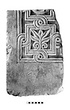
| Broken above and on right.
Preserves lower left corner of slab, with elaborate interlace design beginning 0.185m. from bottom, 0.065m. from left.
Traces of cement show reuse in wall.
White marble. Marble ... 7 April 1952 ... Traces of cement show reuse in wall.
|
Inscribed fragment.
Broken on all sides.
One to two letters of the inscription in each of four lines remain.
Pentelic marble.
ADDENDA Joins with I 1868. Found in late context, west of the Tholos. Cement ... Before 100 B.C ... Found in late context, west of the Tholos. Cement as if from 1st. century A.D. screen wall. |
The vertical band handle broken away.
On the rim, acanthus rinceaux, with a bunch of grapes at the start of the nozzle.
Thin black glaze.
Pinkish-buff clay.
Type XVIII (post Sullan) of Corinth collection ... 3 April 1934 ... Burned Hellenistic fill under cement floor. |
| Broken all around, but full thickness apparently preserved.
A bedding of rough stones about the size of a man's fist, over which a thick layer of cement has been poured. In this cement flat stones from ... May 1951 ... A bedding of rough stones about the size of a man's fist, over which a thick layer of cement has been poured. In this cement flat stones from the sea or from a riverbed have been set on edge, and the surface has been ground down smooth and flat. |
| Inscribed fragment.
Part of smooth picked right side preserved, with a smoothed band along front edge.
Ca. twelve lines of the inscription preserved; stoichedon.
Pentelic marble; coated with cement.
ADDENDA ... Ca. 280-275 B.C ... Pentelic marble; coated with cement.
ADDENDA Joins I 625 (Z 329) below. |
The nozzle broken off.
Shallow body; simulated ring foot; large concave discus, ornamented with raised rings. Volutes at the base of the nozzle.
Light brown clay, once covered with thin black glaze, now ... 26 March 1934 ... Fill over cement floor. |
Inscribed fragment.
Broken on all sides.
Three lines of the inscription preserved; in the first and third, traces of two to three letters.
Pentelic marble.
ADDENDA With I 249. Finished Found in late context, ... 25 April 1934 ... Found in late context, west of the Tholos. Cement as if from 1st. century A.D. screen wall. |
Fragment from upper part of head. Crest of lion had been cut in separate piece and attached with two round iron pins set in white cement.
From Stoa of Attalos.
Pentelic marble. Found in area of Stoa, chiefly ... 13 August 1952 ... Crest of lion had been cut in separate piece and attached with two round iron pins set in white cement.
From Stoa of Attalos.
|
| Inscribed Herm base.
Mended and restored in cement, including much of upper right front surface.
Mouldings run at three sides: fascia crowned ovolo at top and cyma reversa over fascia at bottom. Back rough ... 20 May 1970 ... Mended and restored in cement, including much of upper right front surface.
|
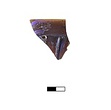
| Part of the rim preserved.
Moulded. Plain vertical lip with two shallow grooves inside; below the lip the wall thickens, and there remain part of two vertical rays in relief, blunt ended.
Purplish indigo ... 17 April 1934 ... Embedded in surface of cement Hellenistic floor.
|
| Roof tile fragment from the Temple of Hephaistos with water-cub, anathyrosis and end of two dowel-cuttings. Anathyrosis very similar to that on sima blocks. Dowel cutting 0.063-0.074m. from edge. Cement ... September 1974 ... Dowel cutting 0.063-0.074m. from edge. Cement adhering.
Parian marble. |
| Rim sherd with upper part of handle.
Rim thickened on inside. Thin strap handle with a flat-sectioned plate, undecorated, added on top.
Plain reddish-brown ware (mica traces).
Import? Local ware? Added ... 3 April 1934 ... Burned fill from destruction of cement floor building. |
| Broken top, bottom and both sides; part of smooth-picked back preserved.
Semi-draped male figure, three-quarter to left, preserved from neck to waist. Left arm held down by side.
Surface much weathered, ... 20 March 1952 ... Surface much weathered, stained, and partly covered with white and red cement.
Pentelic marble. |
| Numerous fragments; missing part restored in cement.
Upper part of base preserved. Horizontal fluting.
Marble. From S.W. corner of tower of Late Roman Fortification at S.W. corner of Library of Pantainos ... July 1959 ... Numerous fragments; missing part restored in cement.
Upper part of base preserved. |
| Inscribed fragment.
Fragment from the upper right corner of a stele with pedimental top.
Broken at left and below. The inscribed face covered with a thick coat of cement.
White marble, apparently Pentelic ... 29 April 1949 ... The inscribed face covered with a thick coat of cement.
White marble, apparently Pentelic. |
| The handle missing.
Watch-shaped body, with long nozzle. Vertical loop handle. Ivy pattern in relief on the top; small depressed center. Low ring foot.
Purplish glaze almost all flaked off.
Buff clay ... 3 April 1934 ... Burned fill over cement floor. |
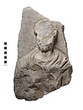
| Broken at front and sides. Back rough-picked.
Head and upper torso of bearded male wearing toga (?) and a cloak, face and surface of chest picked away. Part of left arm preserved.
Traces of cement on ... 12 July 1983 ... Traces of cement on back.
Roman.
|
| Inscribed fragment.
Broken above, below and at left.
Back very roughly picked, not certainly original.
Lower part of inscribed face covered with cement and other hard deposit.
Marble of varying shades, ... 29 April 1949 ... Lower part of inscribed face covered with cement and other hard deposit.
|
| Four joining fragments preserve complete profile; remainder of pot restored in plaster. Flaring lip. Body decorated with tongues marked by grooves. Central boss, concave on exterior, surrounded by a reserved ... 17 March 1932 ... On pebble and cement floor. Ca. first half of 4th. c. |
| Greatest part of one mutule preserved with right and back edge and lower part of the molding above; eight guttae preserved; some completely, some partly, and traces of four more.
Heavy Roman cement preserved ... May 1953 ... Heavy Roman cement preserved in places.
|
| Inscribed fragment.
Broken all around. Back covered with hard cement. Surface pitted along left edge and bottom.
In column I, thirty-nine lines of the inscription preserved; in column II, thirty-three ... 22 March 1938 ... Back covered with hard cement. Surface pitted along left edge and bottom.
|
| Inscribed fragment.
The upper left corner of a stele with pedimental top.
The inscribed surface very much worn, and partly covered with hard cement.
Decree of the year of Phanarchides.
Pentelic marble ... 18 April 1949 ... The inscribed surface very much worn, and partly covered with hard cement.
Decree of the year of Phanarchides.
|
| Inscribed fragment.
The upper part of a stele with pedimental top. Broken below. The pediment much damaged, its upper right corner broken away. The inscribed surface badly worn and partly covered with ... 29 April 1949 ... The inscribed surface badly worn and partly covered with cement and a hard brown deposit.
|
| Inscribed block.
One corner broken away; elsewhere rather battered.
Inscribed on one face in large, deeply cut letters.
Yellow poros. Found as left by previous excavators on back wall of the Stoa of Attalos, ... 18 June 1949 ... Found as left by previous excavators on back wall of the Stoa of Attalos, between rooms 20-21. Much cement still adheres, from which one may suppose that the block comes from the late Roman Fortification wall. |
Inscribed fragment.
Broken on all sides.
Surface blackened by modern cesspool near which it was found.
Five lines of the inscription preserved.
Hymettian marble.
ADDENDA Joins with I 1804.
Cf. Hesperia ... 25 April 1934 ... Found in late context, in the Bouleuterion Square. Cement as if from 1st. century A.D. screen wall. |
Inscribed fragment.
Toothed left side preserved; otherwise broken.
Three letters of the inscription preserved in one line; the tops of two others in the line below.
Pentelic marble.
ADDENDA With I 249; ... 11 May 1934 ... Found in marble pile, in the area west of the Tholos; cement as if from 1st. century A.D. screen wall of Bouleuterion Plateia. |
| Fragment from upper part of a large pot. Plain vertical rim; rolled handle on shoulder. Above the handle around the neck is a thick irregular band of unbaked(?) clay cement, possibly used to seal the jar ... 1 May 1953 ... Above the handle around the neck is a thick irregular band of unbaked(?) clay cement, possibly used to seal the jar.
|
| Top of large columnar grave monument.
In the top is a rectangular cutting, into which a fragment of dark blue-gray stone is now wedged with cement.
Bottom broken off, carrying with it the ends of the fourth ... 6 March 1933 ... In the top is a rectangular cutting, into which a fragment of dark blue-gray stone is now wedged with cement.
Bottom broken off, carrying with it the ends of the fourth and fifth lines of the inscription.
|
Broken at bottom and back, on left, and at tip. At right projection, ca. 0.035m. beyond palmette, ending in finished surface. Roman cement clinging to surface shows double reuse. Palmette antefix carved ... 23 April 1951 ... Roman cement clinging to surface shows double reuse. |
| a) Intact except for inset flange, which is in fragment b) cemented to it.
b) Joins a). Has inset flange of a), inside. Much white cement visible at joints.
Cf. A 2411 (Σ 2837) and A 1686 (Σ 1403). Early ... 11 December 1953 ... Much white cement visible at joints.
|
Broken all around; from a closed pot, unglazed inside. The head and shoulders of Hermes, left, and beneath a handle, (broken away) a smaller figure left. Vine in field.
Red for the beards and part of ... 31 March 1934 ... A hard incrustation of cement, inside and out. |
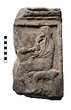
| Top and right side preserved, broken below and at left. Top flat, molding along top of front and side, back rough.
A woman seated left, right hand extended; she probably holds someone's hand who stands ... 1 June 1936 ... Late fill; cement as if from a wall. |
| A rectangular half-housing joint at either end; closed with fine hard white lime cement. Buff clay; unglazed. Lime deposit on inside Not found during June 2001 flood, must have been left in situ.
Not found, ... 15 May 1939 ... A rectangular half-housing joint at either end; closed with fine hard white lime cement. Buff clay; unglazed. |
From the rim of a large open bowl(?). Slightly flaring rim below a projecting lip. Rim set off inside. Set off outside at a lower level by a grooved line with a rouletted band below it; exterior of lip ... 2 -3 April 1934 ... Red fill overlying 'burned' fill from destruction of upper cement floor building. |
| About half the floor and one-fifth of the rim are preserved. Low ring foot. The floor sweeps into a slightly flaring rim which flattens into a horizontal lip with a shallow groove on top. A moulding, flat ... 3 April 1934 ... Burned fill over cement floor. |
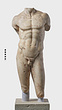
| Head missing. Stubs of arms preserved. Right leg broken below knee; left leg above knee.
Torso of a standing youth, about half life-size, the weight on the right leg. The upper left arm is set back a little; ... 19 March 1948 ... Probably originally built into the NS late Roman wall, which was cut by the tomb builders. Cement found clinging to front of statue, same as that of the late Roman wall, whereas tomb walls are built without cement. |
Lower part of figure avancing left.
Left leg preserved to little above knee, right, to a little below. Mended from two fragments. Full width preserved.
Thin drapery floating back. Back plain. Underneath ... 1 June 1932 ... Faint traces of white paint; streaks of red on under surface, between figure and base, parhaps used as cement.
Pinkish clay. |
| Large fragment of base with angular foot. Foot chipped.
Form 88 or related. Oudna (?) ware: slightly gritty, with thin, smoothish slip on interior, absorbed wash on exterior.
From a disturbed area? Date ... 17 April 1936, 28 April 1936 ... Dumped fill in front of Stoa of Attalos, on cement strosis. Found with coins #1-47 (17 April 1936) and coins #90-101 (28 April 1936). |
| Fragments missing from both upper and lower parts, and small pieces do not join.
Lower half consists of hemispherical bowl with inset flange to receive.
Upper half which has a central spout rising from ... 5 May 1949 ... Traces of marble cement on the joining edges.
|
| Two inscribed fragments.
Two non-joining fragments, each broken on all sides.
"POLETAI" record; Laurion Mines.
Fragment Β 663 a), four lines of the inscription preserved; stoichedon.
Fragment ΒΒ 663 b), ... 25 April 1934 ... Found in late context, in the Bouleuterion Square. Cement as if from 1st. century A.D. screen wall. |
| Inscribed fragment.
Part of toothed right side and rough picked back preserved; otherwise broken.
About half the width of the stele is preserved.
Seven lines of the preamble, and twenty-two lines of the ... 229/8 or 228/7 B.C ... Coarse reddish cement still clings to its sides.
|
Inscribed fragment.
Parts of crowning member of naiskos; face and rabetted bottom surface preserved; broken above towards front, at back and at sides.
Inscription on a plain band below mouldings now broken ... 20 April 1951 ... Bits of Roman cement clinging to it indicate double re-use.
|
| Of the two adjacent preserved edges one is smooth, the other has a tongue and groove joint. Traces of hydraulic cement on both faces; but not enough remains to show water deposit. From Klepsydra.
Tan-colored ... 1961 ... Traces of hydraulic cement on both faces; but not enough remains to show water deposit. |
| Most of one volute preserved, except for its lower edge.
A part of a very large Ionic capital, with carefully carved details. Volute has solid center with traces of cement for attaching a rosette. Base ... 31 March 1937 ... Volute has solid center with traces of cement for attaching a rosette. |
| Fragment of inscribed block.
The top is smooth dressed, polished as if from wear, and covered with a hard cement; the bottom is rough picked. On the preserved right side is an anathyrosis band along the ... 4th. century B.C ... The top is smooth dressed, polished as if from wear, and covered with a hard cement; the bottom is rough picked. |
Appears to have fallen into the drain from above, after the drain was filled up. Hence need not to be contemporary.
Most of lip gone at one end. Simple tongue joint; broad shallow corrugation, more marked ... May-June 1936 ... Traces of hard white cement at joints.
Coarse pinkish clay, in part light buff at surface. |
| Much restored in cement. Upper and lower tori. Good crisp work.
The diameter is appropriate to the Ionic column drums found in the same tower, together with the painted capitals A 2972 and A 2973.
Pentelic ... June 1959 ... Much restored in cement. Upper and lower tori. |
| Inscribed fragment.
Broken below, top badly battered.
Center area of text worn smooth by foot traffic, the whole face originally found covered in a thick, very hard cement, presumably from a modern wall, ... 354/353 B.C ... Center area of text worn smooth by foot traffic, the whole face originally found covered in a thick, very hard cement, presumably from a modern wall, perhaps of Poikile Street, no. 5.
|
| Upper part of a woman somewhat under life-size.
Preserved are left shoulder, breast and part of upper arm. Head and neck insets, missing. The woman wears a thin, clinging chiton, highly girded, cf. S 462, ... 11 April 1934, February 1954 ... Traces of reddish cement.
Fragment of lower torso added February 1954 from marble pile moved from section Δ.
|
| Inscribed fragment on two opposite faces.
Mended from two pieces; part of the smooth picked top preserved; sides and bottom broken.
"POLETAI" record.
Seventeen lines of the inscription preserved on face ... (smaller piece) 1 February 1934
(larger piece) 13 April 1934 ... The largest piece, found, in late fill, west of Tholos, with reddish cement on it, and doubtless once built into the heavy Roman retaining wall, nearby. |
| Fragments of inscription.
Fragment Β 28 a), broken above and both sides
On the front of the bottom, below the inscribed surface a moulding.
Part of one line of the inscription preserved.
b), another ... a) (Β 28) 18 October 1933
b) 24 December 1934 ... b), another fragment, joining the first above; cement as if from heavy Roman wall. |
| The left half of a terracotta sima, preserved to full height. Trace of lion's head spout at right. A goodly amount of tile preserved behind.
On front in relief an ornate floral design. Red color on flat ... 24 April 1935 ... Close to wall of outer apse of late Roman Building (some of cement of which clings to one end of sima). |
Lower part of body covered with globules, as on rim.
On rim, globules, ending in heart-shaped designs toward nozzle.
Small discus, plain, with central filling hole. Stuck to the right side of the discus ... 5 May 1932 ... Stuck to the right side of the discus and the rim is a hard brown cement-like substance.
|
| Single rim sherd.
The shape imitates Phocean Red Slip ware, form 3 (B-C); not decorated.
Yellow orange fabric (Munsell 7.5 YR 7/8, core to 5 YR 7/8), with numerous small brown inclusions; thin red to ... 17 April 1936, 28 April 1936 ... Dumped fill in front of Stoa of Attalos, on cement strosis. Found with coins #1-47 (17 April 1936) and coins #90-101 (28 April 1936). |
a) Rib between coffer, with single astragal. Upper part broken away. Width, coffer to coffer, preserved, and height of coffer face on one side. Rabbet. Return of astragal preserved, but not intersection ... February 1953 ... Presence of Roman cement indicates same provenience for this fragment (H.A.T). |
| Lower right corner of capital of archaic grave stele. Broken above, at left and behind.
Across bottom a row of tongues picked out in paint, traces of which remain.
Above tongues a horizontal fillet with ... 2nd quarter or middle of 6th c. B.C ... Traces of hard cement on all faces and edges show that the fragment in its present form was used as a building stone.
|
| The rim of a deep basin with flaring rim, hanging downward; on top of the rim is applied an upper rim, in part circular, in part star-shaped in section, with a horizontally projecting round boss, hollowed, ... 3 April 1934 ... fill from destruction of upper cement floor building. |
| Broken off at the neck; the nose broken, and a piece missing from the top of the head; otherwise well preserved, save for a few chips, and the remains of cement from the wall.
Modern dowel hole in neck: ... 19 April 1934 ... Broken off at the neck; the nose broken, and a piece missing from the top of the head; otherwise well preserved, save for a few chips, and the remains of cement from the wall.
|
| Inscribed lintel block.
The left end is embedded in cement, but the dimensions appear to be fully preserved; a few large chips missing from the top, and the junction with the door posts broken away at ... 20 May 1933 ... The left end is embedded in cement, but the dimensions appear to be fully preserved; a few large chips missing from the top, and the junction with the door posts broken away at the corners. |
| Inscribed fragments.
Fragment Β 658, left side, smooth, then toothed, preserved.
Nine lines of the inscription preserved.
Fragment T 1057, joins with the smaller fragment B 658, at left.
Inscribed face ... (Β 658) 25 April 1934
(Τ 1057) 2 February 1952 ... (Β 658), found in late context, west of the Tholos. Cement as if from 1st. century A.D. screen wall.
|
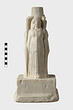
| Square base with moldings around the bottom. Into it is set a column (no capital, top finished off smooth), backed against which are three draped female figures, carved in high relief. Each wears a garment ... 1st-2nd c. A.D ... ADDENDA: The black substance appears to be lead cement. (M. Farnsworth, 1956) |
| Mended from over 73 fragments; apparently deliberately destroyed. Missing is body of goat and fragments from back of neck and back of right hand of faun.
The faun, smiling, is holding panpipes in his ... 5 May 1932 ... The back of the head was apparently broken off in antiquity and mended by a dowel strengthened with cement; when found, the join had worked loose; as shown on photograph taken before mending.
|
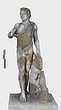
| Mended from many pieces; the head, set in a large, rough-picked socket, is missing. Missing also are part of the upper left arm, the left hand, the right arm and shoulder, most of the back above the hips, ... 11 April 1934, 27 April 1934 ... Traces of coarse reddish cement suggest that this statue had been built into the destroyed upper part of the nearby heavy Roman wall.
|
| Top is flat with a vertical step between a lower front and a higher back part. Cyma reversa bed mold, hawk's beak crown. Cutting for two Π-clamps at each end. In each end a cutting for an end dowel, which ... 28 May 1964 ... No trace of lead but remains of fine buff cement in the dowel holes. |
| Bearded herm head of Archaic type. Back of head broken away above, hair around brow damaged, nose and chin broken away, surface damaged. Full height preserved. Front of neck forms a tongue (width broken), ... Early 5th century B.C ... Under the mortar, the broken surface of the nose appeared to have been rubbed smooth to a slightly convex surface and then picked to give a purchase to cement or stucco. A round hole, 0.006m. in diameter was bored in at the point where the tip of the nose would have projected. |
| A life-size statue, the head and right arm are missing; the upper front part of the body has been cut away; the draped left arm is preserved to the lower forearm, which was separately inserted, and part ... 6 June 1931 ... This arm was fastened in by means of three peg holes and cement, which was found in place. |
| a) Fragment showing folds of himation over left arm. Arm was inset and attached with a square dowel.
b) Draped torso (?) fragment. On one face flat folds appropriate to himation on back of figure. This ... a)-c) (ΚΤΛ 375) November 1954
(Ι 1680) 1959 ... The figure is preserved from neck to plinth, so that there is no doubt about pose and movement, but one fragment which supplies the connection in the region of the thighs is interior only so that a gap appears on the surface, which has been filled out with cement. Head broken off at neck. |
|
|