|
|
| A herd of cattle before the Temple of Hephaistos ... Scan from: "Athens 1917: Through the eyes of the Army of the Orient", by Anastassiadis and Korma (2017), Melissa Publishing House, (p. 83, fig. 25). Horizontal (normal) ... 1917 ... A herd of cattle before the Temple of Hephaistos. |
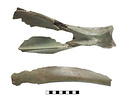
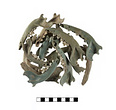
| Cattle rib (below) and scapula (above) used as expedient tools in the casting process. From deposit G 5:3 (well at 97/Γ) ... Craig Mauzy ... For Lynn Snyder.
Raw file in Public / Photography / Unworked / Projects / 2016.07. Objects Horizontal (normal) ... 30 Jun 2010 ... Cattle rib (below) and scapula (above) used as expedient tools in the casting process. |
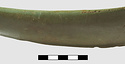
| Detail of an expedient cattle-rib tool, showing fine parallel striations and general polish caused by abrasion during use.
From deposit G 5:3 (well at 97/Γ) ... Craig Mauzy ... For Lynn Snyder.
Raw file in Public / Photography / Unworked / Projects / 2016.07. Objects Horizontal (normal) ... 9 Dec 2016 ... Detail of an expedient cattle-rib tool, showing fine parallel striations and general polish caused by abrasion during use.
|
First trial east Stoa colonnade, N. of S. wall III, layer 12.
Note quantities of cattle bones, the knuckles sawn off and many worked bits. Evidently a bone implement factory near by. [nbp. 2139] Coins: ... Late 3rd c.-earliest 4th c. A.D ... Note quantities of cattle bones, the knuckles sawn off and many worked bits. |
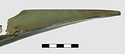
| Detail of fragment of a cattle scapula used as a tool, showing smoothing and polishing of the edges of the element and beveling of the distal (working) edge (to the left in the photo).
From deposit G 5:3 ... Craig Mauzy ... For Lynn Snyder.
Raw file in Public / Photography / Unworked / Projects / 2016.07. Objects Horizontal (normal) ... 9 Dec 2016 ... Detail of fragment of a cattle scapula used as a tool, showing smoothing and polishing of the edges of the element and beveling of the distal (working) edge (to the left in the photo).
|
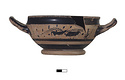
| Mended, one-third of rim missing.
Torus ring foot, concave lip, canted horseshoe handles. Reserved: underside of foot except for central dot and glazed circle, outside of foot, narrow band on lower body, ... 6 July 1995 ... Poor black-figured decoration in main zone, same scene both sides: a pair of cattle (bull right, cow left?) |
| Achilleus. Achilleus and Aias Gaming. Athena Polias. Athlete. Aias. Aineas carrying Anchises. Akademos. Akastos. Chimaera. Amazon. Bee. Bellerophon. Cock. Amazonomachy. Bird. Animal, upside down. Animal ... Agora 23 359 ... Cattle |
| Second century B.C. fill with early 13th c. A.D. fill in mouth.
The Byzantine objects from the mouth are P 13713-P 13718, L 3585.
Lower fill contained bones of many infants and dogs.
The bones from this ... Mid-2nd c. B.C ... The following animals have been found: dogs, horses, pigs, goats, cattle, cat, birds, turtles.
|
| Homer A. Thompson ... (Grave XXX: EG)
Rectangular cutting with burned bones of a female 40-45 years old, and both burned and unburned pottery fragments.
Rectangular trench, measuring approximately 0.80m long, 0.40m wide, with ... Middle Geometric I ... As for the animal bones, probably the belonged to two sheep or goats, at least one specimen of cattle, a hare and a bird,, but there is nothing clearly identifiable as dog; of the 65 fragments of animal bones recovered, only four were clearly burnt. |
| Aegina. Chronology. Aktorione-Molione. Cocks. Amphora. Color paint. Column krater. Cooking jugs. Amphoriskos. Cooking Ware fabric. Analatos Painter. Corinthian fabric. Argive Monochrome Ware. Corinthian ... Agora 8 132 ... Cattle |
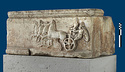
| The base has been hacked away on top and in the back; great, rough cuttings extend from the central rectangular cutting on the top, presumably made when the base was first cut, to support what ever stood ... 4th c. B.C ... The block has been at least once reused, perhaps as a tethering stone for cattle (this would account for the hacking and for the rope marks). |
|
|

.png.icon.jpg)
.png.icon.jpg)