|
|
Plain rectangular. Found with Hellenistic sherds in cistern C. Leica ... 1 June 1935 |
Chipped at right.
Obverse: a peacock left.
Reverse: flat; the letter delta (Δ) in black glaze.
Gray clay.
Cf. MC 278-281, 292 from the same die, and the same well, as this. Well, earth. Leica ... 26 May 1936 |
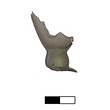
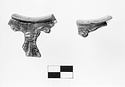
| Piece from the base of a small deep goblet (?)
Preserved is part of the steep wall, the moulded stem, and a little of a spreading foot.
Pale greenish glass, nearly colorless. North-South Trench VI, middle ... 28 July 1947 |
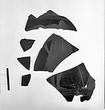
From the wall of a large pot. Almost vertical side, very uneven inside. Unglazed inside. Outside, in black-brown glaze, part of a panel decoration of six concentric circles, the outer one having short ... 19 May 1951 |
| Fragment of rim and discus only.
Clay: fine buff (burned). Assembly Place, behind terrace wall of Period III. 94-17-23 ... 1931 ... Hesperia 65 (1996), pp. 293, pl. 78 c. |
Preserved is only the right arm of a woman, draped to the elbow, holding a child whose head and draped shoulder are preserved.
The child faces right.
Medium fine slightly micaceous clay, brownish yellow ... 5 April 1934 |
Five non-joining wall fragments. Max. dim. a) 0.132, b) 0.127, c) 0.127, e) 0.04, f) 0.044.
A, youth leaving home(?). Fragment a (illustrated) comes from just below the rim and shows a little of the top ... Ca. 470. |
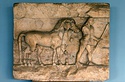
| Reins of horse, man's right hand and arm, missing. Non-joining fragment of horse's leg.
Archaistic relief. Bearded man with long hair, carrying chlamys on right arm and spear. Moves right leading pair ... Roman period. |
The glaze inside does not cover the center of the floor; glazed band on deep vertical face of lip ... Early 6th c. B.C. |
A: two deep pine-cones (?)
B: plain.
ADDENDA, May 2002: Only half remaining. Entered as coin no. 8, for the day. With coins of 4th and 5th c. A.D. Leica ... 22 June 1933 |
Glaze somewhat worn.
Obverse: a peacock on the upper face, standing left, one claw advanced, tail not spread.
Reverse: flat, plain.
Similar to MC 278.
Cf. MC 278-279, 281, 292-293, which are from the ... 2 May 1936 ... MC 278-279, 281, 292-293, which are from the same die as this ... Well.
4th c. B.C. |
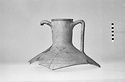
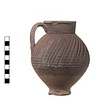
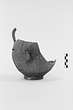
Mended from many pieces; upper half only preserved. Body ribbed; short roughly made neck; thick short handles from neck. Late Roman type, but early Byzantine date.
Incised on shoulder in large letters: ... June 1949 |
From the floor of a black glazed kylix, with a trace of the stem.
Incised inside: Early sand fill under drain. 1776 ff. Leica ... 9-12 June 1939 |
| Intact, save minor fractures. Small flat bottom; round body; straight neck; heavy rolled lip; band handle, from lip to shoulder.
Very gritty grayish clay. Buff slip.
Cf. P 14092 (from the same series, ... May 1938 |
| Many joining fragments preserve the neck and shoulder with one handle and part of the other. Rolled rim; double rolled handles; light offset at base of neck.
Reddish clay. Light buff slip. Previously ... 22 July 1950 |
Wall fragment.
Bearded figure reclining on cushions, left; a cloak is thrown over his legs, and a part of the drapery of another reclining figure appears behind him at right.
Relief contour for chest ... 1931 |
| Intact except for small chip at rim and foot.
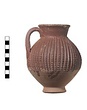
Globular body. Oblique gouging on upper two-thirds of body, mid part wheel-ridged overlapping.
Dark orange clay, brown-orange glaze (partial) with drips on ... 3 July 2003 |
| Rim and foot chipped. Body intact.
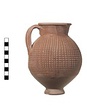
Globular body. Upper part with tight vertical gouging, middle part wheel-ridged overlapping.
Light orange-gray clay. Thin brown slip/glaze (partial), purple where thick ... 3 July 2003 |
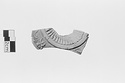
Fragment from center of Late Roman C plate. Stamped motifs, resembling flower calyx, radiating from center.
Light red clay; red wash. From sherds, B 220. Leica, 2-293 ... 28 April 1932 ... Fragment from center of Late Roman C plate. Stamped motifs, resembling flower calyx, radiating from center.
... Leica, 2-293 |
| Intact except for chipped rim. Slip worn in places.
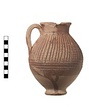
Out-turned rounded lip, sliced ridged handle. Ovoid body. Vertical/oblique gouging on top of body, mid-part wheel ridged.
Light buff clay. Dull brown ... 3 July 2003 |
| Obverse: a peacock on the upper face, standing left, one claw advanced, tail not spread.
Reverse: flat, plain.
Similar to MC 278.
Cf. MC 278-280, 292-293, which are from the same die as this. Well.
4th ... 2 May 1936 ... Agora:Object:MC 293 ... Agora X, p. 130, pl. 32, no. C 23 d. |
Obverse: a peacock on the upper face, standing left, one claw advanced, tail not spread.
Reverse: flat, plain.
Worn black glaze.
Buff clay (?)
Cf. MC 279-281, 292-293 which are from the same die as this ... 1 May 1936 ... Agora:Object:MC 293 ... Agora X, p. 130, pl. 32, no. C 23 a. |
Similar to MC 278, but the shape more irregular and the glaze more worn. The bird 's head and neck missing.
Obverse: a peacock on the upper face, standing left, one claw advanced, tail not spread.
Reverse: ... 1 May 1936 ... MC 278, 280-281, 292-293,which are from the same die as this ... Well.
4th c. B.C. |
| Chipped at upper right.
Obverse: a peacock left.
Reverse: the letter delta (Δ) in black glaze.
Cf. MC 278-281, 293 from the same die, and the same well, as this. Well, earth. Leica ... 25 May 1936 ... Agora:Object:MC 293 ... Agora X, p. 130, pl. 32, no. C 23 e. |
Fragment from near center of Late Roman C plate. Mended from two pieces. Parts of three conventional stamped motifs preserved.
Light red clay with red wash. Dump. Leica, 2-293 ... 28 April 1932 ... Fragment from near center of Late Roman C plate. Mended from two pieces. ... Leica, 2-293 |
Wall fragment. Max. dim. 0.041.
The fragment preserves the bared right shoulder, start of arm, and a bit of the drapery of a male figure.
Not from the same bell-krater as 293. The drawing on 294 is looser ... Probably mid-5th century B.C. |
Most of the floor preserved; a small piece only of the rim. Fine false ring foot and shallow body with convex side wall and plain rim. Fine grooves outside the rim.
Pink clay with white grits, fired ... 1-3 June 1936 |
| Body intact, but chipped and cracked rim.
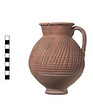
Rounded out-turned lip. Vertical gouging on upper body, slanting towards one side, mid belly with few wheel ridges. Sliced handle with three grooves.
Light orange ... 3 July 2003 |
| Large chip at rim. Rim and foot also with minor chips. Body intact.
Out-turned lip. Rounded belly. Mid part body wheel-ridged, upper part with oblique gouging, vertical against one side of handle. Sliced ... 3 July 2003 |
Late Roman C plate fragment. Bit of low base ring preserved. Stamped design of heart terminating in spirals.
Orange-red clay with red wash. From sherds, B 215. Leica, 2-293 ... 28 April 1932 ... Late Roman C plate fragment. ... Leica, 2-293 |
Four joining fragments preserve the profile complete, with about half the rim and all of the foot. Restored in plaster. Open bowl with ring foot, sloping floor and plain rim, nearly vertical. Two horizontal ... July 1947 |
| Three fragments from an inscribed architrave; grave monument.
Fragment Η 158 a), the largest fragment, broken at both ends, preserves the rough picked top and back, and the smooth finished under surface ... (Η 158 a) 18 March 1933
(Η 158b) 18 March 1933
(Η 158 c) 20 May 1933 |
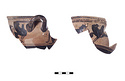
| Six fragments from a bell krater, part of an egg pattern preserved below the rim. a) The top of a head, right, with a white wreath.
b) A youth wearing a short chiton, cloak and travelling hat, standing ... 30 April-1 May 1936 |
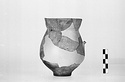
| Part of the body most of the way to the shoulder and the lower part of the handle attachment. Lower part of a two-ribbed handle and two loose body fragments. Ring foot; wavy vertical grooves down the body ... May-June 1937 |
| Fragments from a cup:
a) Part of rim and upper attachment of horizontal strap handle with flat thumb grip of double square-ended leaf pattern.
b) From the attachment of the other end of the handle?
c) ... 22 May 1935 |
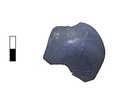
| No edges preserved.
Piece of flat bottom curving without break into side walls.
Opaque dark blue glass. Agora sample no. 293. Well on lower north slope of Areopagus. Lower fills, fill 5.
1st c. A.D. Leica ... 16 April 1938 ... Agora sample no. 293 ... Lower fills, fill 5.
1st c. A.D. |
Fragment from near center of Late Roman C plate. Stamped with palm leaf and two sets of concentric circles on one side, one on the other.
Light red clay; thin red wash. From sherds, B 131. Leica, 2-293 ... 28 April 1932 ... Fragment from near center of Late Roman C plate. Stamped with palm leaf and two sets of concentric circles on one side, one on the other.
... Leica, 2-293 |
| Mended from many fragments. Restored in plaster. Flat base. Low-bellied with bulging rim, defined by a groove. Lower end of a thin handle preserved on belly.
Fine, brownish ware, light brown on surface ... 24 March 1938 |
Fragments from bottom of Late Roman C plate. Stamped motif between multiple rouletted circles.
a) Ring foot. Light orange clay with red wash.
b) Another fragment added August 1964 from same place. Part ... 28 April 1932 ... Fragments from bottom of Late Roman C plate. Stamped motif between multiple rouletted circles.
a) Ring foot. ... Leica, 2-293 |
Fragment from bottom of Late Roman C plate. Low ring foot; sides of plate begin to curve up at outer edge of fragment. Stamped with six-pointed stars formed by interlacing triangles. Two stars preserved, ... 28 April 1932 ... Fragment from bottom of Late Roman C plate. Low ring foot; sides of plate begin to curve up at outer edge of fragment. ... Leica, 2-293 |
| About one-half preserved, including one handle, mended into two large non-joining fragments (a, b), with two small non-joining fragments (c, d).
Out-turned rim with degenerate dot-ivy. Same scene both ... 6 July 1995 ... About one-half preserved, including one handle, mended into two large non-joining fragments (a, b), with two small non-joining fragments (c, d).
Out-turned rim with degenerate dot-ivy. ... Agora XXIII, no. 1606; Hesperia 15 (1946), p. 293, no. 76. |
| About two-thirds of the rim preserved, in two non-joining fragments.
a) Large piece of the neck.
b) Rim and start of neck only.
Rounded rim with reserved band decorated with crossed horizontal zigzags, ... 14 March 1936 |
| Fragments of inscribed block.
List of names; possibly the list of those who lost their lives at Syracuse.
Fragment Η 419 a), broken away above, below, and to the left. The right side has anathyrosis ... Late 5th. century B.C ... Fragment ΒΒ 39 c), back preserved.
... a) (Η 419) 59/ΚΔ
a) (Η 419) K 6
b) (ΗΗ 245) T 17
c) (ΒΒ 39) Q 21 ... Leica, 3-293, 6-198, 84-18, 84-482 |
| Fragmentary; restored in plaster. Missing, the lower part of the handle and its attachment, about half the rim and much of the walls. The figured panel is not set square with the handle, but begins close ... 8 October 1932 |
| Mended from many fragments. Of the cylindrical handles, only attachment areas preserved. About two-thirds of the lip complete. Chips from base and gaps in body of vase. Surface badly worn especially on ... August-September 1932 ... Matz (1955), Festschrift C. Weickert,p. 43, fig. 1 ... Art and Archaeology 34 (November-December 1933), p. 293. |
Rim and floor fragment.
Broad rim with moulded overhang. Corinthian tile fabric, smooth buff slip. Outer edge of rim glazed red; alternating bands of red and black on overhang. Grit added to center of ... Context ca. 480-470 B.C ... For the full shape see the restored drawing of an example in Corinth, C-34-931: Hesperia, VI, 1937, p. 296, fig. 28, 174. ... The stems are finished smooth and may carry stripes or bands of glaze; cf. op. cit., p. 293, fig. 25, 174-175; also P 24229. |
Eight non-joining wall fragments, a and b with rim and strengthened with plaster. Band on inside at rim, a narrower one 0.068 below rim. Glaze fired red on inside, slightly misfired below figures on outside ... Ca. 460-450 B.C ... P.H. a) 0.35; est. diam. at rim 0.50; max. dim. b) 0.395, c) 0.145, d) 0.056, e) 0.068, f) 0.084, g) 0.10, h) 0.085. ... Fragment d (c) shows a little of her hair and shoulder (the glaze indicates this positioning). ... Delivorrias et al.) and in LIMC II, pp. 292--293, s.v. Apollon (W. |
|
|