|
|
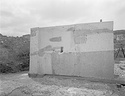
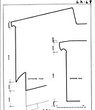
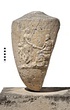
| Thyrsos. Finished Byzantine Building, Room X. Κ̣ρί[νις]
thyrsos
[Θ]α̣[σίων] (inv) Leica ... 11 June 1938 ... Byzantine Building, Room X. |
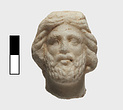
The lower part of a face from a tragic (?) mask with pierced eyes.
White paint inside, with traces on outside.
Red clay. Byzantine Building, room XX.
Late Roman to Early Byzantine fill. Leica ... 16 May 1938 ... Byzantine Building, room XX.
Late Roman to Early Byzantine fill. |
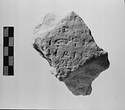
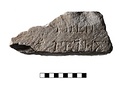
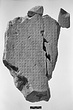
Inscribed fragment.
Broken all around and behind.
Citation.
Hymettian marble. Found in Byzantine context, below the floor of the room XVIII, of a Byzantine building, east of the Stoa of Zeus. Leica ... Ca. 200 B.C ... Found in Byzantine context, below the floor of the room XVIII, of a Byzantine building, east of the Stoa of Zeus. |
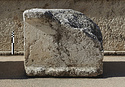
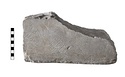
| Perhaps part of a door jamb.
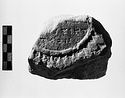
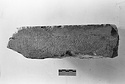
The back is smooth, the front rough-picked, with a curved molding of crosses and degenerate palmettes.
Byzantine.
Pentelic marble. Lying on the floor in the passage of the ... Byzantine ... The back is smooth, the front rough-picked, with a curved molding of crosses and degenerate palmettes.
Byzantine.
Pentelic marble ... Lying on the floor in the passage of the burned Byzantine building. |
Face and front part of head preserved.
Mold was heavily incised for features. Clay covered with white paint.
Coarse red clay. Byzantine Building, room xxi, below floor 1. Leica ... 12 February 1934 ... Byzantine Building, room xxi, below floor 1. |
Face only preserved.
Mold was deeply incised for features.
White engobe.
Coarse red clay. Byzantine Building, room xxvii, below floor 4. Cf. coins nos. 3, 4 for the day. Leica ... 12 February 1934 ... Byzantine Building, room xxvii, below floor 4. |
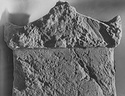
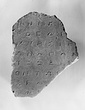
Inscribed fragment.
Inscribed face only preserved.
Ten lines of the inscription preserved.
Pentelic marble. Found in a wall of a Byzantine building, south of the altar of the Twelve Gods. Leica ... 20 May 1938 ... Found in a wall of a Byzantine building, south of the altar of the Twelve Gods. |
| Clay mostly fired grey.
Impression broken away right, incomplete all round otherwise; thyrsos(?). Par: SS 05544* Finished Byzantine Building, room XVIII, from black earth. Late Roman context. Θά[σιον] ... 26 June 1933 ... Byzantine Building, room XVIII, from black earth. |
Inscribed fragment.
Broken all around and behind.
Honorary monument or decree (?).
Seven lines of the inscription preserved.
Bluish-white marble. Found in Byzantine context, under the floor of a Byzantine ... 3-5 May 1934 ... Found in Byzantine context, under the floor of a Byzantine building, room xviii, east of the Stoa of Zeus. |
| Inscribed fragment.
Broken all around and behind.
Part of six lines of the inscription preserved.
Pentelic marble. Found just below the floor of a Byzantine building (room xxi), east of the Stoa of Zeus ... Ca. 158 B.C ... Found just below the floor of a Byzantine building (room xxi), east of the Stoa of Zeus. |
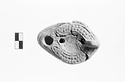
Rosette on discus; herringbone on rim.
Solid handle, triple grooved above, double below.
On the bottom, two concentric grooves.
Type XXVIII of Corinth collection. Byzantine Building, Room xxvii, west ... 10 February 1934 ... Byzantine Building, Room xxvii, west part, just below floor 4. |
Fragment from the shoulder of a closed pot. Upper part of a bearded male figure, draped, moving right, carrying a bier?
Buff clay; red on beard and hair. Debris in Byzantine Building, Room 3. Leica ... 16 April 1936 ... Debris in Byzantine Building, Room 3. |
| Inscribed fragment.
Inscribed face only preserved.
Six letters remain.
Poros. Found built into a bench in a Byzantine building, east of the southern part of the Stoa of Zeus. Leica, 87-1-13, 87-1-14 ... 5 May 1938 ... Found built into a bench in a Byzantine building, east of the southern part of the Stoa of Zeus. |
| Inscribed fragment of grave stele.
Bottom and apex of pediment broken away; otherwise complete.
Two lines of the inscription preserved.
Pentelic marble. Found in the paving of a Byzantine building, south ... 4 April 1938 ... Found in the paving of a Byzantine building, south of the Eleusinion. |
About half the base and a bit of the side wall preserved, with the signature inside a single groove.
Type XVIII of Corinth collection.
Byzantine Building, room xxvii, below floor 5. Cf. coin, ii. 12.34, ... 12 February 1934 ... Byzantine Building, room xxvii, below floor 5. |
Nozzle and handle broken away.
Rosette on discus; on the rim, debased grape leaves and tendrils.
Reverse, plain.
Type XXVIII of Corinth collection. Byzantine Building, room xxvii, below floor 4. Cf. coin, ... 12 February 1934 ... Byzantine Building, room xxvii, below floor 4. |
| Device. Rdg: dev poss a long spread wing(VG)*Par: =Kthsi(= on
numerous stps in Pridik 1917, but only the kind w/ 2 names
and no dev(VG)* Finished Byzantine Building, Room XXV. Θασι[---]
device Απ[---] ... 30 May 1938 ... Byzantine Building, Room XXV. |
| Inscribed fragment.
Inscribed face and smooth left side preserved.
One line of the inscription preserved.
Island marble. Found in a wall of a Byzantine building over the area of the late Roman Building, ... 31 May 1938 ... Found in a wall of a Byzantine building over the area of the late Roman Building, east of the central part of the Stoa of Zeus. |
A virtually square capital carved with seven petaled palmettes on the face and leaves at the corners. A square dowel hole irregularly placed on top.
A rosette above the palmette is preserved on only one ... Byzantine ... A small round dowel hole underneath and a small incised cross at one side.
Byzantine.
Pentelic marble ... Built against the southerly cross-wall of the upper Byzantine Building, in Trench 7. |
| Inscribed fragment.
Broken all around and behind.
Four lines of the inscription preserved.
Pentelic marble. Found under the floor of the Byzantine building, room xx, east of the Stoa of Zeus; 2nd.-3rd ... 28 March 1934 ... Found under the floor of the Byzantine building, room xx, east of the Stoa of Zeus; 2nd.-3rd. centuries A.D. context. |
| Inscribed fragment.
Broken all around and behind.
Remains of three lines of letters, within a conventional wreath.
Hymettian marble. Found just below the floor of a Byzantine building (room xxi), east ... 12 February 1934 ... Found just below the floor of a Byzantine building (room xxi), east of the Stoa of Zeus. |
Discus and handle broken away.
On the rim, herringbone pattern. The reverse almond-shaped, bounded by a double groove, enclosing the signature "KY".
Type XXVIII of Corinth collection. Byzantine Building, ... 8 March 1934 ... Byzantine Building, room xviii, lowest black filling in plundered foundation pit. |
| Broken behind; smooth-picked at left where the side is preserved.
Of the relief is preserved the right arm and bosom of a seated woman, wearing a chiton with buttoned sleeves.
Pentelic marble. Byzantine ... 22 April 1936 ... Byzantine Building I, wall F. |
Flat profile.
Coarse micaceous clay, fired buff inside with a pale yellow wash outside; distinct,
rather thick slip.
Retrograde.
Thasian(?). Stored wit "άγνωστα".
Class: Th?*
Dim: W 0.044* Byzantine ... 12 May 1934 ... Byzantine Building, room xviii, lowest layer above classical floor. |
Columnar grave monument.
Broken at the top, a small portion of the ring preserved.
Hymettian marble. Found around with stones just east of the second west wall of the Byzantine building, at surface, northwest ... 3 May 1934 ... Found around with stones just east of the second west wall of the Byzantine building, at surface, northwest of the church of St. |
Inscribed fragment.
Inscribed face only preserved.
List of Ephebic names.
Five lines of the inscription preserved.
Pentelic marble. Found in late context just above ground level of Byzantine building, ... Beginning of 3rd. century A.D ... Found in late context just above ground level of Byzantine building, over the foundation of the northern part of the Stoa of Zeus. |
Inscribed fragment.
Inscribed face, rough picked back (?) and a small bit of the right side preserved.
One line of the inscription preserved.
Pentelic marble. Found in a wall of a Byzantine building, east ... 1 June 1938 ... Found in a wall of a Byzantine building, east of the central part of the Stoa of Zeus. |
Inscribed fragment.
Inscribed face and smooth dressed top preserved.
Citation from decree.
Six lines of the inscription preserved, three within wreath.
Hymettian marble. Found in a wall of a Byzantine ... 4 June 1938 ... Found in a wall of a Byzantine building, east of the central part of the Stoa of Zeus. |
Rear part and bottom only preserved.
On discus, rosette; rim, plain; handle, solid.
On reverse, within two circular grooves, the signature "A".
Thin red wash.
Red clay.
Type XXVIII of Corinth collection ... 24 February 1934 ... Byzantine Building, room xxviii between floors 4 and 5. |
Complete but somewhat rubbed. The mold for the top part.
On the discus, head of Helios; on the rim a continuous band of small circles.
Coarse red clay, fired to yellow in places on the surface.
For lamp ... 29 March 1934 ... Byzantine Building, room xx, between floors 2 and 3; late Roman-Byzantine context. |
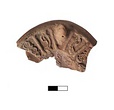
Curve fragment.
Much worn impression, an edge partly broken away; garlanded boukranion.
Cf. Dumont (1872), p. 184, no. 254 (incomplete). Par: Dumont 1871, p184 nr 254 (incomplete)* Byzantine building, ... 8 April 1933 ... Byzantine building, room IX, firm filling over classical floor. |
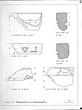
| A square impost block, carved on the beveled edge with trefoil ornament in the corners, cross with circles in the center, with two crosses in diamonds with dotted triangles as filling ornaments on either ... Byzantine ... Rough-picked beneath; smooth-picked on top, with a dowel on one side, to which the design is adapted as a series of diminishing triangles.
Byzantine.
Marble ... Resting on earth in the filed Room of the upper Byzantine Building. |
Mended from several pieces; bits missing.
Cross on discus; impressed circles on rim. Pointed knob handle. Flat bottom with two almond-shaped grooves enclosing several stamped circles.
Crumbly red clay ... 10 February 1934 ... Byzantine Building, Room xxvii, northeast corner, between floors 2 and three. |
Nozzle broken away.
On discus, rosette; on rim, two grooves; handle solid, three grooves above, two below.
On reverse, within two almond-shaped lines a "C".
Thin red glaze.
Red clay.
Type XXVIII of Corinth ... 13 February 1934 ... South of Byzantine Building, room xviii, below its ground level. |
Part of top only remains.
On discus, a dog to right, with head turned back.
Two filling holes and an air hole. Herringbone on rim.
Unglazed.
Buff clay.
Type XXVIII of Corinth collection. Byzantine Building, ... 9 March 1934 ... Byzantine Building, room xviii, from lowest black filling in pillaged foundation pit. |
Half of nozzle and part of bottom missing.
Convex sides.
Herringbone on rim.
Whirling rosette on discus.
Solid handle, grooved above and below.
On reverse, double bounding line and small circles.
Unglazed ... 22 April 1933 ... Byzantine Building, Room VI, below top of Roman wall. |
| Inscribed fragment.
Broken at left, right, bottom and possibly on top; back face dressed with pointed chisel.
Honors Tiberius Claudius as benefactor of the city.
Parts of two lines of the inscription preserved ... 16 March 1933 ... Found over the floor of Byzantine building, northwest of the Temple of Ares. |
| Inscribed fragment.
Inscribed face and smoothly dressed right side preserved.
Five lines of the inscription preserved, trace of another above (?).
Pentelic marble.
ADDENDA Joins to I 5709. Found in a ... 19 May 1938 ... Found in a wall of a Byzantine building, south of the altar of the Twelve Gods. |
Discus, deeply concave, plain; on the rim, vine pattern. The handle solid.
On the reverse, double almond-shaped bounding groove, punctuated by tiny circles and enclosing a palm branch.
Unglazed.
Red clay ... 8 March 1934 ... Byzantine Building, room xviii, lowest black filling in plundered foundation pit; coins. |
Front part broken away.
On the discus, the head of Helios; the rim plain; the handle solid, plain.
On the reverse, a single circular groove.
Unglazed.
Light red clay, very soft.
Type XXVIII of Corinth ... 6 March 1934 ... Byzantine Building, room xviii, southest part of room, between floors 3 and 4. |
The front part broken away.
On the discus, Greek cross, jewelled; on the rim, a band of raised circles.
The handle solid, grooved.
On the reverse, a plam branch.
Unglazed.
Clay coarse, flaky.
Type XXVIII ... 6 March 1934 ... Byzantine Building, room xviii, southest part of room, between floors 3 and 4. |
Mended from two pieces.
Convex sides; herringbone on rim; Christian cross on discus; solid handle with double groove above and below; on the reverse, within a double groove, a palm branch.
Buff to red ... 5 July 1933 ... Byzantine Building, room XVIII, black earth overlying bedrock at west end. |
A segment from the back of the head.
The hair in deep wavy grooves, radiating from the crown of the head, runs down to a fillet, below which the surface is smooth.
Pentelic marble.
Joins S 539 (Ν 179) ... Early Roman period (?) ... Byzantine building, Room XXVII, above south corner of the Altar of the Twelve Gods. |
| Volutes missing and a large part of one of the upper ends; much battered.
Poros. Finished Built into north wall of Building A (Byzantine). Leica PD 2348 ... May 29 1937 ... Built into north wall of Building A (Byzantine). |
| Inscribed stele.
Broken away below; the lettered face much worn; in its middle the worn socket for a door pivot.
From the year of Peithidemos, in which the Chremonidean War began.
Hymettian marble. Found ... 267/6 B.C ... Found faced up, used as a threshold, in a Byzantine building, in the northwest part of the Market Square. |
More than half of the mold for the top side of lamp has been broken away.
On the rim, grape clusters and tendrils.
On the discus, a rosette on which a Greek cross has been superimposed.
Unglazed.
Coarse ... 22 April 1933 ... Byzantine Building, Room XV, lowest loose filling. |
Part of one side of the mold for the upper part of the lamp.
On the discus, a rosette; on the slanting rim two rows of short parallel lines.
Channel from discus to wick hole.
Coarse red clay.
For lamp ... 12 February 1934 ... Byzantine Building, room xxiv, lying on "classical floor". |
Plain discus with three small filling holes.
A band of small raised circles on the rim. The handle solid; on the reverse, a palm branch within an oval bounded by a double groove punctuated by circles ... 8 March 1934 ... Byzantine Building, room xviii, lowest black filling in plundered foundation pit; coins. |
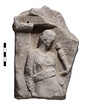
| From the upper left-hand corner of a small pedimental grave stele; left side rough-picked; back of slab and a bit of top preserved; the surface much worn.
A woman leaning against the framing pilaster holds ... 27 May 1938 ... Byzantine Building, Room XXIII. |
| Inscribed fragment.
Broken all round, and behind.
Honorary decree in praise of an archon and his two paredroi.
Nine lines of the inscription preserved; stoichedon.
Pentelic marble. Found in Byzantine building, ... 288-263 B.C ... Found in Byzantine building, in room xiii, loose filling above bedrock; from a late context just east of the Great Drain, opposite the south wing of the Stoa of Zeus. |
| Inscribed fragment.
The lower part and right side broken away; the top curved; in the back a large circular cutting.
Chisel marks not removed from inscribed face.
Four lines of the inscription preserved ... 4th. century B.C ... Found in a wall of a Byzantine building, east of the central part of the Stoa of Zeus. |
The top of the handle broken away; the nozzle cracked.
On the discus, a rosette; one large and three small holes. Herringbone on rim; the handle solid, grooved.
On the reverse, palm branch, within double ... 10 March 1934 ... Byzantine Building, room xviii, lowest black filling in plundered foundation pit. |
Most of the center of the discus gone.
Convex sides; herringbone on rim; Christian cross on discus with circles in the arms; solid handle, double grooved on top; on the reverse, within double almond-shaped ... 27 June 1933 ... Byzantine Building, room XVIII, from lowest black filling of plundered foundation pit. |
Tip of handle broken off.
Convex sides; stamped pellets on relief on rim; rosette on discus; handle with single groove below; on the reverse within a double circle; a palm branch.
Three circles toward ... 5 July 1933 ... Byzantine Building, room XVIII, black earth overlying bedrock at west end. |
Stocky handle lump beneath.
Coarse light reddish-buff clay; little or no slip.
Impression incomplete above and below, worn across the middle and damaged by chips.
Cf. Dumont (1872), pp. 192, 299-300 ... 26 April 1933 ... South Byzantine Building, south room, lying on classical floor. |
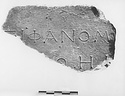
| Inscribed fragment.
From the front upper part of a statue base. The top is finished with toothed chisel. In the top is preserved part of the curved sinking for the plinth proper.
Archon Phanomachos.
Two ... 259/8 B.C ... Found in late Roman context, under the floor of a Byzantine building (room xxiv), north of the Temple of Ares. |
Inscribed fragment.
Original surface on face and right edge only.
Possibly an Ephebic Decree of the third century. Some of the demotic of Hermodoros or Herortious seems to be preserved.
Part of eight lines ... 244/3 B.C ... Found at a Roman level, under the Byzantine building (room xxi), east of the Stoa of Zeus. |
The handle, and part of the rim, discus, and sides preserved.
On the rim a band of circles containing a design resembling the "snappers" of modern clothes.
On the discus, the head of a cock left, with ... 26 June 1933 ... Byzantine Building, room XVIII, from black earth, at north end of room. |
Convex sides; herringbone on rim; plain discus with four filling holes; handle semi-perforated, with double groove above and below and ending in two circles at the discus end.
On the reverse, within a ... 6 July 1933 ... Byzantine Building, room XVIII, west end, black earth just above classical floor. |
| A bearded male head, broken off at the root of the neck in which is a vertical dowel hole. Its abundant hair falls in a heavy ringlet down either side of the face. Over the back of the head it is combed ... 13 February 1934 ... Byzantine Building, room xxvii, below floor 5. |
Part of left side preserved with anathyrosis; otherwise broken.
Inscribed with one letter: Α.
ADDENDA Also interpreted as fragment of an inscription. Byzantine well. Leica ... 15 April 1939 |
| Inscribed fragment.
Broken at top and left.
Anathyroses on right side as though of an architectural block. Lower face of inscription has chisel marks worked down (?).
A list of names, last name in larger ... 19 May 1972 ... Found face up on the floor of a Byzantine building, about 30.00m. west of the Royal Stoa. |
| Mended from several pieces.
On the discus a bird, in a relief. Double row of raised dots on the rim. Solid handle.
On the bottom, two almond-shaped grooves with four circles between the grooves, and a ... 12 February 1934 ... Byzantine Building, room xxvii, below floor 5. |
In channel of rim a band of circles with two diameters drawn in each, and with a tiny circle in each quadrant.
On discus, Christ erect holding cross in right hand; a winged angel flies toward him from ... 10 February 1934 ... Byzantine Building, room xviii; northeast corner, between floors two and three. |
Half of top only remains.
In channel of rim alternating groups of concentric circles and quatrefoils, the band terminating toward the nozzle in concentric triangles.
On the discus, the Christian monogram, ... 24 February 1934 ... Byzantine Building, room xxiv, below floor 2, loose filling. |
| The handle, and part of the rim sides, discus, and bottom preserved.
Convex sides; rim panels filled alternately with dolphins and degenerate quilloche (?); discus has running maeander lengthwise down ... 23 June 1933 ... Byzantine Building, room XVIII, between floor. |
Only a bit of the reverse preserved, signed.
Unglazed. Damaged by fire.
Pinkish clay.
Type XXVIII (?) of Corinth collection. Hypocaust-building debris; late Roman and early Byzantine. Boxes 46-47. Leica ... 12 April 1934 ... Hypocaust-building debris; late Roman and early Byzantine. |
| Broken on both sides and bottom.
On top mason's marks, the letters Γ Δ, facing inside.
From the Temple of Ares.
Pentelic marble. Byzantine walls along road between Gymnasium and Byzantine Houses to west ... 9 May 1951 |
Part of upper surface with dowel hole and part of one edge preserved. Mason's mark on top: Ρ Ε.
From Temple of Ares.
Pentelic marble. Paving of court of Byzantine House by Pier 14. Leica ... 23 May 1949 |
| Top surface preserved, with mason's mark, Α Θ.
From the Temple of Ares.
Pentelic marble.
See A 238 (Η 441). From Byzantine wall at north end of section; originally numbered A 238 b; renumbered, 1953. Leica ... 6 June 1935 |
| Inscribed fragment.
Broken all around, save on left side which is smooth picked.
Decree in praise of a sacred embassy, a board of theoroi.
Part of eight lines of the inscription preserved, with one letter ... Early 3rd. century B.C ... Found in late Roman context below the floor of a Byzantine building, north of the Temple of Ares. |
| Top surface and part of one side preserved, with mason's mark, Α Ρ.
From the Temple of Ares.
Pentelic marble.
See A 238 (Η 441). From Byzantine wall at north end of section; originally numbered A 238 c; ... 6 June 1935 |
Broken behind, below, to left and to right.
Front surface preserves smooth fascia with crowning molding above partly preserved. Mason's mark on top surface, partly broken away, Ο or Θ.
Calcined by fire, ... 20 April 1951 |
Inscribed fragment of columnar grave monument.
Inscribed face only preserved.
Two lines of the inscription preserved.
Hymettian marble. Found in a Byzantine pithos over the north foundation of the Hellenistic ... 28 April 1936 ... Found in a Byzantine pithos over the north foundation of the Hellenistic Building, on Kolonos Agoraios. |
| One upper corner only remains. Bearing surface on top; anathyrosis across top and down front of end. Carefully cut in top surface, mason's letter: Λ.
From the Temple of Ares.
Pentelic marble.
See A 238 ... 2 June 1936 |
The middle nozzle, with part of the bottom and most of the discus is broken away.
A trefoil arrangment of nozzles with the handle at the place of the stem. On the rim, debased vine leaf design. On the ... 12 May 1934 ... Byzantine Building, room xviii, lowest layer above classical floor. |
Inscribed fragment.
Broken top, bottom and right.
Streaky white-gray marble. Found while washing marbles collected in Summer 1974, from demolition of Roman Round Building. Late Roman curved Wall and Byzantine ... October 1974 ... Found while washing marbles collected in Summer 1974, from demolition of Roman Round Building. Late Roman curved Wall and Byzantine Wall. |
| A little of under surface, and some of face preserved, with a trace of the start of the molding above.
From the Temple of Ares.
Pentelic marble.
Cf. epikranitis of the Temple of Hephaistos, H. 0.207m ... 3 May 1951 |
| Front face and bottom are only original surfaces. Front face is finished with toothed chisel and decorated with band of palmette and honeysuckle of which only the engraved outlines remain.
From the Temple ... May 1953 |
Inscribed fragment.
Broken all around and at back.
Five lines of the inscription preserved.
White marble. Found while washing marbles collected in Summer 1974, from demolition of Roman Round Building ... October 1974 ... Found while washing marbles collected in Summer 1974, from demolition of Roman Round Building. Late Roman curved Wall and Byzantine Wall. |
| Inscribed funeral lekythos.
Almost half of the circuference preserved; base and neck broken away; surface battered and worn.
At right, on a raised ground-line, a partly-draped bearded man is seated left, ... 26 May 1938 ... Found in a wall of Byzantine building, over the area of the altar of the Twelve Gods. |
Inscribed fragment.
Broken at top and lower right corner.
Stele with part of tenon.
Honoring a mantis.
Hymettian marble. Found while washing marbles collected in Summer 1974, from demolition of Roman Round ... October 1974 ... Found while washing marbles collected in Summer 1974, from demolition of Roman Round Building. Late Roman curved Wall and Byzantine Wall. |
Fragment a), a big block, preserves part of the dressed face, the top and one end; fragment b), a chip, preserves part of the face and end. On both, on the end 0.037m. from edge, a channel, parallel with ... 11 April 1951 |
| Six fragments, non joining, but believed to come from the same block.
a) Fragment of right end, broken along left side and back. Hawk's beak on front projects 0.028m. In the higher back part is a clamp ... 9 May 1951 |
| All surfaces preserved with anathyrosis at both ends. Setting lines on top ca. 0.395m. from front surface. On top a raised surface for 0.32m. from front.
Mason's mark on top: Ι Γ Ε.
Double T-clamps, dowel ... 11 April 1951 |
Applied to the side of the vase, a figure in relief.
Only the bottom of the drapery, and ends of the feet peeping out under it, remain.
The ground on which it stands projects from the side of the vase ... Card: 222-205 B.C ... Clearing north wall of east building.
Disturbed Byzantine. |
| The flutes roughly cut away and the drum reused as a millstone (or olive press weight, see Expedition 21).
On the top mason's mark, the letters: Β Θ.
From the Temple of Ares.
Pentelic marble. Found at ... 1953 |
The top is somewhat chipped. Only the crowning member of the pedestal is preserved.
In its top are two sinkings for the feet of a bronze statue. Beneath the plinth proper is a cyma recta above an ovolo ... 6 March 1934 ... Built into a wall of a Byzantine Building (room xviii), east of the Stoa of Zeus. |
Broken at back and left end. Top much worn, as block was used as a door sill (see post and pivot holes at right end).
Parts of mason's marks preserved - seem to be Γ Γ. These are ca. 0.41m. apart on centers ... 9 May 1951 |
| Broken to left, right, below and behind.
Front surface preserves below a vertical smooth surface. Above it, and projecting 0.007m., a fascia. Above this the spring of a curved molding, which is broken ... 26 May 1951 |
Broken to left, right, below and behind.
Top surface preserves setting line for orthostate course 0.043m. from front edge; weathering outside this line. Cutting for double T-clamp 0.32m. from front edge ... 26 May 1951 |
Building block reused for late Roman inscription.
Right side, back and bottom preserved, these being the bottom, side and end respectively of the building block upon which the inscription was cut, when ... 24 March 1937 ... Building block reused for late Roman inscription.
Right side, back and bottom preserved, these being the bottom, side and end respectively of the building block upon which the inscription was cut, when it was reused, on its end.
... Found in late Byzantine road fill, over the southeast corner of the temple of Ares. |
| Broken to left, right and behind. On front surface, parts of three fasciae preserved, the lower two smooth, the top one rough-picked. Part of original bottom preserved with striations of toothed chisel ... 25 April 1951 |
| Handle and end of nozzle missing.
A broad and a narrow raised band round the filling hole; ribs on the rim.
Two dolphin-shaped lugs.
Raised base, rising in the center.
Poor metallic glaze inside and out; ... 3 May 1933 ... Middle Stoa Building Fill. Under Byzantine wall. |
| Piece from neck and shoulder of large amphora.
Dipinto in red paint.
Gritty buff clay, slipped. in Fill over Roman floor outside apse of Roman building. Leica PD 1133-32(F 331) ... 12 March 1935 |
Inscribed fragment.
Broken all around.
Two lines of the inscription preserved on front, with large "Π" between. On back text in large letters above. Below two columns.
Pentelic marble.
ADDENDA This fragment ... October 1974 ... Found while washing marbles collected in Summer 1974, from demolition of Roman Round Building. Late Roman curved Wall and Byzantine Wall. |
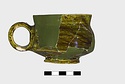
| Handle, bottom and complete profile on one side preserved; restored in plaster. Low flat base; lip slightly flaring; ring handle set vertically on side.
Chalky biscuit covered with crackly green glaze ... 6 April 1933 |
Four fragments join to make two.
Fragment a), preserves one corner, with part of the hair and elaborate headdress, from the proper right side; one suspension hole.
Fragment b), from lower down on the same ... 29 April 1952 ... Early Byzantine fill in S.E. corner of Archaic Building (Fountain House). |
One handle missing. Piriform body; very low neck; thickened rim; handles rising from neck. Wall deeply furrowed.
Scratched on shoulder:
Gritty red clay, light buff surface, worn. Well at S.E. corner ... June 1939 |
Nozzle missing. No base, bottom left rough.
Angular, double convex body; groove round small filling hole; large pierced knob on left side (broken).
High base, rising slightly in center.
Dull purplish-red ... 10 March 1933 ... Middle Stoa Building Fill. S.W. trench extension, Byzantine disturbance. |
|
|