|
|
| Section ΟΟ: Excavation Summary February, 1950
The Poros Building ... Margaret Crosby ... A report on the excavation of the Poros Building in Section ΟΟ. As a result of the investigation, the plan of the building, as suggested in 1948, was considerably modified. Revealed is a building with ... 21-26 Jun 1950 ... A report on the excavation of the Poros Building in Section ΟΟ. As a result of the investigation, the plan of the building, as suggested in 1948, was considerably modified. Revealed is a building with a large open court, a central corridor and five rooms at the west side and three southern rooms at the east side. |
| The Odeum ... Homer A. Thompson ... A rectangular building with poros foundations was excavated in the central part of the eastern area of the excavation. The southwest corner, lying in Section Μ, was excavated in 1934 and the rest of the ... 2 Apr-27 Jun 1935 ... A rectangular building with poros foundations was excavated in the central part of the eastern area of the excavation. ... The building consists of a rectangular auditorium or theater surrounded by a corridor. ... A late Roman complex, of which the Giants were the northern limit, was built over the earlier poros building. |
| Section ΟΟ 1948 ... Margaret Crosby ... Work in Section ΟΟ was concentrated on the east and west ends of the north side of the section: parts of the ancient east-west street were explored; ca 20 meters of the Great Drain was clearly exposed; ... 8 Mar-26 Apr 1948 ... Work in Section ΟΟ was concentrated on the east and west ends of the north side of the section: parts of the ancient east-west street were explored; ca 20 meters of the Great Drain was clearly exposed; remains of a house (House E) from the 4th century and Hellenistic period, with cistern (Cistern A), water storage tank and a well (Well I) were found; the Roman Bath (Building A and Hypocaust area) was further explored, and a well in the central court (Well II) dug out; a trial cut was dug in a long, narrow poros building with a large open yard and a series of small rooms; and an early Geometric grave was found and excavated. |
| Section ΟΟ: Preliminary Summary 1947 ... Margaret Crosby, Eugene Vanderpool ... Excavations in Section ΟΟ were taken place in four parts: the modern and Turkish road levels were removed; a part of the Great Drain, and drains connected with it, were examined; high Roman levels of Building ... 17 Mar-14 Aug 1947 ... Excavations in Section ΟΟ were taken place in four parts: the modern and Turkish road levels were removed; a part of the Great Drain, and drains connected with it, were examined; high Roman levels of Building A (Roman Bath) were dug and several rooms, a courtyard and two wells were uncovered; and in the South Central Area a number of houses, some wells and a kiln were uncovered. |
| The Heiaia ... Homer A. Thompson ... A summary account taking cognizance of the result of the exploration of the ancient building, the Heliaia, carried out in July and August, 1960 ... 15 Jul-5 Sep 1960 ... A summary account taking cognizance of the result of the exploration of the ancient building, the Heliaia, carried out in July and August, 1960. |
| Excavation Summary Section ΟΟ: 1969 ... John McK. Camp II ... Further excavations were conducted in Section ΟΟ, supplementing those done earlier. The large Roman complex, now known as the Southwest Bath, were completely explored. Cuts to the north of the building ... 13 May-6 Jul 1969 ... Cuts to the north of the building reveal a series of stratified roads. A well was cleared and excavated, and a Hellenistic cistern complex was dug out. |
| Sections Φ, Χ, Ψ, April-June 1957 ... A. L. Boegehold ... Three private dwellings, already known from the preliminary excavation of 1937, formed the major themes of the investigation this year: Southwest House, Polygonal House and Late Roman House and Water Channel ... 10 Mar-12 Aug 1957 ... In the report each building is treated separately, and then a summary point out how they are related to one another. |
| Excavation Summary Section ΟΟ 1968 ... M. Alison Frantz ... The excavation of the Roman Bath east of the Poros Building was resumed in order to clarify aspects on plan and chronology of the building. It was discovered that there had been a bath in the area from ... 17 Jun-31 Jul 1968 ... The excavation of the Roman Bath east of the Poros Building was resumed in order to clarify aspects on plan and chronology of the building. It was discovered that there had been a bath in the area from at least the 2nd century B.C. |
| Section Ψ Season of 1938 ... Eugene Vanderpool ... Finds from Section Ψ span from Turkish down to the Neolithic and Geometric times. Several wells and cisterns from various periods were found and explored. The most extensive remains in the section belong ... 24 Jan-18 Jun 1938 ... The most extensive remains in the section belong to a building of the late Roman period. |
| Preliminary Report on the 2007 Excavation Season ... John McK. Camp II ... Excavation continued this year in the sections ΒΖ, ΒΗ and Γ.
In Section ΒΖ South, two areas were investigated: the north-south road and the areas west of the road. In the road, hard-packed gravel surfaces ... 13 Jun-3 Aug 2007 ... It seems to have been a building of at least six rooms/shops set side-by-side along the street. A draw-shaft and part of the tunnel of a Hellenistic cistern complex was found outside the building to the east. The tunnel may lead to a collapsed cistern located within the building itself.
|
| The Odeion ... Homer A. Thompson ... The exploration of the Odeon was resumed and the remainder of the late accumulation around the foundations of both the Odeion and the overlying late Roman building were removed, and the pre-Odeion ground ... 1 Jun 1938-23 Jun 1939 |
| Section ΜΜ
Summaries for 1936 ... Homer A. Thompson ... Three main ancient features were excavated within Section ΜΜ: the North Stoa, the South Building and the ancient East-West Street passing between the two buildings. After the destruction of the buildings, ... 10 Feb-25 May 1936 |
| Investigations in the Area of the Tholos 1937 ... Homer A. Thompson ... An overview of the work carried out in the area of the Tholos in 1937. The 6th century B.C. accumulation was stripped away revealing a complex of foundation walls, of limestone polygonal construction, ... 5 Apr 1937-21 Jul 1947 ... The 6th century B.C. accumulation was stripped away revealing a complex of foundation walls, of limestone polygonal construction, of private houses. ... Black-figured pottery found in the debris overlying the floors of the earlier houses provide a terminus post quem for the earliest Tholos. The building suffered greatly by Sylla's invasion in 86 B.C and the subsequent reconstruction altered the area and Tholos. |
| 1. The Tholos. A Brief Sketch of the History of the Building as Revealed by the Excavations of 1934
2. The Bouleuterion ... Eugene Vanderpool ... A report mainly about the results of the excavations of the Tholos and the Bouleuterion, but a notebook index attached refer to all features excavated during 1934. A list of coins associated with the construction ... 15 Jan-19 May 1934 ... A report mainly about the results of the excavations of the Tholos and the Bouleuterion, but a notebook index attached refer to all features excavated during 1934. A list of coins associated with the construction of the Bouleuterion is also attached.
1. ... At the same time a propylon was added. |
| Preliminary Report on the 1998 Excavation Season ... John McK. Camp II ... Most work this year was concentrated to a new area at the extreme northwest, where a modern building had been demolished. Fill from modern to Byzantine times were excavated. The principal feature uncovered ... 8 Jun-31 Jul 1998 ... Most work this year was concentrated to a new area at the extreme northwest, where a modern building had been demolished. ... A Mycenaean chamber tomb was found under the floor of one of the rooms. The date of the tomb seems to be 14th century B.C.
A second chamber tomb was found a bit further north, rich in finds, including two bronze daggers and one knife blade.
|
| Sections Ε, Ν, Η 1952 ... Homer A. Thompson ... Mycenaean graves were excavated in section Ε.
Section Ν was disturbed by late pits, bothroi and walls. Excavation was carried out through Roman levels. The area seemed to have been leveled out and raised ... 4 Mar-31 May 1952 ... The area seemed to have been leveled out and raised as part of a landscaping project turning the area into a level square. ... A Mycenaen well was found as well as a fine Archaic altar and peribolos. A series of monument bases, lining the east band of the Great Drain, were examined.
|
| Preliminary Report on the 2006 Excavation Season ... John McK. Camp II ... This summer the 75th anniversary of the beginning of the excavations and the 50th anniversary of the reconstruction of the Stoa of Attalos were celebrated.
Excavation were concentrated on two areas: northwest ... 13 Jun-4 Aug 2006 ... Considerable new information about the building plan emerged and evidence gathered suggest that the use of the building was commercial rather than public. The 5th century B.C. as a construction date was confirmed.
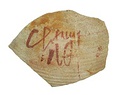
... More evidence that terracotta figurine production took place in the area were recovered. A remarkable find was a small cooking-pot buried near the Classical commercial building, with the remains of the head and feet of a chicken inside, and lines of lightly-incised letters on the outside.
|
| Preliminary Report on the 2005 Excavation Season ... John McK. Camp II ... Excavations were carried out in three sections in the summer of 2005: BZ, BH and Γ.
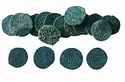
In section BZ, mostly Roman levels were excavated, dating from the 1st to the 5th centuries A.D. Much more of the north-south ... 13 Jun-5 Aug 2005 ... West of the street evidence of a Roman bath was found. ... In section Γ, the area of the Strategeion, a large mid-5th century B.C. building, was re-opened for excavation with the intention to clarify its plan and to gather more information about its function. A large hoard of Athenian silver coins was discovered within the building. |
| Report on Excavations in the Athenian Agora 1991 ... T. Leslie Shear, Jr ... This is a report on the archaeological field work conducted in the Athenian Agora during the period from December 1990 to December 1991. The actual excavation period was preceded by the demolition of a ... 10 Jun-9 Aug 1991 ... The actual excavation period was preceded by the demolition of a newly acquired building.
... It was possible to explore a section of the Eridanos River which passes through the Agora in a great masonry tunnel covered by large slabs. ... This new area revealed the Byzantine phases of a building just behind the stoa. |
| Athenian Agora 2023: Preliminary Report ... John K. Papadopoulos Debby Sneed ... A summary of the first excavation season in Section ΒΚ, an area beneath a building demolished in the fall of 2022.
Prior the excavation a geophysical survey was undertaken.
Modern, Ottoman, and Byzantine ... 12 Jun-4 Aug 2023 ... A summary of the first excavation season in Section ΒΚ, an area beneath a building demolished in the fall of 2022.
Prior the excavation a geophysical survey was undertaken.
... In addition, a Geomatics study was conducted in order to produce a model of the Hephaisteion, and a study of the ancient DNA from burials in the Agora was initiated. |
| Agora Excavations Preliminary Report - Summer 2014 ... John McK. Camp II ... Excavations in 2014 were carried out in three sections: ΒΘ, ΒΓ and ΒΖ.
In Section ΒΘ, overlying the Painted Stoa, the Byzantine houses of the 11th century A.D. were further exposed in the western part ... 9 Jun-1 Aug 2014 ... The eastern half was dug deeper; a pithos discovered at a lower level suggests an earlier phase of the Byzantine settlement. ... In Section ΒΖ, excavation continued in early layers in the area north of the Classical Commercial Building. A Mycenaean chamber tomb, collapsed in antiquity and cleaned out and filled in the late 8th century B.C., was partially excavated. ... In Classical levels, numerous post-holes of various sizes and depths were dug.
A large number of images of Section ΒΘ were taken with the use of a drone. |
| Preliminary Report on the 2009 Excavation Season ... John McK. Camp II ... Excavations were conducted in four sections: Γ, ΒΘ, ΒΗ and ΒΖ.
In Section Γ, the investigation of the Classical buildings south of the Tholos continued with the aim to find out if they were civil, commercial ... 8 Jun-31 Jul 2009 ... It was clarified that the complex consists of three houses grouped around a central courtyard. A well in the courtyard was emptied, and the finds recovered indicate a domestic or commercial use of the buildings. ... In section ΒΖ, the exploration of the Classical Commercial Building continued. It became clear that it was a building with a least six adjacent rooms in a row opening on to the street in front. |
| Preliminary Report on the 2010 Excavation Season ... John McK. Camp II ... Excavations took place in five sections: ΒΗ, ΒΘ, ΒΖ, Γ and Δ.
In Section ΒΗ, excavation continued and late fills overlying the Stoa Poikile were cleared. A good cross-section of the stoa foundations was ... 15 Jun-6 Aug 2010 ... Two Byzantine wells within the interior of the building were left undug. ... In Section ΒΖ, excavations were concentrated on the northern parts of the Classical Commercial Building, in an attempt to clarify its plan and building history. ... A trophy base with the representation of a pile of military equipment was found. |
| Report on Excavations in the Athenian Agora 1990 ... T. Leslie Shear, Jr ... This is a report on the archaeological field work conducted in the Athenian Agora during the period from December 1989 to December 1990. The actual excavation period was preceded by preparatory operations ... 4 Jun-3 Aug 1990 ... This is a report on the archaeological field work conducted in the Athenian Agora during the period from December 1989 to December 1990. The actual excavation period was preceded by preparatory operations including the demolition of a newly acquired building.
... A well was dug and produced a large amount of pottery.
|
| Section Κ 1953 ... Eugene Vanderpool ... Excavations was carried out in the building fill in the area south of the Middle Stoa, and in the area between the South Stoa and the Fountain House. Work was also done to the porch of the Fountain House ... 23 Feb-30 Jul 1953 ... Excavations was carried out in the building fill in the area south of the Middle Stoa, and in the area between the South Stoa and the Fountain House. Work was also done to the porch of the Fountain House. A Late Roman cistern was cleared and three wells were dug. |
| Section ΛΛ 193
Excavation Summary ... Dorothy Burr Thompson ... Excavations in Section ΛΛ revealed that the original contour of Kolonos Agoraios had been much sharper than in modern times. No traces of early graves were found in the area; first sign of habitation is ... 1 Feb-23 Jun 1937 ... No traces of early graves were found in the area; first sign of habitation is pottery from the last half of the 5th century B.C. found in metal working pits in connection with a drain and a road. ... In the early 3rd century the easternmost houses went out of use to leave space for the Hellenistic Building.
In the early Roman period a filling of large sherds covered most of the area, probably due to the general building activity of that period. In section ΛΛ, a great stair was constructed.
|
| Συνοπτική Έκθεσις Πεπραγμένων ... Sophokles Lekkas ... This report, written in Greek by the chief foreman of the Agora excavations, is a synopsis of supplementary work that took place in and around the excavation area. The works included, among others, demolition ... 22 Sep 1952-31 Jan 1953 ... This report, written in Greek by the chief foreman of the Agora excavations, is a synopsis of supplementary work that took place in and around the excavation area. The works included, among others, demolition and reconstruction of buildings related to the excavations, building new roads, transporting finds, and back filling of trenches. |
| Agora Excavations
Season Summary 2015 ... John McK. Camp II ... Excavations were carried out in three areas: in Byzantine levels over the Painted Stoa in Section ΒΘ; at the north end and beneath the Classical Commercial Building in Section ΒΖ; and in Section ΟΟ in ... 8 Jun-31 Jul 2015 ... Excavations were carried out in three areas: in Byzantine levels over the Painted Stoa in Section ΒΘ; at the north end and beneath the Classical Commercial Building in Section ΒΖ; and in Section ΟΟ in the old excavations. It was a varied and productive season with material dating from the 14th century B.C. to the 12th century A.D. |
| Section Φ Season of 1937 ... Eugene Vanderpool ... In antiquity the area included in Section Φ lay outside the Agora proper and were apparently occupied only by houses and small buildings. The earliest period of which any considerable remains were found ... 25 Jan-17 Jun 1937 ... In the northeast corner fragments of terracotta water pipes were found, some in situ, dating from the late 6th or the 5th century B.C.. A small building with polygonal limestone walls were cleared, its purpose uncertain. ... From the Roman period a house was partly cleared. ... A late Roman building covered almost the whole section and was probably part of the great complex of late Roman buildings that covered most of the center of the Agora. |
| 1996 Excavation Summary ... John McK. Camp II ... Excavations were carried out in two areas: in early levels underneath the west end of the Middle Stoa, and in and around the Classical commercial building north of the Stoa Poikile. The result of the 1996 ... 10 Jun-2 Aug 1996 ... Excavations were carried out in two areas: in early levels underneath the west end of the Middle Stoa, and in and around the Classical commercial building north of the Stoa Poikile. The result of the 1996 season showed a variety both in material recovered and in chronological range, covering the time period from the early Iron Age to Hellenistic times. |
| Agora Excavations 1995 Preliminary Report ... John McK. Camp II ... Excavations continued in the areas of the Panathenaic Way, west of the Stoa Poikile, and in and around the Classical commercial building north of the Stoa Poikile.
In the Panathenaic way the exploration ... 12 Jun-4 Aug 1995 ... Excavations continued in the areas of the Panathenaic Way, west of the Stoa Poikile, and in and around the Classical commercial building north of the Stoa Poikile.
... In the second half of the 5th century B.C. the road surfaces were carefully prepared, perhaps to then serve as a race track.
The exploration of the levels overlying the Classical commercial building continued and more of the walls of the third room from the south were found along with a cement lined basin. ... West of Stoa Poikile, the clearing of a late Archaic well was completed. |
| Section ΟΟ 1949
Grave Area ... Margaret Crosby ... A report on the excavation in the immediate vicinity of the Early Geometric burial found in 1948 in Section ΟΟ. Two Geometric graves were uncovered, and also walls and drainage systems belonging to the ... 28 Mar-9 Nov 1949 ... A report on the excavation in the immediate vicinity of the Early Geometric burial found in 1948 in Section ΟΟ. Two Geometric graves were uncovered, and also walls and drainage systems belonging to the industrial establishments of the later 6th and 5th B.C. centuries, as well as sporadic remains from later periods, such as a 4th B.C. century pit and a Hellenistic cistern. ... In addition, limited excavations were carried out in the ancient street north of the Poros Building. |
| Agora 2019 - Summary Report ... John McK. Camp II ... Excavations were carried out in four sections: in Section ΝΝ in the southwest corner of the archaeological site, and in the northwest corner of the Agora in Sections ΒΖ, ΒΘ East and ΒΘ West.
Section ΝΝ ... 10 Jun-2 Aug 2019 ... Excavations took place in an area where a deposit of terracotta figurines had been found in the 1940’s. ... North of the tank, a corner of a marble bench or seat was uncovered. ... They were probably part of a large building or monument which now lies under the scarp.
|
| Excavation Summary Section ΒΔ: 1972 ... Stephen G. Miller ... With the exception of the removal of certain modern intrusions, the recovery of a few layers of a late Roman road, and the discovery of the westward continuation of the southern foundation of Roman Building ... 22 Mar-20 Jun 1972 ... With the exception of the removal of certain modern intrusions, the recovery of a few layers of a late Roman road, and the discovery of the westward continuation of the southern foundation of Roman Building β, the work in Section ΒΔ during the 1972 season was concentrated on the exploration of the lower levels in the western area of the section. |
| Preliminary Report on the 2002 Excavation Season ... John McK. Camp II ... Excavations continued in the northwest corner of the Agora (sections ΒΕ and ΒΖ) and in the Eleusinion area (ΕΛ), and a trial trench was opened up in the Panathenaic Way (Σ).
In section ΒΖ, the exploration ... 10 Jun-2 Aug 2002 ... At the end of the season, a Roman statue head appeared.
... This area was affected by a heavy rain fall which made work difficult. However, a shaft of a Protogeometric or early Geometric well was partially excavated.
|
| Agora Excavations 1997 Season Preliminary Report ... John McK. Camp II ... Excavations were carried out in two separate areas: under the Middle Stoa in the Agora square, and just north of the northwest entrance of the Agora. The excavations produced material covering a wide chronological ... 10 Jun-1 Aug 1997 ... The excavations produced material covering a wide chronological span, from the earliest Iron Age to the beginning of the Hellenistic period. The early material was particularly abundant, for example an iron age burial, and a disturbed grave and two wells from the eighth century B.C. ... The demolition of a recently required property was begun. |
| Athenian Agora
Excavation Summary for 2021 ... John McK. Camp II ... Excavations continued in sections ΒΖ and ΒΘ in and under the Classical Commercial Building, the Painted Stoa, and the orthostate enclosure suggested to be the Leokoreion.
In section ΒΖ the goal was to ... 14 Jun-6 Aug 2021 ... In section ΒΖ the goal was to find out more about the later Archaic remains, perhaps houses or shops, underlying the Classical building. Pottery of the 8th century B.C. and the discovery of another well suggest that the area was used for habitation in the Iron Age after centuries as a burial ground. A number of ostraka were found in Persian destruction fills, and a fragment of a small gravestone of the 4th century, probably of a slave, was discovered.
... In the western trench, fragments of a Roman inscription were found. |
| Excavations in the Athenian Agora, 2024: Preliminary Report ... John K. Papadopoulos Debby Sneed ... A summary of the second excavation season in Section ΒΚ, in the area beneath the former building at 14 St. Philip Street.
The area was divided into three trenches and yielded mixed material from the Modern ... 10 Jun-2 Aug 2024 ... A summary of the second excavation season in Section ΒΚ, in the area beneath the former building at 14 St. ... The excavation followed a strategy of total collection and 100% dry sieving with flotation and phytolith samples from all the baskets.
... They counted the tiles and kept a sample.
Aerial and ground photogrammetry were conducted on a regular basis.
|
| Preliminary Report on the 2008 Excavation Season ... John McK. Camp II ... Excavations took place in three sections, two north of Hadrian Street (ΒΗ and ΒΘ) and one in the old area south of the Tholos (Γ).
In Section ΒΗ, layers in, over and behind the building identified as the ... 10 Jun-1 Aug 2008 ... Behind the back wall a small fragment of a large terra cotta pipe was found in situ in middle Byzantine layers. Layers contemporary with the Stoa were not reached this season. A rubble wall may represent a late blocking of the interior colonnade, relatively common in the late Roman period.
In Section ΒΘ, a new section was opened up after the demolition of two houses. |
| Agora Volunteer Report 2017 ... John McK. Camp II ... Excavations took place in three sections, ΒΘ, ΒΖ and ΟΟ, covering a time span from the 14th century B.C. to the 12th century A.D.
In Section ΒΘ work continued in later layers over and in front of the Stoa ... 12 Jun-4 Aug 2017 ... Excavations took place in three sections, ΒΘ, ΒΖ and ΟΟ, covering a time span from the 14th century B.C. to the 12th century A.D.
... Excavation over the northern channel revealed a cover slab decorated with a large hoplite shield.
... An unusual type of bone dice came out while cleaning a scarp. |
| AGORA 2022 - Preliminary Report ... John McK. Camp II ... The initial plan to excavate under the modern building at 14 St. Philip Street had to be postponed due to delayed demolition. Instead, excavations were carried out around and inside the Stoa Poikile.
In ... 14 Jun-5 Aug 2022 ... The initial plan to excavate under the modern building at 14 St. Philip Street had to be postponed due to delayed demolition. ... In Section ΒΖ, the area of a collapsed late Roman wall was cleared, and excavation took place in late Archaic and early Classical layers, where a large number of ostraka was found.
A small excavation was carried out in Section ΒΓ to clarify certain issues at the Crossroads Enclosure.
|
| Preliminary Report on the 1999 Excavation Season ... John McK. Camp II ... Most of the work this season was concentrated in the northern half of Section ΒΖ where the Byzantine levels were further explored. Street walls along both sides of the north-south road were revealed and ... 7 Jun-30 Jul 1999 ... Several built pithoi were found within the houses, representing impressive storage capacity. A small hoard of copper coins dates the houses to the 11th century A.D. when the area after two centuries of abandonment became densely populated.
In Section ΒΕ excavation continued in the Classical commercial building where another pyre was discovered. A well was uncovered and was partly dug. |
| Preliminary Report on the 2004 Excavation Season ... John McK. Camp II ... All the work during the season 2004 was concentrated on the northwest corner of the Agora north of the Panathenaic Way.
In BZ North, the last remains of Byzantine fills and walls were removed and Hellenistic, ... 7 Jun-16 Jul 2004 ... In Section BZ South, work continued in the North-South Road and in the building along its west side. In the building, further cleaning took place, revealing more of an early Roman structure. Along the west side of the street a terracotta pipeline for fresh water was traced for much of the length of the excavated area.
|
| Preliminary Report on the 2011 Excavation Season ... John McK. Camp II ... Excavations were carried out in three sections, two of them overlying the Painted Stoa (ΒΗ and ΒΘ) and one in the Panathenaic Way (ΒΓ).
In Section ΒΓ, excavations were concentrated on the Panathenaic Way ... 13 Jun-5 Aug 2011 ... These post holes had been interpreted as a starting-line for a racetrack. Instead they seem to be part of a temporary roped-off enclosure of which three sides are defined. ... A second trench in the road was opened to reexamine the hypothesis that the road itself had been used as a race track.
|
| Preliminary Report on the 2012 Excavation Season ... John McK. Camp II ... Excavations were carried out in four areas during the 2012 season: three in the area of the Painted Stoa at the northwest corner of the Agora (sections ΒΗ, ΒΖ, ΒΘ), and one in the Panthenaic Way (section ... 11 Jun-3 Aug 2012 ... The report is a very preliminary account of the results of the work this season.
... In section ΒΗ, a well was excavated to its full depth. ... Remarkable finds were an almost complete black-figured lekythos, and a tiny electrum coin.
|
| Preliminary Report on the 2001 Excavation Season ... John McK. Camp II ... Excavations were carried out at the northwest of the Agora in sections ΒΖ and ΒΕ, and in the area of the Eleusinion in section ΕΛ.
In Section ΒΖ, the investigation of the settlement of the 11th century ... 11 Jun-3 Aug 2001 ... The lowest floor levels of the buildings were excavated down into layers of the 7th to 9th centuries, exposing the Byzantine walls to their full depth and the upper parts of the late Roman walls beneath. A well was partially excavated, a stone-lined cesspit was uncovered and a large plaster-lined pit was discovered. The last of a modern basement was successfully cleared out. ... In section ΒΕ, the work in the Classical shop building continued. Another Hellenistic pyre was found beneath the floor of one of the rooms. |
| Preliminary Report on the 2013 Excavation Season ... John McK. Camp II ... Excavations were carried out in several areas, spanning Mycenaean to Byzantine times.
Full exploration in Section ΒΘ East was prevented since the Byzantine walls could not yet be removed, but a trial trench ... 10 Jun-2 Aug 2013 ... Embedded in a 6th century A.D. fill, an inscribed statue base was found. In another trial trench, a cover slab, which overlay the north channel of the Eridanos river, was discovered. A camera put inside the channel made it clear that is was made up in part by reused blocks.
|
| ΚΚ Excavation Report 1936 ... Dorothy Burr Thompson ... Section ΚΚ, the area inside the modern fence around the so-called Theseion, was cleared to bedrock in order to determine the entire history of that portion of Kolonos Agoraios. Excavation revealed that ... 10 Feb-13 Mar 1936 ... In Hellenistic times private houses were built outside the terrace wall, and some time after the middle of the second century B.C. the hill was included in the general scheme of enlarging the Agora region. A closed building, which purpose has not yet been determined, was set into the north side of the hill. Later, an exedra was built and a garden laid out. Two early Roman villas show that the region soon became a popular residential district. |
| Preliminary Report on the 2000 Excavation Season ... John McK. Camp II ... Excavations were carried out in three sections, two to the northwest, (ΒΖ and ΒΕ) and one to the southeast of the Agora square (ΕΛ).
In Section ΒΖ the investigation of the remains of the 11th century settlement ... 6 Jun-28 Jul 2000 ... Several pithoi were more fully exposed and one tile-lined well was uncovered and partially excavated. A large amount of late Roman coins were recovered. The evidence of the excavations give a picture of an neighborhood with close-packed houses with no open space between and with considerable subterranean storage.
In Section ΒΕ the explorations of early levels in and around the Classical shop building continued. Further cleaning of the two Mycenaean tombs were carried out. |
|
|