|
|
| Classical Building II, Layer 7B ... 1st c. A.D. |
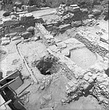
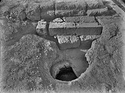
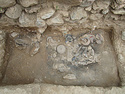
| David Scahill ... Below packed clay floors in Room 2 of Classical Building II; bordered on east and south sides by polygonal cross wall and back wall extension for Classical Building. Late Roman wall and drain installation ... LHIII A:1 ... Below packed clay floors in Room 2 of Classical Building II; bordered on east and south sides by polygonal cross wall and back wall extension for Classical Building. ... Upper part of tomb cut away by leveling for floors of Classical Building. Loose fill of stones and earth with large number of Geometric sherds ranging from Protogeometric to late Geometric in date, from top of cutting extending down into layer of tomb contents. |
Fill against back wall foundations of Royal Stoa I/6,9-4/8,14. Dug separately, these many fills contain material which joined horizontally and vertically all along back wall of Royal Stoa. Fill seems to ... 2nd/3rd quarters of 5th c.-420s |
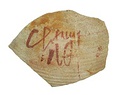
| Layer of crushed bedrock with ostraka, behind Classical Building ... 17 June-17 July 1996
28 July 1997 |
Well East of Circular Building, at 25/ΙΗ.
Well dug originally in 5th c. B.C. and probably had POU fill. In 2nd c. A.D. the shaft was intersected by a horizontal vaulted brick tunnel belonging to the Brick ... 5th c. B.C.(?) |
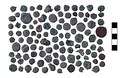
Pit (Well?) under Building A, Room 2. Coins:
9 May 1949 #1-#2
11 May 1949 #4
12 May 1949 #3 (not a coin, bronze fragment in lotted metal tins ΠΠ 295). Estimated Grid
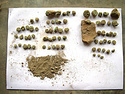
Remains of coloring matter found with ... Hellenistic-Early Roman ... Pit or Well Under Building A, Room 2 |
Well at SE corner of Court of Late Roman Building (Trench C). Estimated Grid ... 12th c. A.D. |
Floor of Mudbrick Building.
The material from this deposit comprises what was found on the floor of the Brick Building, as opposed to the fallen brick fill Coins:
24 February 1936 #1-#3 SS 11078-SS 11079 ... To ca. 165 B.C ... Floor of Mudbrick Building.
The material from this deposit comprises what was found on the floor of the Brick Building, as opposed to the fallen brick fill ... SS 11078-SS 11079 Uncertain from Q-R 10-11:2 or Q-R 10-11:1 |
| A well at the northeast corner of Classical Building, behind back wall. Dumped fill appears to have occurred as a single event as there are joining sherds throughout.
POU date ca. first half 5th c. B.C.; ... 5th c. B.C. |
Double Well by E. Entrance to Square Building (Well A) (formely a O 8:1) Coin
21 April 1951 #1 (disintegrated) Carefull there is two O 8:1, the actual one is a filling around rubble wall at 35/ KE.
Estimated ... 750 to early 7th century B.C. |
Deposit of jewelry in hypocaust area (92/ΙΗ) of Bath to East of Poros Building. Coins:
8 April 1948 #12-#47 ... 2nd-3rd c A.D. |
| Marcie Handler ... Located in the south section of Room E in the Byzantine Building east of the North-South Road. The uppermost 1.5 meters of well lining was built of well-coursed stones (some reused marble blocks) and tiles ... 12th c. A.D ... Excavations | 2001 | Trenches | Handler | Byzantine Building East of the North-South Road | Room E | Well J 2:18 ... Excavations | 2003 | Trenches | Handler | Byzantine Building East of the North-South Road | Room E | Well J 2:18 |
Well T: Middle Helladic. Close to Paved Building. Diameter ca. 0.75-0.80m.
No apparent water, but a thin layer of sand at the bottom ... Middle Helladic |
| Pit and drain at SE corner of Apollo Temple. Antedates building of Apollo Temple which was assigned to a date 'late in the third quarter' ... 3rd quarter 4th c. B.C. |
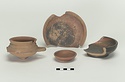
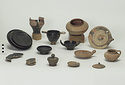
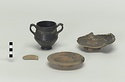
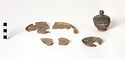
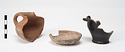
| Classical Pyre between floors in Room 2 of Classical Building II.
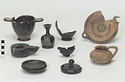
Below floor at 51.66 7masl. Broken pyre pots in fill of ash and carbon, from 51.541-51.513, resting on next floor at 51.513 masl, next ... Ca. 400-390 B.C ... Classical Pyre between floors in Room 2 of Classical Building II.
... Broken pyre pots in fill of ash and carbon, from 51.541-51.513, resting on next floor at 51.513 masl, next to foundation trench of crosswall between rooms 2 and 3. |
| Destruction Fill in channel of Apsidal Building.
Cf. nb.p. 989 for continued digging in this channel. Coins:
24 July 1990 #202, #204, #208
27 July 1990 #219-#222
30 July 1990 #226
31 July 1009 #236
1 August ... 14 June-3 August 1990 ... Destruction Fill in channel of Apsidal Building.
Cf. nb.p. 989 for continued digging in this channel ... Coins:
24 July 1990 #202, #204, #208
27 July 1990 #219-#222
30 July 1990 #226
31 July 1009 #236
1 August 1990 #246
2 August 1990 #240, #243 |
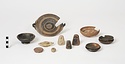
| Pyre against north face of polygonal wall, Room 2, Classical Building II. No floor preserved above, but the pyre is below floor level 51.820masl, preserved just to the east and above patchy floor with ... Ca. 275-260 B.C ... Pyre against north face of polygonal wall, Room 2, Classical Building II. ... Includes 2 chytra, small saucer and rilled rim plates. |
| Susan I. Rotroff ... Grave 2 (bis). Cut into by builders of I 5:2. No remains.
Possible contents in I 4-5:1 Layer C (= layer 6, lower building fill), catalogued as ΒΓ 2065 - ΒΓ 2125 ... Middle Helladic or later Bronze Age (date uncertain) ... Grave 2 (bis). Cut into by builders of I 5:2. ... Possible contents in I 4-5:1 Layer C (= layer 6, lower building fill), catalogued as ΒΓ 2065 - ΒΓ 2125. |
| Marcie Handler ... Fill within the drain from the basin on the west side of Roman Room B through Wall A.
After we removed the fill within the basin on the west side of Roman Room B (BZ XXVII p. 5325), we began excavating ... Late Roman ... Excavations | 2003 | Trenches | Handler | Roman Building East of the North-South Road | Roman Room B | Coin Hoard J 2:21 |
| Marcie Handler ... Continued from 2000 season, 10-12 July 2000; BZ XXIII p. 4472.
The hoard was originally excavated during the 2000 season (Lot BZ 1049, 5th-6th centuries AD), from a higher elevation through a gap in the ... 10-12 July 2000
21-22 July 2003 ... Excavations | 2003 | Trenches | Handler | Byzantine Building East of the North-South Road | Room F | Coin Hoard J 1:2 | Fill |
| Sacrificial Pyre = Pit in floor (identified as pyre by SIR); with the characteristic small plates and saucers. "Saucer Grave" at 12/ΚΑ.
Dimensions: 2m (length)x 0.70 (width).
North of north wall of building ... First half 4th c. B.C. |
| Anne McCabe ... Adjacent to the SW face of Byzantine Wall 14. The circular cutting, 0.90m in diameter, appeared at 53.504m under a layer of loose rubble (Lot 481). Wall of the well roughly built, consisting at the top ... 11-19 July 2006
24 June-21 July 2009 |
East of Classical Building II backwall, above Mycenaean chamber tomb K 2:5. Rough circular pit of reddish brown fill cut into geometric fill that extends down inside tomb. Some evidence of burning on pottery ... Ca. 460 B.C ... East of Classical Building II backwall, above Mycenaean chamber tomb K 2:5. |
A pit, perhaps a well, extending beneath the foundations of [Building D, the Primitive Bouleuterion] the Hellenistic Metroon. Not completely dug due to its position. A dumped filling so far as dug, apparently ... Ca. 575-525 B.C. |
Well on lower slopes of Areopagus.
Diameter ca. 1.50m. Dumped filling of 8th c. at the top. Fill mostly Geometric but containing bits of later (even Roman) pottery. Perhaps cleaned out and refilled with ... 730-700 B.C. |
Narrow trench in bedrock; one section found to NE of Circular Building west of the Stoa of Attalos, another (Q 8:1) beneath the terrace of the Stoa of Attalos opposite Pier 19. A single filling in both ... Ca. 450-425 B.C. and shortly after |
Circular well cut through the old road after it had gone out of use, and filled probably at the time of the building of the drain and building A, and the throwing of fill over the road ... Ca. 430-400 B.C. |
| Sacrificial Pyre I, Classical Building II.
The pyre was set through the original floor level of the northern room of the Classical Building and apparently is the remainder of a ritual conducted when the ... Ca. 375-350 B.C. |
Classical commercial building, room 3, against south wall. Small fragments of pottery dispersed in fill overlying two floor levels (at 51.897 and 51.941 masl). Five objects of pyre type: ribbon-handled ... 4th c. B.C. |
| Sacrificial Pyre II, Classical Building II.
Found right beneath the stuccoed channel built for sluicing in the 1st c. A.D., and must have been partly disturbed when the channel was constructed. It may ... Ca. 250 B.C ... Sacrificial Pyre II, Classical Building II.
Found right beneath the stuccoed channel built for sluicing in the 1st c. ... AS 1719.1 in Study Collections-Case No. 99C-2 box V. |
South Stoa I: 75-76/ΚΗ-Λ South Shop Building Layer g (O 16:1) and South Stoa I: Stony Fill below floor level (O 16:2). (merged from O 16:1 and O 16:2) Coins:
11 May 1953 #29 (illegible) Merged from two ... Ca. 420-400 B.C. and earlier ... South Stoa I: 75-76/ΚΗ-Λ South Shop Building Layer g (O 16:1) and South Stoa I: Stony Fill below floor level (O 16:2). (merged from O 16:1 and O 16:2) ... Merged from two separate deposits: O 16:1 and O 16:2 |
| Identified as pyre by SIR.
In room E. Burnt "pocket" found while digging red earth that contained late Hellenistic pottery, including a fragment of Pergamene (discarded). No pit was discerned, but concentration ... 3rd quarter 4th c. B.C. |
| Matt McCallum ... The pyre was uncovered in a small, triangular area between the BZ Building foundations (but at a lower level) and the northern scarp of the current excavation area. It rested in a patch of orange-brown ... 1-7 August 2006 |
| David Scahill ... At northeast corner of Classical Building II; on south side of dromos of Tomb K 2:5, and separated from it by ca. 0.6m of bedrock. Chamber cut through bedrock. The northeast corner of chamber defined ... LHIII A:1 ... At northeast corner of Classical Building II; on south side of dromos of Tomb K 2:5, and separated from it by ca. 0.6m of bedrock. |
| Marcie Handler ... It was situated in the NW corner of Room 3 in the Classical Commercial Building, just S of Wall 11, the cross-wall that divides Room 3 from Room 4 to the north. The pyre pots were found surrounded by ... Late 4th c. B.C ... It was situated in the NW corner of Room 3 in the Classical Commercial Building, just S of Wall 11, the cross-wall that divides Room 3 from Room 4 to the north. The pyre pots were found surrounded by fill with charcoal and burnt bone below a floor surface preserved immediately to the E (J/13,14-2/7,8; 52.20 masl.).
|
| Handler ... Found in an area of disturbed fill north of a floor surface in Room 4 of the Classical Commercial Building. The floor surface (n. 3 on the west side of Room 4) was preserved at 52.503-52.544 masl., and ... 2nd half 4th c. B.C ... Found in an area of disturbed fill north of a floor surface in Room 4 of the Classical Commercial Building. The floor surface (n. 3 on the west side of Room 4) was preserved at 52.503-52.544 masl., and was excavated in Lot ΒΖ 1758 (2nd half of the 4th c. ... AS 1396.3 in Study Collections-Case No. 99C-2 box V, while a bone bag now stored in drawer 33 (animal bones) |
| Enclosure within Roman Circular Building. The finds apparently reflect the entire area inside the enclosure. Pottery lot ΒΓ 515 identifies the deposit as layer 10 and coin #895 from layer 11 says "layer ... 12-18 August 1971
9-10 May 1972 ... Enclosure within Roman Circular Building. The finds apparently reflect the entire area inside the enclosure. ... Coins:
13 August 1971 #890
9 May 1972 #895 (layer 11, "layer below the deposit")
The Bone bags from J 5:2 were analyzed by Michael MacKinnon: there are domestic taxa represented by a mix of skeletal elements. |
Filling on original floor of Primitive Bouleuterion = Building D.
Metroon pit η. H 10:2 is also contemporary with the construction of the building ... Third quarter 6th c. B.C ... Filling on original floor of Primitive Bouleuterion = Building D.
Metroon pit η ... H 10:2 is also contemporary with the construction of the building. |
Fillings in and to the north of Building A/Poros Building/Greek Building ("Strategeion"), the accumulation mostly a late archaic dump, but not deposited till near the middle of the century. Most of the ... First half of 5th c. to ca. 460-450 B.C ... Fillings in and to the north of Building A/Poros Building/Greek Building ("Strategeion"), the accumulation mostly a late archaic dump, but not deposited till near the middle of the century. ... Coins:
12 June 1937 #1-#3
18 June 1937 #1-#5
21 June 1937 #1-#2 (not found in notebook and database)
20 June 1949 #1-#2 ... Subdivisions:
.1=a) Undisturbed filling of the building.
.2=b) Undisturbed filling to north of the building.
.3=c) Building fill in disturbed places. |
Cistern System #3: West Chamber at 69/ΛΣΤ, joined by a crooked passage to 69/Λ. Under the southwest corner of the Hellenistic Building to the north of the Temple of Hephaistos. Upper fill of early 1st ... 175-125 B.C ... Under the southwest corner of the Hellenistic Building to the north of the Temple of Hephaistos. Upper fill of early 1st c.
E 6:2 (upper fill): Three Knidian amphora handles; type 51 C lamp; long-petal bowls.
E 6:1 and E 6:2 (lower fill): Joins between objects in both chambers and tunnel between them indicate fill the same. |
Well 12: Archaic.
It lies on a rocky ledge about thirty meters north of the Klepsydra, just east of the Panathenaic street. In spite of its depth, it produced little pottery and its contents were of slight ... 6th c. B.C.? |
| David Scahill ... Behind northeast corner of Classical Building; east wall C. Below Hellenistic levels and early Classical pit. Chamber cut through bedrock, depth ca. 0.90m., diameter ca. 2m., roughly square in shape, angling ... LH III A:1 |
| Mycenaean Grave at SE corner of Pier 12 (Burial 9).
There are no traces of dromos, which must have been located at the north and have been cut away by the trench four the south stylobate of the Square ... Myc. III A:1 |
| Marcie Handler ... Pyre under floor no. 9 in the center of Room 4. It was adjacent to the southern face of Wall 4, but at lower elevation than the lowest course of the wall foundation (which was found at 52.250 masl.), suggesting ... 375-350 B.C ... It was adjacent to the southern face of Wall 4, but at lower elevation than the lowest course of the wall foundation (which was found at 52.250 masl.), suggesting that the pyre was deposited during a phase of the building that predates Wall 4. Pyre J 2:30 was located approximately 0.20m below Pyre J 2:28, which was excavated during the 2007 excavation season.
The oblong pit for Pyre J 2:30 was cut into Floor no 10 (removed in Lot ΒΖ 2122) and was covered by Floor no 9 (removed in Lot ΒΖ 2120), both of which dated approximately to the last quarter of the 5th c. |
A total of 79 ostraka was recovered from Room 5 of the Classical Building.
More of this deposit was excavated in the 2021 season on the opposite side of the scarp of Wall R, up against the face of Wall ... 500-475 B.C. |
Middle Stoa Building Fill (with filling to S) (See also Κ: H-I-J 14-15 and Λ: K-M 13-14)
This deposit is not definitive and must be considered with the above deposits before details are entered into database; ... To ca. 180 B.C ... Coins: Θ
1 March 1933 #14
2 March 1933 #3
6 March 1933 #3, #8
9 March 1933 #1-#3, #20
10 March 1933 #6-#7, #10, #15, #18, #20-#21, #26-#27, #31-#32, #35, #37
11 March 1933 #5, #7
14 March 1933 #34
16 March 1933 #1
17 March 1933 #4-#5, #26-#27
31 March 1933 #2-#3, #5-#8
12 May 1933 #11, #15-#16
13 May 1933 #1
15 May 1933 #2-#3, #6-#7
16 May 1933 #10
20 May 1933 #6
22 May 1933 #7
24 May 1933 #8-#11
27 May 1933 #9-#10
1 June 1933 #2-#3
Coins: Λ
24 April 1935 #1
3 May 1935 #2
4 May 1935 #1
6 May 1935 #1, #3
8 May 1935 #2
Coins: ΜΣ and K
19 February 1953 #1
24 February 1953 #1-#6
28 February 1953 #2-#9
2 March 1953 #4 (?)
3 March 1953 #2
4 March 1953 #2-#11
5 March 1953 #1-#3, #6-#23, #25-#26 #28
6 March 1953 #2-#3
7 March 1953 #3-#8
9 March 1953 #1
13 March 1953 #3, #9-#14, #16-#17
14 March 1953 #1-#26
16 March 1953 #7-#9, #13-#17
17 March 1953 #1-#19
18 March 1953 #1-#3
19 March 1953 #1-#6, #12-#13, #18-#19
24 March 1953 #3
27 March 1953 #1-#9
28 March 1953 #1-#11
29 April 1953 #7-#14
22 May 1953 #1 (?)
17 May 1954 #13-#34
20 May 1954 #6-#10, #12-#13
25 May 1954 #1-#19, #21-#25, #27-#59
5 June 1965 #2-#7
18 June 1965 #1-#6
1 July 1965 #1-#3
2 July 1965 #1
17 July 1965 #7-#8
22 July 1965 #1-#3
29 July 1965 #1-#14
26 June 1967 #1-#2
27 June 1967 #2
29 June 1967 #1-#2
11 July 1967 #1
12 July 1967 #2-#5
13 July 1967 #1, #3
14 July 1967 #1
24 July 1967 #1
28 July 1967 #1
Coins : Κ
14 March 1953 #1, #3-#7, #9-#12, #14
18 March 1953 #3-#5
27 March 1953 #3-#4, #7, #10-#12
11 April 1953 #1
18 April 1953 #3, #6-#7
23 April 1953 #7
24 April 1953 #2-#5, #7
25 April 1953 #14-#16, #20, #25-#27, #30-#32, #34-#36, #38
29 April 1953 #1-#3
30 March 1954 #2-#3
31 March 1954 #1-#3
1 April 1954 #1, #3-#4 |
See I 870, a piece of which was found in disturbed red fill in Β' southeast of Tholos.
Although apparently from the same context as P 5339 (tins 24-26, undisturbed fill), P 5336-P 5338 are recorded from ... 27 February-8 April 1935 |
Pit in House N, Room 2 (RSY, House C). Filling thrown in behind the west wall of the Great Drain South at the time of the building of the drain and the extension of House C.
Cf. Hesperia 20 (1951), pp ... Ca. 430-410 B.C ... Pit in House N, Room 2 (RSY, House C). Filling thrown in behind the west wall of the Great Drain South at the time of the building of the drain and the extension of House C.
|
Mycenaean Chamber Tomb W. of Circular Building (at Σ:30/ΛΕ?)
It had been badly disturbed by a fourth-century B.C. pit which cut into the northeast part of the chamber (rectangular, ca. 1.80m by 1.30m) ... Myc. III A 2 |
Some objects listed in deposit nb. V are not on this list because they in fact come from disturbed fills or are part of the material from above well 2 (G 12:21) ... 20 February-1 March 1935
6 March 1935
11 March 1935
20 March 1935
25 March 1935 |
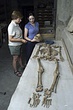
Mycenaean Grave W. of Circular Building. Measuring 1.40m by 0.55m and it was covered with a few rough stone covering slabs, under which lay the skeleton of an adult with the head to the north and the knees ... Myc. III A2-B ... Mycenaean Grave W. of Circular Building. Measuring 1.40m by 0.55m and it was covered with a few rough stone covering slabs, under which lay the skeleton of an adult with the head to the north and the knees up. ... Skeleton not listed by Angel (see Agora XIII, p. 212, n. 2.) |
Filling of Middle Drain (Tr. H+F in Section Ζ). Sand and gravel filling of the old course of the west branch of the Great Drain, a large (ca. 1.00m. deep and 1.30m. wide) underground channel in the area ... 150-100 B.C. |
Double Well by Entrance to Square Building (Well B)
Wall A (R 9:2) was Late Geometric or transitional well, into one-half of which a bothros had been sunk in Turkish times (16th c. A.D.)-R 9:3.
This bothros ... ca. 17th century A.D ... Double Well by Entrance to Square Building (Well B)
Wall A (R 9:2) was Late Geometric or transitional well, into one-half of which a bothros had been sunk in Turkish times (16th c. |
Ash and Carbon Dump in Corridor directly behind Room C of Brick Building.
This material comprises what appears to have been a household dump associated with the period of use of the Brick Building, but ... To mid-2nd century ... Ash and Carbon Dump in Corridor directly behind Room C of Brick Building.
This material comprises what appears to have been a household dump associated with the period of use of the Brick Building, but probably dating just prior to its abandonment, since it included a a few roof tiles, presumably from the demolition of the Brick Building. The dump is located in the corridor between the back wall of the Brick Building and the retaining wall behind the building , immediately east of the line of the dividing wall between Rooms B and C [City Grid: Q/18-11/2] |
An unfinished well in the northwest room of the Poros Building, west of the Areopagus. Dumped filling. Chips from marble-working, variety of plain and figured wares ... Ca. 400-385 B.C. |
Late Roman Fills: SE Building, Conglomerate Wall. (see O-Q 18-19)Deposit list under O-Q 18-19 Coins
21 May 1938 #14
23 May 1938 #1-#2
24 May 1938 #2, #3-#4
25 May 1938 #3 Asterisk: O-P 20-21* ... Late Roman Fills: SE Building, Conglomerate Wall. ... Coins
21 May 1938 #14
23 May 1938 #1-#2
24 May 1938 #2, #3-#4
25 May 1938 #3 |
Construction fill below floor of Brick Building.
Areas involved:
a) Western portion of Room A: packing below floor.
b) Room B: packing below floor of northern,larger room.
c) Fill over water channel in ... First quarter 2nd century, before its end ... Construction fill below floor of Brick Building.
Areas involved:
a) Western portion of Room A: packing below floor.
b) Room B: packing below floor of northern,larger room.
c) Fill over water channel in smaller, southern room B; channel discovered by builders of Brick Building,rebuilt by them and covered over.
d) Foundation trench of earlier building beneath Brick Building, filled and covered by builders of Brick Building.
e) "Apparently from below floor of building" (nb.p. 1282).
... Coins:
14 July 1950 #1 (disintegrated)
18 July 1950 #1-#3 (disintegrated)
SS 11078-SS 11079 Uncertain from Q-R 10-11:2 or Q-R 10-11:1 ... It was believed to antedate the construction of the building since the wall of the building seemed to cut it. |
| Laura Gawlinski ... Well in courtyard of Early Building I, adjacent to wall of Room B. Tile lined; upper course in situ, lower two collapsed probably in antiquity. Letters inscribed on rims (eta, phi, omicron, theta). Medium ... First quarter of the 4th c. B.C. |
| Disturbed pyre in NE stoa area.
In western room of westernmost shop building. A patch of ash i or at the level of layer 2 (lot Ι 189d), partially destroyed by modern wall. Pottery from layer 2 dates ... 400-350? ... In western room of westernmost shop building. A patch of ash i or at the level of layer 2 (lot Ι 189d), partially destroyed by modern wall. Pottery from layer 2 dates at least as late as the early 4th c. |
Furnace Dump from N. Hypocaust in Bath to East of Poros Building. Coins:
26 March 1948 #4-#8
27 March 1948 #1-#3
29 March 1948 #2-#7
1 April 1948 #2-#3
3 April 1948 #14-#15
7 April 1948 #16-#27
8 April ... Second half 3rd c.-first half 4th c. A.D ... Hypocaust in Bath to East of Poros Building ... Coins:
26 March 1948 #4-#8
27 March 1948 #1-#3
29 March 1948 #2-#7
1 April 1948 #2-#3
3 April 1948 #14-#15
7 April 1948 #16-#27
8 April 1948 #7-#10
16 April 1948 #10 |
Destruction Layer, Brick Building.
It represents material from the layer of fallen brick covering the floor and wall socles of the Brick Building and therefore marking the destruction of the structure ... To ca. 165 ... Destruction Layer, Brick Building.
It represents material from the layer of fallen brick covering the floor and wall socles of the Brick Building and therefore marking the destruction of the structure. ... Presumably the Brick Building was demolished for that very reason, although it may be noted that in some areas there was a layer of ash and carbon over the floor of the Brick Building and so the immediate cause of destruction may have been fire ... Coins:
14 February 1936 #1
15 February 1936 #2
21 February 1936 #1, #3
22 February 1936 #1 |
Fillings below the courtyard floor of the Poros Enclosure west of the Areopagus. The lowest layer, over bedrock, is of the archaic period and may have accumulated on the spot before the start of building ... First half of 5th c. B.C ... The lowest layer, over bedrock, is of the archaic period and may have accumulated on the spot before the start of building operations. ... These levels may not have been sealed over by the construction of the building until the last quarter of the century ... Subdivisions:
.1=layer 1, surface
.2=layer 2
.3=layer 3 |
| David Scahill ... Burial in Geometric well (J 3:8), in Classical Building II, Room I, next to south ashlar wall. "No grave goods!"
ADDENDA: J. Papadopoulos later associated P 34449 and P 34450 to that grave. (Cf. Agora ... Geometric |
Mycenaean burial, disturbed (Piers 12-13 east). Plan unclear.
Bones discarded.
It was found in the trench for the east stylobate of the Square Building. It was so badly disturbed by the Classical builders ... Myc. IIIA:2 |
| Laura Gawlinski ... Fill excavated south and west of Early Building Ii, Room E latrine, with a high concentration of votive material, such as pyre saucers, miniature loom weights, and ribbon handled plates. Some traces of ... 400-350 B.C ... Fill excavated south and west of Early Building Ii, Room E latrine, with a high concentration of votive material, such as pyre saucers, miniature loom weights, and ribbon handled plates. ... Pyre G 13:14 and G 13:2 are in about the same location (though the elevation of the latter cannot be determined), and it is possible that they are somehow related. |
Filling between tongue walls to north of main apse in Late Roman complex, equals "Coroplasts' Dump" overlying Odeion south side.
Containers Ο 17-Ο 20 are from "debris of burnt building" [i.e. Odeion ... 267-ca. 350 A.D ... Containers Ο 17-Ο 20 are from "debris of burnt building" [i.e. Odeion destruction debris] and should go with deposit L-M 9-12 ... Coins:
25 February 1935 #2
27 February 1935 #1-#3
1 March 1935 #1 ... These finds include only those from "Late Roman fill between tongue walls" (the "brownish earth" indicated on nbp. 252 plan),and not from "debris of burnt building" which should fall under Destruction Debris of Odeion deposit L-M 9-12. |
POU = 10.00-11.30m.
"The well is important because it gives us a terminus post quem for Building D." (nbp. 3346)
Shallow well, producing little water or trouble, but a great quantity of coarse late Roman ... Ca. A.D. 300-370 and Ca. A.D. 400 ... "The well is important because it gives us a terminus post quem for Building D." (nbp. 3346)
Shallow well, producing little water or trouble, but a great quantity of coarse late Roman pottery, with Type XXVIII lamps ... Coins:
19 May 1937 #11-#12
20 May 1937 #1
21 May 1937 #1-4
27 May 1937 #1
28 May 1937 #2 |
| Well cut into bedrock under late Roman building in ΕΛ. 1.2m in diameter with small cutting of unclear function at south edge about 0.2m wide. Walls cut straight down, tapering near bottom to 0.8m. Footholds ... Late Archaic |
This is associated with Building A. It had a circular marble well-head with a rectangular well slab beneath. The construction throughout was of well tiles. It produced little to a depth of -8.60m. Between ... 4th c. A.D ... This is associated with Building A. It had a circular marble well-head with a rectangular well slab beneath. ... Coins:
22 July 1947 #1
23 July 1947 #2-#3 |
| Well in Room 6 of Street Stoa U/2,U/3-13/15.
Associated with the building lying under the Roman Street Stoa. Its fills divided into 5 separate layers, with the bulk of finds belonging to Layer 1, the ... 14 June-21 August 1973 ... Well in Room 6 of Street Stoa U/2,U/3-13/15.
Associated with the building lying under the Roman Street Stoa. ... It was also noted that there were joins between objects found in the well and those found in the fill immediately above it, suggesting that the whole area was raised at the time the well was filled in.
Layer 2. 52.25m-50.43 (boxes 73-74) was a fill of almost pure earth, stones, and cut bedrock. ... An additional 212 tins were thrown; these included 46 tins of lekanis fragments, 50 tins of roof tiles, 87 tins of amphora fragments, 7 tins of mortar fragments, 2 tins of lopas fragments, 4 tins of eschara fragments, 4 tins of basins and tubs in fragments, and 11 tins of assorted coarse ware fragments. |
Investigations in the area around the Tholos, especially to the east and south of the building, between it and the Great Drain, and not otherwise specified as deposits.
This "deposit" has no form. It ... various levels and dates ... Investigations in the area around the Tholos, especially to the east and south of the building, between it and the Great Drain, and not otherwise specified as deposits.
... Coins:
16 April 1937 #1
21 April 1937 #1
28 April 1937 #1-#3
21 May 1937 #1-#2
22 May 1937 #1-#2
28 May 1937 #1-#2
29 May 1937 #1-#2
3 June 1937 #2
16 February 1938 #1
31 May 1938 #1 |
Tiled well, ca. 30m south of the Tholos. Associated with Building D. Hellenistic Group A with Late Roman fill in upper 3.00m. Objects A 245 and P 4597 are from fill on floor around well-head, contemporary ... 325-260 B.C ... Associated with Building D. Hellenistic Group A with Late Roman fill in upper 3.00m. ... Coins:
13 March 1933 #1 at well head (#2-#3)
21 March 1933 #1 (dump) (not a coin) ... Subdivisions:
.1=Upper fill
.2=Lower fill/POU |
Cistern-chamber on the northwest side of Kolonos Agoraios, 10 to 12m west of the end of the Hellenistic Building. Dimensions at bottom 2.50m x 2.75m.
The west chamber of a cistern system composed of two ... Use filling early 1st-2nd c. B.C ... Cistern-chamber on the northwest side of Kolonos Agoraios, 10 to 12m west of the end of the Hellenistic Building. Dimensions at bottom 2.50m x 2.75m.
... Dumped filling of early 1st/2nd c. B.C.
.2=Dumped filling second half 1st c. |
Hellenistic fill South of Middle Stoa near NW corner of Heliaea. This fill contained material later in date than that which made up the middle Stoa Building Fill.
Only the coins (and a few amphora handles ... To ca. 140 B.C ... This fill contained material later in date than that which made up the middle Stoa Building Fill.
Only the coins (and a few amphora handles [why only these?]) ... Coins:
5 April 1954 #1-#4
6 April 1954 #1-#3 + N 31011
7 April 1954 #1-#9 + N 31012- N 31015
8 April 1954 #1-#2
9 April 1054 #1-#14 + N 31016-N 31026
10 April 1954 #40-#42
4 June 1954 #1-#3 + N 31027 |
Debris, Room I of Street Stoa (R/16,20-13/10,15).
The lack of any rooftiles and similar architectural debris suggests that perhaps it was brought in from an adjacent area and dumped in the room. This is ... 6-8 May 1975 ... Another possible explanation is that the room was quarried for clean bedrock fill (perhaps by the builders of the Late Roman Building to the east), with the resultant filling of the room with destruction debris from Alaric's attack on the city, perhaps taken from the same area where the bedrock fill was to be used (cf. east, in Room 1 and the south half of Room 2. |
Well at 15/ΙΕ = Pocket in side of Turkish Pit at 15/ΙΔ.
Shallow well on the lower slopes of the Acropolis, east of the Panathenaic Way, in the area later occupied by the Archaic Building.
Located 3.5m ... 700-675 B.C. with intrusions ... Shallow well on the lower slopes of the Acropolis, east of the Panathenaic Way, in the area later occupied by the Archaic Building.
Located 3.5m north of the Archaic peribolos wall, in a spot later covered by the Temple of Triptolemos. ... Other: 3 plaques; 1 shield; 2 columnar type; 2 animals; 1 leg; 1 handmade object.
|
House R, fill under drain tiles and fillings associated with house K in industrial area, including what was C 19:15, plus C 19:16 and
C 19:17.
a) House built as dwelling in second half of 5th.c.
b) Used ... Ca. 5th and 4th c. B.C ... Most of the material comes however from the second and third phases noted above: either the marble-workers' shop, or the heavy filling of dumped earth and marble chips thrown in over the area when the level was raised for the remodelling of the building at about the middle of the 4th c. ... Coins:
29 October 1947 #1-#2 |
|
|